5 min read
Bitcoin is falling 5% below 85k, the lowest level since December, while Ether has tumbled 6% as the market mood sours. The total cryptocurrency market cap has plunged 4% to $2.9 trillion.
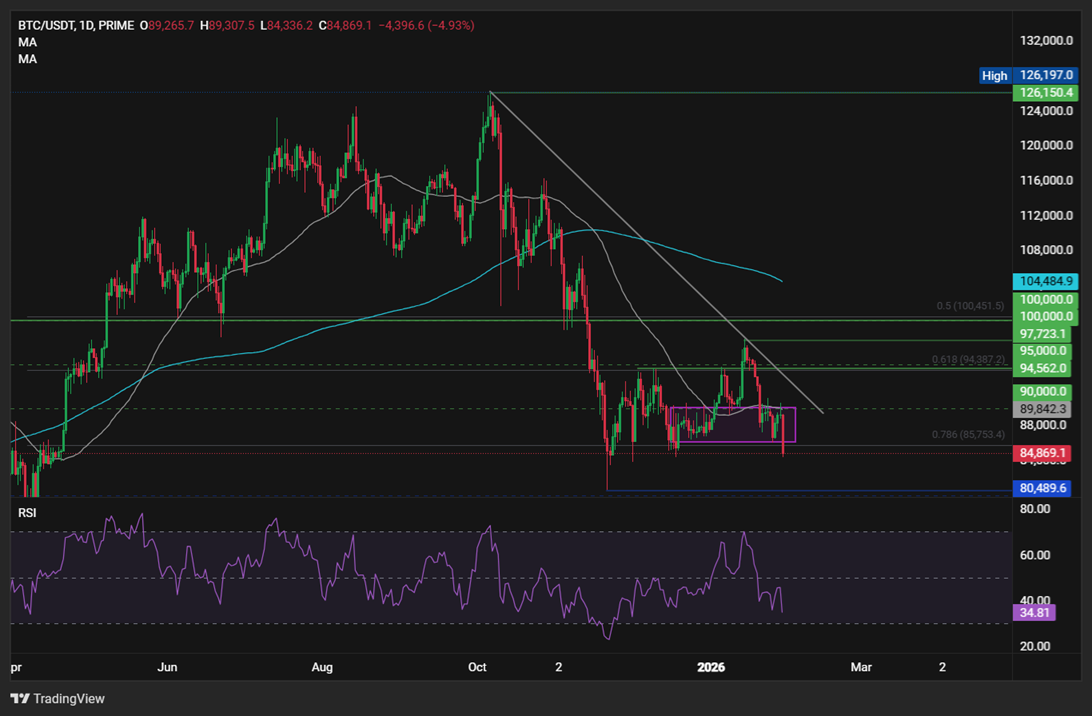
The sell-off is not isolated to crypto. Cryptos are mirroring a tech sell-off that has dragged stocks lower. U.S. stocks are falling sharply. The Nasdaq trades 1.8% lower, underperforming the Dow Jones, which is 0.4% lower.
Gold and Silver prices have also been drawn into the volatility. Gold and Silver scaled to fresh record highs in overnight trade of $5597 and $120, respectively, before tanking 5% and 7%. The volatility we are seeing in the precious metals markets indicates that safe havens are trading more like cryptocurrencies.
The deteriorating market mood comes as investors digest mixed mega-cap earnings, a slightly more hawkish Federal Reserve, and tensions with Tehran.
Trading involves risk.
The Fed leaves rates unchanged, hints at a longer pause
The Federal Reserve left interest rates unchanged at 3.5%-3.75%, in line with forecasts, and signalled no reason to rush to cut rates further. Policymakers highlighted a solid US growth outlook and noted some stabilisation in the jobs market, hinting that interest rates would likely remain unchanged for longer.
The prospect of higher rates for longer is weighing on risk assets such as Bitcoin and tech stocks, which are notably sensitive to the rate outlook. Meanwhile, cyclicals, which tend to benefit from a stronger growth environment, are showing resilience, explaining the divergence between the Dow and the Nasdaq.
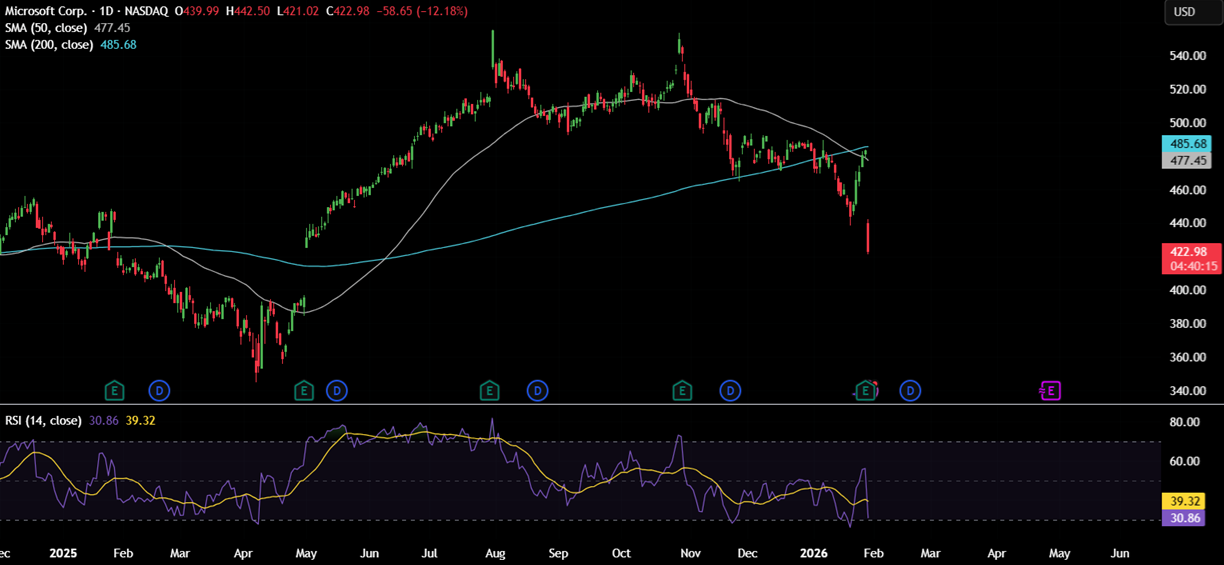
Tech stocks tumble after mixed earnings, Microsoft plunges 12%
Tech stocks are slumping, pulling crypto lower after earnings showed no signs of a slowdown in artificial intelligence spending. Microsoft is falling 12%, its worst daily decline since the pandemic, on fears that it could take a while for its investments in AI to pay off. Despite a 60% rise in net income, earnings were overshadowed by huge capex spending of $37.5 billion, well above the $34.5 billion expected.
Meta, meanwhile, impressed investors with stronger-than-expected earnings and revenue, as well as impressive current-quarter guidance. Meta also announced plans to allocate $115 billion to $135 billion in AI spending this year. This is almost double the 2025 spend. While investors have raised concerns about large spending plans in previous quarters, the company’s 24% year-over-year revenue growth appeared to ease those concerns.
Separately, Nvidia, Microsoft, and Amazon are in talks to invest a further $60 billion in OpenAI, ramping up AI spending.
The Nasdaq is falling away from near-record highs, and investors are once again sceptical about the AI trade. Doubts over the AI trade set in at the end of last year, spurring a rotation away from growth and tech stocks toward value stocks, including large-cap cyclicals and small caps. This rotation coincided with Bitcoin’s decline from the October record high below 100k.
Until there is clearer evidence of easing financial conditions or renewed confidence in the AI-led growth narrative, Bitcoin and tech stocks could remain vulnerable to further downside during periods of risk aversion.
Trading involves risk.
Author

 Risk Disclaimer
The content provided here is for informational purposes only. It is not intended as personal investment advice and does not constitute a solicitation or invitation to engage in any financial transactions, investments, or related activities. Past performance is not a reliable indicator of future results.
The financial products offered by the Company are complex and come with a high risk of losing money rapidly due to leverage. These products may not be suitable for all investors. Before engaging, you should consider whether you understand how these leveraged products work and whether you can afford the high risk of losing your money.
The Company does not accept clients from the Restricted Jurisdictions as indicated in our website/ T&C. Some services or products may not be available in your jurisdiction.
The applicable legal entity and its respective products and services depend on the client’s country of residence and the entity with which the client has established a contractual relationship during registration.