10 min read
 Quick definition: MACD in one minute
MACD (Moving Average Convergence Divergence) is a technical analysis indicator created by Gerald Appel in the late 1960s. It measures the relationship between two exponential moving averages of an asset’s price to help traders spot trend changes, momentum shifts, and potential entry and exit points across forex, stocks, crypto, and commodities.
What is the MACD indicator?
The MACD, pronounced “Mac-D”, stands for Moving Average Convergence Divergence. The MACD demonstrates the relationship between 2 lines representing moving averages of a financial asset’s price. The MACD often includes a histogram to further assist traders by providing a visual representation of the strength of a trend, so any crossovers are clearly defined.
The MACD is used to discover new short-term trends and help identify when current trends are reaching a point of exhaustion, potentially signaling a trend reversal ahead.
Why the MACD matters
Although the MACD is often referred to as a lagging indicator, it is among the most widely used technical analysis indicators in existence, and a cornerstone of any good trader’s toolset — regardless of whether they are trading forex, crypto, or stock charts.
The MACD can effectively act as an indicator confirming trend changes with a bearish or bullish crossover of the signal line. However, the MACD can give false positive readings on trend changes that don’t actually occur. It’s important to utilize the histogram and other technical indicators or price patterns to confirm signals before taking a position.
How the MACD works
When the short-term moving average — the EMA 12 — is above the longer-term moving average — the EMA 26 — the reading is considered a positive value and a buy signal. When the long-term moving average is below the short-term moving average, it’s considered a negative value and a sell signal.
In addition to being used to watch for a cross of the signal line before taking a long or short position, the MACD is also used to spot divergences, or rapid rises and falls in an asset’s price. These rapid rises or falls tend to signal that an asset is overbought or oversold, and can be used in conjunction with the Relative Strength Index for superior trading signals.
Oftentimes the MACD will set a lower low or higher high, while the asset’s price sets a higher low or lower high, creating a divergence in price. Divergences indicate that the underlying price action doesn’t represent what’s reflected on price charts, and usually precede a powerful move.
How the MACD is calculated
The MACD is calculated by taking the 26-period EMA and subtracting it from the 12-period EMA to create the MACD line. Then a nine-day EMA of the MACD — called the signal line — is plotted over the MACD line to complete the calculation.
Formula:
MACD line = EMA(12) − EMA(26)
Signal line = EMA(9) of MACD line
Histogram = MACD line − Signal line
Default MACD settings
| Parameter | Default value |
What it represents
|
| Fast EMA | 12 periods |
Short-term momentum
|
| Slow EMA | 26 periods | Long-term trend |
| Signal line | 9 periods |
Smoothed MACD for crossovers
|
Tip: Some traders adjust settings to 8, 17, 9 for more sensitivity on shorter timeframes.
How to read the MACD indicator
The MACD’s value is positive whenever the 12 EMA is above the 26 EMA, and negative whenever the 26 EMA is above the 12 EMA. When the lines cross, it often tells traders the trend momentum may be changing. If the two lines grow apart in distance, it often signals that the trend is growing in strength.
Key readings at a glance:
- MACD line above zero → bullish momentum, uptrend in play
- MACD line below zero → bearish momentum, downtrend in play
- MACD crosses above signal line → potential buy signal
- MACD crosses below signal line → potential sell signal
- Histogram bars growing → trend is strengthening
- Histogram bars shrinking → trend is losing momentum
- Divergence (price vs. MACD) → possible reversal ahead
The histogram takes visualization a step further by showing the distance between the MACD line and the signal line as it grows.
How to use the MACD indicator
The MACD is used as a signal to buy or sell depending on whether it crosses above or below the signal line. The signal line often begins to curl or turn ahead of major moves — spotting these early changes can be the key to a successful trading strategy. However, acting too early can be detrimental, as the MACD can often show false positives.
The MACD histogram can also be used as a visual screener to confirm crossovers from bearish to bullish price action. The greater the distance between the signal lines, the larger the bars on the histogram will become, and the stronger the trend. This histogram can also be used to signal reversals by watching for it to round back toward and above the zero line.
MACD signal summary
| Signal | What it means |
Suggested action
|
| Bullish crossover | MACD crosses above signal line |
Consider long entry
|
| Bearish crossover | MACD crosses below signal line |
Consider short entry
|
| Histogram expanding (positive) | Uptrend strengthening | Hold long / wait |
| Histogram expanding (negative) | Downtrend strengthening | Hold short / wait |
| Bullish divergence | Price falls, MACD rises |
Watch for reversal long
|
| Bearish divergence | Price rises, MACD falls |
Watch for reversal short
|
The MACD is also a helpful tool when combined with other indicators and oscillators for confirmation — for example, the Relative Strength Index or Stochastic RSI.
The best MACD trading strategies
There are a number of methods involving the MACD; however, the best strategy is often the most simple and straightforward one. Trading bearish or bullish crossovers can often be the most effective approach.
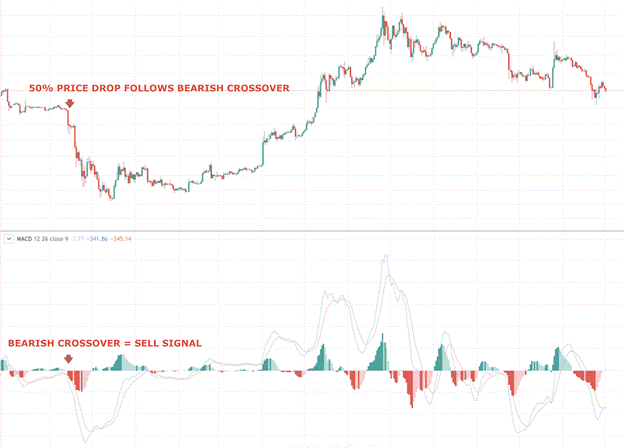
Strategy 1: Opening a sell order based on a bearish MACD crossover
In the BTC/USD price chart below, the MACD can be seen beginning to make a bearish cross downward, signaling a sell on the asset’s price chart. If a trader opened a short position the moment the bearish crossover happened, it would have resulted in a 50% drop — and using 100× leverage could have resulted in a 5,000% profit.
Strategy 2: Watching for an asset to become oversold
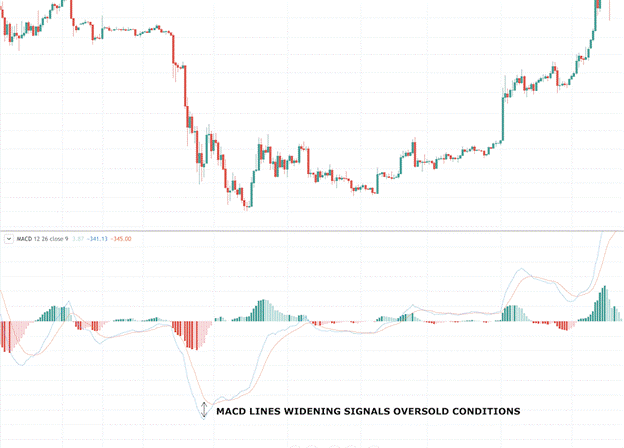
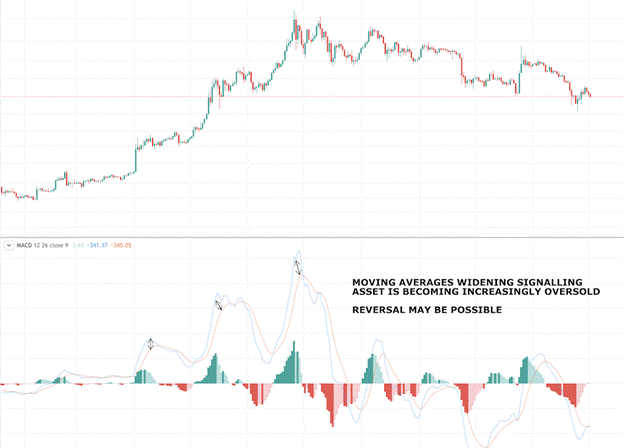
Once the MACD follows a bearish crossover, traders should watch for an asset to become oversold by waiting for the MACD moving averages to widen, signaling that the asset is becoming oversold. The wider the distance between the two MACD lines, the more oversold the asset is and a bounce could soon follow. Oversold conditions do not yet signal a buy.
Strategy 3: Spotting an early buy signal with divergence
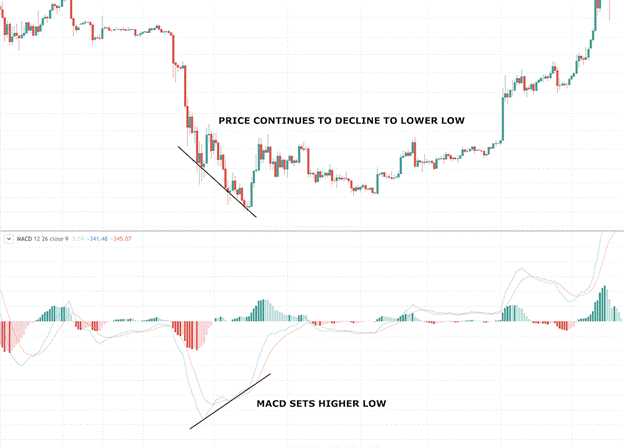
Oftentimes, traders can spot divergences in price charts that could signal a powerful move ahead. In the below example, price sets a lower low while the MACD diverges and sets a higher low — suggesting that buying is picking up steam despite price declining, and that a reversal may soon follow.
Strategy 4: Opening a buy order based on a bullish MACD crossover
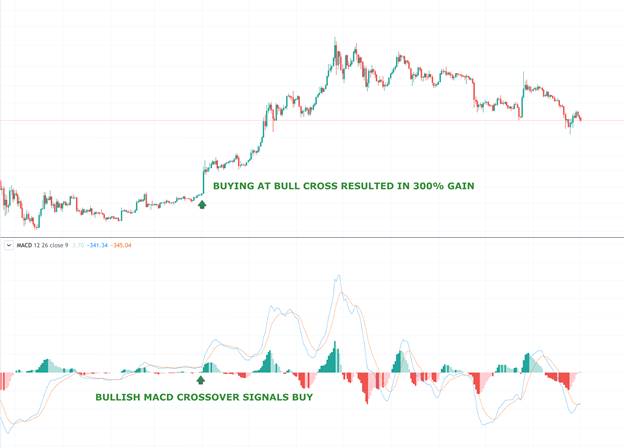
In the chart below, the MACD begins to tighten, eventually crossing upward into a powerful move. A buy order at this signal would have resulted in an over 300% return on investment at the peak.
Strategy 5: Preparing for trend reversal with overbought signals
The MACD can be utilized to understand when an asset is overbought. At each subsequent pullback, the MACD lines increasingly widen — showing that the asset is becoming more and more overbought and possibly signaling that a reversal may be ahead. Eventually, the asset becomes so overbought that a trend reversal occurs and a downtrend follows.
Strategy 6: Scalp trading using the MACD
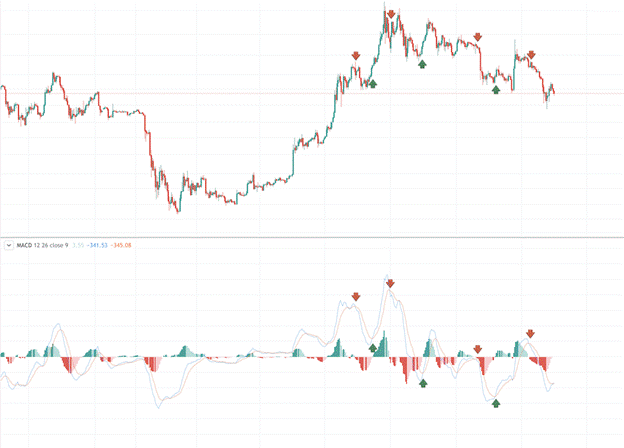
In addition to the above common strategies, traders can also make short-term scalp trades back and forth with each minor bullish and bearish crossover of the MACD lines. Each time the MACD line makes a bearish crossover, a short order should be opened. As the MACD line crosses back up bullish, it signals that a long order should be opened and a rally typically follows.
Tips and common mistakes
The MACD can also be used to discover divergences between price action and the indicator’s signal lines, which can provide an early prediction that a trend change may soon occur.
However, divergences on the MACD are often considered an unreliable signal due to false positives. Traders are urged to double-confirm any divergences with other technical indicators in addition to the MACD.
The most common way to utilize the MACD is with default settings over 12, 26, and 9 exponential moving averages. Other popular settings include 8, 17, and 9.
Beware of trading a bearish or bullish crossover too early — always search for confirmations in other indicators or chart patterns, as oftentimes the MACD will give a false positive signal.
Conclusion
Now that you have learned all there is to know about the MACD — how it’s calculated, how to read its signals, and how to apply it across six real trading strategies — it’s time to put that knowledge to work.
The MACD is just one of many technical indicators available on the PrimeXBT trading platform. PrimeXBT provides all of the tools needed to develop a winning and profitable trading strategy, allowing even new traders to grow their capital quickly, safely, and easily.
Ready to try? Open a demo account on PrimeXBT and practise reading MACD signals risk-free before committing real capital.
What does the MACD indicator show?
The MACD shows the relationship between two exponential moving averages (EMA 12 and EMA 26) of an asset’s price. It helps traders identify trend direction, momentum strength, and potential reversal points.
How do you read the MACD indicator for beginners?
Watch for two key events: (1) the MACD line crossing above the signal line = potential buy; (2) the MACD line crossing below the signal line = potential sell. Growing histogram bars confirm the strength of the move.
What are the default MACD settings?
The standard settings are a 12-period fast EMA, a 26-period slow EMA, and a 9-period signal line. These defaults work well across most timeframes and asset classes.
How is the MACD different from a simple moving average?
A simple moving average smooths price data over time. The MACD goes further by measuring the distance between two EMAs and plotting the result as a dynamic line — making trend momentum and reversals much easier to spot.
Why does the MACD give false signals?
Because it’s a lagging indicator based on historical price data, the MACD can react slowly or misread sideways/choppy markets. Always confirm MACD signals with other tools such as RSI, volume, or support/resistance levels.
Author



 Risk Disclaimer
The content provided here is for informational purposes only. It is not intended as personal investment advice and does not constitute a solicitation or invitation to engage in any financial transactions, investments, or related activities. Past performance is not a reliable indicator of future results.
The financial products offered by the Company are complex and come with a high risk of losing money rapidly due to leverage. These products may not be suitable for all investors. Before engaging, you should consider whether you understand how these leveraged products work and whether you can afford the high risk of losing your money.
The Company does not accept clients from the Restricted Jurisdictions as indicated in our website/ T&C. Some services or products may not be available in your jurisdiction.
The applicable legal entity and its respective products and services depend on the client’s country of residence and the entity with which the client has established a contractual relationship during registration.