7 min read
If you’ve traded Bitcoin (BTC) through a Federal Reserve rate decision or a Consumer Price Index (CPI) release, you already know what a macro event looks like on a chart. Price compresses, range breaks, and the market picks a direction.
What most crypto traders don’t realise is that the same pattern plays out simultaneously on gold (XAU/USD), Foreign exchange (Forex) pairs like USD/JPY, and equity indices. Learning to read these events across multiple markets can open up setups you’d otherwise miss.
The three phases of a macro event on a chart
Most scheduled economic releases follow a recognisable three-phase pattern on the price chart. It looks the same whether you’re watching BTC/USD, XAU/USD, or USD/JPY.
1. The squeeze
In the time leading up to a major data release, price action often compresses into a narrowing range. Traders reduce exposure, liquidity thins out, and the chart may print a series of small-bodied candles or a visible triangle/wedge formation.
On a BTC/USD chart, you might see this as declining volume and a tightening Bollinger Band. The same compression tends to appear on XAU/USD and USD/JPY before events like non-farm payrolls (NFP) or a Bank of Japan (BoJ) rate decision.
2. The break
When the data is released, price can move sharply in one direction, especially when the numbers come in lower or higher than expected. This initial move can be volatile as the market digests the numbers.
The key question is whether the initial direction holds or reverses, and this is where your technical analysis (TA) skills come in:
- Does the breakout candle close above or below a key support/resistance level?
- Does volume confirm the move?
3. The follow-through
These initial reactions to news can be highly unpredictable, and it can be very difficult to trade during the actual release itself. Once the initial reaction settles, price action can give clues on the new short-term trend. Will it retrace the initial breakout move, or see continuation?
This can be where many of the most reliable opportunities may form, as the pre-event uncertainty has cleared and the chart starts to offer structure again.
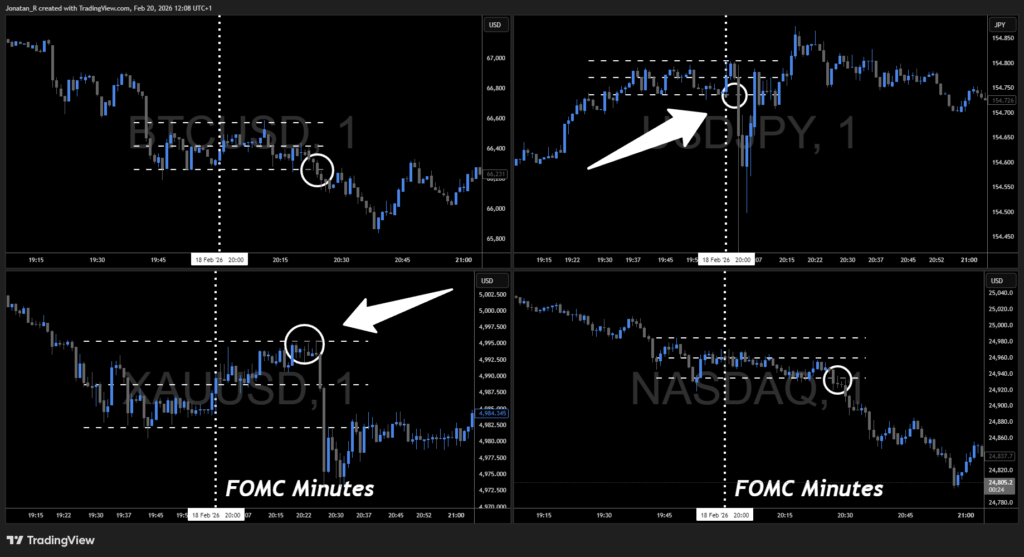
One event, four reactions: BTC/USD, USD/JPY, XAU/USD, and NASDAQ on the 1-minute chart around the FOMC minutes release on 18 February 2026. Some markets move quicker than others as they react to and digest the news.
Reading the same event across different assets
Here’s where it gets interesting. A single macro event often moves several markets simultaneously, but not always in the same direction.
Take a scenario where US inflation data comes in higher than expected. This tends to strengthen the US dollar as markets price in a more hawkish Federal Reserve:
- USD/JPY may push higher (dollar strength against the yen)
- XAU/USD may come under pressure (a stronger dollar tends to weigh on gold)
- BTC/USD could go either way, depending on whether the market interprets the data as risk-on or risk-off
The point isn’t to predict which way each market will move. It’s to recognise that one data release can create multiple opportunities across multiple instruments, and each could offer a different risk/reward profile.
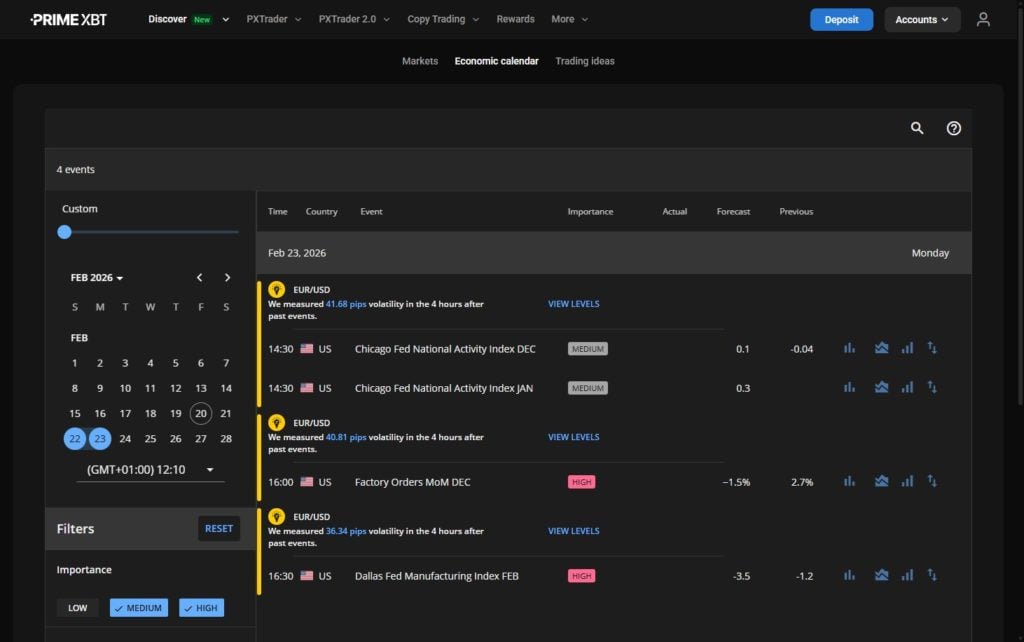
The economic calendar, available under the Discover tab on the PrimeXBT platform, shows upcoming scheduled events filtered by importance. Traders can use it to prepare for high-impact releases and identify which markets may be affected ahead of time.
Which events matter most
Not all macro events move markets equally. A handful of recurring releases tend to generate the most consistent price action:
- US non-farm payrolls (NFP), released on the first Friday of each month, tends to be one of the highest-volatility events for XAU/USD, USD/JPY, and the broader Forex market. BTC can also react, though less consistently.
- US CPI data is closely watched for its implications on Federal Reserve policy. A surprise in either direction can move gold, Forex, and crypto simultaneously.
- Central bank rate decisions from the Federal Reserve, the BoJ, and the European Central Bank (ECB) can set the tone for weeks of trending price action, particularly on currency pairs like USD/JPY and EUR/USD.
The key advantage over crypto catalysts: these events follow a published schedule. You can identify key levels on your charts beforehand, set alerts, and plan your entry logic in advance.
A practical approach
Here’s a simple example framework for how investors could potentially read macro events across markets:
- Before the event — identify key support and resistance levels on two or three instruments. Look for pre-event compression on the chart. Set alerts at the levels that could confirm a breakout in either direction.
- During the event — watch how price reacts to those levels. Don’t rush to enter in the first few seconds, as the initial move may reverse. Wait for a candle close above or below your key level before considering a position.
- After the event — look for follow-through. If the breakout holds and volume confirms the direction, the idea could be valid. If price quickly reverses back into the pre-event range, the move could have been a false break.
By watching this pattern across gold, Forex, and BTC simultaneously, you may spot the cleanest opportunity of the three rather than being locked into a single market.
Bringing it together
On the PrimeXBT platform, you can monitor and trade XAU/USD, USD/JPY, BTC/USD, and equity indices from a single dashboard. When a macro event hits, you don’t need to switch between platforms to find the best setup.
The event is the same, but the chart that offers the cleanest entry might be different each time.
Trading involves risk.
Author



 Risk Disclaimer
The content provided here is for informational purposes only. It is not intended as personal investment advice and does not constitute a solicitation or invitation to engage in any financial transactions, investments, or related activities. Past performance is not a reliable indicator of future results.
The financial products offered by the Company are complex and come with a high risk of losing money rapidly due to leverage. These products may not be suitable for all investors. Before engaging, you should consider whether you understand how these leveraged products work and whether you can afford the high risk of losing your money.
The Company does not accept clients from the Restricted Jurisdictions as indicated in our website/ T&C. Some services or products may not be available in your jurisdiction.
The applicable legal entity and its respective products and services depend on the client’s country of residence and the entity with which the client has established a contractual relationship during registration.