9 min read
On Saturday 28 February 2026, the United States and Israel launched coordinated strikes on Iran. It was a weekend. Traditional markets were closed. But one market was already open, pricing in the news in real time: crypto.
This is the edge that comes with trading a 24/7 market. While equity traders were watching the news from the sidelines, Bitcoin (BTC) was already telling the story. And if you knew how to read it, you had a significant head start on what Monday’s open would look like across oil, gold, and equities.
That kind of cross-market awareness is a skill crypto traders are already better positioned to develop than most.
What Bitcoin did that weekend
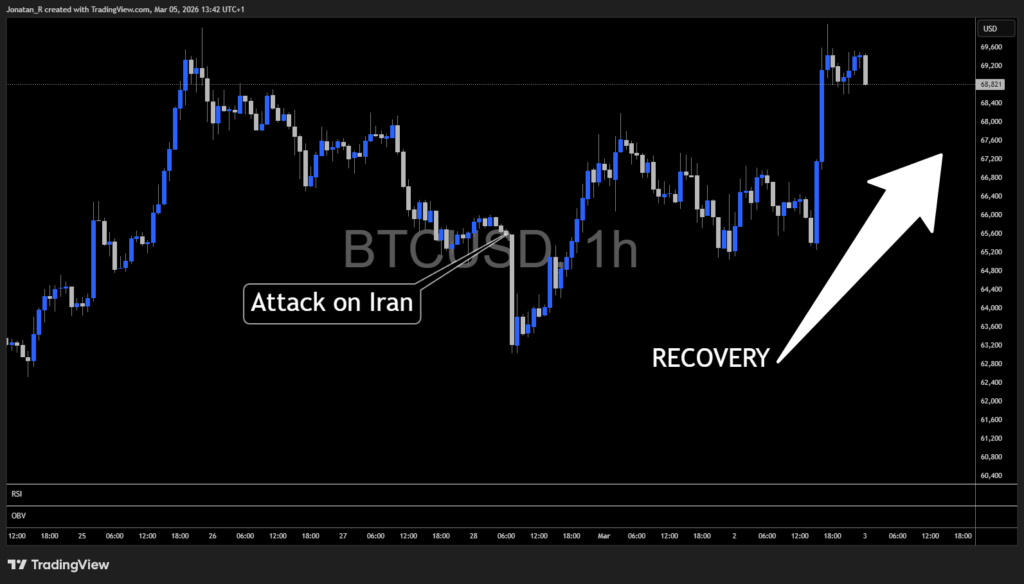
When the strikes were reported, BTC sold off sharply, dropping to around $63,000. For context, key technical support sat in the $63,000–$63,100 zone, a level the market had been watching closely.
What happened next was the signal. Rather than breaking down through that support, BTC held. Then it recovered. By Sunday, following confirmation that Iran’s Supreme Leader had been killed, BTC had climbed back above $67,000.
That recovery didn’t happen because the geopolitical situation had calmed down. It was still very much escalating. It happened because the market, in aggregate, decided that even a major conflict of this scale wasn’t enough to drive sustained selling in a risk asset.
That was information. It told you, before any traditional market had opened, that the panic was potentially contained.
How traditional markets confirmed it on Monday
When US equity markets opened on Monday 2 March, the reaction was far more muted than many had feared. Overnight futures had been pointing to a Nasdaq drop of more than 2%. The actual open: down 0.1%.
If you had been watching BTC over the weekend, this wasn’t a surprise. The crypto market had already done the heavy lifting of price discovery, absorbing the shock, flushing out leveraged positions, and settling at a level that reflected measured caution rather than panic.
The traditional market moves that did play out were in the assets you’d expect from a geopolitical event of this kind:
- Oil up ~7%: Iran is a significant oil producer, and any conflict in the region raises legitimate concerns about supply disruption, particularly around the Strait of Hormuz, through which roughly 20% of global oil supply flows
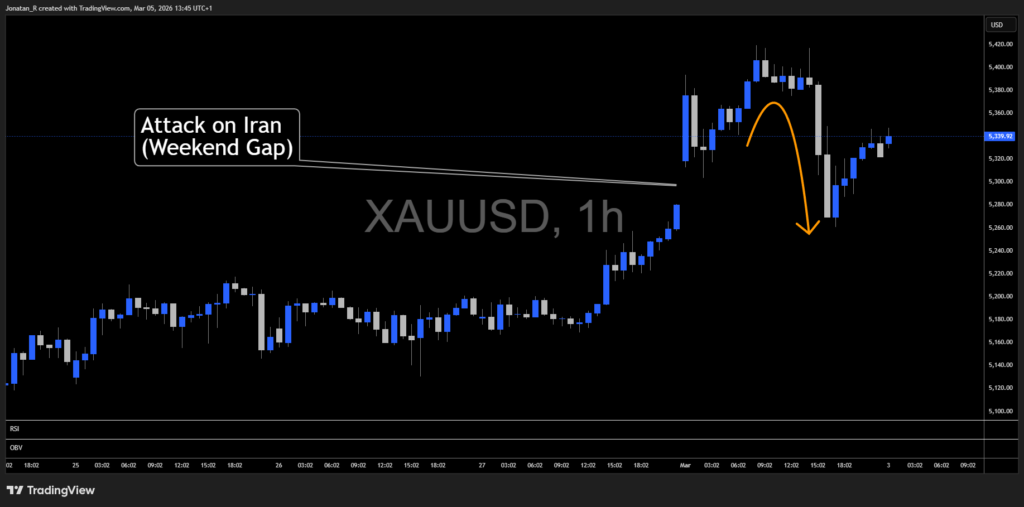
- Gold (XAU/USD) up ~2%: safe haven demand kicked in, but the relatively contained move reflected measured concern rather than full-scale panic
- Equities resilient: the muted stock market reaction aligned closely with what BTC’s weekend price action had already suggested
This sequence, crypto absorbing the shock first and traditional markets catching up on Monday, is a pattern that tends to repeat whenever a major event breaks over a weekend. Understanding it means you’re rarely walking into Monday’s open blind.
The three traditional markets to watch during geopolitical events
BTC gives you the sentiment read. But to understand the full picture, there are three traditional markets that tend to move most directly in response to geopolitical risk.
Oil
Conflict in a region that produces or controls the flow of oil tends to be priced in immediately. The key question the market is asking is whether supply will actually be disrupted, and how severely.
Knowing the key technical levels on Oil before an event gives you context. If oil spikes but fails at a major resistance level, the market may be treating the event as a short-term scare. If it breaks through with conviction, that’s a different signal entirely.
Gold
Gold (XAU/USD) acts as a measure of how deep the fear runs. In times of genuine uncertainty, including wars, sudden leadership changes, and threats to global stability, demand for gold tends to rise as investors seek assets that hold value independent of any single currency or government.
A useful cross-market read: if oil spikes but gold stays flat, the market is may be treating the event as a localised supply concern. If both move together, the market is pricing in something more systemic.
Crypto traders will recognise this kind of confirmation logic. It’s the same principle as checking whether a BTC move is being confirmed or contradicted by the broader altcoin market.
Equity indices
Indices like the S&P 500, Nasdaq, and major regional benchmarks tend to reflect broader risk sentiment. When geopolitical fear is running high, they sell off as uncertainty weighs on corporate earnings expectations. When the market concludes that the event is contained, they can recover quickly.
The practical approach: know your levels before the news hits
You can’t predict when a geopolitical event will happen. What you can do is make sure you know the key technical levels on the markets that matter, so that when something does break, especially over a weekend, you’re reading price action rather than reacting to headlines.
For each of these markets, the same technical analysis (TA) tools you already use on crypto apply directly:
- Support and resistance zones: where is price likely to hold or break?
- Volume: is the move being confirmed by real participation, or is it a low-liquidity overreaction?
- Momentum indicators: is the move accelerating or fading?
The 28 February example is instructive precisely because BTC’s hold of the $63,000 support zone was a clean TA signal. It wasn’t a narrative call. It was price respecting a level. That same discipline applies when you’re reading oil at a resistance level or gold approaching a key breakout zone.
Why diversification matters more than prediction
The broader lesson from events like this isn’t about being right on the direction. It’s about not being overexposed to one market or one outcome when something unpredictable hits.
A trader with positions across BTC, gold, and oil isn’t just speculating on each individually. They’re building a portfolio where different assets can respond differently to the same event. When crypto sold off on 28 February, gold was moving in the opposite direction. That kind of natural hedge only exists if you’re across multiple markets.
Geopolitical events are, by definition, unpredictable in their timing. The practical response isn’t to try to forecast them. It’s to make sure you’re never in a position where a single event can only hurt you, with no way to benefit from the volatility it creates.
Trading multiple markets on PrimeXBT
Understanding how oil, gold, indices, and crypto interact during geopolitical events is only useful if you can act on it quickly. Switching between platforms mid-event is the last thing you want to be doing when markets are moving fast.
On the PrimeXBT platform, all of these markets are available from a single account. You can trade Bitcoin (BTC) and major cryptocurrencies alongside gold (XAU/USD), oil, equity indices, stocks, and Forex pairs without needing to manage separate accounts or transfer funds between exchanges.
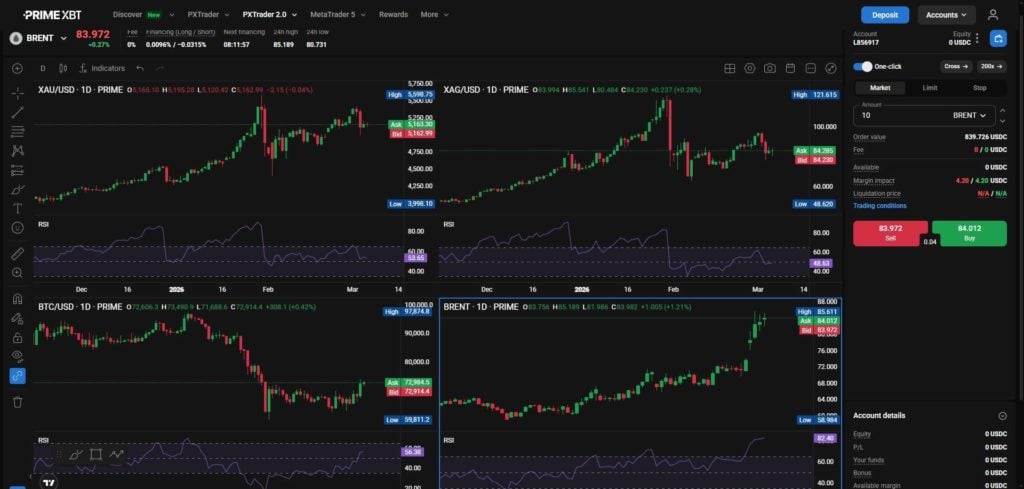
That kind of access matters for the scenario we’ve described in this article. When a weekend event hits and you’re watching BTC hold or break a key support level, you can move across to gold or oil in the same session, on the same platform, with the same capital.
It also makes diversification practical rather than just theoretical. Spreading exposure across crypto, commodities, and indices doesn’t require multiple brokers or complex setups. It requires one account and an understanding of how these markets relate to each other, which is exactly what PrimeXBT is built for.
Trading involves risk.
Author



 Risk Disclaimer
The content provided here is for informational purposes only. It is not intended as personal investment advice and does not constitute a solicitation or invitation to engage in any financial transactions, investments, or related activities. Past performance is not a reliable indicator of future results.
The financial products offered by the Company are complex and come with a high risk of losing money rapidly due to leverage. These products may not be suitable for all investors. Before engaging, you should consider whether you understand how these leveraged products work and whether you can afford the high risk of losing your money.
The Company does not accept clients from the Restricted Jurisdictions as indicated in our website/ T&C. Some services or products may not be available in your jurisdiction.
The applicable legal entity and its respective products and services depend on the client’s country of residence and the entity with which the client has established a contractual relationship during registration.