8 min read
Every crypto trader knows the feeling. Bitcoin (BTC) stalls, volume dries up, and the chart starts printing candle after candle inside a tightening range. You’re watching and waiting, but nothing happens.
These consolidation phases are a normal part of BTC’s market cycle, and they can last weeks or even months. The question isn’t whether they’ll happen, it’s what you do with your time and capital while they play out.
The answer, for a growing number of crypto-native traders, is to look beyond digital assets. Markets like Gold (XAU), USD/JPY, and the Nikkei 225 (listed as JAPAN on the PrimeXBT platform) frequently offer tradeable setups during the exact periods when BTC goes quiet. And the skills you’ve already developed, reading charts, managing risk, understanding momentum, can transfer directly.
Gold: the original store-of-value trade
If you trade BTC, you’ve almost certainly heard the “digital gold” comparison. But actual gold, traded as XAU/USD, deserves attention on its own merits, especially when crypto markets are flat.
Gold tends to move on a different set of drivers than BTC. Central bank purchasing, inflation expectations, and shifts in interest rate policy are the primary forces behind XAU/USD. When these macro themes are active, gold can trend strongly even while BTC sits in a range.
From a technical standpoint, XAU/USD tends to respond well to standard chart analysis. Support and resistance levels, trendlines, Fibonacci retracements, and moving average crossovers can all help identify potential setups. If you’re used to plotting key levels on a BTC/USD chart, the process may feel familiar.
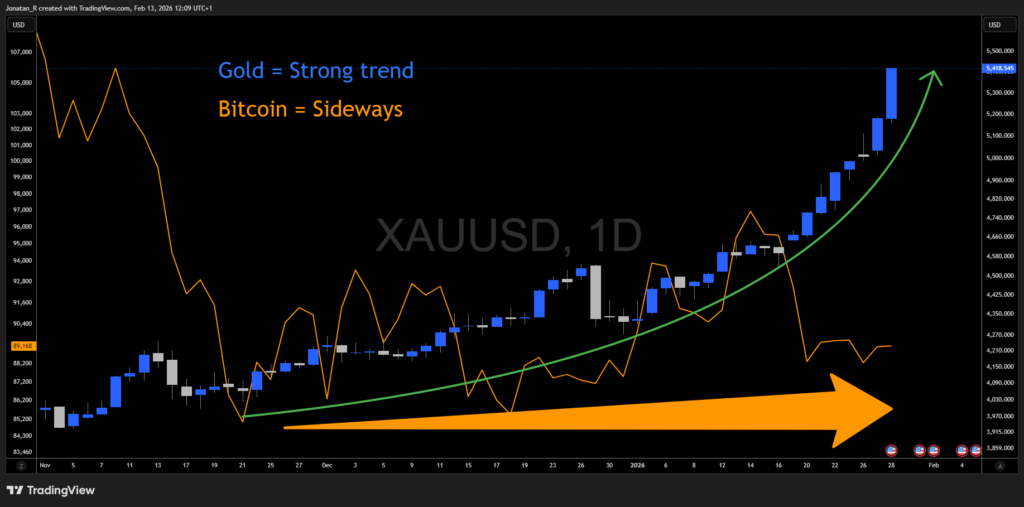
There are a few practical differences worth knowing. Gold’s most active price action tends to cluster around the London and New York session overlap (roughly 13:00–16:00 UTC), when both physical and derivatives markets are trading. The asset also responds to scheduled economic events. US inflation data, Federal Reserve decisions, and non-farm payrolls reports can all generate sharp, directional moves in XAU/USD that technical traders may be able to position around.
On the PrimeXBT platform, you can trade gold with leverage, which means even measured moves on XAU/USD can generate meaningful Profit/Loss (P/L) outcomes.
USD/JPY: where macro meets momentum
USD/JPY is one of the most actively traded Foreign exchange (FX, or Forex) pairs in the world, and it offers something crypto traders don’t always get: a market driven by clearly identifiable, structural forces.
The pair reflects the relationship between two of the world’s largest economies. When the US Federal Reserve and the Bank of Japan (BoJ) are moving in different directions on interest rates, one cutting while the other holds or raises, USD/JPY can trend for extended periods. These divergences in monetary policy may create the kind of sustained directional moves that trend-following traders look for.
Japan’s economy also has a characteristic that makes USD/JPY especially interesting. As an economy with significant export sectors, Japan’s corporate earnings can be sensitive to currency fluctuations. A weaker yen has historically tended to support Japanese equities (more on that below), while a stronger yen can weigh on them. This interconnection means USD/JPY doesn’t just offer its own trading opportunities, it can also serve as a potential lead indicator for moves in other Japanese assets.
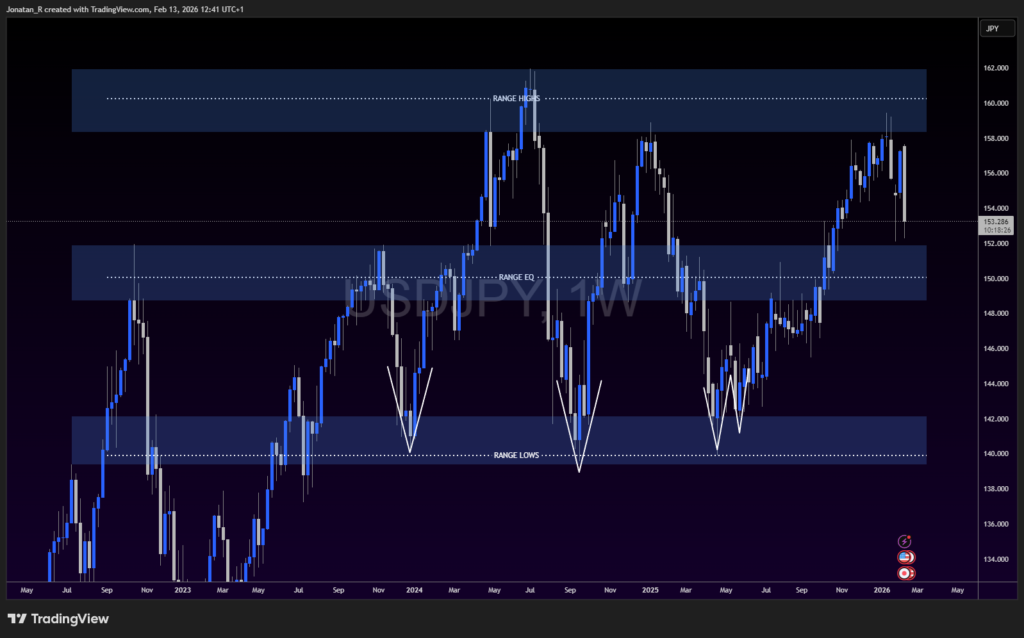
For crypto traders, FX pairs like USD/JPY might initially seem slow. Daily ranges are often measured in fractions of a percent rather than the larger percentage moves common in crypto. But this is where leverage changes the picture. With leverage, even a 0.5% move on USD/JPY can generate P/L comparable to a much larger move on a lower-leverage instrument.
The Nikkei 225: Asia’s most tradeable equity index
The Nikkei 225 is Japan’s premier stock market index, tracking 225 of the country’s largest blue-chip companies listed on the Tokyo Stock Exchange. For crypto traders looking to diversify, it offers something neither gold nor Forex provides: direct exposure to an equity market with its own distinct personality.
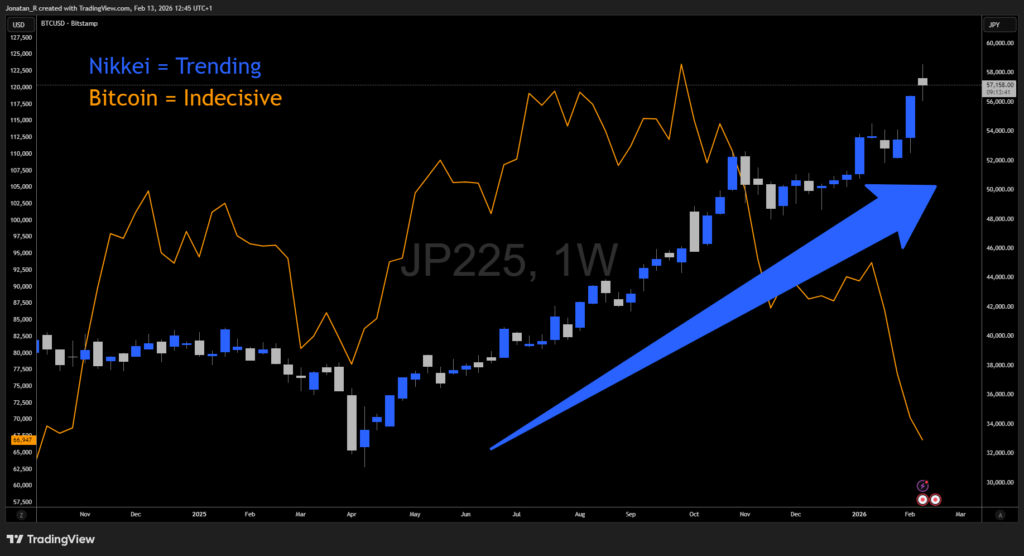
The Nikkei is a price-weighted index (similar to the Dow Jones Industrial Average), meaning higher-priced stocks carry more influence. It’s heavily influenced by global technology sentiment, Bank of Japan policy, and yen movements, making it a genuinely macro-sensitive instrument. When global risk appetite shifts, the Nikkei often responds decisively.
What may make it particularly appealing for crypto traders is its volatility profile. Among major developed-market indices, the Nikkei is known for notable day-to-day price swings, driven partly by Japan’s sensitivity to global trade flows and partly by the yen’s influence on export-heavy constituent companies. This can create the kind of intraday and swing trading opportunities that crypto traders are already accustomed to looking for.
The Nikkei’s primary trading session runs from 00:00 to 06:00 UTC (with a midday break), which is worth noting for traders in South Asia and Africa. If you’re in India, Pakistan, or South Africa, the Tokyo session falls during your morning hours, a convenient window for active trading before European and US markets open.
As a CFD instrument on the PrimeXBT platform, you can trade the Nikkei with leverage in both directions, meaning you can position for both rising and falling Japanese equities without needing a brokerage account in Tokyo.
The common thread: your skills already transfer
If you’re reading this as someone who learned to trade on crypto, it’s worth stepping back and recognising what you’ve already built. You understand candlestick patterns, support and resistance, volume analysis, and risk management. You’ve traded in volatile, leveraged markets. You know how to set stop losses and manage position sizes.
These aren’t “crypto skills.” They’re trading skills. And they can work on gold, on Forex pairs, on equity indices, on any liquid market with a price chart.
The only thing that changes is the context around each asset. Gold responds to inflation and central banks. USD/JPY responds to interest rate differentials. The Nikkei responds to Japanese corporate earnings and global risk appetite. Learning to read these drivers alongside your existing technical analysis (TA) is what may separate a crypto trader from a multi-asset trader.
Why it matters
BTC will break out of its range eventually, it always does. But the traders who use sideways periods to explore other markets often come back sharper. They develop a broader understanding of how global capital may flow between asset classes, and they build a toolkit that can work regardless of whether crypto is in a bull run, a bear market, or stuck in no man’s land.
On the PrimeXBT platform, we’ve built exactly this kind of flexibility. Crypto, Forex, commodities, and indices, all accessible from one account, one dashboard, one set of tools. When BTC goes sideways, your trading doesn’t have to.
Trading involves risk.
Author



 Risk Disclaimer
The content provided here is for informational purposes only. It is not intended as personal investment advice and does not constitute a solicitation or invitation to engage in any financial transactions, investments, or related activities. Past performance is not a reliable indicator of future results.
The financial products offered by the Company are complex and come with a high risk of losing money rapidly due to leverage. These products may not be suitable for all investors. Before engaging, you should consider whether you understand how these leveraged products work and whether you can afford the high risk of losing your money.
The Company does not accept clients from the Restricted Jurisdictions as indicated in our website/ T&C. Some services or products may not be available in your jurisdiction.
The applicable legal entity and its respective products and services depend on the client’s country of residence and the entity with which the client has established a contractual relationship during registration.