5 min read
The Australian dollar surged to its highest level in three years after January’s inflation data came in hotter than expected. Annual CPI held at 3.8%, above the 3.7% forecast, while trimmed mean inflation ticked up to 3.4%, marking a fourth consecutive month above the RBA’s 2-3% target band. With the central bank having already hiked rates to 3.85% earlier this month, markets are now pricing in another rate hike as early as May. That policy divergence, with the RBA tightening while most major central banks hold or ease, is providing a strong tailwind for AUD/USD.
The weekly chart: a potential shift in structure
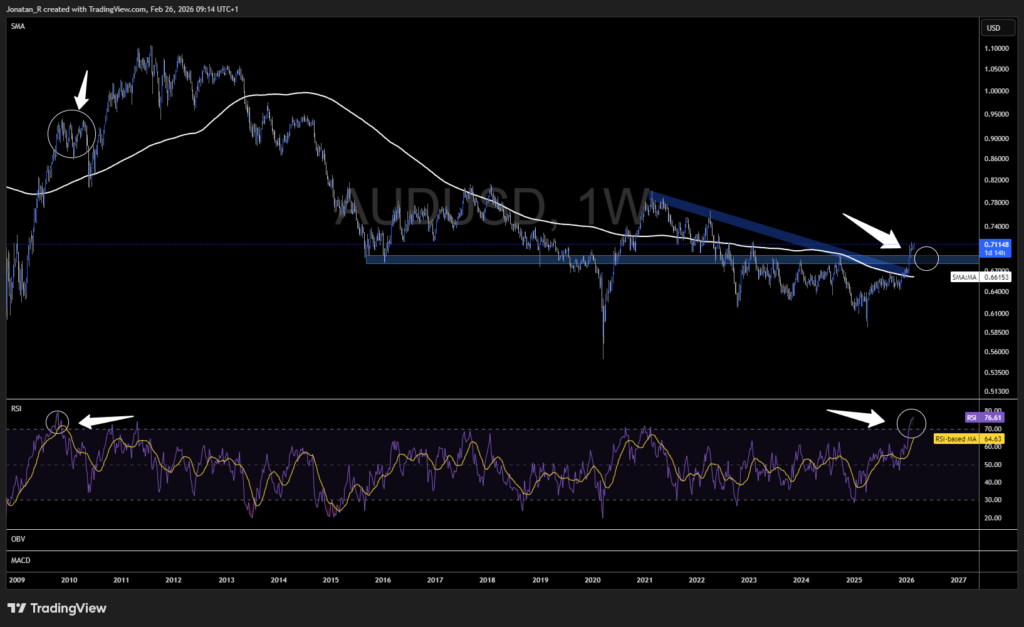
The weekly chart is showing some significant developments. Earlier this year, AUD/USD broke above a descending trendline that had contained price action for years, while also reclaiming the weekly 200 SMA and pushing through a key horizontal resistance zone around 0.6900 that had capped rallies since the beginning of 2023.
The weekly RSI is now at its highest level since 2009, during the recovery from the Great Financial Crisis. While that might sound like a warning signal, it’s important to remember that RSI can remain overbought for extended periods during strong uptrends. A high reading alone is not a reason to fade the move.
A potential key level to watch on the higher timeframes going forward is 0.6900. If price were to pull back and hold that former resistance as support, it could be an early signal that a new long-term bullish cycle is forming.
The daily chart: strong trend, but momentum is fading
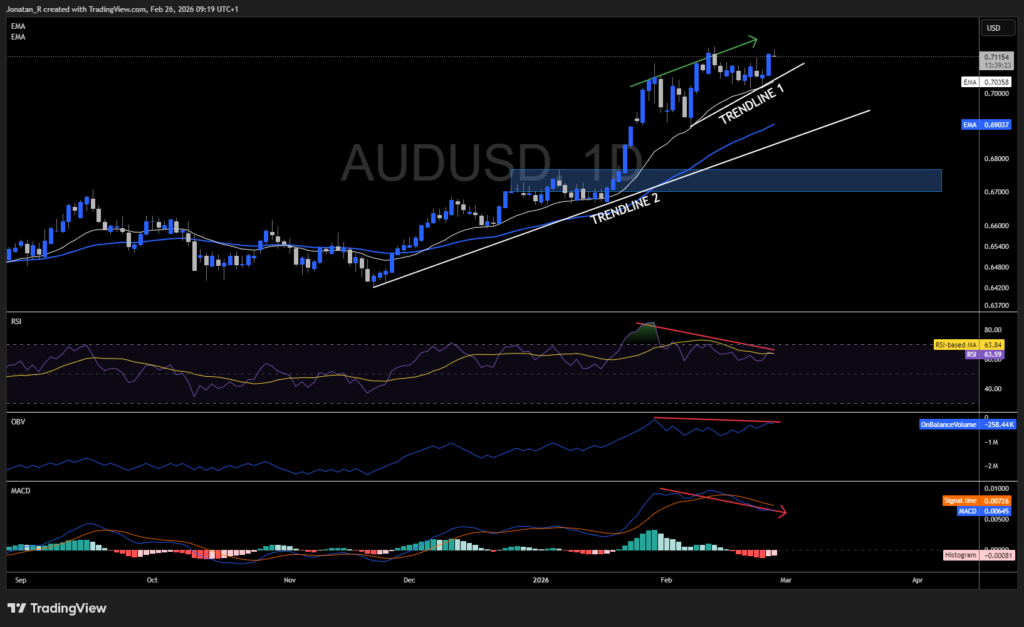
The daily chart shows a clean uptrend, with price riding above a steeply rising 20 EMA and 50 EMA, both nicely fanned out and sloping higher. That’s textbook trending behaviour.
However, the momentum and volume picture is starting to tell a different story:
- RSI is forming a structure of lower highs while price pushes higher
- OBV failed to break above its previous high, suggesting weakening participation
- MACD is beginning to show signs of topping out
This type of divergence doesn’t guarantee a reversal, but it does suggest the trend could be losing steam. A key level to watch is trendline 1 on the chart. A break below it could signal that the divergence is starting to play out.
If that happens, two support levels could come into focus:
- Trendline 2, which tracks the broader bullish structure
- The breakout zone between 0.6700 and 0.6800, which could act as strong support given its significance as former resistance
For now, the trend remains intact. But the mixed signals from momentum and volume suggest some caution is warranted.
The 4-hour chart: range breakout above a double bottom
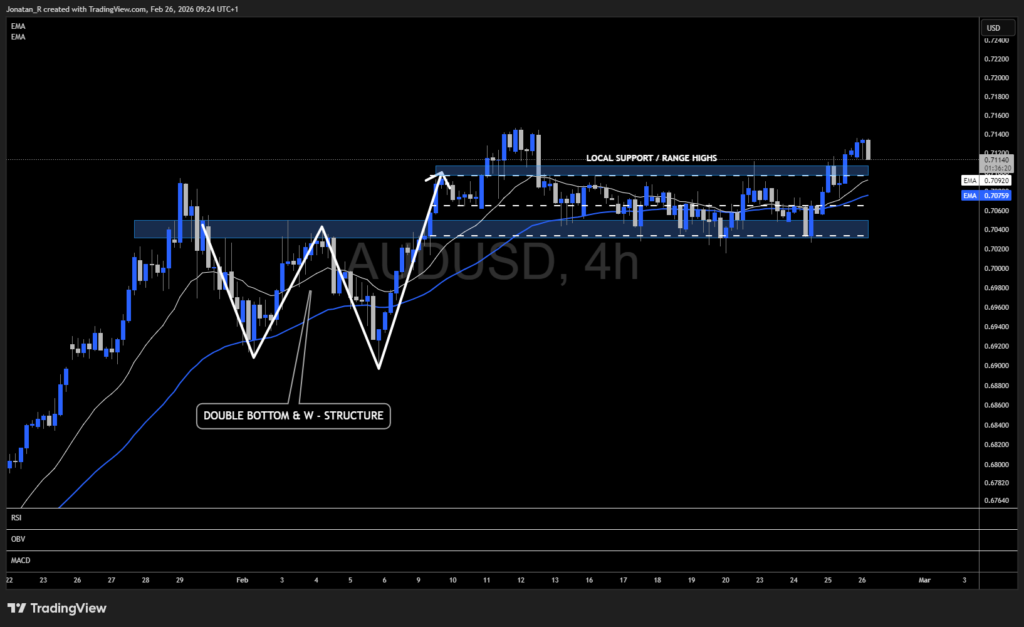
Zooming into the 4-hour timeframe, AUD/USD formed a clear double bottom (W-structure) at the beginning of February. Since breaking above the neckline, price has built a range on top of it, and has now broken above that range following the inflation data.
The immediate support to watch is the previous range highs around 0.7100. This is the local level that needs to hold for the breakout to potentially remain valid. A drop back below it would suggest a return to range-bound conditions, and could open the door for the bearish divergence visible on the daily chart to play out, particularly with the weekly RSI already at such elevated levels.
As long as 0.7100 holds as support, the short-term structure remains bullish. But a failure here could shift the picture quickly, given the warning signs building across the higher timeframes.
Trade Now
Trading involves risk.
Author



 Risk Disclaimer
The content provided here is for informational purposes only. It is not intended as personal investment advice and does not constitute a solicitation or invitation to engage in any financial transactions, investments, or related activities. Past performance is not a reliable indicator of future results.
The financial products offered by the Company are complex and come with a high risk of losing money rapidly due to leverage. These products may not be suitable for all investors. Before engaging, you should consider whether you understand how these leveraged products work and whether you can afford the high risk of losing your money.
The Company does not accept clients from the Restricted Jurisdictions as indicated in our website/ T&C. Some services or products may not be available in your jurisdiction.
The applicable legal entity and its respective products and services depend on the client’s country of residence and the entity with which the client has established a contractual relationship during registration.