5 min read
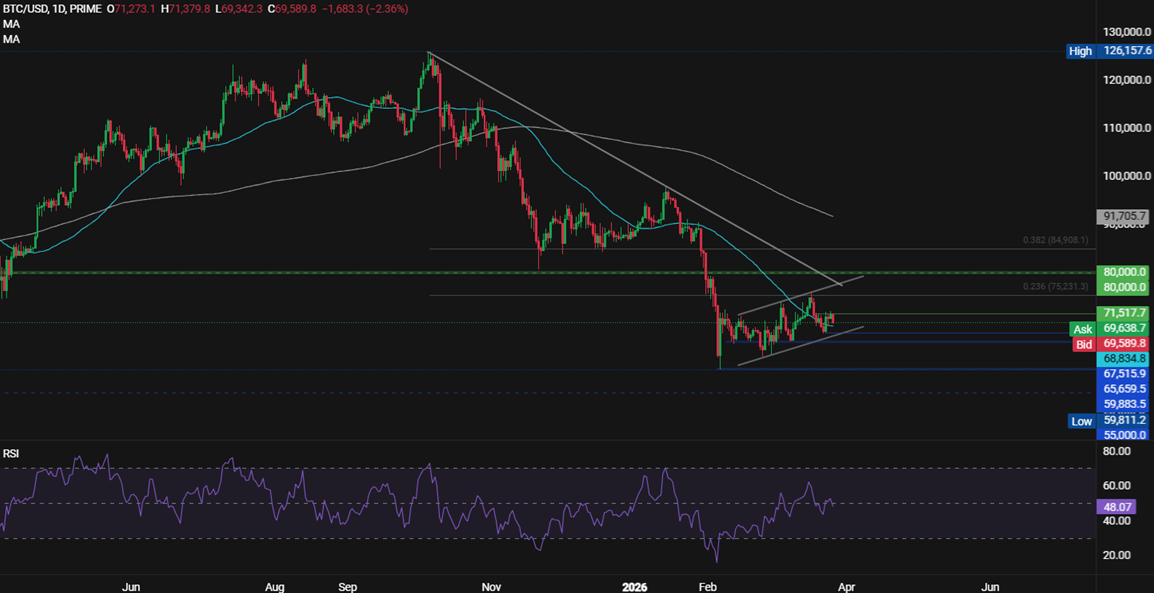
Bitcoin has fallen back below $70,000 on Thursday as market sentiment weakens amid fading hopes of de-escalation in the Middle East.
The world’s largest cryptocurrency is down around 2.5% over the past 24 hours. Altcoins are also under pressure, with Ethereum and XRP falling 4.7% and 3.3% respectively below 2100 and 1.40.
Diplomatic hopes fade
The move lower in crypto comes as Iran said it is reviewing President Trump’s 15-point ceasefire proposal but will not engage in direct talks with the US, highlighting the fragility of any diplomatic progress.
Adding to the uncertainty, President Trump has warned of further escalation if Iran does not admit military defeat, increasing the risk that tensions could intensify again.
Oil and yields stay in focus
Oil prices are rebounding once again, with Brent crude rising back above $100 per barrel. The renewed strength in oil is stoking inflation concerns, pushing Treasury yields higher. The benchmark 10-year US Treasury yield has risen to around 4.38%.
Rising yields tighten financial conditions, drawing liquidity away from Bitcoin, Ethereum and other risk assets while increasing the opportunity cost of holding non-yielding assets such as BTC.
Broader market mood deteriorates
The broader market tone is also weakening. US equities posted solid gains on Wednesday on optimism around de-escalation, but futures are now pointing to a weaker open, down nearly 1%.
For oil prices and Treasury yields to fall — and for risk sentiment to improve — markets will need to see clear and credible signs of de-escalation, particularly the reopening of the Strait of Hormuz.
However, any eventual agreement is likely to be complex, as both Washington and Tehran will need to present the outcome domestically as a strategic win, making negotiations challenging and potentially prolonged.
Until then, Bitcoin and the broader crypto market are likely to remain driven by macro and remain vulnerable to further downside if yields continue to rise.
Whales accumulate ETH, institutional demand fades
Despite the challenging backdrop, whales have increased their Ethereum accumulation over recent days. According to Lookonchain, four whale wallets withdrew 64,763 ETH from Binance and Bitget on Tuesday.
Meanwhile, wallets holding 10k to 100k ETH saw an 850kETH increase in their collective balance over the weekend.
However, institutional interest is fading. According to SoSoValue, US spot ETH ETFs have recorded six straight days of net outflows.
ETH technical analysis
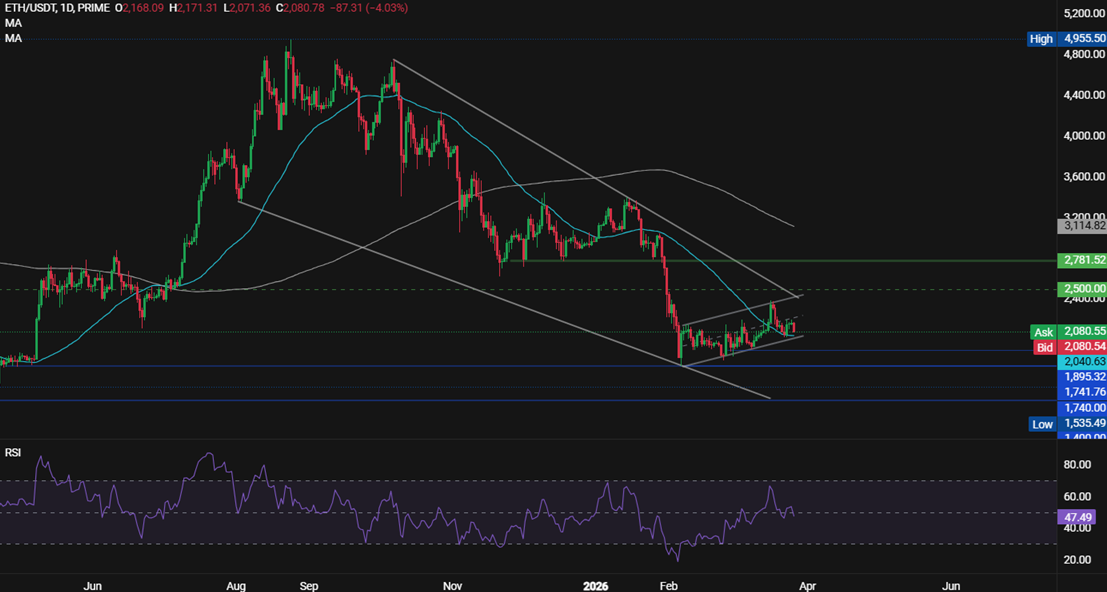
ETH/USDT trades within a longer-term falling wedge. More recently, the price has recovered from the 1740 low, trading in a rising channel. The price trades above its 50 SMA but faced rejection at 2175, the mid-point of the channel and is heading lower.
Immediate support is at the 50 SMA at 2050. Below here, the lower band of the rising channel comes into focus at 2000, also the psychological level. A breakdown of the channel opens the door to 1900, the March low and 1740, the 2026 low.
Buyers will need to rise above 2175 to bring 2380, the March high, into focus ahead of 2420, the confluence of the falling trendline and the upper band of the rising channel
Trading involves risk.
Author

 Risk Disclaimer
The content provided here is for informational purposes only. It is not intended as personal investment advice and does not constitute a solicitation or invitation to engage in any financial transactions, investments, or related activities. Past performance is not a reliable indicator of future results.
The financial products offered by the Company are complex and come with a high risk of losing money rapidly due to leverage. These products may not be suitable for all investors. Before engaging, you should consider whether you understand how these leveraged products work and whether you can afford the high risk of losing your money.
The Company does not accept clients from the Restricted Jurisdictions as indicated in our website/ T&C. Some services or products may not be available in your jurisdiction.
The applicable legal entity and its respective products and services depend on the client’s country of residence and the entity with which the client has established a contractual relationship during registration.