6 min read
Gold is in freefall, posting its worst weekly performance in over four decades and its longest losing streak in years. The sell-off has caught many investors off guard. With an active war in the Middle East, most expected gold to hold up as a safe haven. Instead, the opposite has happened.
The reason comes down to a cruel irony: the conflict has driven oil prices sharply higher, keeping inflation elevated and forcing the Federal Reserve to hold rates steady with little prospect of cuts on the horizon. Rising Treasury yields have made holding a non-yielding asset like gold increasingly costly, while a strengthening US dollar has added further pressure. The geopolitical bid that drove gold’s historic rally simply cannot compete with the rate and dollar dynamics now working against it.
Daily timeframe
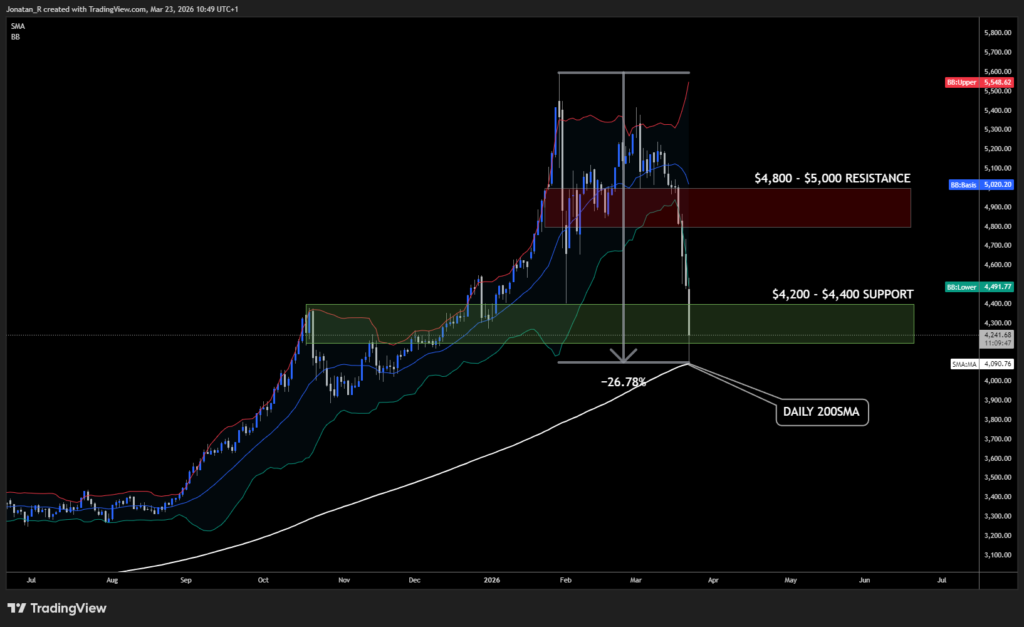
Gold trades outside the lower Bollinger Band for the fourth consecutive session as the sell-off drives price into the $4,200–$4,400 support zone, with the daily 200 SMA now within reach below.
Gold (XAU/USD) has just delivered one of the most aggressive sell-offs in its history. From the all-time high to the current lows, price has dropped over 26%, a collapse rarely seen in a market traditionally associated with stability and store of value.
To illustrate the sheer magnitude of this move, the Bollinger Bands tell the story clearly. Price has traded outside the lower band for four consecutive sessions, a statistically extreme reading that highlights just how far and fast this sell-off has extended. This is not a buy signal. It is simply a way of contextualising the severity of the decline — moves of this nature sit well outside normal market behaviour.
The sell-off has driven price straight into the $4,200–$4,400 support zone, a key area from mid-2025 that now finds itself back in focus. Just as notable is where price currently sits relative to the daily 200 SMA, now tracking near $4,090. This is the first time gold has tested the 200 SMA since reclaiming it back in November 2023. For long-term trend followers, that is a significant moment.
Above, the $4,800–$5,000 zone has flipped from support to resistance. Any recovery attempt could face heavy supply in this area.
The question now gripping the market is whether this marks a long-term top or simply a deep correction within a broader bull market. When price becomes this overextended, mean-reversion rallies are common. Whether any bounce proves to be a sustained recovery or simply relief before further downside is something only time will answer.
4-hour timeframe
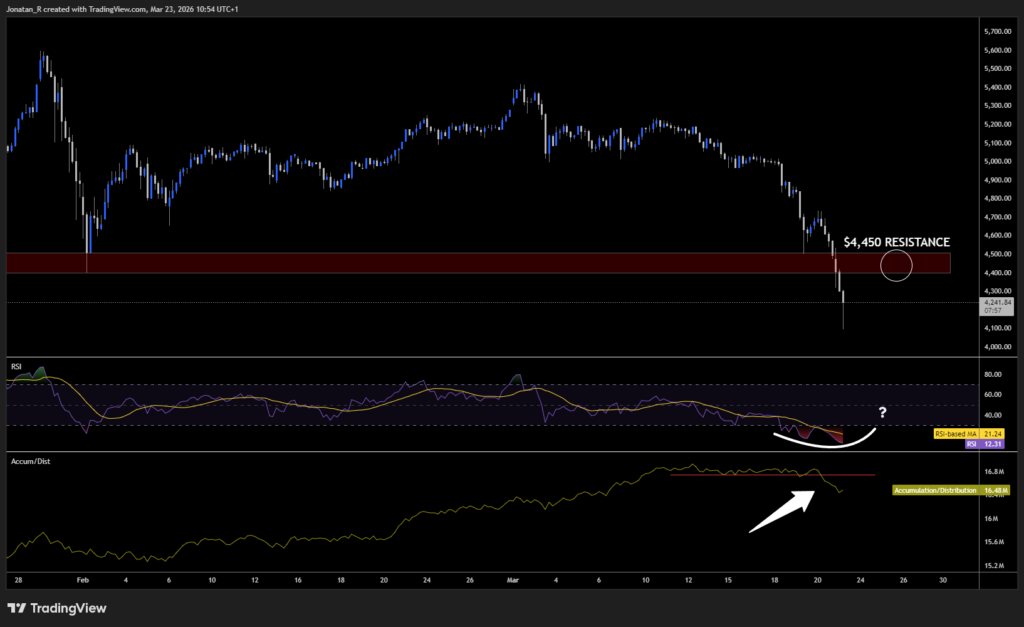
The Accumulation/Distribution line breaks down sharply as gold faces immediate resistance at $4,450, with no bullish RSI divergence yet to suggest a reversal is forming.
Zooming into the 4-hour chart, the immediate level to watch on any recovery attempt is $4,450, which now acts as the first resistance above current price. A reclaim of this level could be an early sign of strength and a potential first step toward a mean-reversion move. A rejection here, however, could keep bears firmly in control and leave the door open for further downside.
The RSI is deep in oversold territory, but there are no bullish divergences present yet. Traders looking to position for a relief rally may be watching for one to develop, where price makes a lower low while the RSI begins to form a higher low. That kind of divergence has not materialised at this stage, and until it does, the momentum picture remains bearish.
The Accumulation/Distribution line reinforces the bearish case. After trending higher for much of the rally, it has rolled over sharply and broken down, confirming that selling pressure is dominant across the timeframe. Money flow is moving out, not in.
Key levels to watch:
- Resistance: $4,450, then $4,800–$5,000
- Support: $4,200–$4,400 zone, then the daily 200 SMA near $4,090
Trading involves risk.
Author



 Risk Disclaimer
The content provided here is for informational purposes only. It is not intended as personal investment advice and does not constitute a solicitation or invitation to engage in any financial transactions, investments, or related activities. Past performance is not a reliable indicator of future results.
The financial products offered by the Company are complex and come with a high risk of losing money rapidly due to leverage. These products may not be suitable for all investors. Before engaging, you should consider whether you understand how these leveraged products work and whether you can afford the high risk of losing your money.
The Company does not accept clients from the Restricted Jurisdictions as indicated in our website/ T&C. Some services or products may not be available in your jurisdiction.
The applicable legal entity and its respective products and services depend on the client’s country of residence and the entity with which the client has established a contractual relationship during registration.