6 min read
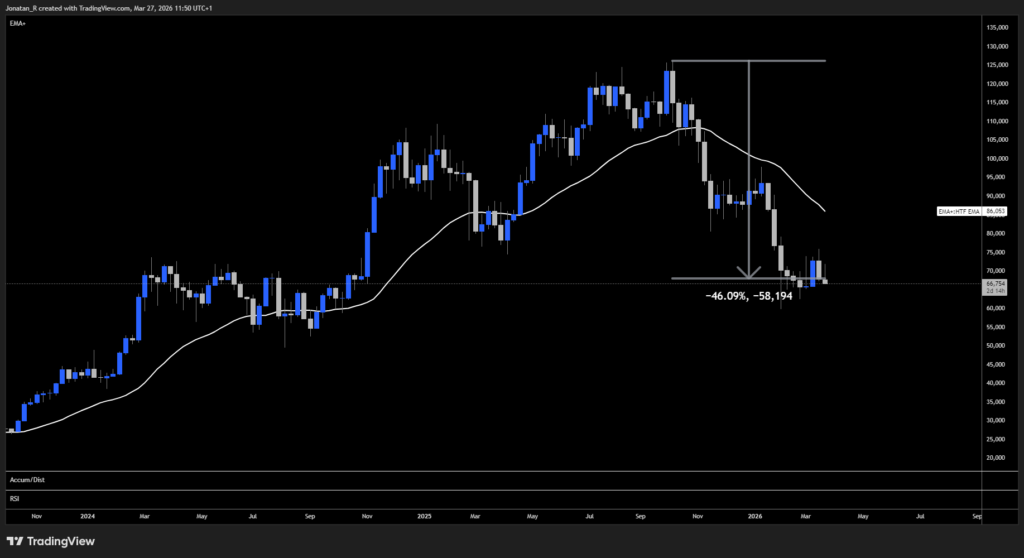
Goldman Sachs signalled this week that crypto prices “may have troughed” after a 46% decline from Bitcoin’s (BTC) October 2025 all-time high near $126,000, while Bernstein declared that Bitcoin “has found its trough” with a $150,000 year-end target. With BTC/USD consolidating around $69,000, the question is whether on-chain data supports the bottoming thesis or whether the macro risks make it premature.
- Goldman Sachs cited three factors: reduced forced selling, improving liquidity, and technical stabilisation, though cautioned that volumes could take three months to recover
- Long-term holder selling collapsed 87%, but exchange wallet movements (notably 800,000 BTC moved internally by Coinbase) may distort the headline figure
- Miner hash rate dropped 22%, though much of this appears driven by miners pivoting to AI infrastructure rather than traditional capitulation
- Bitcoin ETFs saw $1.53 billion in March inflows after four months of outflows totalling $4.5 billion, but retail investors hold 62% of ETF assets
- Whale wallets hit record highs, but analysts have flagged that exchange wallet reorganisations can create false accumulation signals
- Exchange reserves fell to 2.7 million BTC, a seven-year low, which may be the cleanest bullish signal in the data
- The macro backdrop remains hostile: the Fed held rates at 3.50–3.75% with a hawkish outlook, Brent crude trades above $108, and Bitcoin’s correlation with the S&P 500 hit 0.74
Has Bitcoin bottomed? What the on-chain data says
Goldman Sachs analyst James Yaro wrote on March 26 that crypto prices “may have troughed,” citing the exhaustion of forced selling across the market. The previous Bitcoin analysis explored the technical structure of BTC’s consolidation range, and the fundamental picture has evolved significantly since then.
The sell-side data is compelling on the surface. Long-term holder net selling (wallets holding BTC for more than 155 days) fell from −243,737 BTC in early February to −31,967 BTC by March 1, an 87% decline. Miner selling dropped 82% over the same period, from −4,718 BTC to −837 BTC. Goldman’s argument is that when forced sellers are exhausted, the remaining supply becomes stickier, creating a firmer floor under the price.
However, there are significant data quality concerns. Senior CryptoQuant analyst Julio Moreno identified that exchange wallet reorganisations, where platforms move funds between internal wallets, can appear identical to accumulation on basic analytics platforms. Coinbase alone moved approximately 800,000 BTC internally, much of which was incorrectly categorised as long-term holder supply movement. When exchange-internal transfers are filtered out, Moreno found that genuine large holders were actually net sellers, not accumulators.
The miner story has a twist. The 22% hash rate decline is being framed as capitulation, but at least eight major publicly-traded miners are deliberately converting facilities from Bitcoin mining to AI data centres. CoinShares projects that mining revenue could fall from 85% of total revenue to under 20% by end of 2026 for companies with AI contracts, which offer 80–90% operating margins versus volatile, low-margin mining. Miners are also actively selling Bitcoin (over 15,000 BTC in early 2026) to fund the transition, adding real supply pressure.
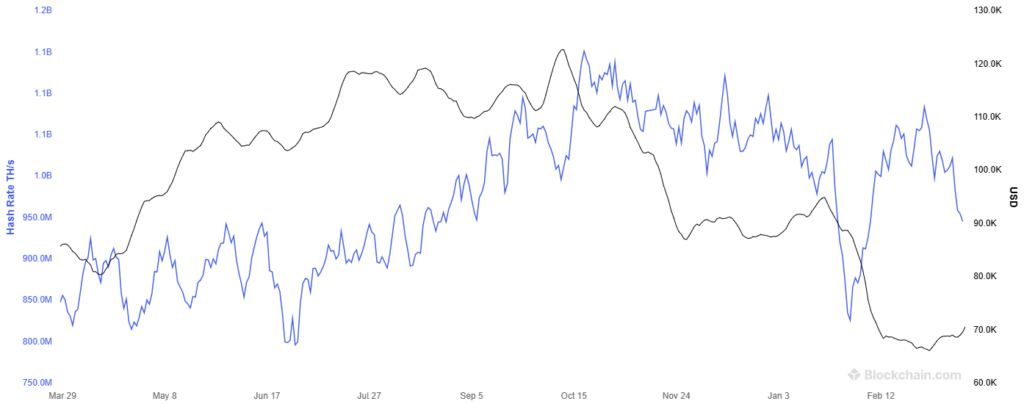
From Blockchain.com
The ETF picture is mixed. March saw $1.53 billion in net inflows, breaking a four-month outflow streak. But this follows $4.5 billion in outflows, leaving the net position still negative. 13F filings show that 62% of Bitcoin ETF holdings are retail, not institutional, meaning the “sticky money” narrative is overstated.
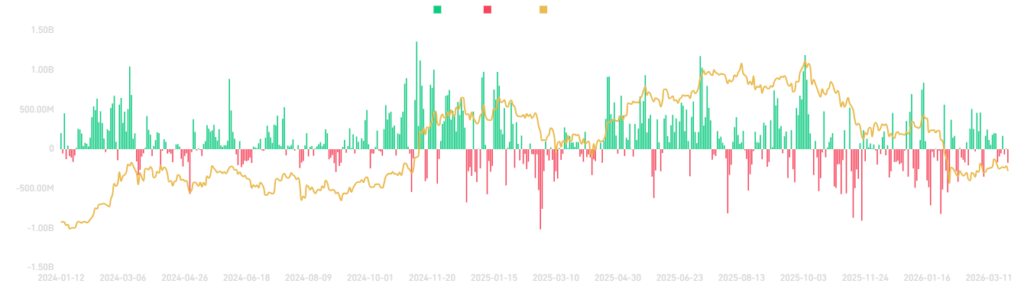
https://www.coinglass.com/etf/bitcoin
Bernstein offered the strongest bull case, noting that despite a 46% crash, ETFs lost less than 5% of total assets. They maintain a $150,000 year-end target, arguing this is “a capital flows argument, not a chart pattern.”
The cleanest bullish signal may be exchange reserves at 2.7 million BTC (a seven-year low) and the Binance Scarcity Index at its highest since October 2025. These are harder to distort and suggest available liquid supply is genuinely thinning. However, low liquidity amplifies moves in both directions.
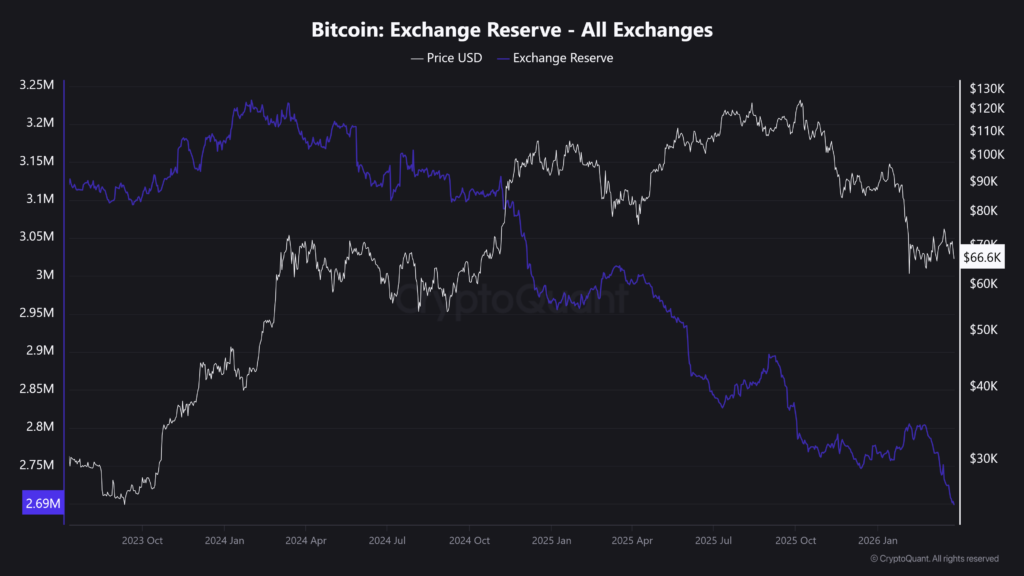
cryptoquant.com – Exchange Reserve – All Exchanges
On the macro side, the Fed held rates at 3.50–3.75% with a hawkish dot plot, Brent crude sits above $108, and Bitcoin’s correlation with the S&P 500 reached 0.74 in early March. A broader equity selloff would likely drag BTC lower regardless of on-chain dynamics.
Daily timeframe
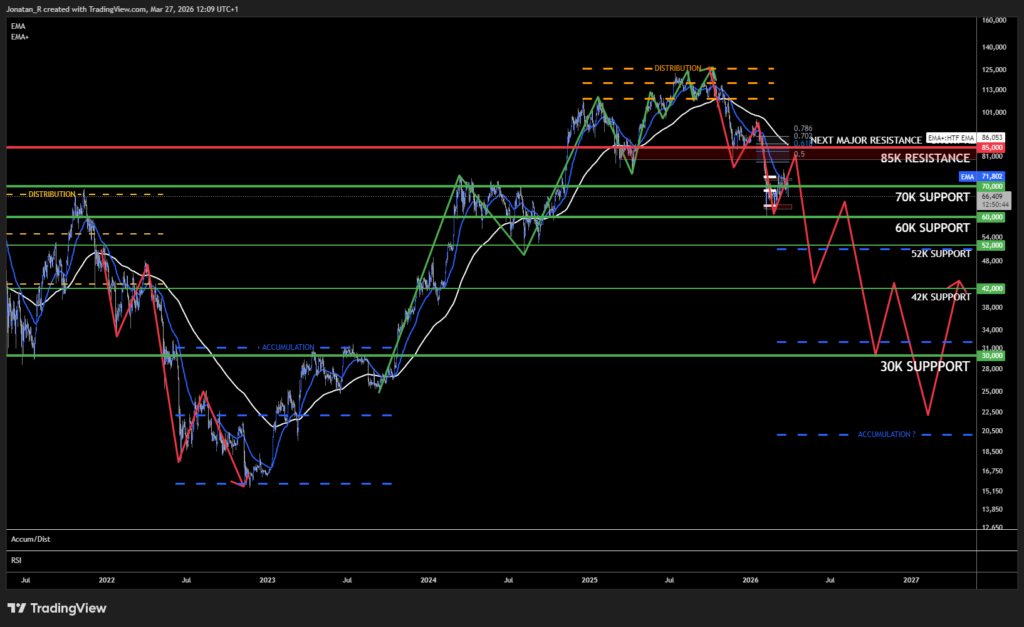
Zooming out on the daily timeframe, the picture is clear. BTC/USD has broken down from the distribution range that formed between roughly $113,000 and $126,000 throughout mid-to-late 2025, and price is now trading around $69,000.
This is not a typical bull market structure, and despite analysts calling for a potential bottom based on on-chain dynamics, price is not confirming that. As we explored above, some of those on-chain metrics may not actually be telling us what they appear to at first glance.
Trading involves risk.
Author



 Risk Disclaimer
The content provided here is for informational purposes only. It is not intended as personal investment advice and does not constitute a solicitation or invitation to engage in any financial transactions, investments, or related activities. Past performance is not a reliable indicator of future results.
The financial products offered by the Company are complex and come with a high risk of losing money rapidly due to leverage. These products may not be suitable for all investors. Before engaging, you should consider whether you understand how these leveraged products work and whether you can afford the high risk of losing your money.
The Company does not accept clients from the Restricted Jurisdictions as indicated in our website/ T&C. Some services or products may not be available in your jurisdiction.
The applicable legal entity and its respective products and services depend on the client’s country of residence and the entity with which the client has established a contractual relationship during registration.