6 min read
The Nasdaq index is under significant pressure. A hawkish Federal Reserve, persistent inflation concerns, and ongoing geopolitical tensions in the Middle East have combined to drive one of the sharpest sell-offs of the year, pushing the index below its 200-day simple moving average for the first time in nearly a year. With rate cut expectations now effectively priced out for 2026, the question traders are asking is simple: is this a buying opportunity, or the start of something more serious?
Here is what the charts are saying.
Daily timeframe analysis
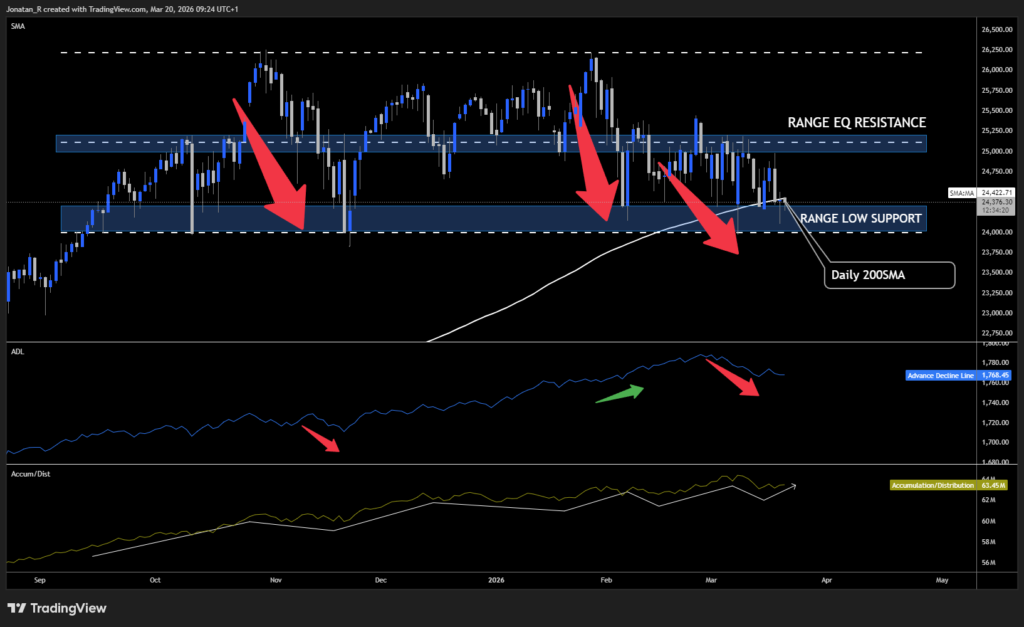
The Nasdaq is testing range low support for the third time in recent months, with the 200-day SMA now in play and broad market participation behind the sell-off potentially confirming this is no ordinary dip.
The daily chart tells a story of mounting pressure on a key structural support zone. The Nasdaq index has been trading within a well-defined range for several months, and the range low support area around 24,000–24,300 is now being tested again. Crucially, each test of this level is happening with less force than the last. The violent bounces that characterised earlier visits to this zone are becoming shallower and shorter, suggesting that buyers could be losing conviction at this support level.
The daily 200 SMA now sits just below current price, and yesterday’s candle saw the index test it for the first time in close to a year. A confirmed close below this level could be a significant technical development, shifting the medium-term bias firmly to the downside.
Two indicator readings add important context:
- The Advance/Decline Line (breadth) is showing that this is not a sell-off concentrated in a handful of mega-cap tech names. Broad market participation is behind this move, with the majority of Nasdaq constituents declining together. This distinguishes the current sell-off from the February episode, where price dropped sharply but the breadth indicator remained in an uptrend, suggesting the damage was narrow. Right now, the breadth indicator is deteriorating alongside price — a clearer and more concerning signal.
- The Accumulation/Distribution Line remains in a broadly bullish structure, but is approaching a critical inflection point. If this line rolls over and breaks its own rising structure, it would indicate that institutional money flow is shifting from accumulation to distribution — adding further weight to the bearish case.
Key levels to watch:
- 24,000–24,300 — range low support; a confirmed break opens the door to deeper selling
- 25,000–25,250 — range equilibrium and key resistance on any recovery attempt
- Daily 200 SMA — the line in the sand for the medium-term trend
4-hour timeframe analysis
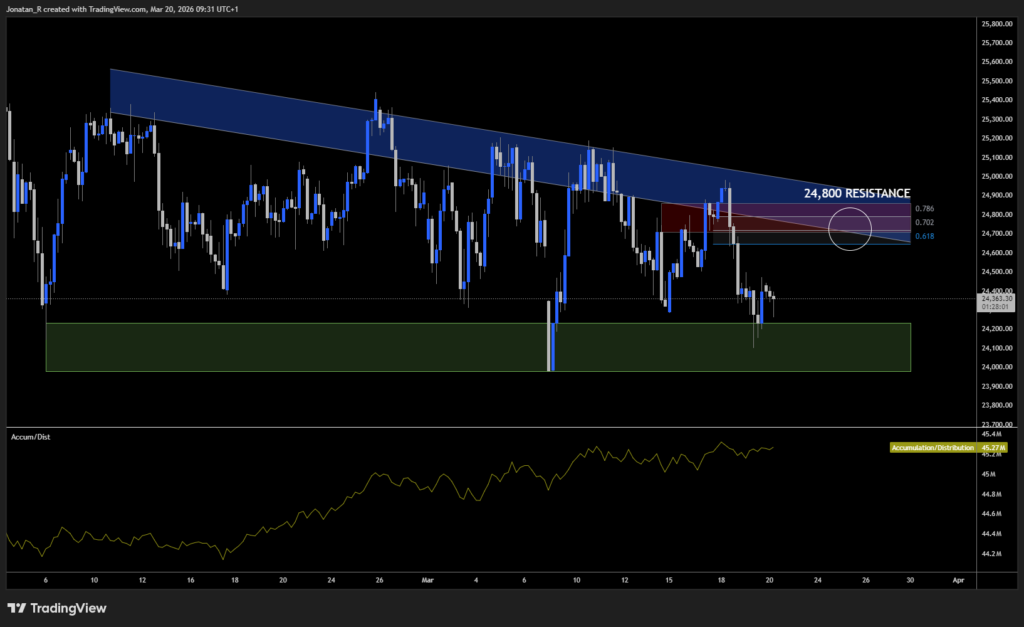
A descending triangle structure is compressing price between flat support and a declining trendline, with the Accumulation/Distribution Line suggesting buyers are still active — but a break in either direction could be imminent.
Zooming into the 4-hour chart, a descending triangle-like structure has formed, with a flat support base around 24,000–24,200 and a declining trendline capping each recovery attempt at lower and lower highs. It is worth noting that the context here matters. This pattern is forming within a higher timeframe range rather than at the end of a sustained trend, which limits its predictive weight as a standalone signal.
What is more meaningful is what the structure itself is telling us: volatility is contracting. Price is coiling between the flat support below and the descending resistance above, with each swing becoming tighter. This type of compression typically resolves in a sharp directional move, and given the broader macro backdrop, the direction of that break will be critical.
Interestingly, the Accumulation/Distribution Line on the 4-hour chart is still trending higher, suggesting that within this local compression zone, buyers have been absorbing selling pressure. This creates a possible case for one more push higher before the picture clarifies.
If buyers do manage to defend the current support zone and push higher, the key level to watch on the upside is 24,800. This area represents a confluence of the descending trendline, a horizontal resistance level, and the 0.618–0.786 Fibonacci retracement zone of the most recent leg down — a classic reload zone for sellers looking to re-enter. A clean rejection there would likely confirm the path of least resistance remains to the downside.
A break below the local support, however, would shift the picture considerably. Without this floor holding, there is limited structure standing between current price and a more aggressive move lower.
Key levels to watch:
- 24,000–24,200 — local support base; the line in the sand on the 4-hour
- 24,800 — confluence resistance: descending trendline, horizontal level, Fibonacci reload zone
- A break below support could open the door to a more aggressive sell-off; a reclaim of 24,800 would be the first sign of stabilisation
Trading involves risk.
Author



 Risk Disclaimer
The content provided here is for informational purposes only. It is not intended as personal investment advice and does not constitute a solicitation or invitation to engage in any financial transactions, investments, or related activities. Past performance is not a reliable indicator of future results.
The financial products offered by the Company are complex and come with a high risk of losing money rapidly due to leverage. These products may not be suitable for all investors. Before engaging, you should consider whether you understand how these leveraged products work and whether you can afford the high risk of losing your money.
The Company does not accept clients from the Restricted Jurisdictions as indicated in our website/ T&C. Some services or products may not be available in your jurisdiction.
The applicable legal entity and its respective products and services depend on the client’s country of residence and the entity with which the client has established a contractual relationship during registration.