7 min read
In a dramatic turn of events, President Trump signalled on Monday that the conflict in the Middle East could be nearly over, sending oil prices sharply lower and equity markets into a powerful reversal. After weeks of war-driven volatility, markets are now beginning to reprice the possibility of a resolution — but with mixed signals still emerging from Washington, uncertainty remains high. Below, we break down the key levels to watch in both oil and the S&P 500.
S&P 500: the weekly chart

The big picture on the S&P 500 tells a story of a market that has been losing momentum for some time. Since reclaiming its uptrend following the tariff-driven selloff in April 2025, price action has gradually curved over, with the index spending recent months forming a high timeframe range between 6,500 and 7,000.
Key observations on the weekly chart:
- The index broke below 6,750, the range equilibrium, during the recent war-driven selloff, dropping down to test the major support zone at the lower end of the range
- Trump’s comments on Monday triggered a sharp recovery, with price reclaiming 6,750 and closing back above the range midpoint
- The weekly RSI has been printing a clear bearish divergence as price ranged higher, suggesting momentum has been weakening throughout
- Last week saw the first weekly close below the weekly 20 EMA since it was reclaimed in May 2025, a notable shift in structure
- Price is now testing that weekly 20 EMA as resistance, adding significance to whether bulls can hold this recovery
- The weekly 50 EMA is converging with the 6,500 support level, which could provide a strong confluence of support should the index come under pressure again
The 6,750 level is now the critical line in the sand. The longer price trades below it, the greater the risk of a deeper breakdown. A sustained hold above it would be a more constructive sign for bulls.
S&P 500: the daily chart

Zooming into the daily timeframe, the bearish RSI divergence that has been building since late 2025 continues to play out. The recent recovery has brought price back above 6,750, but the chart still carries a number of warning signs.
- The daily 20 EMA has crossed below the daily 50 EMA, a bearish signal that typically suggests broader momentum has shifted to the downside
- While reclaiming 6,750 is encouraging for bulls, price still has significant work to do before a truly bullish structure can be confirmed
- Overhead resistance remains heavy, and the index will need to clear multiple layers before the picture materially improves
As we noted when we last covered the S&P 500 earlier this month, the index has been caught between geopolitical uncertainty and inflation pressures — and while yesterday’s relief rally offers some hope, the technical backdrop still warrants caution.
S&P 500: the 4-hour chart

On the shorter timeframe, the S&P 500 remains in a clear downtrend structure, with the relief rally from Monday now running into a key resistance cluster.
- Price is testing the 6,825 area, which is reinforced by a descending trendline from the February highs
- This zone also aligns with the local reload zone (RLZ), the Fibonacci retracement band between the 0.618 and 0.786 levels, adding further confluence to this resistance
- A convincing break above 6,825 and the descending trendline could open the door for a deeper recovery within the broader range, potentially targeting the 6,900–6,950 area
- Failure to break above here would suggest the relief rally is running out of steam, and would keep the broader bearish structure intact
The 6,825 level is the key trigger to watch in the short term. Bulls need a clean break and hold above this level to build confidence in the recovery.
Brent crude: the 1-hour chart
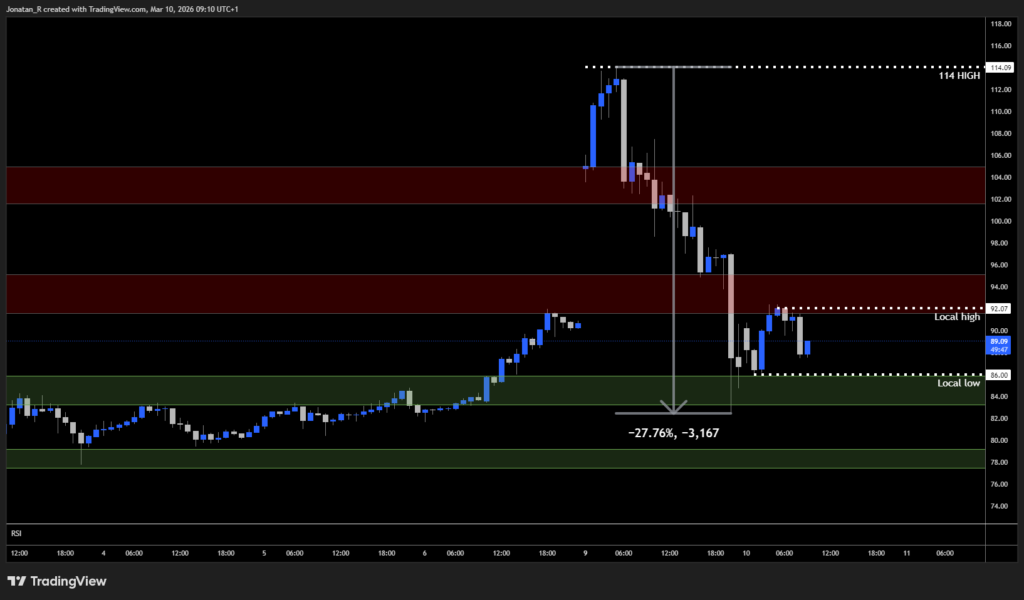
As we covered in yesterday’s analysis, Brent crude had surged aggressively on the back of the escalating conflict in the Middle East. Monday’s session told the opposite story.
After reaching a high of $114, Trump’s comments that the war could be nearly over triggered one of the sharpest single-session selloffs in recent memory, with Brent dropping nearly 28% from peak to trough before stabilising.
Price is now trading in a clearly defined short-term range, and the break in either direction could set the tone for the weeks ahead:
- $92 is the key level to the upside, aligning with the local highs formed after the initial drop. A break and hold above this level could suggest the conflict is far from resolved, and that the war premium may begin to build back into the price
- $85–86 is the key support level to the downside. A break below here could signal that markets believe a swift resolution is genuinely on the table, opening the door to a more sustained move lower
- Some traders are already questioning whether this is another instance of Trump signalling one thing before reversing course — a pattern markets have become familiar with throughout his presidency. If that proves to be the case, the $92 resistance break becomes the key level to watch
Until a clear break emerges in either direction, Brent appears likely to remain volatile and headline-driven.
Trading involves risk.
Author



 Risk Disclaimer
The content provided here is for informational purposes only. It is not intended as personal investment advice and does not constitute a solicitation or invitation to engage in any financial transactions, investments, or related activities. Past performance is not a reliable indicator of future results.
The financial products offered by the Company are complex and come with a high risk of losing money rapidly due to leverage. These products may not be suitable for all investors. Before engaging, you should consider whether you understand how these leveraged products work and whether you can afford the high risk of losing your money.
The Company does not accept clients from the Restricted Jurisdictions as indicated in our website/ T&C. Some services or products may not be available in your jurisdiction.
The applicable legal entity and its respective products and services depend on the client’s country of residence and the entity with which the client has established a contractual relationship during registration.