5 min read
The S&P 500 has come under pressure this week as the escalating conflict in the Middle East sends oil prices sharply higher and revives fears of a prolonged inflationary environment. With Brent crude posting its biggest weekly rally since 2022 and rate cut expectations being pushed further out, equities are caught between geopolitical risk and a deteriorating macro backdrop. Today’s February jobs report could add another layer of uncertainty, landing on a market that has already erased its gains for the year.
Weekly chart: momentum fading beneath the surface
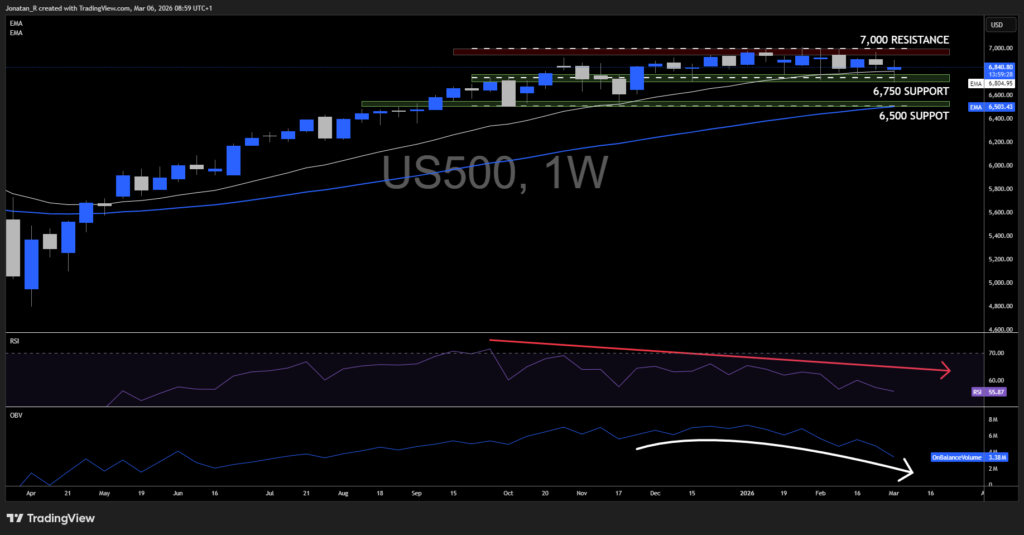
On the weekly chart, the S&P 500 has been in a steady uptrend since the tariff-driven selloff in April 2025. However, beneath the surface, momentum has been steadily fading. The RSI is showing a clear bearish divergence, printing lower highs while price pushed to new highs earlier this year. OBV has also broken lower, suggesting that the volume behind recent moves has been declining.
This week marks the first trading below the weekly 20 EMA, which has historically acted as a reliable indicator of trend direction during bull markets for the S&P 500. A sustained break below this level could signal a shift in the broader trend.
The index is currently trading within a high-timeframe consolidation range that could potentially develop into a distribution range if risk conditions continue to deteriorate. The key levels to watch are:
- 7,000 resistance at the top of the range, which capped price at the January all-time high
- 6,750 as the midpoint of the range, currently being tested
- 6,500 support at the bottom of the range, where the weekly 50 EMA is also converging
A hold above 6,750 could keep the consolidation range intact. A break below it could open the door toward the 6,500 level, which would represent the next major support.
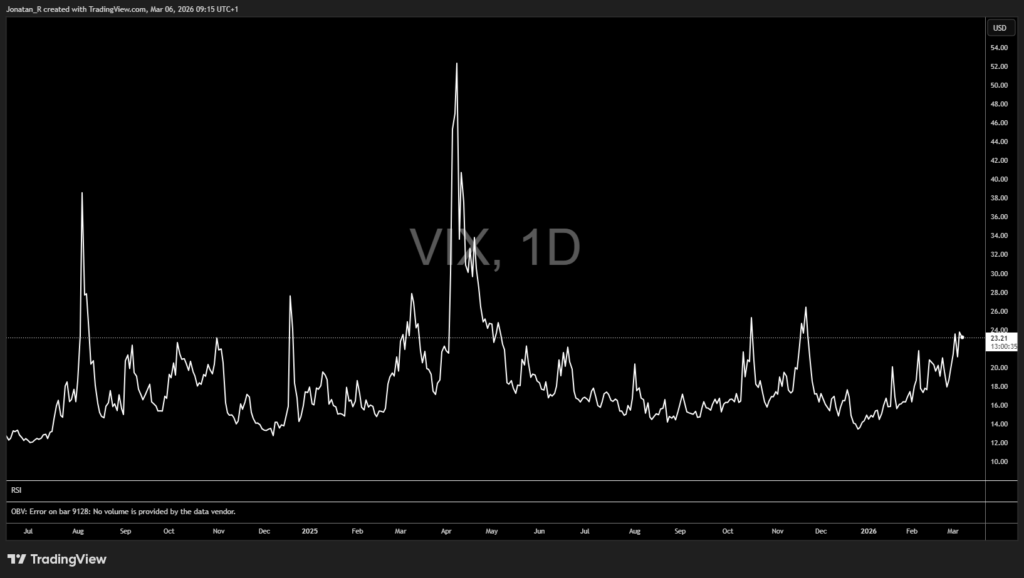
Adding to the caution, the CBOE Volatility Index (VIX) spiked to its highest level since November this week, briefly touching 28 before pulling back. Historically, VIX readings in the mid-to-high 20s indicate elevated fear but not outright panic. The index remains well above its long-run average of 20, suggesting that the market is pricing in sustained uncertainty rather than a single event.
4-hour chart: a local range reflecting market indecision
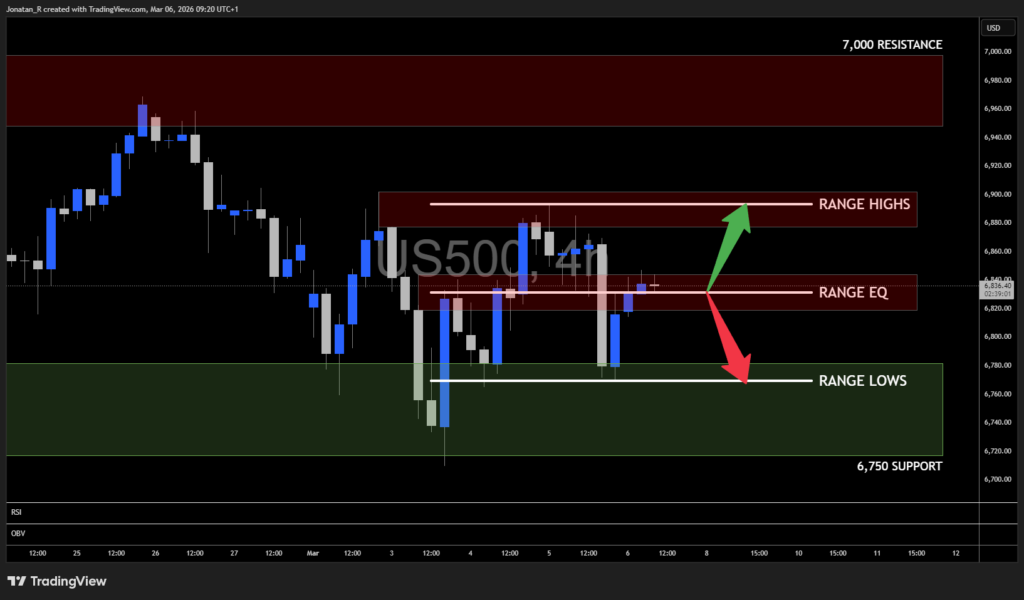
Zooming into the 4-hour chart, the S&P 500 is currently testing the equilibrium of a local range at around 6,840. The range highs sit at approximately 6,890, with the range lows at around 6,770.
The price action within this range is telling. Given the geopolitical uncertainty and the unpredictability of the current environment, market participants are clearly struggling to price the situation. The choppy, overlapping candles reflect indecision, and the S&P 500 remains trapped within this local structure, itself sitting inside the broader high-timeframe consolidation range discussed above.
From here, the two scenarios are straightforward:
- A push higher from current levels could take the index toward the range highs at 6,890. A break above that level could signal that the geopolitical situation is showing signs of calming down, and would open the door back toward the 7,000 resistance overhead.
- A rejection at current levels could send price back toward the range lows at 6,770. A break below that area would bring the 6,750 high-timeframe support into play, and if the overall situation deteriorates further, a move toward the 6,500 level and the weekly 50 EMA could follow.
With the February jobs report due today and the conflict in the Middle East still unfolding, volatility is likely to remain elevated. The direction of the next breakout from this local range could set the tone for the months ahead.
Trading involves risk.
Author



 Risk Disclaimer
The content provided here is for informational purposes only. It is not intended as personal investment advice and does not constitute a solicitation or invitation to engage in any financial transactions, investments, or related activities. Past performance is not a reliable indicator of future results.
The financial products offered by the Company are complex and come with a high risk of losing money rapidly due to leverage. These products may not be suitable for all investors. Before engaging, you should consider whether you understand how these leveraged products work and whether you can afford the high risk of losing your money.
The Company does not accept clients from the Restricted Jurisdictions as indicated in our website/ T&C. Some services or products may not be available in your jurisdiction.
The applicable legal entity and its respective products and services depend on the client’s country of residence and the entity with which the client has established a contractual relationship during registration.