7 min read
The S&P 500 has spent the past three sessions recovering from a break below its 200-day moving average, driven by hopes of a US-Iran ceasefire. Overnight, Iran rejected direct talks and Israel struck Isfahan, putting the recovery rally under immediate pressure.
Here’s what we’re looking at today:
- Whether the bounce off the 200-day MA has the momentum to continue
- Why the weekly chart raises questions about a potential distribution range at the highs
- The key resistance levels the index must clear to confirm a recovery
- The immediate support level at 6,540 that could determine short-term direction
Weekly chart analysis
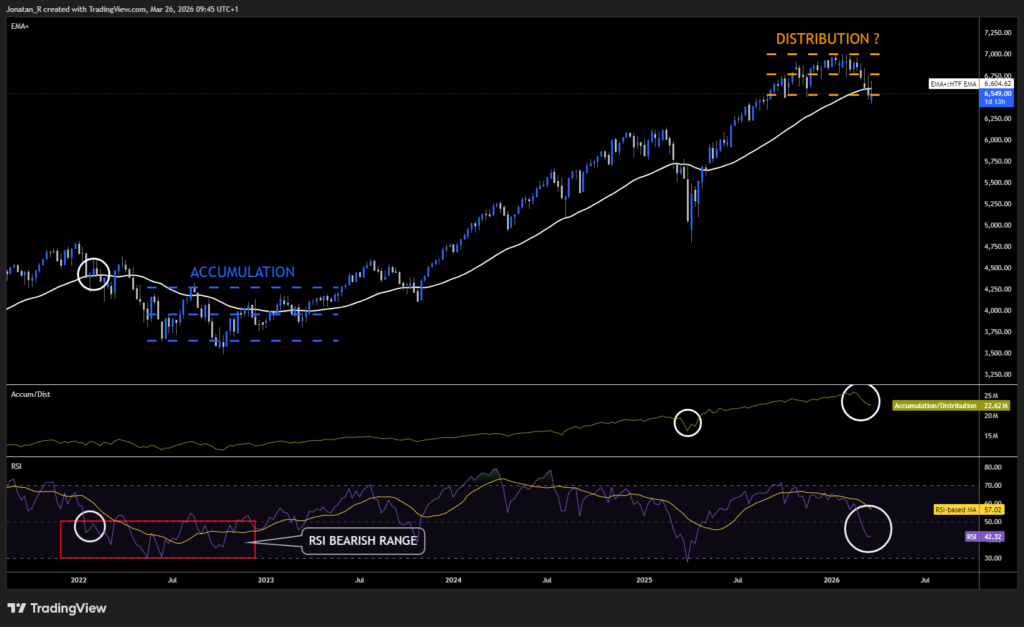
The weekly chart shows price breaking below the 200-week SMA, with a potential distribution range forming at the highs and both the A/D line and RSI beginning to roll over below the 50 level.
Zooming out to the weekly timeframe provides important context for the current pullback.
The S&P 500 has broken below its 200-week SMA, the long-term trend line that has acted as a reliable support floor throughout the bull market. Price is now trading beneath it, and the moving average is shifting from support to potential resistance.
More notably, the price action at the highs raises a concerning question. The index spent several weeks consolidating in the 6,750–7,000 zone, printing a pattern that bears a resemblance to a distribution range — a period where smart money may have been offloading positions into strength. That question remains open, but it is worth monitoring closely.
Two indicators add to the cautious tone:
- Accumulation/Distribution line: After a prolonged uptrend, the A/D line has started to roll over at the highs, a potential sign that selling pressure is quietly building beneath the surface
- Weekly RSI: Currently sitting below the 50 level, the RSI is at risk of entering what has historically been a bearish range for this indicator. The last time RSI traded in this zone for a sustained period was during the 2022 drawdown
None of this confirms a trend reversal. The long-term structure of the bull market remains intact. But the weekly picture suggests this is not a straightforward dip-buying environment, and the recovery rally carries real overhead risk.
Daily chart analysis
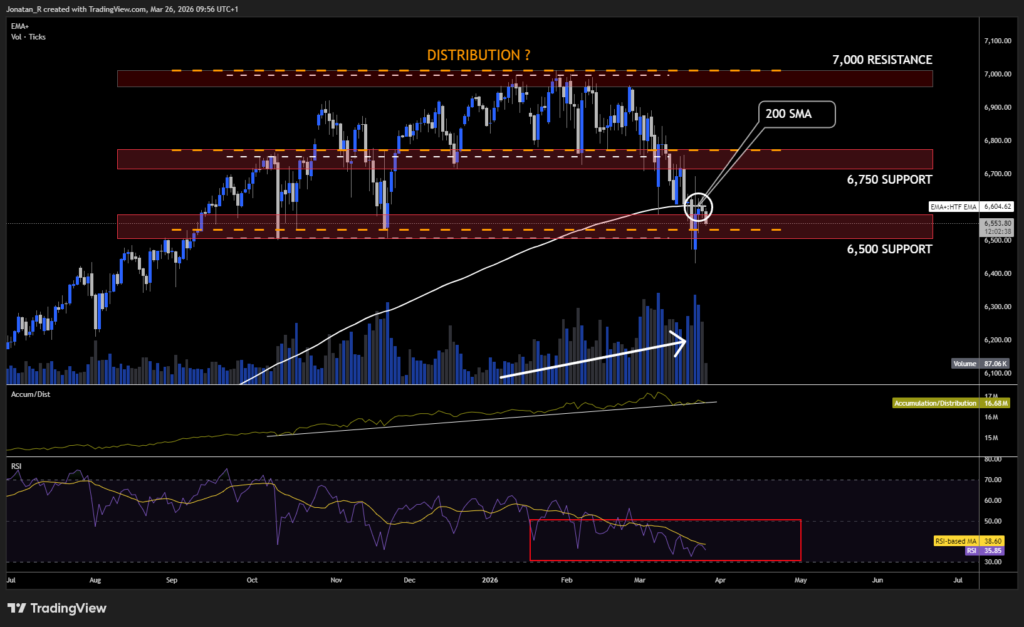
Price has been rejected from the 200 SMA and is testing the 6,500 range lows, with rising volume on the move lower and the RSI building bearish structure below 50.
The daily chart tells a cautious story.
After breaking below the 200 SMA, the S&P 500 attempted a recovery rally back towards it — but was firmly rejected. Price has since pulled back into the 6,500 support zone, which represents the range lows of the broader consolidation structure. This is the line in the sand for bulls.
Volume is a concern. As price has moved lower, volume has picked up notably — a sign that selling pressure has conviction behind it, rather than being a low-participation drift.
Two indicators reinforce the bearish lean:
- RSI: The daily RSI has been building structure below the 50 level for an extended period, consistent with a bearish momentum regime. There is no sign yet of a recovery towards neutral
- Accumulation/Distribution line: The A/D line has not broken down sharply, but it is showing clear weakness — failing to make new highs and sitting on the edge of a potential breakdown. This suggests that buying pressure is quietly fading even as price attempts to stabilise
Key levels to watch:
- 6,750 / 200 SMA — the area the index was rejected from, now acting as resistance
- 6,500 — current range lows and the immediate support floor; a confirmed break below here opens the door to further downside
- 7,000 — major resistance above; unlikely to be in play unless the macro picture shifts materially
The overall picture favours the bears for now. A decisive close below 6,500 would be a significant development. Conversely, reclaiming the 200 SMA is the minimum requirement for bulls to shift the narrative.
4-hour chart analysis
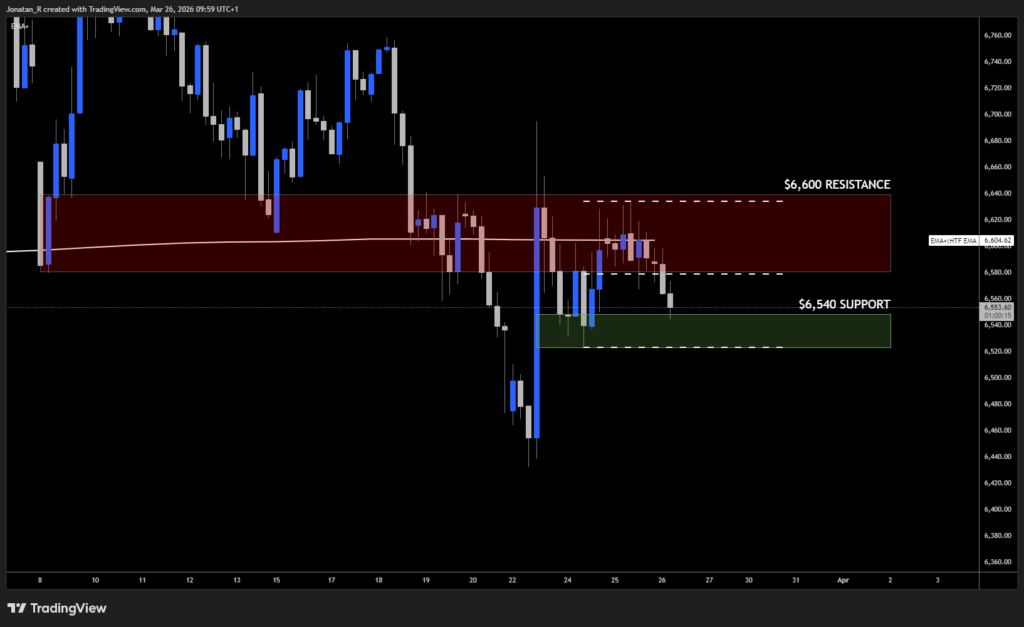
Price is compressing between the 6,600 resistance zone and local support at 6,540, with a break in either direction likely to set the short-term direction.
Drilling down to the 4-hour timeframe, the picture is one of compression ahead of what could be a decisive move.
Price is currently sandwiched between two clearly defined levels. To the upside, the 6,600 resistance zone aligns closely with the daily 200 SMA, making it a high-confluence area that bulls need to reclaim to build any credible recovery case. To the downside, 6,540 is acting as immediate local support, with price appearing to form a short-term range between the two.
A break in either direction from this range is likely to be telling:
- A break above 6,600 would suggest the recovery rally has legs and could open the door for a test of 6,750
- A break below 6,540 would signal a resumption of the broader downtrend and bring the 6,500 range lows back into focus
As we covered in our previous S&P 500 analysis, the index has been struggling to shake off bearish pressure. For now, the path of least resistance remains to the downside unless bulls can reclaim and hold above 6,600.
Trading involves risk.
Author



 Risk Disclaimer
The content provided here is for informational purposes only. It is not intended as personal investment advice and does not constitute a solicitation or invitation to engage in any financial transactions, investments, or related activities. Past performance is not a reliable indicator of future results.
The financial products offered by the Company are complex and come with a high risk of losing money rapidly due to leverage. These products may not be suitable for all investors. Before engaging, you should consider whether you understand how these leveraged products work and whether you can afford the high risk of losing your money.
The Company does not accept clients from the Restricted Jurisdictions as indicated in our website/ T&C. Some services or products may not be available in your jurisdiction.
The applicable legal entity and its respective products and services depend on the client’s country of residence and the entity with which the client has established a contractual relationship during registration.