7 min read
The Nikkei rallied over 7% last week on hopes that the US-Iran ceasefire would hold and lead to a reopening of the Strait of Hormuz. That optimism lasted exactly one weekend. Here is what happened and what the charts are saying now:
- 21 hours of talks in Islamabad collapsed on Sunday after Iran refused to commit to ending uranium enrichment and the US rejected Tehran’s demands for Hormuz transit fees, frozen asset releases, and a broader Lebanon ceasefire
- Trump responded by ordering a US naval blockade of all vessels entering or leaving Iranian ports, effective 10am ET Monday
- Brent crude surged approximately 8% back above $103, reversing last week’s ceasefire-driven decline
- The Nikkei gapped down sharply on Monday’s open, erasing the bulk of its weekly gain in a single session
- Japan imports roughly 90% of its energy needs, making it one of the most exposed major economies to any disruption in Hormuz shipping. Only around 17 vessels crossed the strait on Saturday, compared to roughly 130 daily transits before the war
The ceasefire remains technically in place until 22 April, but with the US now blockading Iranian ports and Iran’s navy chief calling Trump’s threat “ridiculous,” the path to a permanent deal looks significantly more uncertain. The key question for the Nikkei is whether this is a temporary shock or the start of another leg lower.
Daily chart analysis
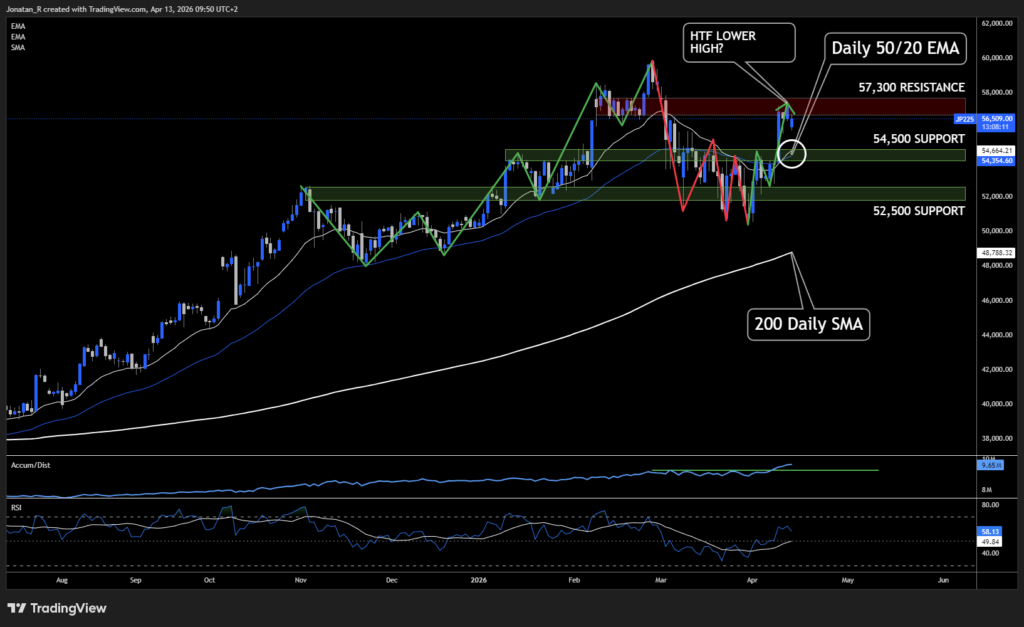
The Nikkei daily chart shows the rejection at 57,300 resistance and the key 54,500 support zone aligned with the daily 20 and 50 EMAs.
On the daily timeframe, the Nikkei had an explosive move higher on 9 April as ceasefire optimism flooded into risk assets, pushing the index back toward the 57,300 resistance zone. That rally has now been met with a sharp gap down right at this high-timeframe resistance level, which raises the critical question of whether this rejection is forming a potential higher-timeframe lower high.
Key observations on the daily chart:
- The broader trend remains an uptrend, but the rejection at 57,300 is significant. The previous all-time high of 59,332 (set on 26 February) was never retested, and if the current move fails to reclaim last week’s highs, the structure shifts to a lower-high pattern
- The 54,500 support zone aligns with the daily 20 and 50 EMAs, making it a major confluence area. If price pulls back to this level, it could act as a key support zone for buyers
- If 54,500 breaks, the next meaningful support sits at the 52,500 zone, which has held as a floor on multiple tests since March
- The RSI is currently trading above the 50% level, back within its bullish range. A scenario where price retests 54,500 at the same time as the RSI tests and holds the 50 level as support could be a potentially bullish signal
- The Accumulation/Distribution indicator is breaking into new highs on this latest move, which suggests that the underlying volume profile is still supporting the broader uptrend despite the headline-driven pullback
The daily chart paints a possible picture of a market that is still structurally bullish but facing a critical test. The 57,300 level is the line in the sand for bulls, and the 54,500 EMA confluence is where buyers need to step in to prevent the lower-high pattern from confirming.
4-hour chart analysis
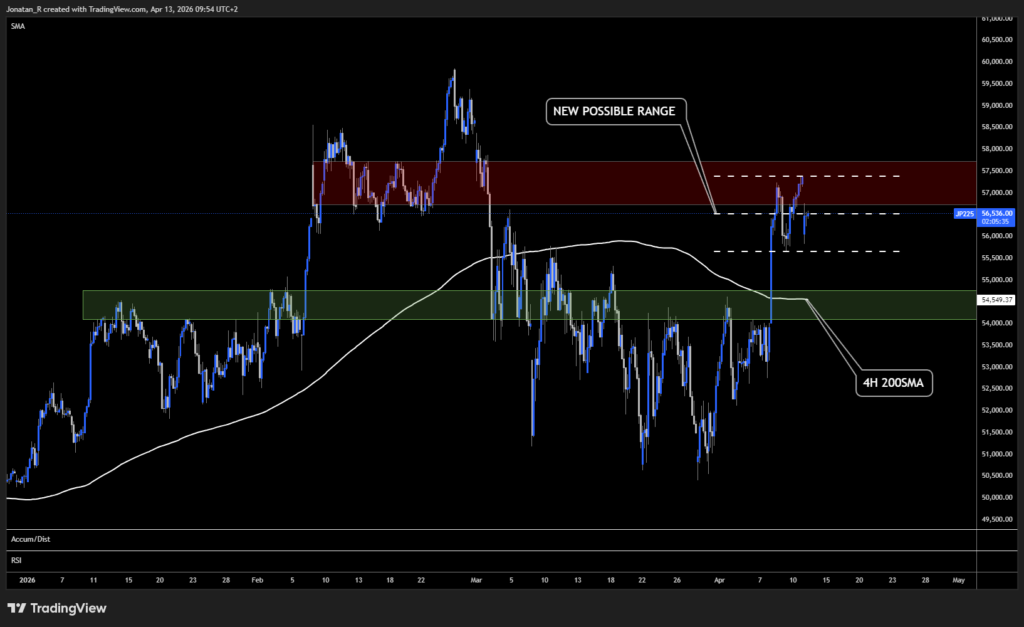
The 4-hour chart highlights the emerging range between 55,700 and 57,100, with the 4H 200 SMA rising into the 54,400 support zone.
On the 4-hour timeframe, the picture becomes clearer. A potential medium-term range is forming, with the following boundaries:
- Range lows: approximately 55,700
- Range highs: approximately 57,100
- The 4H 200 SMA is rising into the 54,400 area, adding further confluence to the support zone identified on the daily chart
A break in either direction could be a telling sign of where the Nikkei heads next:
- A break above 57,100 could put the index back into a much more favourable bullish scenario, suggesting the ceasefire rally has legs and the lower-high thesis is invalidated
- A break below 55,700 could take price down toward the 54,400 level, where the 4H 200 SMA, daily 20/50 EMAs, and horizontal support all converge
This is a range to watch closely. The direction of the breakout could potentially define the Nikkei’s trajectory for the coming weeks, particularly as the ceasefire deadline of 22 April approaches.
What to watch this week
- The ceasefire deadline (22 April): with only eight days remaining and no deal in sight, any further deterioration in US-Iran relations could send oil higher and equities lower
- Oil prices: Brent above $100 is a direct headwind for Japan. Goldman Sachs has warned that if Hormuz remains effectively closed for another month, Brent could average above $100 for the rest of 2026
- The yen: USD/JPY remains near the 160 intervention zone, and any sharp moves in the currency could add volatility to Japanese equities
- Saudi Arabia’s pipeline capacity: Saudi Arabia has restored full pumping capacity through its East-West pipeline to the Red Sea, which could partially offset some of the Hormuz disruption, but this remains a fraction of pre-war traffic volumes
The Nikkei is caught between a still-constructive technical structure and a macro environment that could deteriorate rapidly. The 54,500 support zone and the 57,100-57,300 resistance area are the levels that matter most right now.
Trading involves risk.
Author



 Risk Disclaimer
The content provided here is for informational purposes only. It is not intended as personal investment advice and does not constitute a solicitation or invitation to engage in any financial transactions, investments, or related activities. Past performance is not a reliable indicator of future results.
The financial products offered by the Company are complex and come with a high risk of losing money rapidly due to leverage. These products may not be suitable for all investors. Before engaging, you should consider whether you understand how these leveraged products work and whether you can afford the high risk of losing your money.
The Company does not accept clients from the Restricted Jurisdictions as indicated in our website/ T&C. Some services or products may not be available in your jurisdiction.
The applicable legal entity and its respective products and services depend on the client’s country of residence and the entity with which the client has established a contractual relationship during registration.