7 min read
USD/JPY is back at one of the most watched levels in forex markets. The pair is pressing toward 160 — the threshold that triggered billions in Japanese government intervention in 2024 — and traders are split on what comes next: a genuine breakout to multi-decade highs, or a significant top.
The key drivers at a glance:
- BOJ held rates at 0.75% in March — but a hike at the April 28 meeting is ~70% priced in
- The Fed is on hold at 3.50%–3.75% through 2026 — no cuts priced in
- The wide rate differential continues to fuel carry trade pressure on the yen
- Japan’s Finance Ministry has escalated intervention warnings around the 160 level
- March CPI dropped today — a hot print keeps the dollar bid and the pressure on
Why the yen is weak
The structural case for yen weakness hasn’t changed. Japan’s rates remain dramatically lower than US rates, and as long as that gap stays wide, the carry trade creates persistent selling pressure on the yen. The Iran war has compounded this: Japan imports roughly 90% of its energy needs, so the Strait of Hormuz disruption raises its import bill, weighs on the current account, and adds to inflationary pressure — all yen-negative forces.
The complication: the BOJ’s impossible balancing act
The energy shock is pushing inflation higher in Japan, which could force the BOJ to hike sooner. But the same shock is hitting growth, making tightening politically difficult. The April 28 meeting is the key catalyst — a hike would narrow the rate differential and could trigger a sharp carry trade unwind; a hold puts the 160 intervention question straight back on the table.
The intervention threat
Japan has made its position clear:
- Finance Minister Katayama has warned repeatedly of “excessive volatility” in currency markets
- Japan and South Korea issued a rare joint statement expressing concern over rapid yen weakness
- Currency chief Atsushi Mimura stated authorities are “prepared to respond on all fronts”
- In 2024, Japan spent over ¥15 trillion across multiple rounds of intervention defending the yen near the 160–162 zone
The 160 level is not just psychological — it is where Tokyo has previously acted, and the market knows it.
What today’s CPI means for USD/JPY
March CPI consensus pointed to roughly 3.4% year-over-year — the highest since April 2024 — driven by the Iran war energy shock. A hot print reinforces the Fed’s on-hold stance and keeps the dollar bid, supporting further USD/JPY upside. It also deepens the stagflation risk flagged in the FOMC minutes, which could weigh on risk appetite and push some safe-haven flows back into the yen, creating a potential short-term counter-move even within a broader uptrend.
Three-day chart: bulls in control, but a warning signal is forming
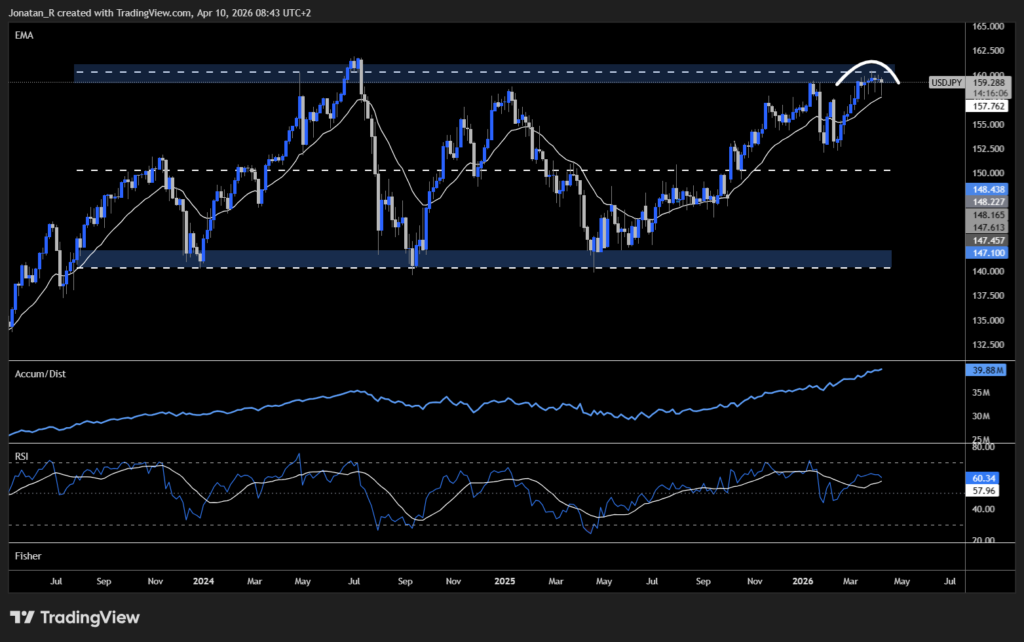
The three-day chart shows USD/JPY testing the top of its multi-year range near 160, with the Accumulation/Distribution in a sustained uptrend but an early RSI divergence beginning to form at the highs.
Zooming out to the three-day chart provides the clearest view of where USD/JPY sits within its broader price structure. The pair is testing the 160 zone — the top of a well-defined multi-year range and a level that has produced significant rejections in the past.
Key observations:
- Prior rejections at 160 have consistently been accompanied by a break below the three-day 20 EMA (white line). That EMA is holding firmly as support, with no confirmed break to the downside yet — keeping the bullish structure intact
- Accumulation/Distribution is in a sustained uptrend with no break of structure, indicating that buying pressure remains dominant rather than distribution forming at range highs
- RSI at 60 with room to push higher before reaching overbought territory — no immediate exhaustion signal from momentum alone
- Early warning: a potential bearish divergence is forming on the RSI — price is retesting the highs but RSI is not matching prior peaks. This is not a confirmed signal; price action needs to follow through to the downside before drawing conclusions
The overall picture on the three-day remains constructive for bulls. Until the 20 EMA breaks and the A/D line rolls over, the path of least resistance could still point toward a test of resistance above 160.
4-hour chart: range-bound with momentum quietly shifting
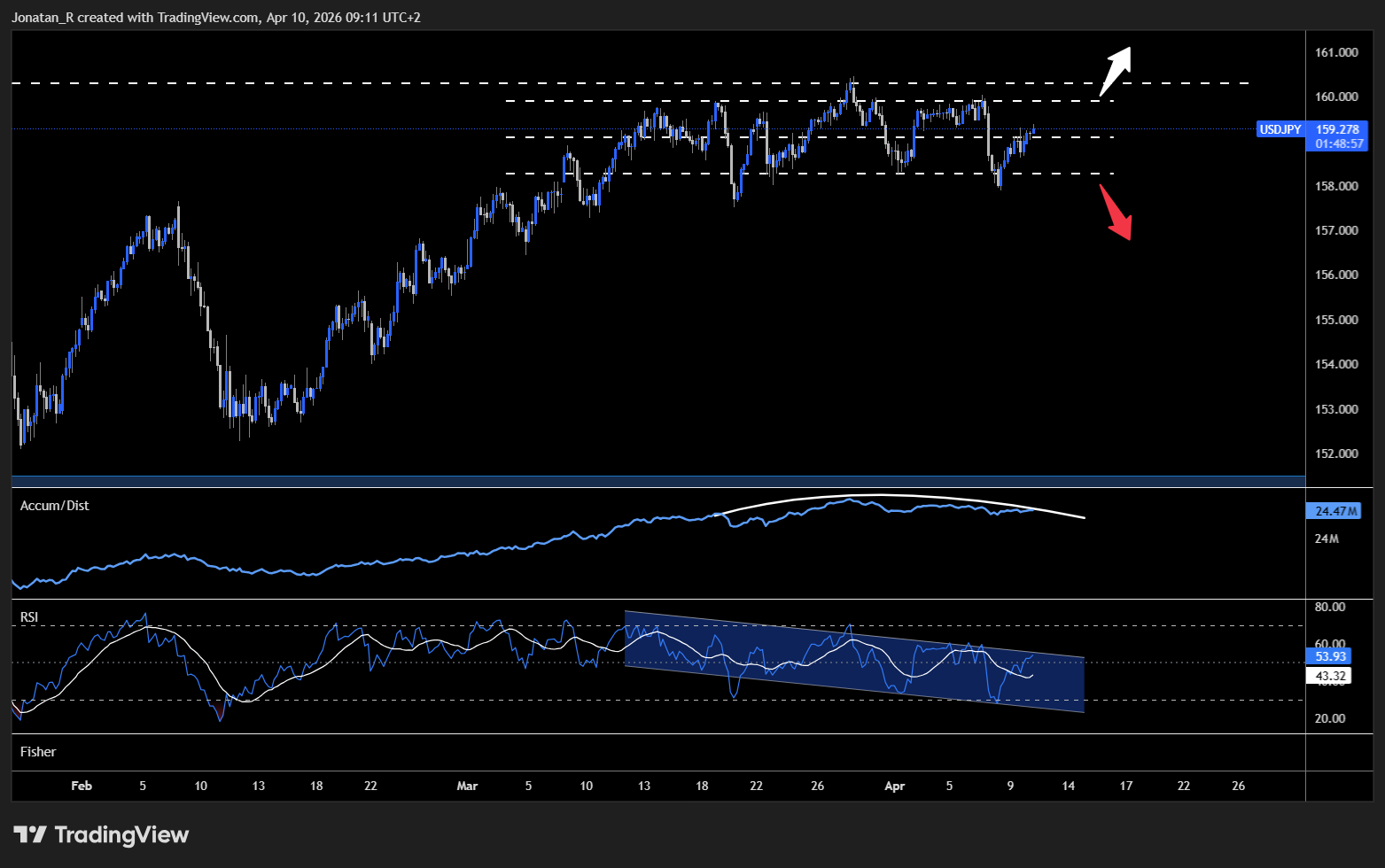
The 4-hour chart shows USD/JPY consolidating between approximately 158.00 and 160.00, with the Accumulation/Distribution topping out and RSI trending lower within a descending channel.
Dropping to the 4-hour timeframe reveals a clear short-term range forming while the higher-timeframe trend plays out. Price has been consolidating roughly between 158.00 and 160.00, with no confirmed break in either direction.
Key observations:
- The Accumulation/Distribution indicator is beginning to top out — the line has curved over and is no longer making new highs, suggesting buying pressure on the 4-hour timeframe is fading even as price holds near range highs
- RSI is in a descending channel, with momentum gradually shifting below the 50 level. More and more of the RSI structure is forming in bearish territory, indicating that upside momentum is slowly being eroded
- No confirmed break yet — price remains within the range, so neither scenario is off the table
What a break in either direction could mean:
- A break above 160 would signal that the market is willing to test intervention territory and could open a move toward the 161–162 zone where prior 2024 highs were made
- A break below 158.00 would be the first sign that distribution is taking hold, potentially initiating a move back toward the mid-range of the broader long-term structure around 150
Key levels to watch:
- 160.00–161.00 — range highs, intervention zone, key resistance
- 158.00 — short-term range support, 4H breakdown trigger
- 150.00 — mid-range of long-term structure, key downside target
- 147.00 — major long-term support zone
USD/JPY is at a genuine inflection point. The three-day chart still favours the bulls, but the 4-hour is showing early signs of distribution. The BOJ’s April 28 decision will likely be the defining catalyst — and with intervention risk rising at 160 and momentum quietly fading on the lower timeframe, traders on both sides have reasons to be cautious here.
Trading involves risk.
Author



 Risk Disclaimer
The content provided here is for informational purposes only. It is not intended as personal investment advice and does not constitute a solicitation or invitation to engage in any financial transactions, investments, or related activities. Past performance is not a reliable indicator of future results.
The financial products offered by the Company are complex and come with a high risk of losing money rapidly due to leverage. These products may not be suitable for all investors. Before engaging, you should consider whether you understand how these leveraged products work and whether you can afford the high risk of losing your money.
The Company does not accept clients from the Restricted Jurisdictions as indicated in our website/ T&C. Some services or products may not be available in your jurisdiction.
The applicable legal entity and its respective products and services depend on the client’s country of residence and the entity with which the client has established a contractual relationship during registration.