6 min read
Bitcoin is falling but remains above $66K on Tuesday as investors continue to weigh mixed signals surrounding the Iran conflict, even as Treasury yields move lower.
A report in The Wall Street Journal suggested that President Trump may be willing to end the conflict without first insisting on the reopening of the Strait of Hormuz — a potential sign of de-escalation. However, continued US troop deployments to the region paint a more complicated picture and highlight the mixed messaging that continues to drive market volatility.
Meanwhile, US Treasury yields have fallen by 9 basis points to 4.35% after Federal Reserve Chair Jerome Powell said inflation expectations remain well anchored. His comments were enough to reduce market expectations for a Fed rate hike in 2026 from 25% to just 5%.
Under normal circumstances, falling yields and a more dovish interpretation of Powell’s comments would be supportive for Bitcoin and other risk assets. US futures are pointing to a firmer open, but Bitcoin and the broader cryptocurrency market remain under pressure, suggesting investors are still cautious.
Fed Powell calms fears but Oil tells a different story
While Powell’s comments imply that monetary policy is in a relatively stable place for now, WTI crude settling above $100 per barrel for the first time since 2022 suggests inflation concerns are far from over.
That matters for Bitcoin because oil prices and Treasury yields have increasingly become key macro drivers for crypto. Lower yields tend to support liquidity and risk appetite, while higher energy prices can revive inflation fears and keep central banks cautious.
Bitcoin’s relative resilience stands out
Despite the pressure, Bitcoin’s relative performance in March deserves attention. BTC is broadly flat over the month, compared with a 13% decline in gold — pushing the precious metal into correction territory — and a 7% fall in the S&P 500.
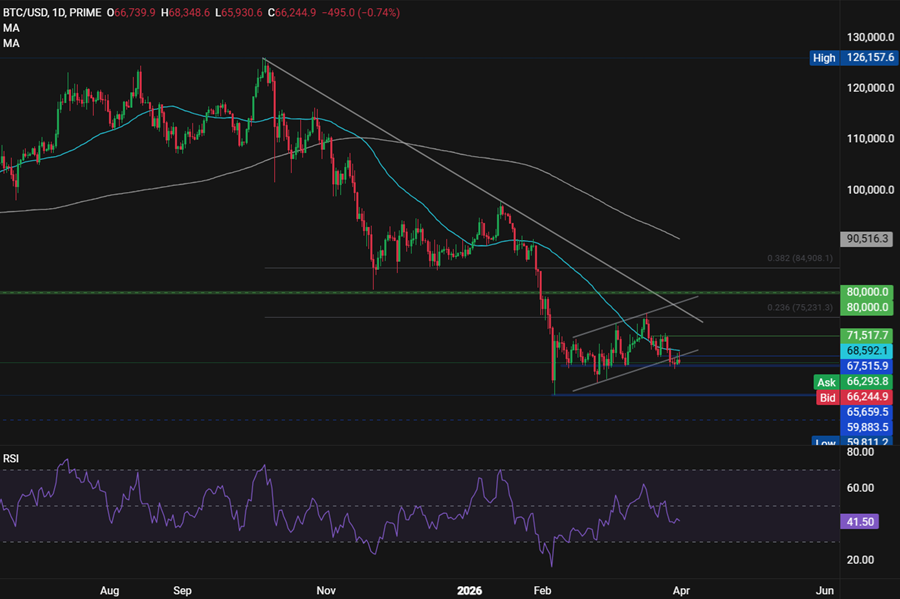
That relative resilience is notable, particularly given the broader market backdrop. However, Bitcoin is still trading around 45% below its all-time high of $126,000 reached in October, so the recovery remains incomplete.
Technically, BTC continues to hover around the $68,000 area, which has repeatedly acted as both support and resistance throughout this cycle.
If the market sees more credible signs of de-escalation in the Middle East, risk sentiment could improve quickly — and Bitcoin’s relative outperformance in March could provide a strong basis for the next leg higher.
Institutional demand supported BTC — but is fading
Institutional demand helped support Bitcoin through much of March. Spot BTC ETFs recorded $1.2 billion in net inflows over the month after four consecutive months of net outflows.
However, momentum appears to be fading. BTC ETFs recorded $296.1 million in net outflows last week, snapping a four-week streak of inflows and raising questions over whether institutional demand is beginning to cool again.
There are also signs of pressure among Bitcoin treasury firms. Nakamoto sold $20 million worth of BTC in March and cut a significant portion of its Metaplanet stake at a loss during the first quarter. The firm’s Bitcoin holdings now stand at 5,058 BTC after selling 284 BTC during the month. This followed a reported $166.2 million loss due to changes in the fair value of its digital asset holdings.
That matters because treasury-company demand has become an increasingly important pillar of support for Bitcoin. According to CryptoQuant, Strategy accounts for roughly 76% of all Bitcoin held by treasury firms. Even so, Strategy also paused its weekly Bitcoin purchases for the first time in over a year, ending a 13-week buying streak that had added more than 90,000 BTC to its holdings.
Data and yields remain in focus
Looking ahead, markets will continue to monitor developments in the Middle East and their impact on oil prices, Treasury yields, and broader risk sentiment.
US JOLTS job openings data is also in focus today and is expected to show that vacancies fell to 6.87 million in February, down from 6.94 million in January.
The release comes ahead of a busy week for US macro data, including ISM manufacturing and services PMIs, as well as Friday’s non-farm payroll report.
Signs of cooling in the US labour market could help Treasury yields fall further — a move that would likely be supportive for Bitcoin in the near term.
Author

 Risk Disclaimer
The content provided here is for informational purposes only. It is not intended as personal investment advice and does not constitute a solicitation or invitation to engage in any financial transactions, investments, or related activities. Past performance is not a reliable indicator of future results.
The financial products offered by the Company are complex and come with a high risk of losing money rapidly due to leverage. These products may not be suitable for all investors. Before engaging, you should consider whether you understand how these leveraged products work and whether you can afford the high risk of losing your money.
The Company does not accept clients from the Restricted Jurisdictions as indicated in our website/ T&C. Some services or products may not be available in your jurisdiction.
The applicable legal entity and its respective products and services depend on the client’s country of residence and the entity with which the client has established a contractual relationship during registration.