8 min read
Gold (XAU/USD) is closing out March with its worst monthly performance since the 2008 financial crisis. After hitting an all-time high near $5,600 in January, the precious metal has shed more than 26%, briefly touching the daily 200 SMA for the first time since October 2023 before bouncing.
Here is what you need to know:
- Gold dropped over 26% from its January highs, hitting the daily 200 SMA for the first time since October 2023
- The daily 20 EMA has crossed below the 50 EMA for the first time since the bull trend began in October 2023
- Price has since recovered roughly 10% from the lows and is consolidating above the $4,200 to $4,400 support zone
- Russia is selling physical gold reserves for the first time in 25 years, offloading 14 tonnes to fund its budget deficit
- Rising Treasury yields, a stronger US dollar, and zero rate cuts priced for 2026 are all working against gold
- Major institutions including J.P. Morgan and Goldman Sachs still target $5,000 to $5,400 by year-end, though some are now reconsidering in light of the March correction
As we covered in our previous gold analysis, the breakdown in gold was driven by surging real yields, a hawkish Fed, and the unwinding of the currency debasement trade. One week later, the question has shifted from “how far can it fall?” to “has the bottom already formed?”
The macro backdrop remains challenging. The Fed held rates steady at its March meeting, and markets are now pricing zero rate cuts for 2026, compared to two to three at the start of the year. US 10-year Treasury yields have climbed to 4.44%, making non-yielding gold less attractive relative to bonds. The US dollar has strengthened as investors seek safety during the Iran conflict, adding further pressure to dollar-denominated gold.
On the supply side, Russia’s central bank has begun selling physical gold from its reserves for the first time in nearly 25 years. The bank sold 300,000 ounces in January and 200,000 ounces in February, bringing holdings to 74.3 million ounces, a four-year low. The sales are aimed at funding a widening budget deficit driven by military spending, which has hit its highest level since Soviet times.
Despite these headwinds, the structural bull case has not disappeared. Central bank gold demand globally remains strong, with J.P. Morgan forecasting roughly 585 tonnes of quarterly investor and central bank demand through 2026. Goldman Sachs maintains a year-end target of $5,400, while analysts at BNP Paribas and Yardeni Research see $6,000 as achievable, though Yardeni has noted he may lower his target to $5,000 if gold continues to defy expectations. The gold miners’ bullish percent index recently fell to 3.7%, a level that has historically coincided with significant bottoms.
So has gold found its floor? The charts may hold some answers. Let’s start with the daily timeframe.
Daily chart
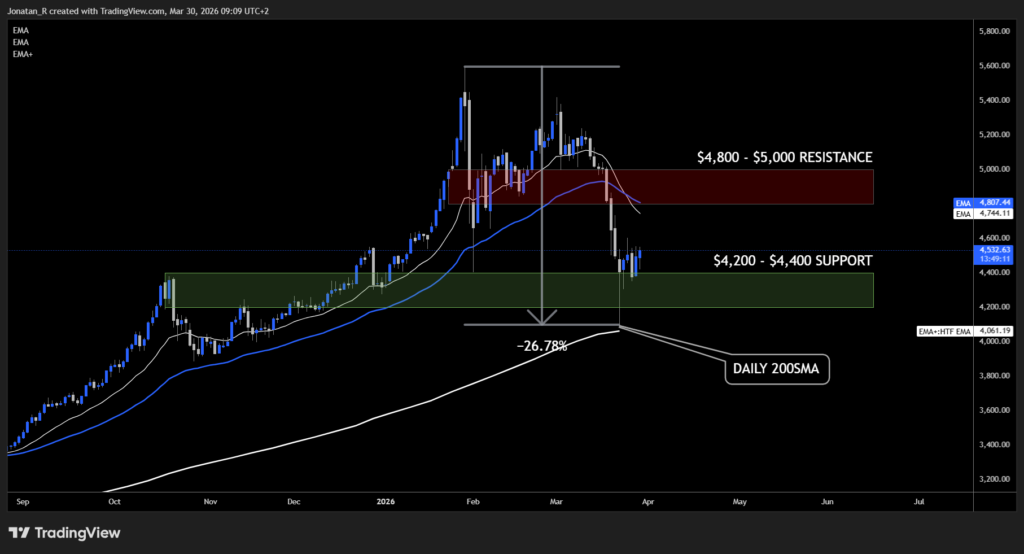
Gold’s daily chart shows a 26% correction from the January highs to the 200 SMA, with price now consolidating between the $4,200 to $4,400 support zone and the $4,800 to $5,000 resistance area where the 20 and 50 EMAs converge.
The daily chart tells the story of a brutal correction within what has been an extraordinarily strong uptrend. After peaking near $5,600 in January, gold fell over 26% to tag the daily 200 SMA, currently sitting around $4,061. This was the first test of the 200 SMA since October 2023, when the current bull trend began.
Adding to the bearish signal, the daily 20 EMA has crossed below the 50 EMA for the first time since that same October 2023 starting point. This type of moving average crossover typically confirms a shift in intermediate-term momentum and suggests the path of least resistance has changed, at least for now.
However, price has since recovered roughly 10% from the lows and is now consolidating above a key support zone between $4,200 and $4,400. This area acted as resistance during the rally in late 2025 and appears to be flipping to support, a constructive sign for bulls.
The key levels to watch on the daily:
- $4,200 to $4,400 — current support zone. Holding above this range is essential for any bottoming argument
- $4,800 to $5,000 — major resistance above. This zone coincides with both the daily 20 EMA ($4,807) and the 50 EMA ($4,744), making it a significant hurdle to reclaim
- $4,061 — the daily 200 SMA. A break below this level would invalidate the bottoming thesis and open the door to a much deeper correction
The structure at this point is one of consolidation after a sharp selloff. Price is caught between well-defined support and resistance, and the direction of the eventual breakout could set the tone for the rest of Q2.
4-hour chart
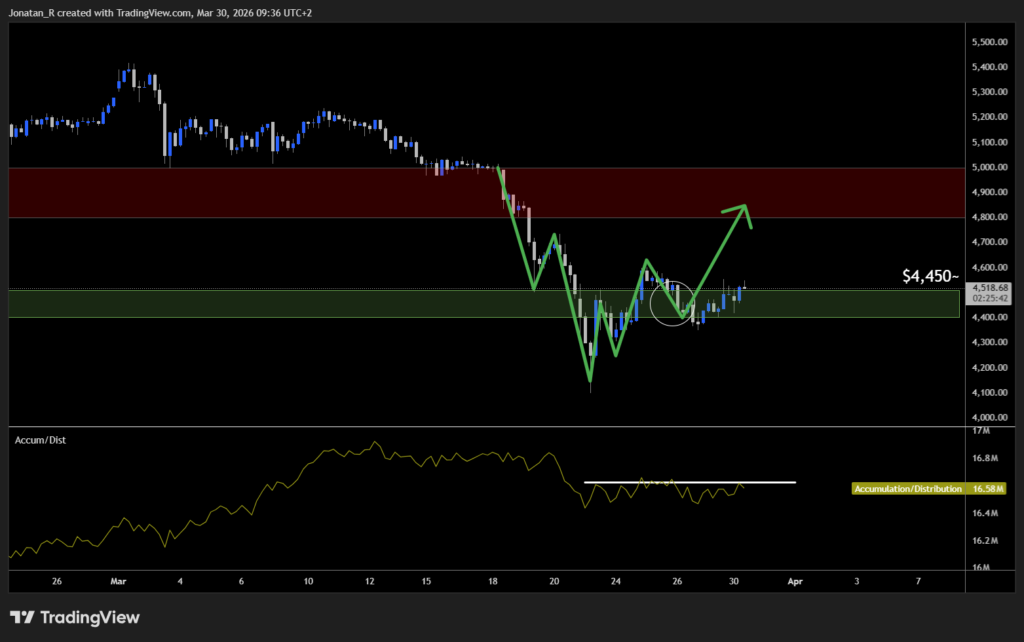
The 4-hour chart shows a series of higher lows and higher highs forming above $4,450, but the Accumulation/Distribution indicator remains range-bound, suggesting the recovery still lacks full volume confirmation.
Zooming into the 4-hour timeframe, the short-term structure is more encouraging. Price has reclaimed the $4,450 level and is now printing a series of higher lows and higher highs, a classic sign of local strength developing at this high-timeframe support zone.
As highlighted in our previous analysis, the green projected path on the chart has broadly played out, with gold bouncing from the lows and grinding higher through the $4,200 to $4,400 support range. The current trajectory, if sustained, could see gold push up to test the $4,800 to $5,000 resistance zone identified on the daily chart.
However, there is a notable divergence worth watching. The Accumulation/Distribution (A/D) indicator on the 4-hour chart remains range-bound, even as price recovers. This means that while the price action looks constructive on the surface, the underlying volume-weighted money flow has not yet confirmed the move higher.
This matters particularly around the $4,600 level. If price breaks above this area without the A/D indicator making a corresponding new high, that could be a warning sign of a weak breakout and a potential fakeout. A genuine breakout would ideally be accompanied by the A/D line breaking above its own horizontal resistance, confirming that real buying pressure is behind the move.
The key levels to watch on the 4-hour:
- $4,450 — reclaimed support. Holding above this level keeps the higher-low structure intact
- $4,600 — the level to watch for breakout confirmation alongside the A/D indicator
- $4,800 to $5,000 — the daily resistance target if the breakout holds
- $4,200 to $4,400 — if the higher-low sequence fails, a retest of this support zone becomes likely
The bottom line: the short-term structure is improving, but the lack of confirmation from the A/D indicator suggests caution. A breakout above $4,600 with volume confirmation would be the first meaningful signal that the worst of the selloff may be over. Without it, the recovery could still be a relief rally within a broader correction.
Trading involves risk.
Author



 Risk Disclaimer
The content provided here is for informational purposes only. It is not intended as personal investment advice and does not constitute a solicitation or invitation to engage in any financial transactions, investments, or related activities. Past performance is not a reliable indicator of future results.
The financial products offered by the Company are complex and come with a high risk of losing money rapidly due to leverage. These products may not be suitable for all investors. Before engaging, you should consider whether you understand how these leveraged products work and whether you can afford the high risk of losing your money.
The Company does not accept clients from the Restricted Jurisdictions as indicated in our website/ T&C. Some services or products may not be available in your jurisdiction.
The applicable legal entity and its respective products and services depend on the client’s country of residence and the entity with which the client has established a contractual relationship during registration.