8 min read
The Nasdaq index’s two-day peace rally has unravelled as fast as it began. President Trump’s prime-time address promised two to three more weeks of war in Iran, oil prices spiked back above $105, and sentiment shifted sharply in the aftermath. Adding a new dimension to the threat, Iran’s Revolutionary Guard named 18 companies, including Nvidia, Apple, Microsoft and Meta, as “legitimate targets” for retaliation, escalating the conflict directly into the heart of the index’s biggest constituents.
Here is what this article covers:
- Why the peace rally failed and what Trump’s address could mean for the near-term outlook
- The IRGC threat to US tech companies and why it matters for the Nasdaq specifically
- Daily chart: death cross approaching, RSI locked in its bearish range, and a clear rejection from former support
- 4-hour chart: intraday structure and the key levels to watch for the next move
Why the rally failed
Markets entered this week on an optimistic note. On Tuesday, reports emerged that Iran’s president had requested a ceasefire, and Trump signalled a willingness to end the war, sending equities sharply higher. The S&P 500 rallied nearly 3% and the Nasdaq index surged over 3.4% in what appeared to be the beginning of a peace trade.
That optimism was short-lived. In his prime-time address on Wednesday evening, Trump said US military objectives were “nearing completion” but vowed to hit Iran “extremely hard” over the next two to three weeks. He offered no clear timeline for ending the conflict and doubled down on demands that the Strait of Hormuz be reopened before any ceasefire could be considered. Iran denied requesting a ceasefire, and oil prices jumped over 4% in the minutes following the speech.
For the Nasdaq specifically, the escalation took on a new dimension. The IRGC named 18 companies as “legitimate targets,” including many of the index’s largest constituents: Nvidia, Apple, Microsoft, Google, Meta, Intel, Oracle, Tesla, IBM, Dell, HP, Cisco, Palantir, JP Morgan, GE, Boeing, and UAE-based AI firm G42. The threat may not be purely symbolic. Iranian drones already struck Amazon Web Services data centres in the UAE and Bahrain in early March, causing outages across the region. Risk consultants have warned that tech infrastructure in the Middle East is now being treated as part of the conflict, not peripheral to it.
This potentially creates a unique problem for the Nasdaq. While the broader market is dealing with the macroeconomic impact of elevated oil prices and a prolonged war, the Nasdaq now faces a direct, targeted threat to the physical operations of its biggest companies in a region where they have been investing heavily in data centres, cloud infrastructure, and AI facilities.
Daily chart
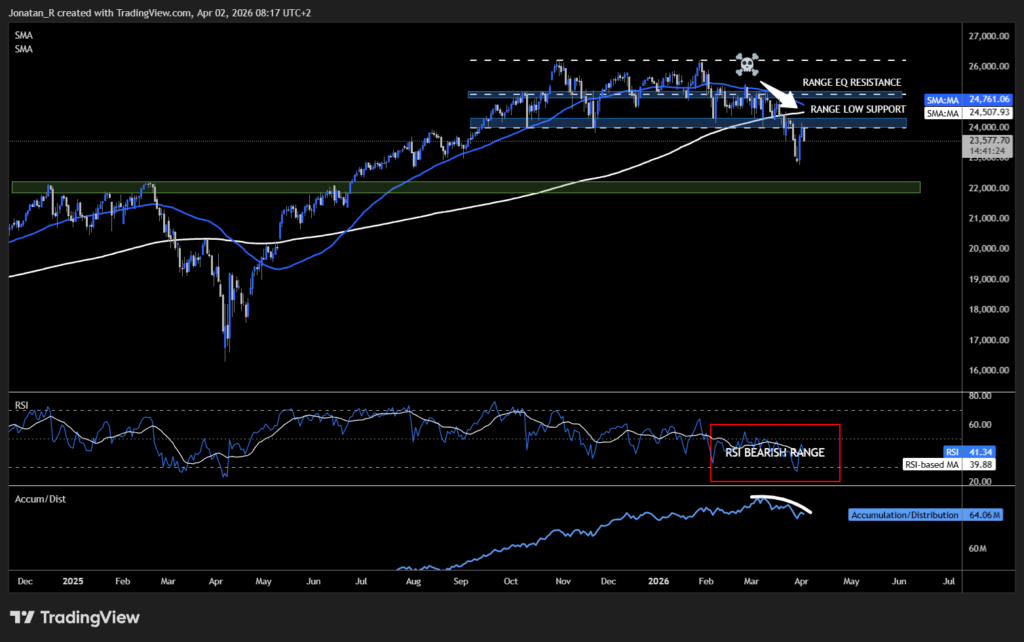
The Nasdaq index has been rejected from its former range low support near 24,000 to 24,500, with the 50 SMA converging on the 200 SMA for a potential death cross and the RSI locked in its bearish range below 60.
The Nasdaq index is under renewed pressure after a two-day peace rally ran straight into resistance and reversed. Price briefly pushed back towards the 24,000 to 24,500 zone, the old range lows that had supported the index throughout late 2025 and into 2026, only to be rejected. Former support is now acting as resistance, a classic bearish confirmation.
The broader technical picture reinforces the concern. The 50 SMA is converging on the 200 SMA from above and could cross below it within the coming days, potentially triggering a death cross, a widely watched bearish signal. While it is a lagging indicator by nature, confirming what price has already shown, it carries weight because so many institutional and algorithmic systems track it.
Momentum tells the same story. The RSI has shifted into its bearish range, oscillating between roughly 20 and 60 rather than the 40 to 80 range that typically characterises a healthy uptrend. Since the selloff began, rallies in RSI have been capping out below 60, which is consistent with a market operating in a bearish regime. The two-day peace rally appears to have done little to change that.
Perhaps most telling is the Accumulation/Distribution indicator, which has clearly broken its prior uptrend structure. This does not appear to be a shallow pullback in a healthy market. The A/D breakdown suggests that genuine distribution is taking place, with selling pressure potentially broadening rather than fading.
If the rejection from the range lows holds, the next significant support sits at around 22,000, a level that aligns with a broader structural support zone visible on the chart. Below that, there is limited structure to potentially slow a deeper move.
Key levels to watch:
- 24,000 to 24,500 — former range low support, now acting as resistance. The level to reclaim for any bullish case to potentially rebuild
- ~22,000 — next major support below; the potential target if the current breakdown continues
- 25,500 to 26,000 — range equilibrium resistance, only relevant on a significant recovery
- Death cross pending — 50 SMA approaching the 200 SMA; a confirmed cross could add further weight to the bearish case
4-hour chart
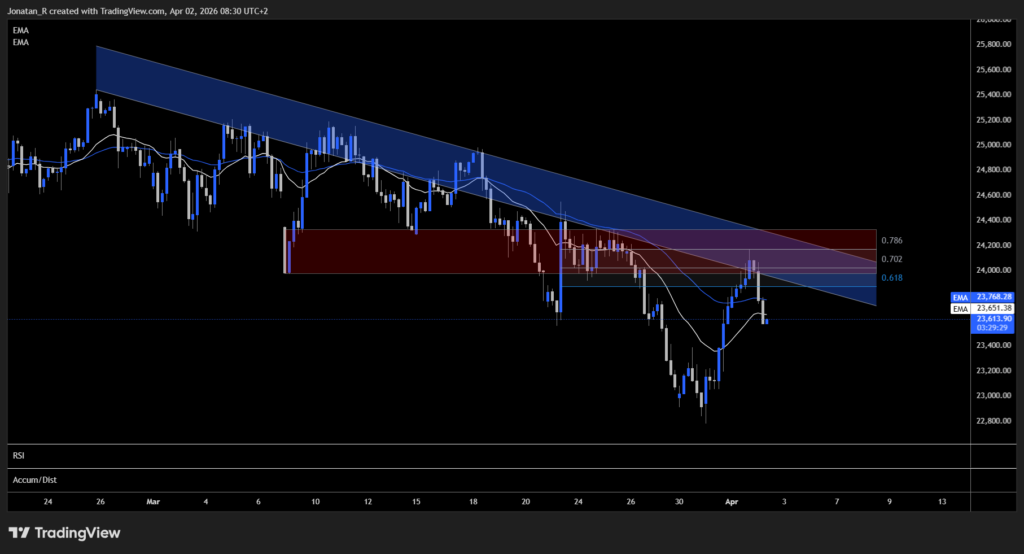
The 4-hour chart shows a clean rejection from the confluence of a descending trendline, horizontal resistance, and the Fibonacci reload zone between 24,000 and 24,300, with local support at 23,300 now in focus.
Zooming into the 4-hour timeframe, the rejection becomes even clearer. The two-day rally carried price into a confluence zone between 24,000 and 24,300, where a descending trendline, the short-term Fibonacci retracement zone (0.618 to 0.786), and a significant horizontal resistance level all converge. That is exactly the type of area where sellers tend to reload, and the reaction has been swift.
For intraday traders, the focus now shifts to the 23,300 area, which represents the most recent local support. This level has held on prior tests, but each bounce from it has been weaker than the last, a potential sign of deteriorating demand. A clean break below 23,300 could remove the last structural floor on the 4-hour chart and potentially trigger a momentum-driven move towards the 22,000 support zone identified on the daily timeframe.
Key levels to watch:
- 24,000 to 24,300 — confluence resistance: descending trendline, Fibonacci reload zone, horizontal resistance. The level that needs to be reclaimed for any short-term bullish case
- ~23,300 — local support; the line in the sand for intraday traders
- ~22,000 — daily support target if local lows give way
For more analysis on how the Iran conflict is impacting global markets, see our recent coverage of Brent crude’s record monthly rally.
Trading involves risk.
Author



 Risk Disclaimer
The content provided here is for informational purposes only. It is not intended as personal investment advice and does not constitute a solicitation or invitation to engage in any financial transactions, investments, or related activities. Past performance is not a reliable indicator of future results.
The financial products offered by the Company are complex and come with a high risk of losing money rapidly due to leverage. These products may not be suitable for all investors. Before engaging, you should consider whether you understand how these leveraged products work and whether you can afford the high risk of losing your money.
The Company does not accept clients from the Restricted Jurisdictions as indicated in our website/ T&C. Some services or products may not be available in your jurisdiction.
The applicable legal entity and its respective products and services depend on the client’s country of residence and the entity with which the client has established a contractual relationship during registration.