5 min read
Oil prices have exploded higher as the escalating conflict in the Middle East continues to disrupt global energy markets. The effective closure of the Strait of Hormuz, a chokepoint responsible for roughly 20% of the world’s seaborne oil, has triggered the sharpest weekly surge in crude prices since 2022.
Gulf production is collapsing, with Iraqi output down an estimated 60% and both Kuwait and the UAE trimming supply as onshore storage fills up. G7 finance ministers are now discussing a coordinated emergency release of strategic petroleum reserves, the first such intervention since the Russia-Ukraine war. With US CPI data also due this week, oil’s surge could have far-reaching consequences for inflation expectations and monetary policy globally.
Weekly chart analysis
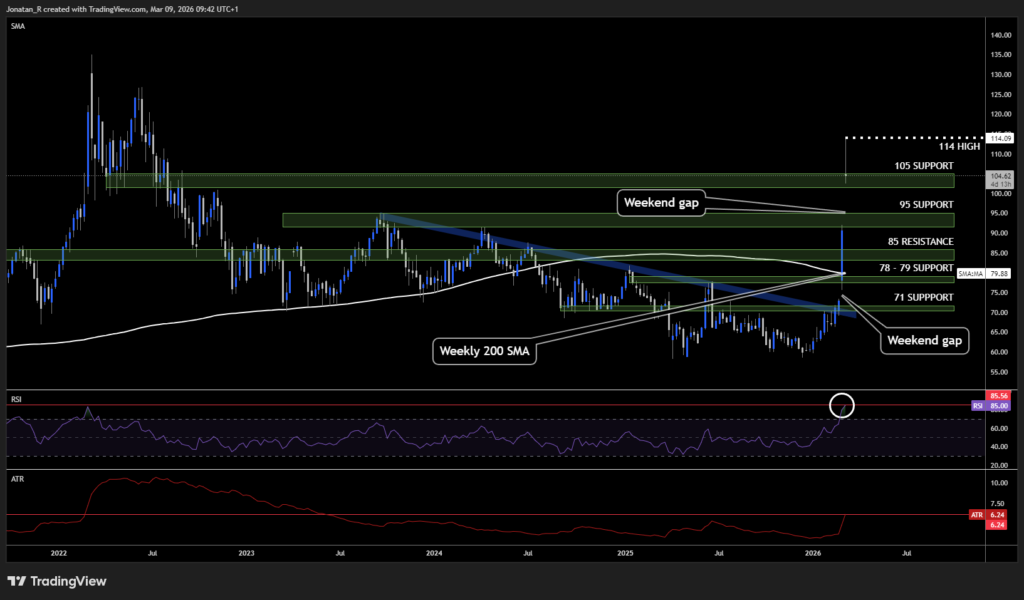
On the weekly chart, Brent crude has put in a massive move to the upside, gapping up and trading as high as $114, the highest price since the summer of 2022. The scale of the move is reflected across multiple indicators, with weekly ATR reaching levels not seen since mid-2023 and the RSI pushing to extreme overbought territory.
This is a market being driven by an extraordinary supply shock. The closure of the Strait of Hormuz has created a potential energy crisis, and the price action reflects that.
Looking at the structure, several historically significant levels stand out:
- $114 is the current session high and the first major resistance to watch
- $105 is the first area of support, aligning with a key level from the 2022 trading range
- $95 comes in at the latest weekend gap, making it a natural pullback target
- $85 was resistance on the way up and could now act as a deeper support level
- $78-79 is the zone where the 200 SMA sits, a level that was reclaimed last week for the first time since July 2024
That weekly close above the 200 SMA is significant. It was the first in over a year and a half, and it suggests the longer-term trend has shifted. When we last covered Brent crude on 4 March, price was trading around the $85 breakout zone. The move since then has been extraordinary.
Daily chart analysis
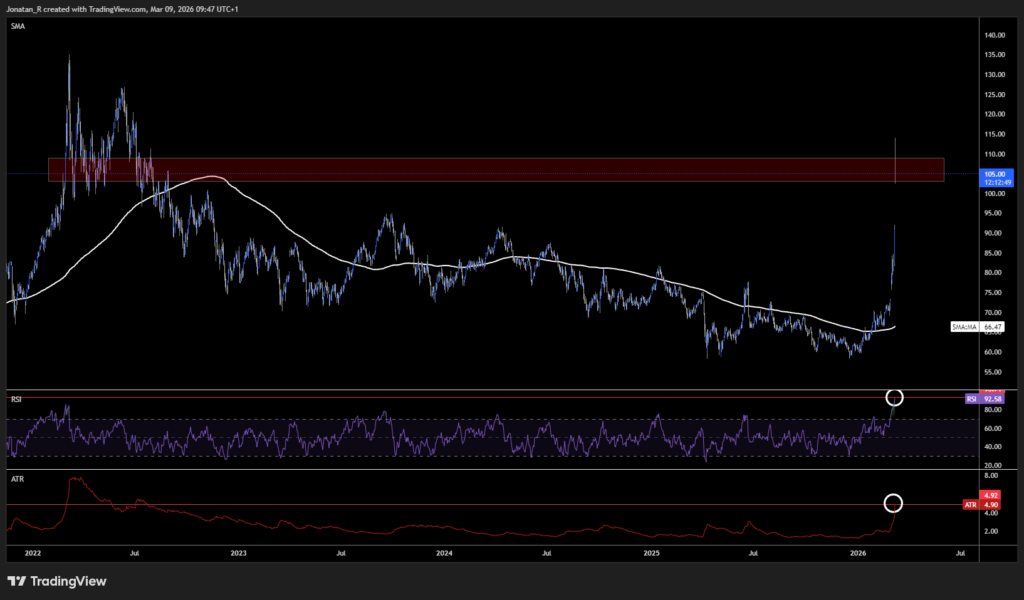
On the daily chart, Brent is running into the high-timeframe resistance area around $105, a level that acted as support during the 2022 rally. Daily ATR has surged to levels comparable to the peak volatility of 2022, and the RSI is deeply overbought.
Now, the fact that we are in a market trading well above its normal ATR range and with momentum indicators at extreme levels does not necessarily mean a correction is imminent. This is a highly unusual, crisis-driven environment, and standard mean-reversion signals could remain stretched for longer than expected.
That said, these readings could be considered when planning your trading and position sizing. Volatility at these levels means larger swings in both directions, and risk management becomes even more critical in this kind of environment.
15-minute chart analysis
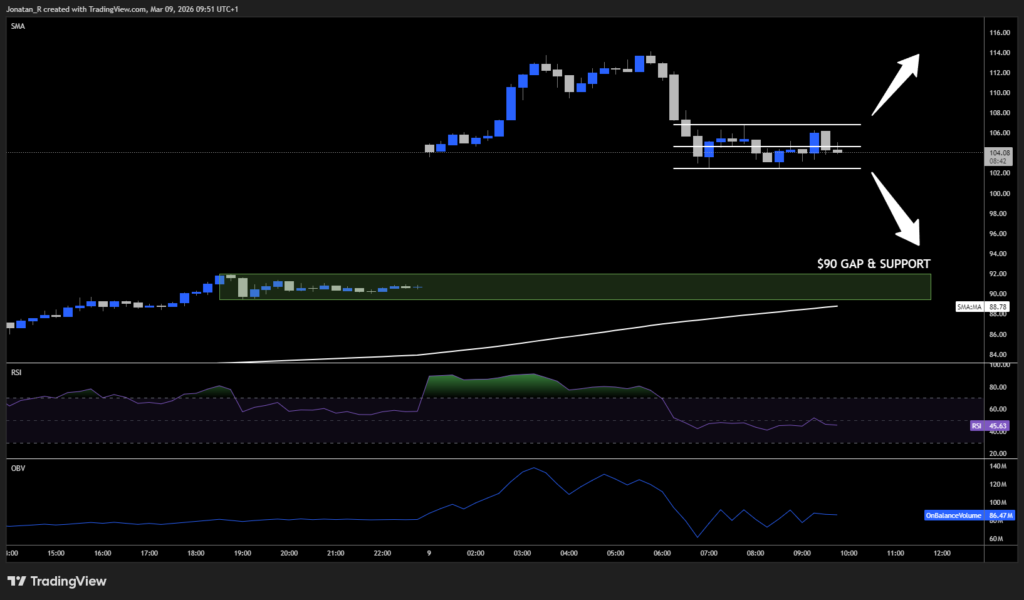
Zooming into the 15-minute chart, Brent has established a clear intraday range following the initial gap-up move. Below, the $90 level stands out as the weekend gap and a significant support zone.
The current consolidation range is clearly defined, and a break above or below it could potentially dictate the next major move. Traders would potentially want to watch for a decisive breakout in either direction before committing to new positions.
If price breaks higher, the $114 session high becomes a possible target. A break lower, however, could open the door to a move back toward the $90 gap support, particularly if the G7 confirms a coordinated reserve release.
Trading involves risk.
Author



 Risk Disclaimer
The content provided here is for informational purposes only. It is not intended as personal investment advice and does not constitute a solicitation or invitation to engage in any financial transactions, investments, or related activities. Past performance is not a reliable indicator of future results.
The financial products offered by the Company are complex and come with a high risk of losing money rapidly due to leverage. These products may not be suitable for all investors. Before engaging, you should consider whether you understand how these leveraged products work and whether you can afford the high risk of losing your money.
The Company does not accept clients from the Restricted Jurisdictions as indicated in our website/ T&C. Some services or products may not be available in your jurisdiction.
The applicable legal entity and its respective products and services depend on the client’s country of residence and the entity with which the client has established a contractual relationship during registration.