7 min read
 When we last covered USD/JPY on the 10th of April, the pair was pressing against the 160 intervention zone and the question we posed was whether this was the top, or just the beginning of another breakout. Yesterday, that question may finally have been answered.
USD/JPY spiked to a multi-month high of 160.72 in early London trade, before suddenly dropping off a cliff. Within hours, the pair had collapsed to test the 155.50 area, leaving a 500-pip wick on the daily candle and closing the body near 156.65. The roughly 3% peak-to-trough swing was the sharpest one-day decline since December 2022, and it came shortly after Finance Minister Satsuki Katayama warned that authorities were nearing the time to take bold action on FX. Nikkei subsequently reported that the Ministry of Finance and the Bank of Japan had carried out direct yen-buying, dollar-selling intervention, the first such action since the 2024 episode, which ultimately consumed roughly $62bn defending the yen.
The bigger question now is whether this intervention sticks, or whether USD/JPY drifts back toward 160 like it did after both the 2022 and 2024 episodes. The carry-trade arithmetic that has driven yen weakness all year has not really changed. The Fed sits at 3.50%–3.75% following Wednesday’s hawkish hold, which featured the most divided FOMC vote since 1992 (8–4, with three dissents against the easing-bias language), while the BoJ remains at 0.75%. With elevated oil prices continuing to weigh on Japan’s import bill and the new pro-stimulus government adding to debt concerns, the structural drivers of yen weakness appear to remain in place. Intervention can shock positioning, but on its own, it rarely shifts underlying fundamentals.
Looking ahead, the Japanese data calendar next week is unusually thin, with multiple public holidays compressing local liquidity through the early part of the week. That could leave USD/JPY exposed to two external forces: any follow-through MoF action that forces a deeper short-yen unwind, and a heavy US data run anchored by Non-Farm Payrolls on Friday 8 May, which could set the near-term tone for Fed expectations. The Monday open could potentially be the most important session for USD/JPY of the year so far.
Key takeaways
- USD/JPY had its sharpest one-day drop since December 2022, falling roughly 500 pips after the MoF and BoJ confirmed direct yen-buying intervention
- The pair has dropped into a key confluence support zone made up of the daily 50 EMA, a long-term ascending trend line, and the 0.618 fib retracement of the latest leg higher
- A bearish divergence on the daily RSI preceded the move and may have acted as a leading indicator
- Holding this confluence support could potentially keep the broader uptrend intact, while a clean break could open the door toward the 150 range equilibrium
- Monday’s open could be a major directional pivot for the pair, and could set the tone for the next several months
Trading involves risk.
Daily chart analysis
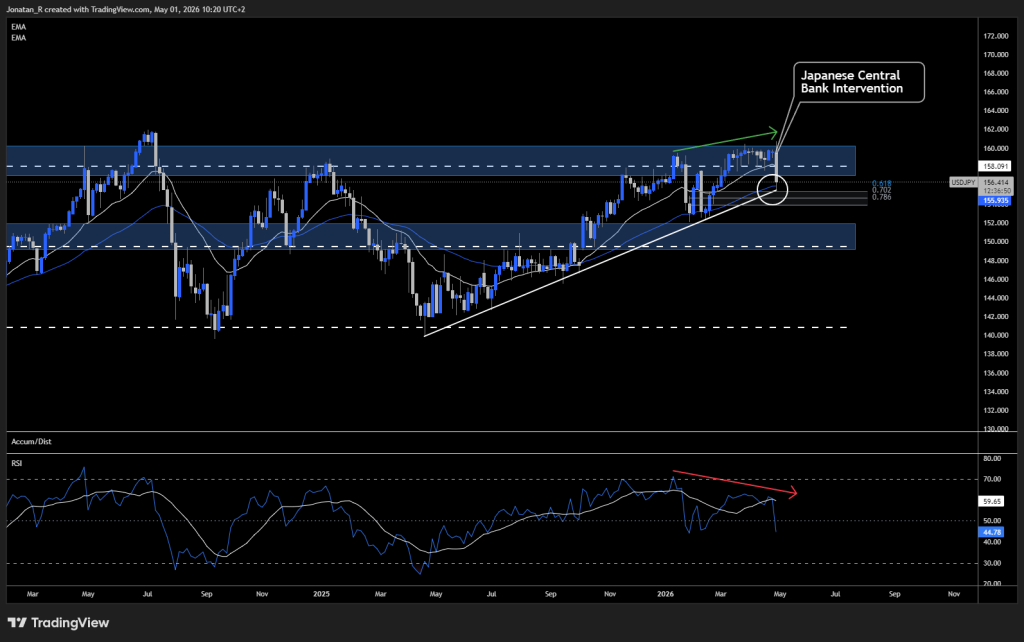
The daily chart tells the full story of yesterday’s move. After grinding higher within the 158–161 intervention zone for several sessions, USD/JPY reversed sharply on confirmed MoF/BoJ action and dropped straight into a major confluence support area.
This zone is made up of three overlapping technical signals:
- The daily 50 EMA, currently sitting around the 156 area
- A long-term ascending trend line stretching back to the 2024 lows
- The 0.618 fib retracement of the latest leg higher, which the pair has tagged almost to the tick
It is also worth flagging that a bearish divergence had been forming on the daily RSI in the weeks leading up to yesterday’s move. Price had been pushing higher into the 160 zone while RSI was failing to make new highs, a classic warning sign of weakening momentum. The intervention itself was the catalyst for the move, but the technical setup was already pointing to a potential rejection. Bearish RSI divergences can sometimes act as leading indicators when they appear at major resistance, and this is a useful example of one possibly playing out in real time.
The level being tested right now could be the one that decides the broader trend. A reclaim of the confluence support could potentially keep the uptrend structurally intact and set up a drift back toward the 158 area, with the 160 intervention zone as the resistance ceiling above that, especially if positioning stays one-way and the rate differential stays wide.
A clean break below this confluence, however, could change the picture meaningfully. The next major support sits around the 150 range equilibrium, where the pair spent much of late 2025 consolidating before the latest leg higher. A move down to that area could potentially mark a structural shift in the trend rather than a routine pullback, and could potentially set up a new directional move that lasts for several months.
The Monday open could be the first real test. Today’s session has been quieter due to the European May Day holiday, and any follow-through selling next week could potentially confirm that the intervention has flipped the trend. Equally, a strong bid on the open could signal that the carry-trade incentive is still pulling the pair back toward 160.
What to watch
- The 156 confluence support as the immediate decision point. Holding it could potentially keep the broader uptrend intact
- The 150 range equilibrium as the major downside target on a clean break of confluence support
- The 158–161 intervention zone as the resistance ceiling on any rebound
- Monday’s open, which could potentially set the directional tone for weeks
- US Non-Farm Payrolls on Friday 8 May, the biggest external catalyst for the pair next week
- Any follow-through verbal or actual intervention from Tokyo, especially given the thin Japanese calendar next week
Trading involves risk.
Author



 Risk Disclaimer
The content provided here is for informational purposes only. It is not intended as personal investment advice and does not constitute a solicitation or invitation to engage in any financial transactions, investments, or related activities. Past performance is not a reliable indicator of future results.
The financial products offered by the Company are complex and come with a high risk of losing money rapidly due to leverage. These products may not be suitable for all investors. Before engaging, you should consider whether you understand how these leveraged products work and whether you can afford the high risk of losing your money.
The Company does not accept clients from the Restricted Jurisdictions as indicated in our website/ T&C. Some services or products may not be available in your jurisdiction.
The applicable legal entity and its respective products and services depend on the client’s country of residence and the entity with which the client has established a contractual relationship during registration.