9 min read
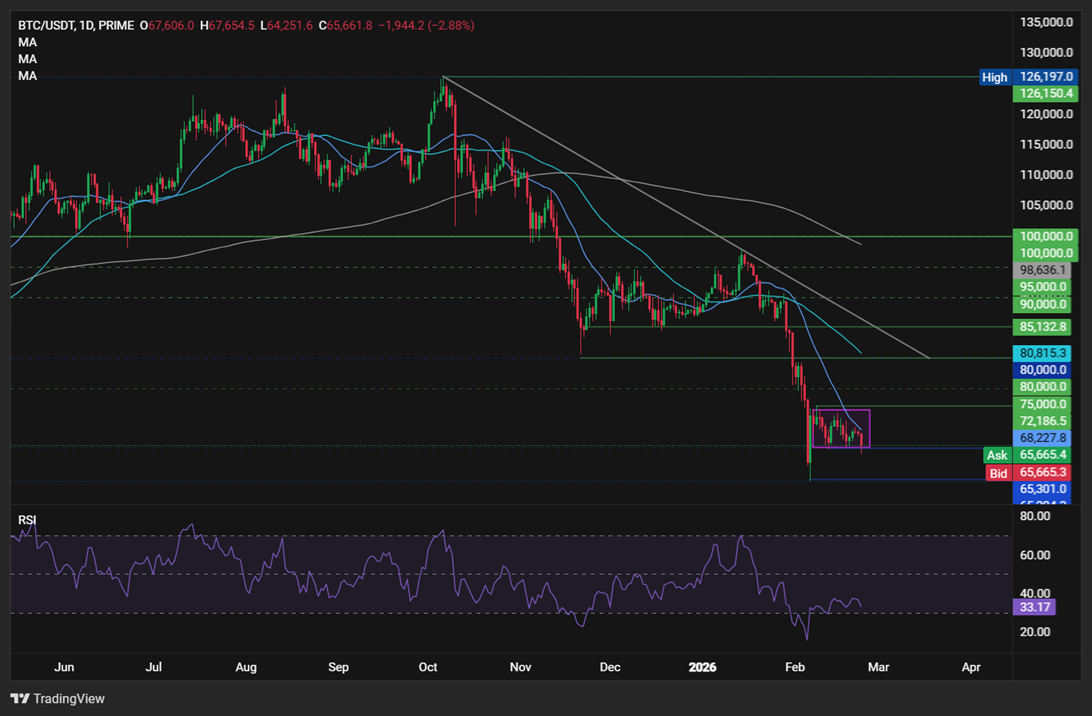
Bitcoin continues to trade within a familiar range. The largest cryptocurrency fell 2.5% across last week and trades at the lower end of the 65k to 71.5k consolidation range that it has traded in since early February. BTC trades 2.5% lower at the start of the new week, testing the 65k support amid mounting headwinds.
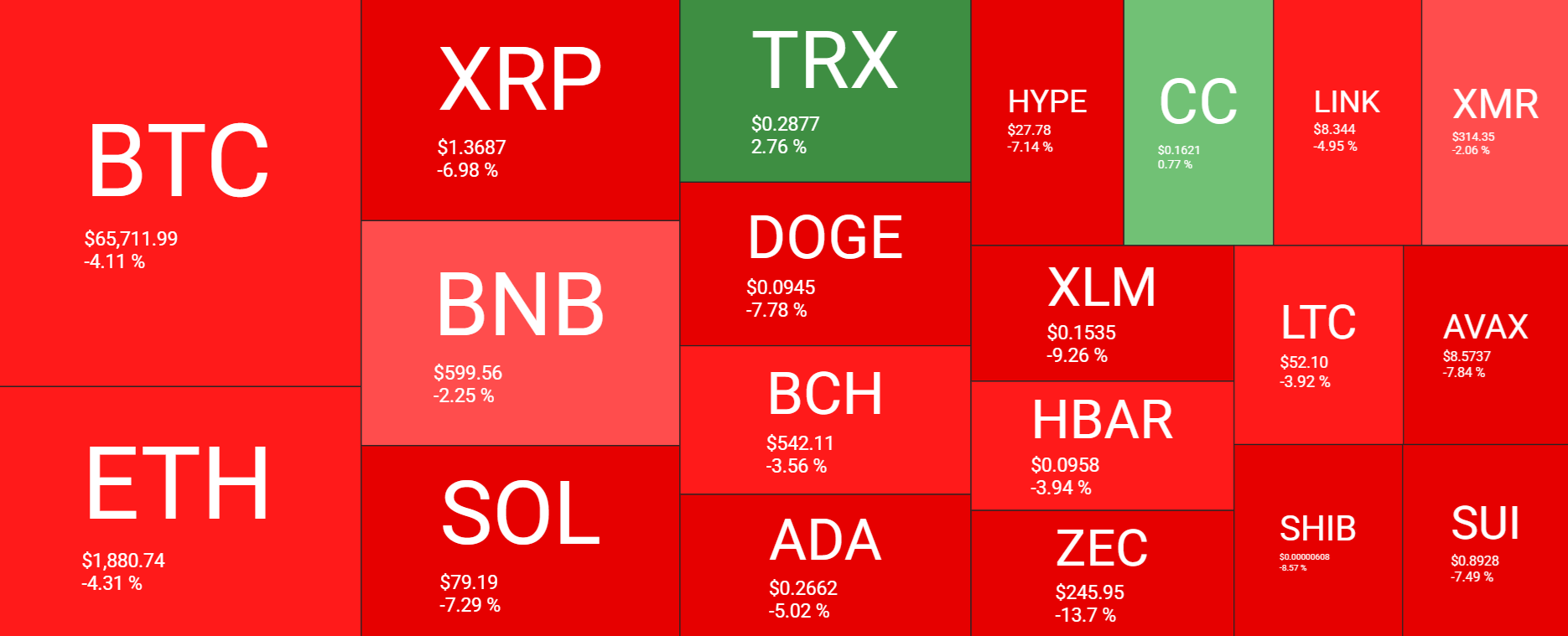
Weakness is seen across the broader crypto space at the start of the week, with Ethereum down 4% over the past seven days, Ripple down almost 7%, and Solana down 7%. There were some pockets of positivity with TRX gaining 2.76% over the past seven days.
The total cryptocurrency market capitalisation remained depressed at $2.25 trillion, down from $2.35 trillion this time last week and down almost $2 trillion from its record high in late October.
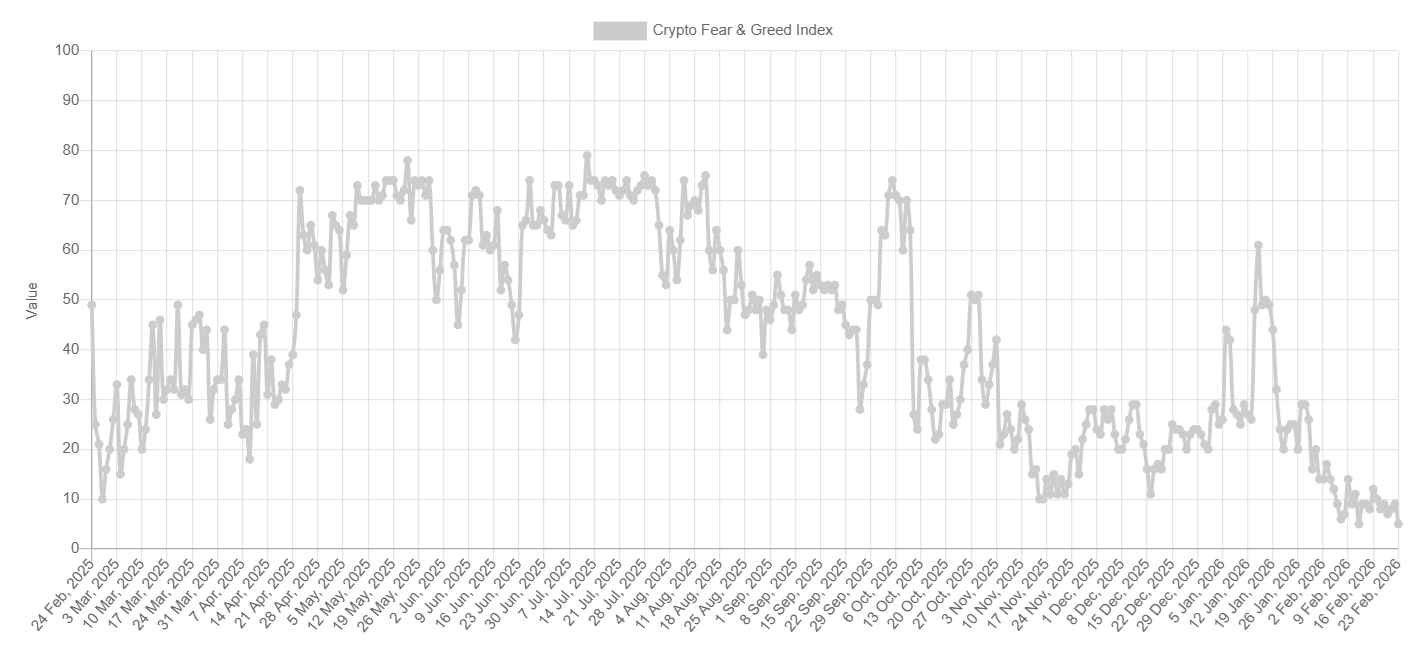
Sentiment analysis shows that their mood towards crypto remains in extreme fear, recording 9 on the alternative.me Fear and Greed index, in line with last week’s reading, but above the record low of 5 reached on 12 February.
Liquidations were low over the past week, which wasn’t surprising given the consolidation in BTC. However, today’s sharp fall in crypto has led to liquidations rising to $415.13 million, of which $385.45 million are long positions.
Institutional demand remains weak
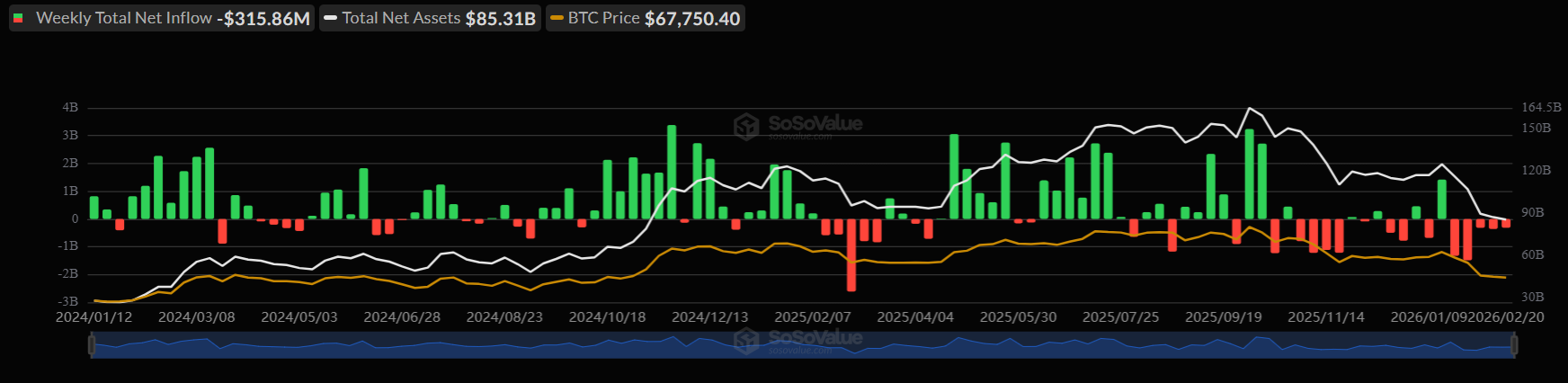
Institutional demand for Bitcoin continues to fade. According to Soo Value data, BTC ETF recorded net outflows of $315.9 million last week, marking the fifth consecutive week of net outflows. A similar trend of persistent net outflows was observed in the mid-February to mid-March period, when Bitcoin fell from $100k to $80k. If this trend continues, BTC could see further declines in the coming weeks.
While institutional demand is weak, Strategy announced further acquisitions last week, purchasing 2,486 BTC. This came following the purchase of 1,142 BTC the previous week and brings the firm’s total holdings to 717,131 BTC. This continued accumulation shows the firm’s long-term conviction in Bitcoin despite recent declines and despite an average purchase price of $76,027.
Macro backdrop
Bitcoin continues to face several headwinds, including uncertainty about the Federal Reserve’s rate outlook, Trump’s tariffs, elevated geopolitical tensions between the US and Iran, and ongoing concerns about the AI trade.
Last week, the January FOMC meeting minutes showed that policymakers were deeply divided over the need for, and possible timing of, further rate cuts amid still above-target inflation. In fact, several Fed policymakers indicated that a rate hike may even be the next move. The less dovish minutes dampened risk appetite, sending BTC to 65.7k before it rebounded on Friday following mixed data.
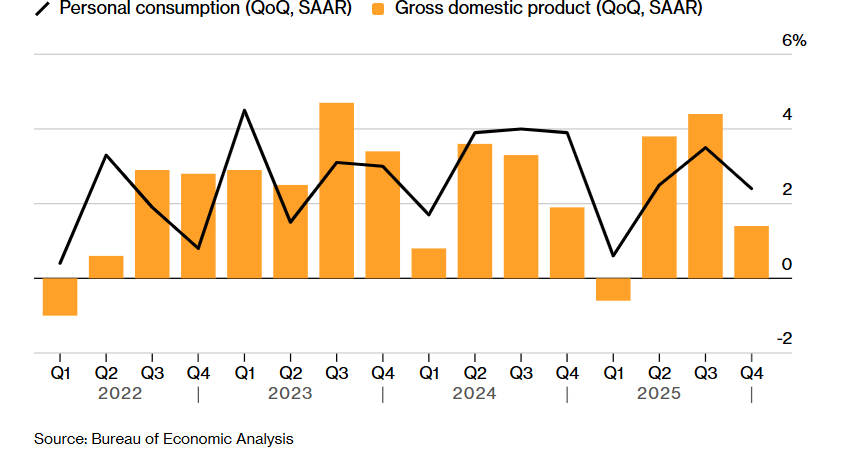
While core PCE, the Fed’s preferred gauge for inflation, rose to 3% YoY in December, up from 2.8%, US Q4 GDP was much weaker than forecast at 1.4% annualised, down from 4.4% in Q3. However, this weakness was largely attributed to the US government shutdown across the quarter. Following the mixed data, the market is still pricing in two rate cuts this year compared to one expected by the Federal Reserve.
As well as uncertainty surrounding the Fed outlook, Trump’s tariff announcements this weekend add to global trade uncertainty, hitting risk sentiment. The Supreme Court voted 6-3 that the International Emergency Economic Powers Act (IEEPA) did not authorise the Liberation Day reciprocal tariffs on all countries and the 25% duties on Canada, China, and Mexico.
As a result, the US may be required to refund nearly $175 billion in duties. In response, Trump said that he would “impose a 10% tariff under Section 122 over and above normal tariffs already being charged. On Saturday, he increased this to 15% and also emphasised that tariffs under sections 301 and 232 remain in effect.
The crypto market appeared unfazed by these developments over the weekend. However, these latest developments are weighing on risk sentiment on Monday, pulling riskier assets, such as stocks, lower. The USD is also falling sharply.
Global trade uncertainty, combined with rising geopolitical tensions between the US and Iran, has led to demand for safe havens such as gold. The precious metal trades up 1% on Monday above $5150.
Could Bitcoin fall further?
With Bitcoin trading at the lower end of its recent range, questions continue to swirl over where BTC is headed next. The three key network cost basis levels to monitor are 91.4k, the short-term holders’ realised price, $54.8k, the network’s realised price, and the long-term holders’ realised price ($38.7k).
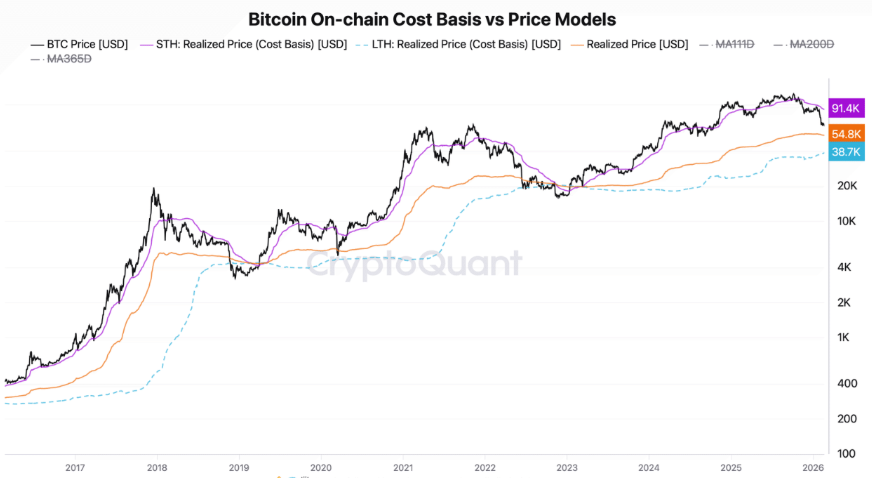
Near term, the 54.8k level is in focus. A sustained drop below this level pushes the average position into a loss, which in turn activates the Sales Pressure indicator to signal a phase of maximum network stress. The last time there was strong network stress was 1133 days ago.
The market regime is bearish. Long-term holders remain in profit, and the maximum stress point hasn’t been reached yet, suggesting further downside.
Whales dominate exchange inflows
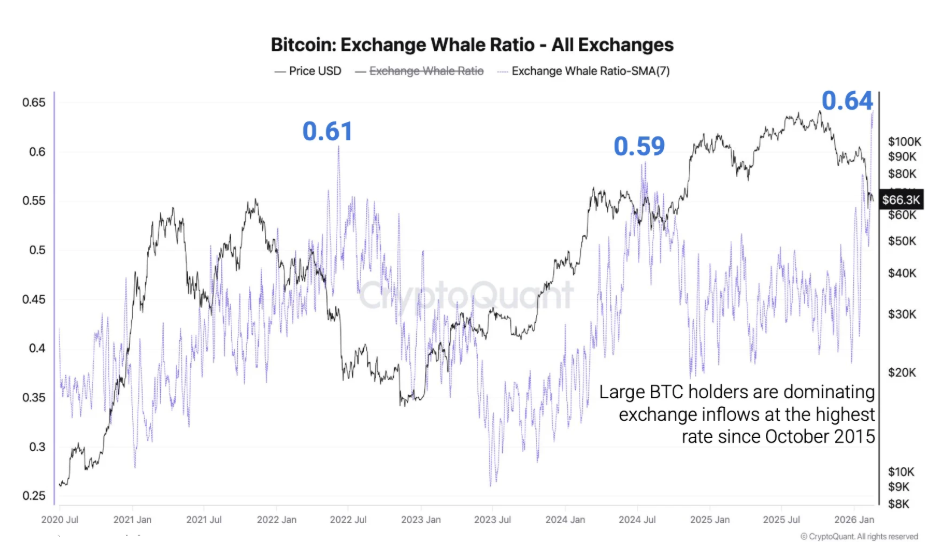
Large holders are increasingly driving Bitcoin exchange inflows amid a broader market bear phase.
According to CryptoQuant, the exchange whale ratio has risen to 0.64, its highest level since October 2015. This means 64% of all Bitcoin exchange inflows come from the top 10 deposits by volume. This suggests that large investors are driving selling activity.
At the same time, the average Bitcoin exchange inflow climbed to 1.58 BTC in February, its highest level since June 2022, the middle of the previous bear market.
However, it’s also worth noting that exchange inflows have normalised after the capitulation spike, reducing immediate selling pressure. Bitcoin’s correction to 60,000 earlier this month saw total exchange inflows surge to around 60,000 BTC on 6 February, its highest daily level since November 2024.
However, since then, inflows have declined to 23,000 on a 7-day moving average, a roughly 60% decline. According to CryptoQuant, this suggests the acute sell-off phase has eased even though exchange flows remain elevated compared to previous months.
At the same time, stablecoin flows point to reduced buying power. Daily net Tether inflows into exchanges have declined sharply from a one-year high of $616 million on 25 November to just $27 million recently. Net flows even turned negative on some occasions, including $469 million outflow on January 25. This means that less liquidity is available at the margin to buy crypto assets.
Amid a backdrop of selling pressure concentrated among large holders and stablecoin outflows, the market structure remains vulnerable to further volatility during the ongoing bear market.
BTC demand shows signs of turning
In this bearish market environment, where BTC is still undergoing a correction, it’s important to consider both the selling pressure and the evolution of demand. Since the start of the year, there has been a gradual shift in the demand dynamic.
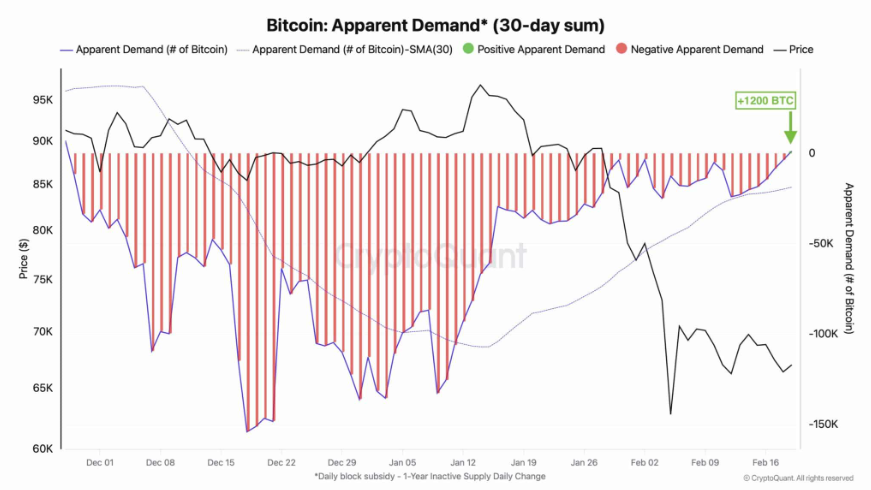
Monthly cumulative Bitcoin demand reached a low of -154k BTC on December 18 and has progressively increased to +1200 BTC. The apparent demand has turned positive after almost three straight months of low demand. This suggests that, although the longer-term market environment remains bearish, structural accumulation has been able to absorb new supply. Several weeks of sustained positive monthly cumulative demand would be needed for BTC to see a recovery.
“Bitcoin to zero”, could it mean a market bottom is likely?
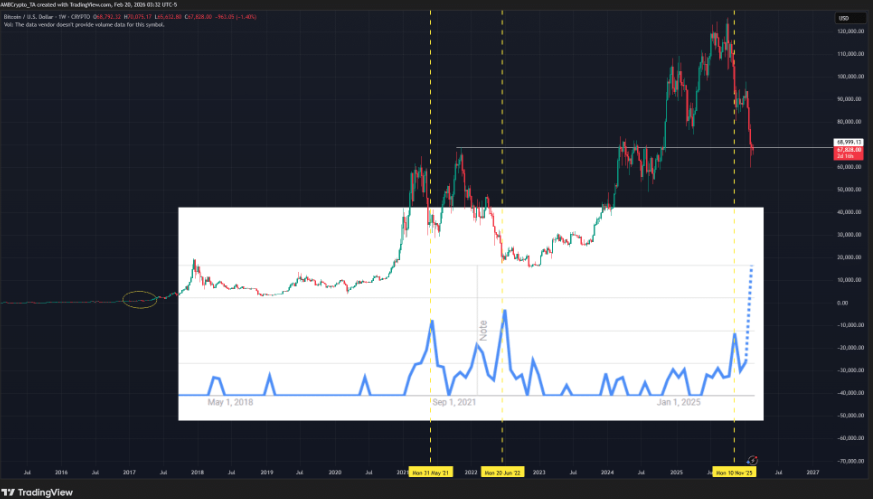
With sentiment on the floor, Google Trends shows “Bitcoin going to zero” searches hit a record high in February. While this sounds alarming in previous cycles, spikes in this search have marked local or market cycle bottoms.
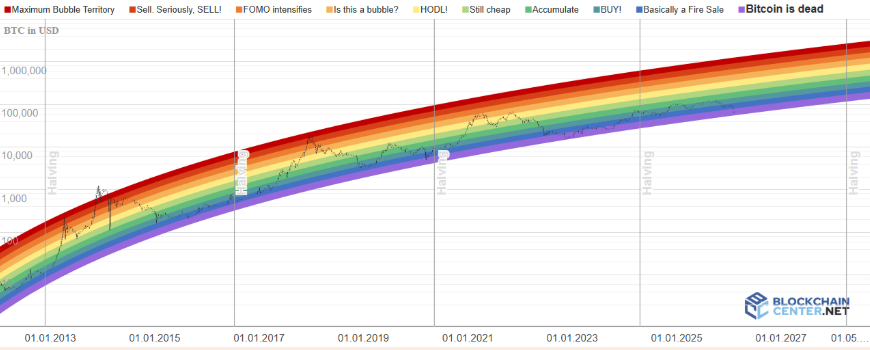
Another sign that Bitcoin could be close to the bottom is the Rainbow chart, which tracks whether Bitcoin is over- or undervalued. This chart shows BTC in the “Bitcoin is dead zone”, with extreme fear pointing to a potential time to buy BTC.
That said, with ongoing headwinds from the Fed and Trump, it may be prudent to wait for the macro backdrop to improve and for more on-chain metrics to turn positive before calling a bottom.
Trading involves risk.
Author



 Risk Disclaimer
The content provided here is for informational purposes only. It is not intended as personal investment advice and does not constitute a solicitation or invitation to engage in any financial transactions, investments, or related activities. Past performance is not a reliable indicator of future results.
The financial products offered by the Company are complex and come with a high risk of losing money rapidly due to leverage. These products may not be suitable for all investors. Before engaging, you should consider whether you understand how these leveraged products work and whether you can afford the high risk of losing your money.
The Company does not accept clients from the Restricted Jurisdictions as indicated in our website/ T&C. Some services or products may not be available in your jurisdiction.
The applicable legal entity and its respective products and services depend on the client’s country of residence and the entity with which the client has established a contractual relationship during registration.