9 min read
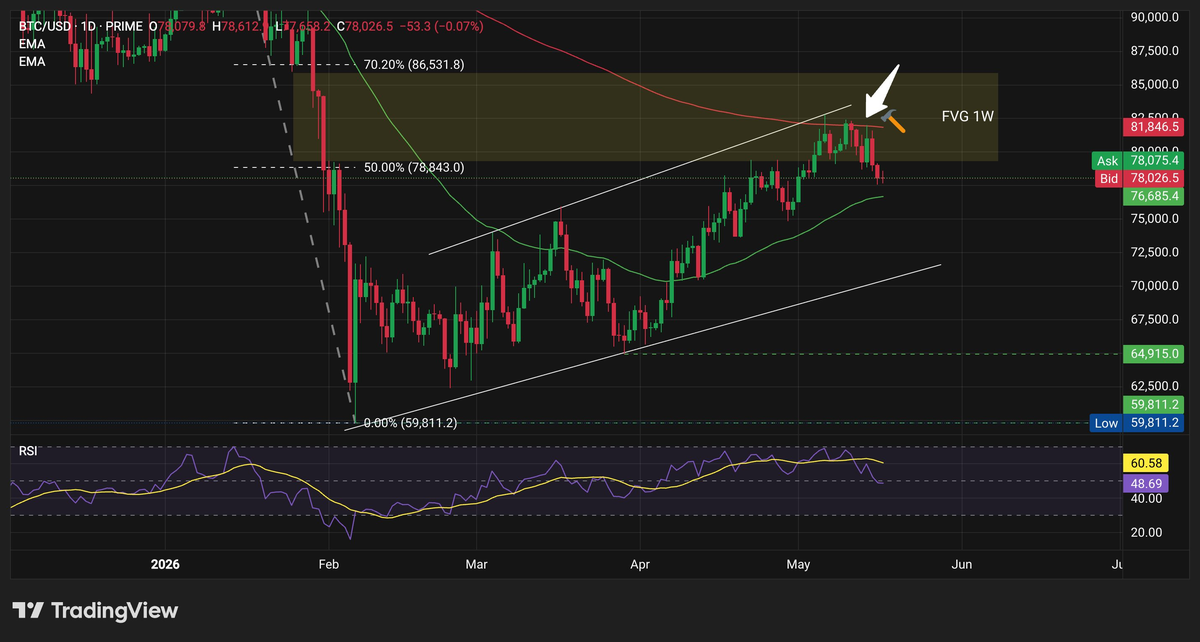
 The pressure on Bitcoin remains strong despite NASDAQ breaking ATHs almost every day. The correlation with M2 monetary mass is still on a low and Bitcoin is forming a bull flag on the daily chart, slowly completing a classic corrective structure seen in previous cycles. The main crypto failed to break above the channel and slowly declines.
A breakdown below $76.5K (20-day EMA) would confirm the flag and re-expose the $72K support. As long as Bitcoin stays under the 200-day EMA (the red line), bulls have nothing to be happy about.
The weekly heatmap was broadly and deeply red. Bitcoin fell 3.41% to $78,219, Ethereum dropped 6.03%, and Solana lost 7.81%. The selloff was triggered by the April CPI print released on May 12: 3.8% YoY vs. 3.7% expected, the highest reading since May 2023, driven by energy costs jumping 17.9% YoY. The market reaction was indiscriminate — larger caps fell less than smaller ones as traders rotated toward liquidity.
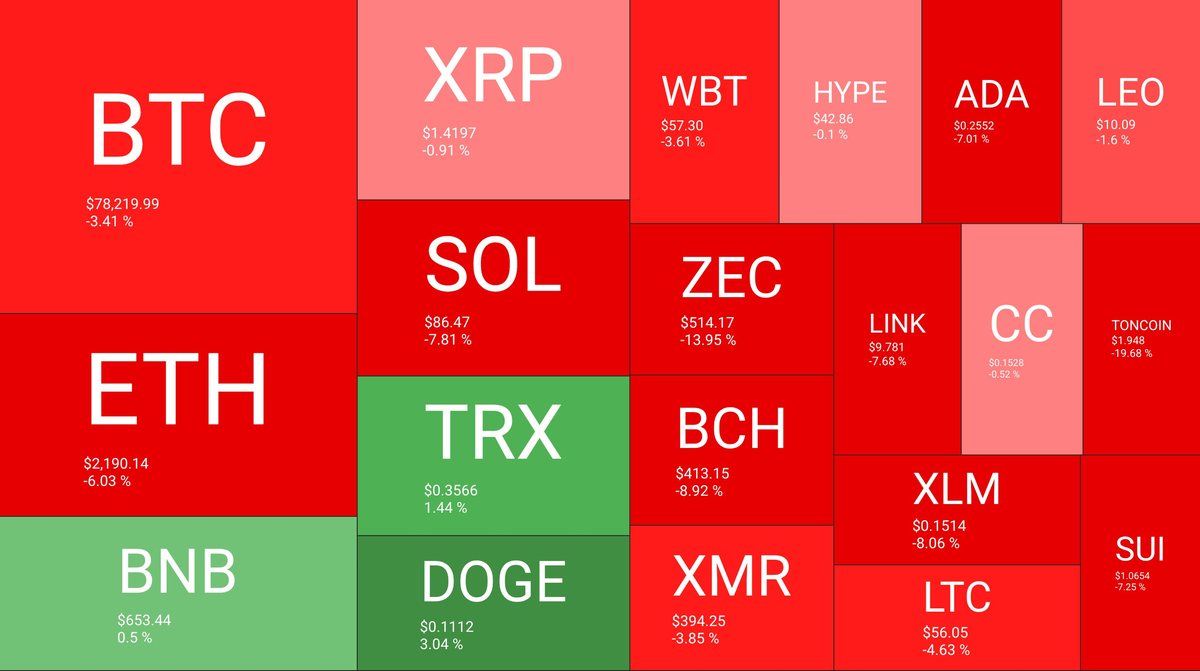
Source: https://quantifycrypto.com/heatmaps
The week’s biggest loser was Toncoin, down 19.68% after last week’s 79% surge. The correction was mechanical: RSI had climbed above 93 on the TON rally, and profit-taking into the CPI-driven risk-off was predictable. ZEC fell 13.95%, LINK dropped 7.68%, BCH lost 8.92%, XLM fell 8.06%. The only coins holding green were BNB (+0.5%), TRX (+1.44%) and DOGE (+3.04%) — with no clear fundamental catalyst.
Altcoin demand remains low
The altcoin season index stood at 34/100, well short of the 75 threshold typically associated with a genuine rotation cycle.
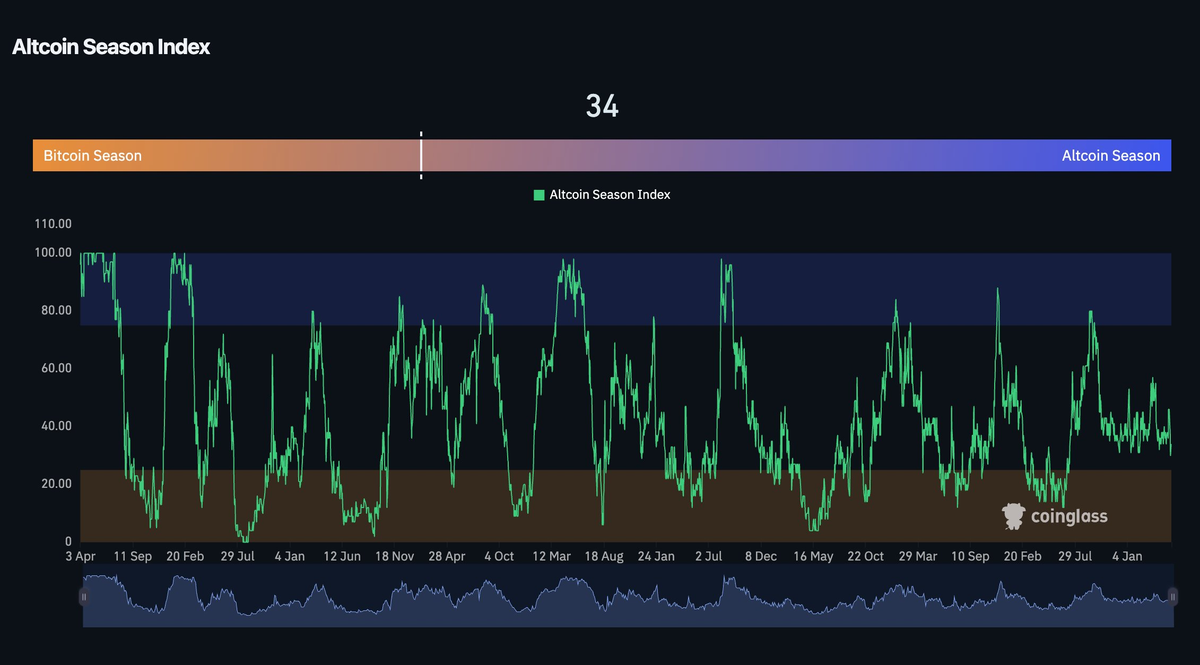
Source: https://www.coinglass.com/pro/i/alt-coin-season
The Altcoin Season Index reads 34, firmly in Bitcoin Season territory and well below the 75 threshold that marks a genuine altcoin rotation. The chart shows the index spiked to near 80 in early March 2026 before collapsing back — a pattern that has repeated several times without ever sustaining a breakout into Altcoin Season. Capital is not rotating into altcoins broadly: it is moving into individual narratives like TON while the rest of the market bleeds.
Trading specific catalysts in individual assets is the more defensible approach. On the contrary, positioning for a broad altcoin rally that macro, on-chain data, and this index do not support is fighting the wind, if you know what we mean.
The sentiment is good for bulls
The Fear and Greed gauge currently reads 26 (Fear), down sharply from 73 (Greed) last week. That is a 47-point drop in seven days — one of the steepest weekly contractions of 2026. The index collapsed from 49 to 26 on the day of the CPI release before partially stabilising. The chart shows BTC price holding near the $78-80K range while sentiment has deteriorated significantly, a classic distribution pattern: price stays sticky while confidence drains.
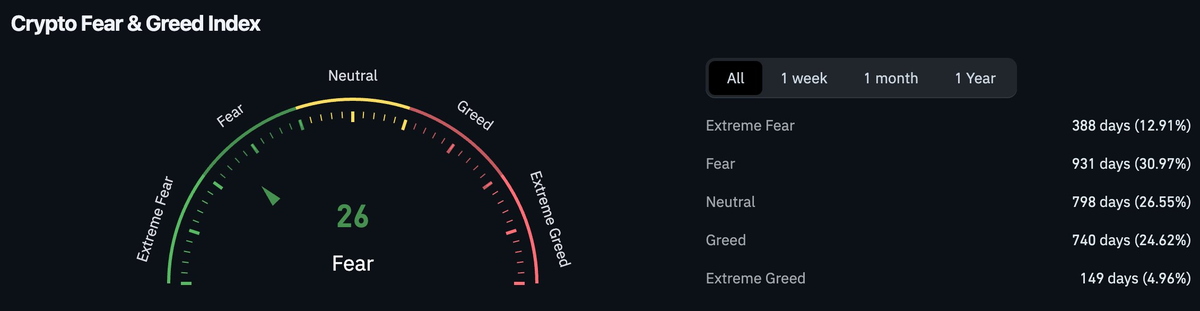
The historical distribution panel on the index provides context. Bitcoin has spent 931 days (30.97%) in Fear and 388 days (12.91%) in Extreme Fear across its history, versus only 149 days (4.96%) in Extreme Greed. At 26, the index is approaching the Extreme Fear boundary. Historically this zone has preceded recoveries, but sustained reversals have required both sentiment compression and rising spot demand — and spot demand remains absent. Sentiment alone is not a buy signal.
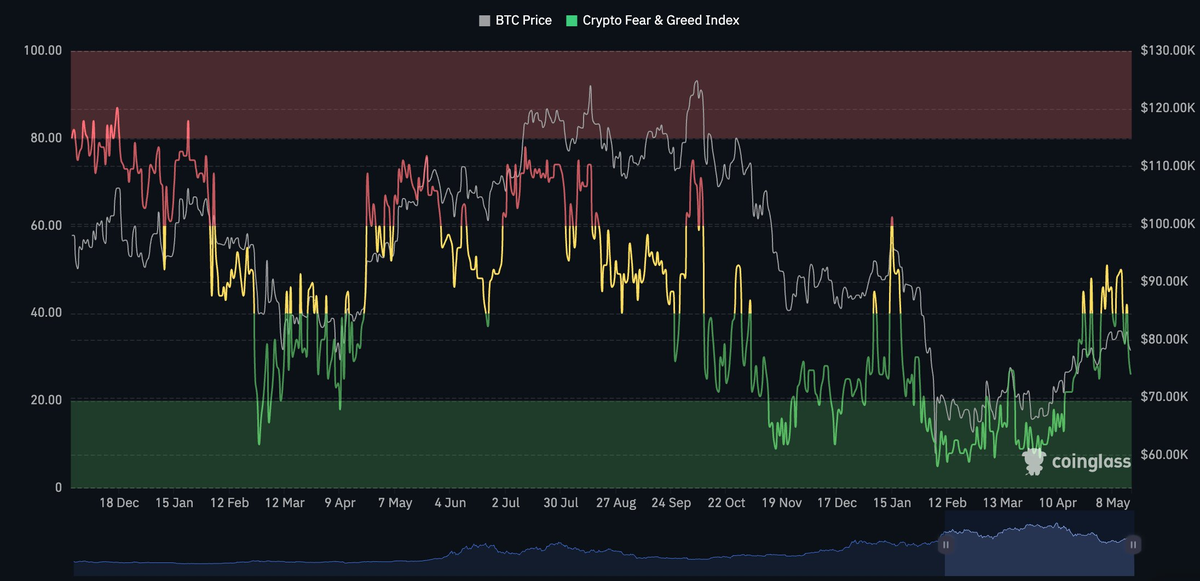
Source: https://www.coinglass.com/pro/i/FearGreedIndex
Macro backdrop: dollar strength and CPI shock
The dominant macro event of the week was the April CPI release on May 12. Headline inflation came in at 3.8% YoY, above the 3.7% forecast, driven almost entirely by energy: gasoline surged 28.4% YoY and fuel oil jumped 54.3% as the Iran conflict continues to feed directly into US pump prices. Core CPI rose 2.8% YoY, above both the 2.7% estimate and the Fed’s 2% target. Traders are now pricing a 28% chance of a rate hike by December and zero chance of a cut in 2026.
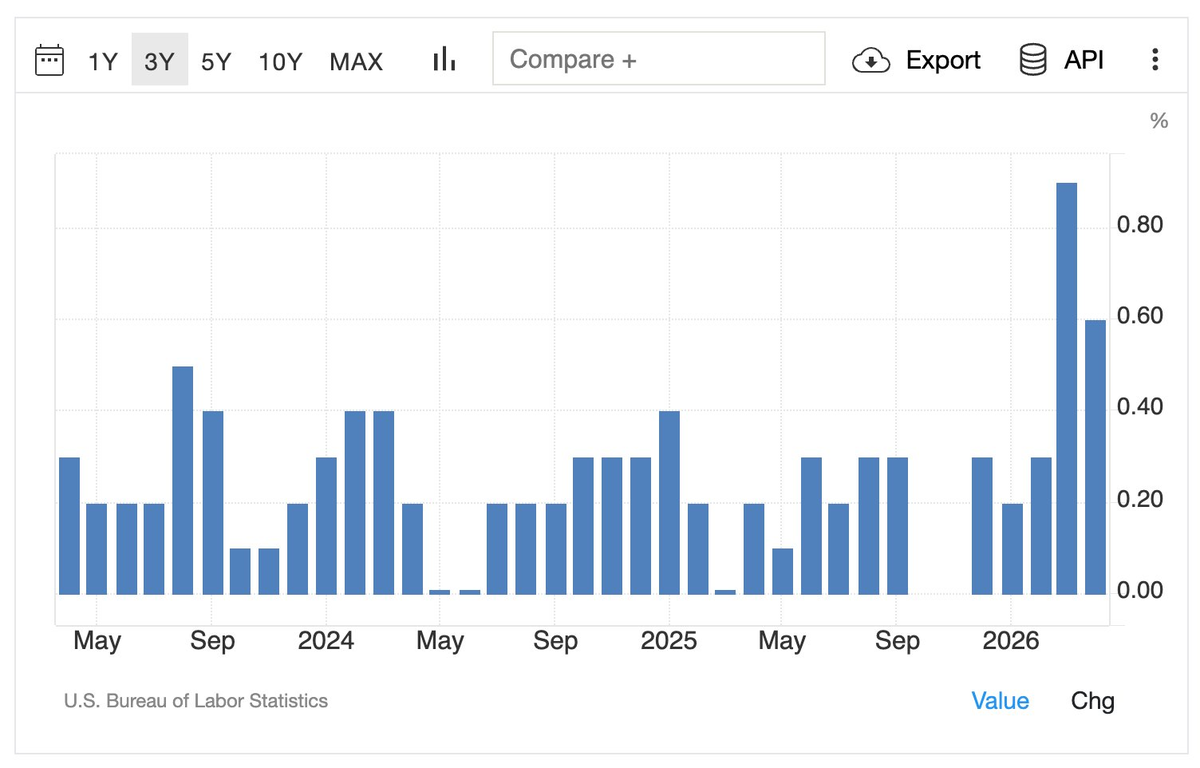
Source: https://tradingeconomics.com/united-states/inflation-rate-mom
The Iran conflict is the reason this CPI shock will not be transitory. Energy price inflation was 12.5% through March and has since accelerated to 17.9% in April. The Strait of Hormuz remains effectively closed — each week it stays shut adds roughly 0.2-0.3% to the monthly energy CPI. Trump described Iran’s latest proposal as unsatisfactory on Thursday, and the Trump-Xi summit in Beijing ended without any breakthrough on the conflict, removing the last near-term catalyst for a diplomatic resolution.
Food prices are building independent momentum. The US Import Price Index rose 1.9% in April, food-at-home costs rose 0.7% in the month alone, the fastest pace since early 2023. With oil sustaining freight costs and the Iran war disrupting regional supply chains, the Fed faces a structurally harder position: cutting rates when both energy and food inflation are accelerating simultaneously would be politically untenable even under Warsh.
US Dollar strength and its meaning to Bitcoin
The EUR/USD chart tells the week’s story clearly. The pair fell from the 1.18 area to 1.1624, a one-month low, as the DXY climbed back above 99 on hot CPI and PPI data. Both moving averages on the daily chart are sloping downward, and RSI at 52 is pointing lower — a bearish setup that was not in place the prior week.
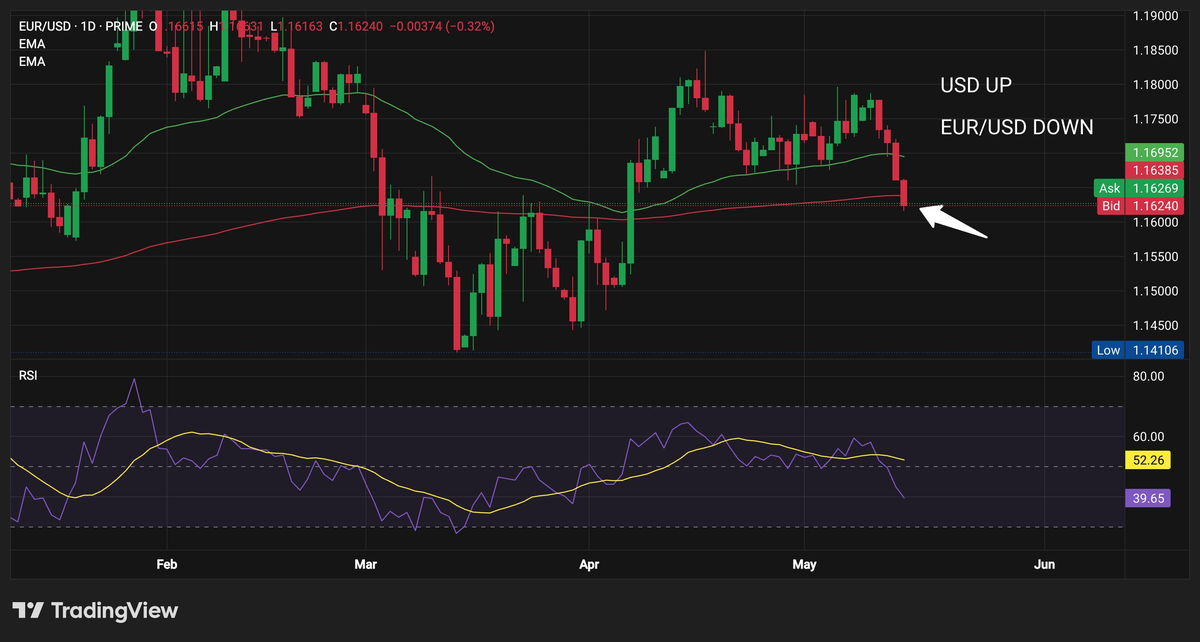
Dollar strength is structurally negative for Bitcoin. The DXY and BTC maintain a long-run inverse correlation: when the dollar strengthens, capital rotates toward yield-bearing assets and away from non-yielding risk assets. The current setup is doubly unfavorable because the dollar is rising on inflationary shock rather than growth strength, meaning equities face simultaneous pressure. If EUR/USD closes a daily candle below the 200-day EMA at approximately 1.1620, further dollar upside would add a compounding headwind for Bitcoin.
Net realised profits lead to profit-fixing
Traders’ unrealized profit margins reached 17.7% on May 5, 2026, the highest reading since June 2025, signaling elevated selling pressure risk as holders sitting on large unrealized gains become increasingly incentivized to distribute. These margin levels mirror those seen in March 2022, precisely when Bitcoin last tested the 200-day MA before resuming its decline.
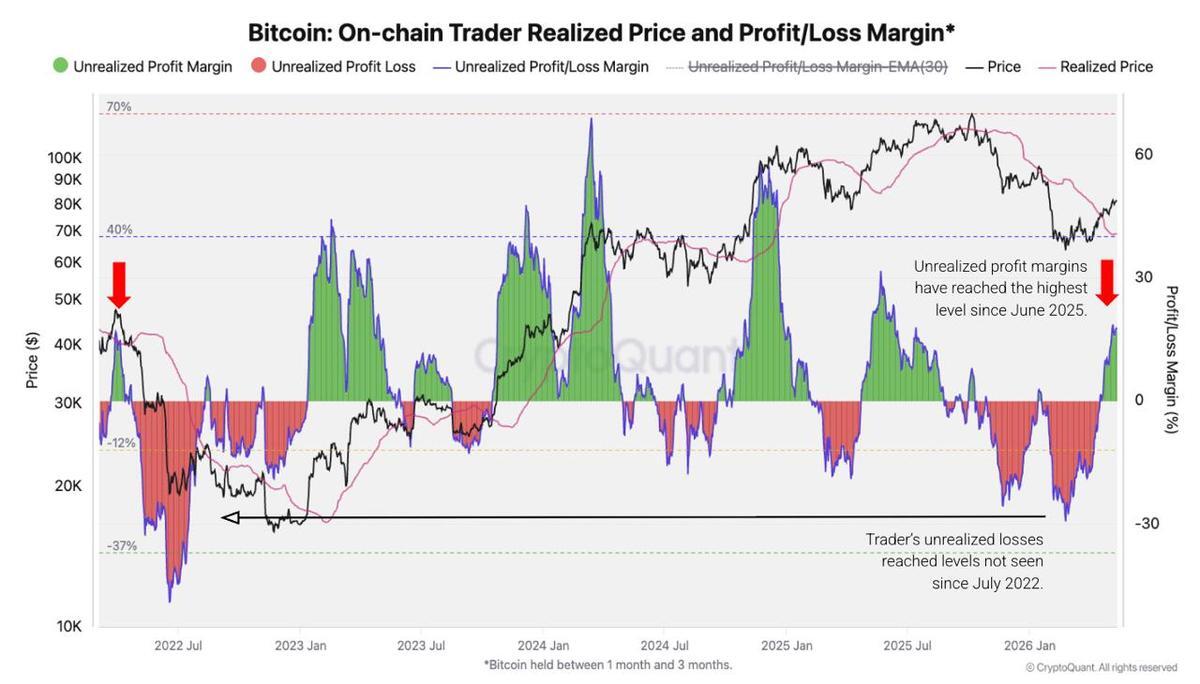
Daily realized profits spiked to 14.6K BTC on May 4, 2026, the highest level since December 10, 2025, suggesting that profit-taking has begun. Historically, spikes of this magnitude in bear market rallies have preceded local price tops, as the cohort of newly profitable short-term holders accelerates distribution into price strength.
Short-term whales decide the next move
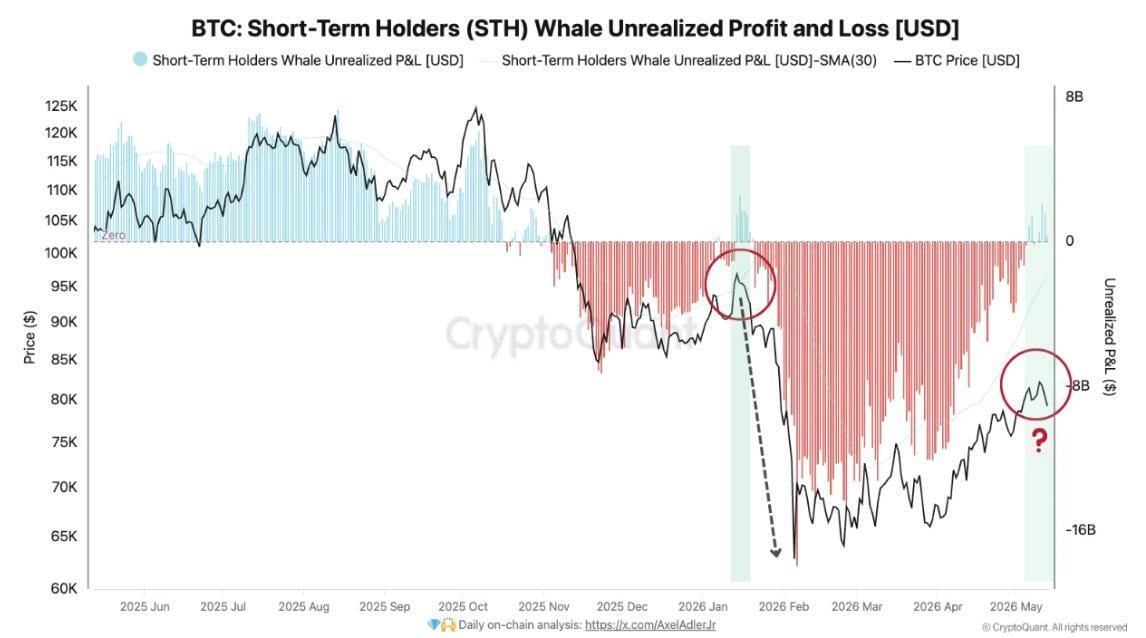
For the third time since October, BTC is trading directly on the short-term holder (STH) whale cost basis, currently near $80K, while this cohort’s aggregate unrealized P&L grinds back toward breakeven from deep negative territory. The first two tests ended in capitulation.
The combination of STH Whale Unrealized P&L and the Short-Term Whale Realized Price reveals a cohort that historically behaves far more emotionally and reactively than long-term capital. Unlike long-term holders, these participants are not driven by conviction or multi-cycle positioning. They are driven by performance, momentum, and risk management.
Source: https://polymarket.com/event/microstrategy-sell-any-bitcoin-in-2025
At the moment, BTC is dancing around the realized price of this cohort, near the $79K-$80K region. Historically, when price loses this level after periods of uncertainty, short-term whales tend to capitulate aggressively.
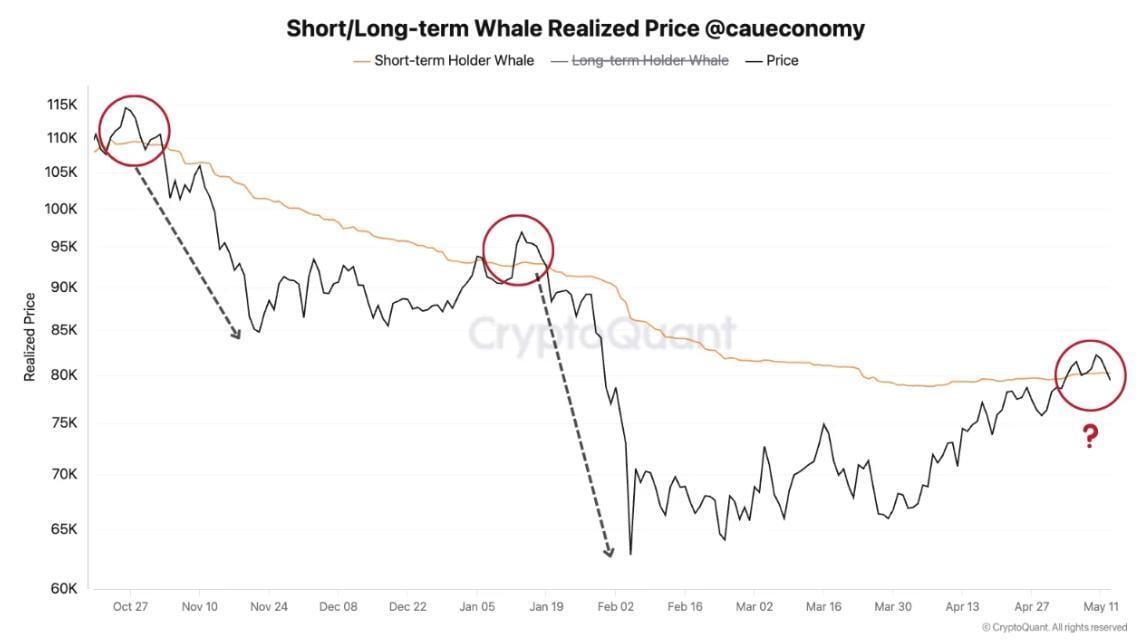
We saw this in late October 2025 and again in January 2026: price briefly traded above their cost basis, optimism returned, unrealized losses compressed, but once momentum faded, this cohort rapidly distributed into weakness and realized losses accelerated.
This third test is rather pattern than a simple coincidence.
Conclusion
The bearish case has strengthened this week. The April CPI print removed any remaining hope of a rate cut in 2026 and added a 28% probability of a hike by December. The dollar surged to a one-month high. Iran negotiations stalled again after the Trump-Xi summit failed to deliver. The Fear and Greed Index collapsed from 73 to 26 in seven days. Short-term whale data shows BTC at its cost basis for a third consecutive test — the first two both ended in capitulation.
The bull case rests on two catalysts: credible progress toward reopening the Strait, which would pull oil below $90 and reprice the rate path dovish, and a clean weekly close above $82K on strong spot volume, which would change the mid-term technical structure. Neither is in place today.
Risk management is more valuable than prediction in this environment.
Trading involves risk.
Author



 Risk Disclaimer
The content provided here is for informational purposes only. It is not intended as personal investment advice and does not constitute a solicitation or invitation to engage in any financial transactions, investments, or related activities. Past performance is not a reliable indicator of future results.
The financial products offered by the Company are complex and come with a high risk of losing money rapidly due to leverage. These products may not be suitable for all investors. Before engaging, you should consider whether you understand how these leveraged products work and whether you can afford the high risk of losing your money.
The Company does not accept clients from the Restricted Jurisdictions as indicated in our website/ T&C. Some services or products may not be available in your jurisdiction.
The applicable legal entity and its respective products and services depend on the client’s country of residence and the entity with which the client has established a contractual relationship during registration.