9 min read
 The Nikkei 225 has broken above 60,000 for the first time ever, completing a remarkable round trip from its mid-March lows when the Iran war and the Strait of Hormuz closure had the index trading well below its February peak. Six weeks later, with the strait still effectively closed and oil prices back above $100, the market has not just recovered, it has pushed into uncharted territory.
Key takeaways:
- The Nikkei closed at a record 60,537 on Monday, the first ever close above 60,000
- The breakout has been driven by AI and tech leadership, with names like Fanuc, Advantest, Disco and Kioxia powering the move
- The Bank of Japan decision later today is the next major catalyst, with markets pricing close to zero probability of a hike
- The FOMC on Wednesday and a wave of Magnificent 7 earnings (Microsoft, Meta, Alphabet, Amazon and Apple) could provide a direct read-through to Japanese semiconductor names
- A bearish divergence on the daily RSI and weak volume on the breakout could point to potential exhaustion
- Key support levels to watch: 57,300 on the daily, 59,300 on the 4-hour
A breakout against the macro backdrop
The April 13 Nikkei article framed the index as vulnerable to a Hormuz-driven energy shock, given Japan’s heavy dependence on Middle Eastern crude imports. Two weeks later, that energy shock has not gone away. The Strait of Hormuz remains effectively closed, Brent is trading back above $100, and Japan’s services producer prices have already started to reflect the disruption, with ocean freight costs surging on the back of the closure. Yet the Nikkei has shrugged it all off and printed fresh all-time highs.
The catalyst on Monday was a reported Iranian proposal to reopen the Strait in exchange for the US lifting its naval blockade on Iranian ports, with nuclear talks postponed to a later phase. The US response has so far been cautious, with Secretary of State Rubio appearing to pour cold water on the offer. But the very fact that Tehran has put a Hormuz-first deal on the table has been enough to revive optimism that the energy supply shock could begin to ease in the coming weeks.
The bigger story sits underneath the headlines. The breakout has been led by Japan’s AI and tech complex. Fanuc jumped almost 16% on Monday after a strong earnings report driven by factory automation and robotics demand. Advantest, Disco, Kioxia, Lasertec and Fujikura all rallied alongside it. Bank of America’s Michael Hartnett has been backing Japanese equities as part of his “lower rates plus AI war” thesis, and the price action appears to be confirming that view.
The catalyst-heavy week ahead
This week sits at the intersection of several major macro events:
- Bank of Japan decision (28 April): Rates are widely expected to remain at 0.75%, with hike pricing having collapsed from around 18 basis points earlier in April to close to zero. Reuters reported that the BOJ is set to cut its growth forecast for FY2026 while sharply revising up its inflation forecast in today’s quarterly Outlook Report. Governor Ueda’s press conference will be the key event, with markets watching for any hawkish signal that could trigger a yen rally
- FOMC decision (29 April): A hold is widely expected, in what could be Powell’s second to last meeting before Kevin Warsh takes over
- ECB decision (30 April): A hold at 2.00% is expected, with markets focused on any signal around a potential June insurance hike
- Magnificent 7 earnings: Microsoft, Meta, Alphabet and Amazon report on Wednesday, with Apple to follow on Thursday. Strong tech earnings could spill over into Japanese AI and semiconductor names
- Q1 US GDP (Wednesday) and March core PCE (Thursday) round out the data calendar
The contradiction worth flagging is that Japan’s March core CPI accelerated to 1.8% from 1.6%, the first acceleration in five months, driven largely by the energy shock. Services producer prices rose 3.1% as ocean freight costs surged. The BOJ is therefore facing a genuine inflation impulse, but one that comes from a supply shock rather than from domestic demand. Today’s communication will need to navigate that tension carefully.
Daily chart
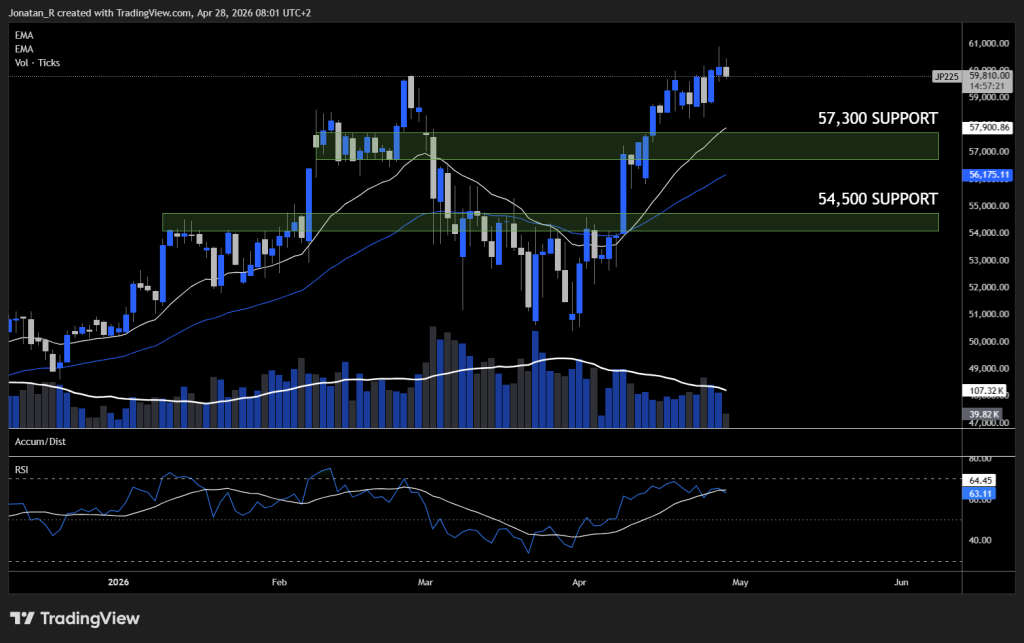
On the daily timeframe, the Nikkei has just broken to a fresh all-time high, with price now trading in price discovery mode above the previous record. The breakout, however, comes with a couple of cautionary signals worth flagging:
- A bearish divergence on the daily RSI has formed as price has pushed to new highs while momentum has failed to confirm the move
- Volume has been relatively weak through the latest leg higher
Neither of these signals is a guarantee that the breakout will fail. Bearish divergences can persist for extended periods in strong trending markets, and volume does not always need to confirm a breakout for it to hold. They are, however, signs that the move higher could be losing some underlying strength and that any retracement should be watched carefully.
If price does reject from current levels, the first major support to watch is the 57,300 zone, which lines up with the daily 20 EMA and represents a high-timeframe support area where bulls could potentially defend and build a base for further upside. Below that, the next level of interest is the 54,500 support zone, which marks a deeper structural level on the chart.
For the bullish case to remain intact, the index would need to hold above 57,300 on any pullback. A loss of that level on a daily closing basis could shift the short-term picture and open the door to a broader retest of the 54,500 area.
4-hour chart
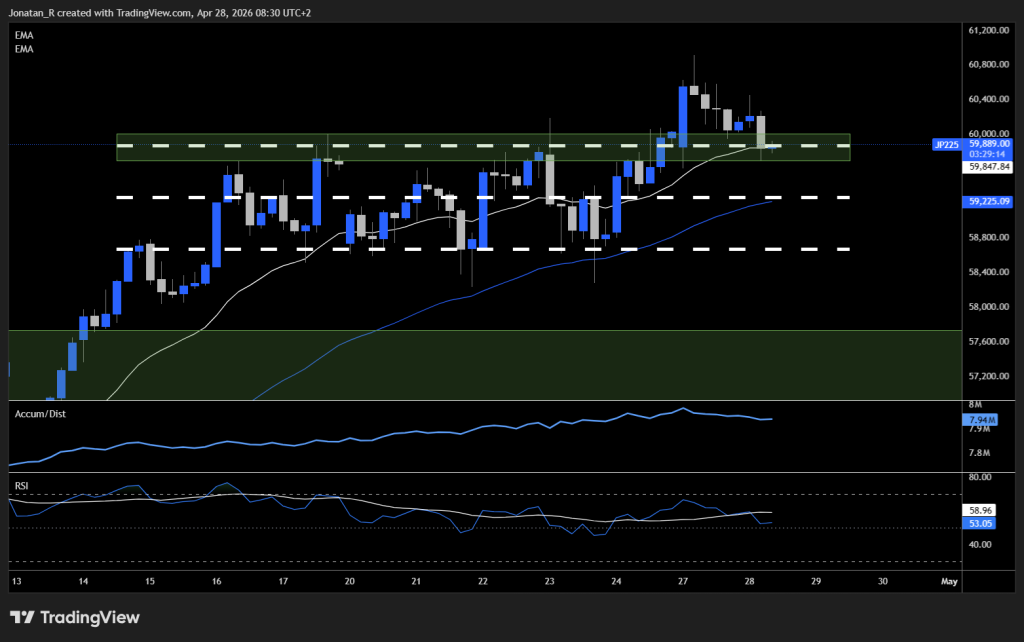
Zooming into the 4-hour timeframe gives a clearer view of the recent breakout structure. Price has broken above a defined range and is now testing the 60,000 area as new support, with the 4-hour 20 EMA also coming into confluence at this level.
The key short-term observations:
- RSI on the 4-hour is testing the 50 level, the typical pivot between bullish and bearish range conditions
- The 4-hour 50 EMA sits in confluence with the range equilibrium around 59,300, marking the next layer of support if 60,000 fails to hold
- Holding the 60,000 area as support could open the door to another move higher and a continuation into fresh all-time highs
The setup is fairly clean. If 60,000 holds, the path of least resistance on the lower timeframes could point back toward the recent highs and beyond. If it fails, the 59,300 confluence becomes the next decision point, and a loss of that level could shift the short-term bias and put the daily 57,300 zone back into focus.
What to watch
- The 60,000 area as immediate support on the 4-hour. Holding this level could keep the breakout structure intact and open the door to fresh highs
- The 59,300 confluence as the next support if 60,000 fails. A break below this level could shift the short-term bias
- The 57,300 daily support zone as the major level on any deeper pullback. This area aligns with the daily 20 EMA and could be a key battleground for the broader uptrend
- The Bank of Japan decision later today. A hawkish surprise from Ueda could trigger a yen rally and weigh on Japanese exporters, while a cautious hold could keep the breakout supported
- Magnificent 7 earnings this week. Strong results from Microsoft, Meta, Alphabet, Amazon and Apple could provide a direct boost to Japanese AI and semiconductor names. A disappointment could remove a key pillar of the rally
- Strait of Hormuz developments. Any progress on Iran’s reopening proposal could ease the energy supply concern that has been weighing on Japanese terms of trade
Trading involves risk.
Author



 Risk Disclaimer
The content provided here is for informational purposes only. It is not intended as personal investment advice and does not constitute a solicitation or invitation to engage in any financial transactions, investments, or related activities. Past performance is not a reliable indicator of future results.
The financial products offered by the Company are complex and come with a high risk of losing money rapidly due to leverage. These products may not be suitable for all investors. Before engaging, you should consider whether you understand how these leveraged products work and whether you can afford the high risk of losing your money.
The Company does not accept clients from the Restricted Jurisdictions as indicated in our website/ T&C. Some services or products may not be available in your jurisdiction.
The applicable legal entity and its respective products and services depend on the client’s country of residence and the entity with which the client has established a contractual relationship during registration.