7 min read
 Oil has rebounded sharply this week. Brent is back around $107 and WTI is trading near $102, with WTI on track for a weekly gain of more than 7% and Brent up over 5%. The move has unwound most of the early-May decline and brings the war premium that we discussed in our last oil article firmly back into the market.
Three forces are stacking together:
- Hot inflation prints have killed rate-cut hopes for 2026, lifting yields and the dollar
- The IEA warned of structural undersupply through October even if the conflict ends sooner
- The ceasefire is unravelling after Trump rejected Iran’s counteroffer as “garbage”
Hot inflation, no cuts, higher yields
This week’s two inflation prints landed well above expectations:
- April CPI: 3.8% YoY, the highest since May 2023
- April PPI: 1.4% MoM headline (versus 0.5% expected), with core PPI at 1.0% (versus 0.3% expected)
The market reaction was immediate. CME pricing now has the Fed on hold through 2026, with the next move increasingly seen as a hike rather than a cut. The 10-year Treasury yield closed near its 2026 high at 4.46%, just below the March peak of 4.48%.
In a normal cycle, that chain could be a headwind for commodities:
- Hot inflation could keep the Fed hawkish, with rates staying higher for longer
- Higher rates could push yields up, as investors demand more compensation for holding bonds
- Higher yields could support a stronger dollar, which typically makes commodities more expensive for non-dollar buyers
- A stronger dollar could pressure oil, dampening demand
But that chain assumes demand is the binding constraint. Right now, it isn’t.
The IEA’s structural undersupply warning
The IEA’s latest Oil Market Report this week flagged a supply picture that the dollar and yield headwinds appear to be unable to offset:
- Hormuz flows are down around 4 million barrels per day in March and April
- The market could remain materially undersupplied through October, even if the conflict were to end next month
- Saudi Arabia has reported its production at the lowest level since 1990, falling to around 6.3 million bpd in April (down 42% since February)
- OPEC has cut its 2026 demand growth estimate from 1.4 million bpd to around 1.2 million bpd
- The EIA’s May Short-Term Energy Outlook expects global inventories to draw at an average of 8.5 million bpd in Q2 2026
When supply is this constrained, the usual transmission from higher rates to weaker commodity prices appears to stop working.
The ceasefire is back on life support
Trump rejected Iran’s most recent counteroffer earlier this week, calling it “garbage” and saying the ceasefire is on “massive life support.” Reports of ship attacks and seizures in Hormuz have returned, and Tehran appears to be exercising selective control over tanker traffic.
The Trump-Xi summit in Beijing this week added a new layer. The White House readout said both leaders agreed the Strait of Hormuz must remain open, and Xi reportedly expressed interest in purchasing more US crude to reduce China’s reliance on the strait. That could potentially serve as a pressure point on Iran, but for now there’s no sign of a breakthrough.
Key takeaways
- Brent around $107, WTI around $102, with weekly gains of over 5% and 7% respectively
- Hot CPI and PPI have wiped out 2026 rate-cut pricing and pushed yields back near 2026 highs
- IEA warns of structural undersupply through October, even if the conflict ends sooner
- Saudi production at its lowest since 1990, with OPEC cutting demand growth forecasts
- Trump rejected Iran’s counteroffer and called the ceasefire “massive life support”
Daily chart
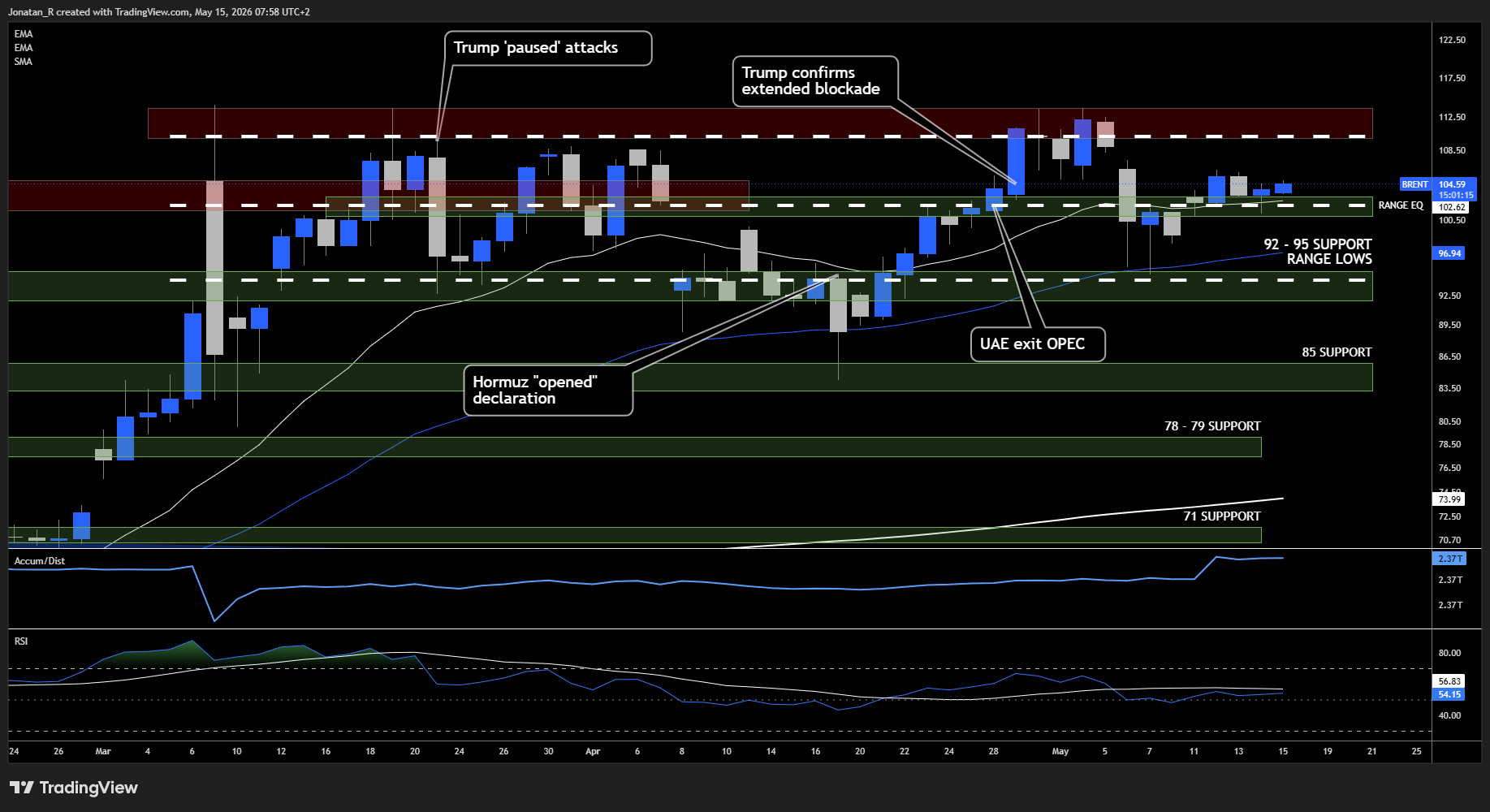
On the daily timeframe, Brent’s recent pullback found support at the $92 to $95 range lows, where price tagged the daily 50 EMA before turning higher. That defence of the range lows could potentially mark the structural floor for the broader uptrend.
Price has now reclaimed both the range EQ around $102 and the daily 20 EMA, with the structure of higher lows from the April low appearing intact.
A few signals are stacking constructively:
- Accumulation/Distribution has broken out to fresh highs ahead of price, a leading divergence that has historically preceded continuation moves higher
- RSI has reclaimed the 50 level, keeping the indicator within its bullish range under the Cardwell framework (40 to 80)
- The defence of the 50 EMA combined with the reclaim of the 20 EMA could potentially signal that the broader uptrend is resuming
The $108 to $112 zone above is the immediate resistance to watch. That’s the area where price was rejected at the end of April on Trump’s “extended blockade” confirmation.
Key levels to watch
Resistance:
- $108 to $112 — the upper boundary of the range and the recent rejection zone
- Range EQ around $102 — recently reclaimed and now acting as first support
Support:
- Daily 20 EMA — the immediate short-term support
- $92 to $95 — the range lows that held the recent pullback, reinforced by the daily 50 EMA
- $85 — the next major horizontal support below
- $78 to $79 — deeper structural support
- $71 — the broader uptrend floor, reinforced by the rising 200 SMA
What to watch
- The Trump-Xi summit outcome for any breakthrough on Hormuz or pressure on Iran
- Further IEA, OPEC, or EIA updates on inventory drawdowns and production
- Any escalation or de-escalation around tanker traffic in the strait
- Fed transition headlines as Kevin Warsh takes over from Powell, with his first FOMC meeting scheduled for June 16-17
- The next round of US inflation and growth data for any shift in the rate path
Trading involves risk.
Author



 Risk Disclaimer
The content provided here is for informational purposes only. It is not intended as personal investment advice and does not constitute a solicitation or invitation to engage in any financial transactions, investments, or related activities. Past performance is not a reliable indicator of future results.
The financial products offered by the Company are complex and come with a high risk of losing money rapidly due to leverage. These products may not be suitable for all investors. Before engaging, you should consider whether you understand how these leveraged products work and whether you can afford the high risk of losing your money.
The Company does not accept clients from the Restricted Jurisdictions as indicated in our website/ T&C. Some services or products may not be available in your jurisdiction.
The applicable legal entity and its respective products and services depend on the client’s country of residence and the entity with which the client has established a contractual relationship during registration.