9 min read
 A direct military exchange between the US and Iran, arriving just as the market’s AI leaders stumbled after earnings, has pushed risk sentiment sharply lower across asset classes. Here’s the backdrop before we look at the intraday picture:
- US-Iran escalation. The standoff has shifted from stalled talks to a direct exchange of fire, with Iran launching ballistic missiles towards Kuwait and Bahrain (which failed or were intercepted) and US forces striking a military site on Iran’s Qeshm Island in the Strait of Hormuz. Iran has reportedly suspended direct communications with Washington.
- A risk premium is back in energy and bonds. Brent crude has pushed higher over recent sessions to trade near the high $90s, while Treasury yields have firmed.
- Cracks in the AI trade. After-hours results from Broadcom and CrowdStrike were broadly solid, yet both shares fell sharply, a sign the bar for the AI names had been set well above even strong numbers.
- A record run stalls. The S&P 500, which had closed above 7,600 for the first time earlier in the week, snapped a nine-session winning streak.
- Jobs data ahead. Friday’s US non-farm payrolls (NFP) report is the next major catalyst, landing into a backdrop where resilient data has markets leaning towards the Federal Reserve (Fed) holding rates for longer.
What’s driving the move
The geopolitical shock is the broader of the two threads. The shift from on-and-off negotiations to active strikes marks a clear escalation, putting a fresh risk premium back into oil, with a reported drawdown in US crude inventories adding to the move. Higher energy costs feed back into the inflation outlook, which helps explain why Treasury yields have firmed even as equities have fallen, a combination that can pressure both risk assets and traditional safe havens at the same time.
The second thread is more specific to equities. The mega-cap technology names leading the rally delivered results that were broadly solid, yet both Broadcom and CrowdStrike fell heavily after hours, a sign that expectations for the AI names had been set well above even strong results. With those same companies among the largest weights in the US indices, the reaction fed straight into the broader market and helped end the S&P 500’s run of gains.
That mix of a geopolitical risk premium and a stumble in the market’s biggest growth names is showing up across very different assets at once. The charts below take an intraday, 4-hour view of how it’s playing out in Bitcoin, gold, Brent crude, and the S&P 500.
Bitcoin (BTC) 4-hour chart
Bitcoin (BTC) has extended its recent sell-off, sliding into a support zone between 62,400 and 65,500 after heavy selling pressure and a wave of liquidations. On the 4-hour timeframe, the Relative Strength Index (RSI) is deeply oversold, sitting at a level we haven’t seen since early February, when price last traded down around the 60,000 area. The Accumulation/Distribution line has broken its recent local uptrend, which suggests sellers have taken firm control for now.
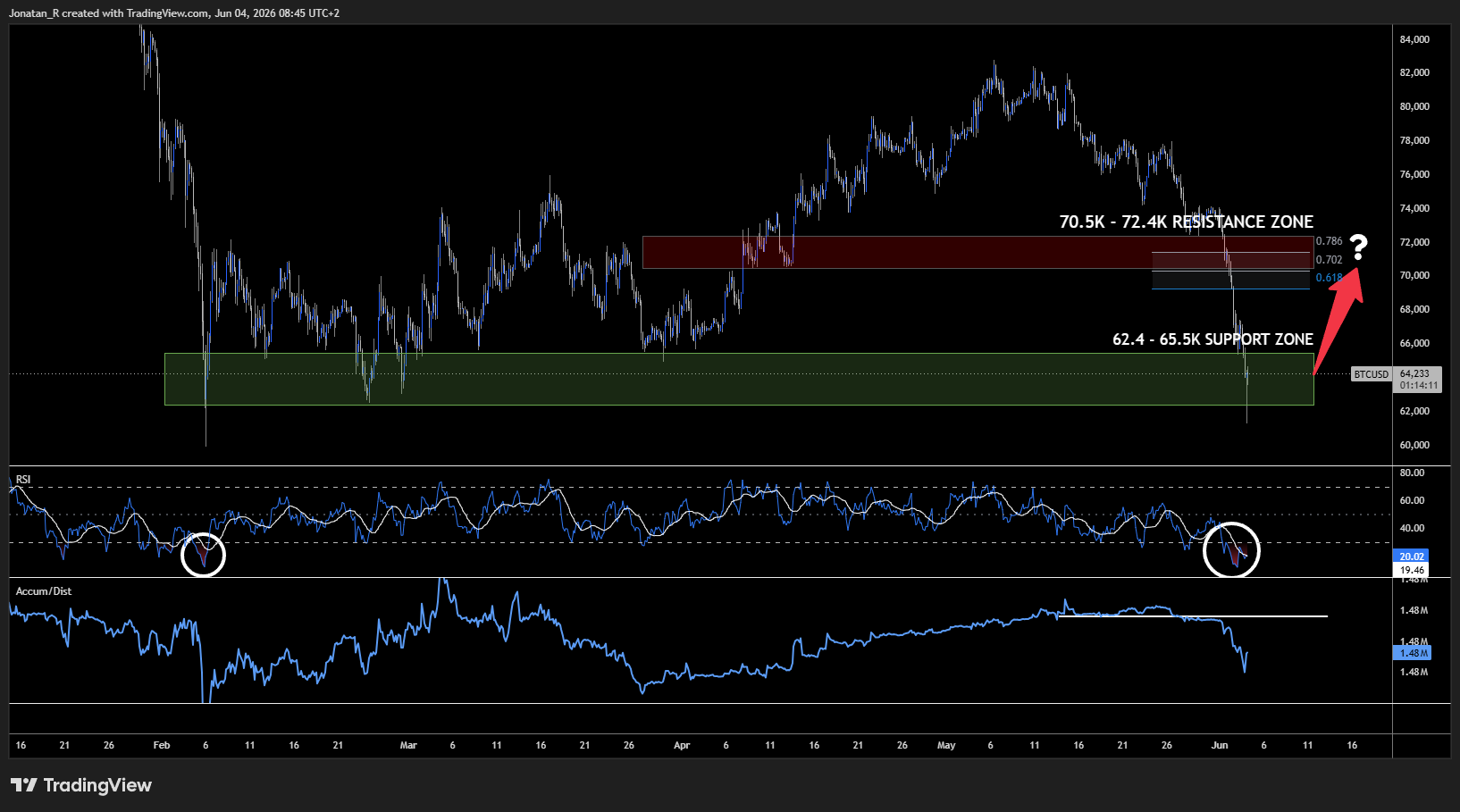
Bitcoin trading within the 62,400 to 65,500 support zone, with RSI deeply oversold on the 4-hour chart.
Given the speed and depth of the move lower, some traders could watch for a potential mean-reverting bounce. The level of interest on the upside sits in the resistance zone around 70,500 to 72,400. A bullish divergence between price and RSI, alongside a bullish break of structure on the 4-hour Accumulation/Distribution line, could potentially add confidence to that scenario. It’s also worth noting that the same resistance zone aligns with the short reload zone from the latest leg down, which could add confluence on any move higher. For context on how the prior structure developed, see our previous Bitcoin analysis.
Gold (XAU/USD) 4-hour chart
Gold (XAU/USD) is trading in the middle of a linear regression channel drawn from the cycle high around late January, and it has pulled back towards a key support level near 4,400. A sustained break below that level could potentially signal a shift towards a more bearish higher-timeframe structure. On the local timeframe, gold is also ranging, with the lower bound near the 4,400 support and the range highs around 4,600.
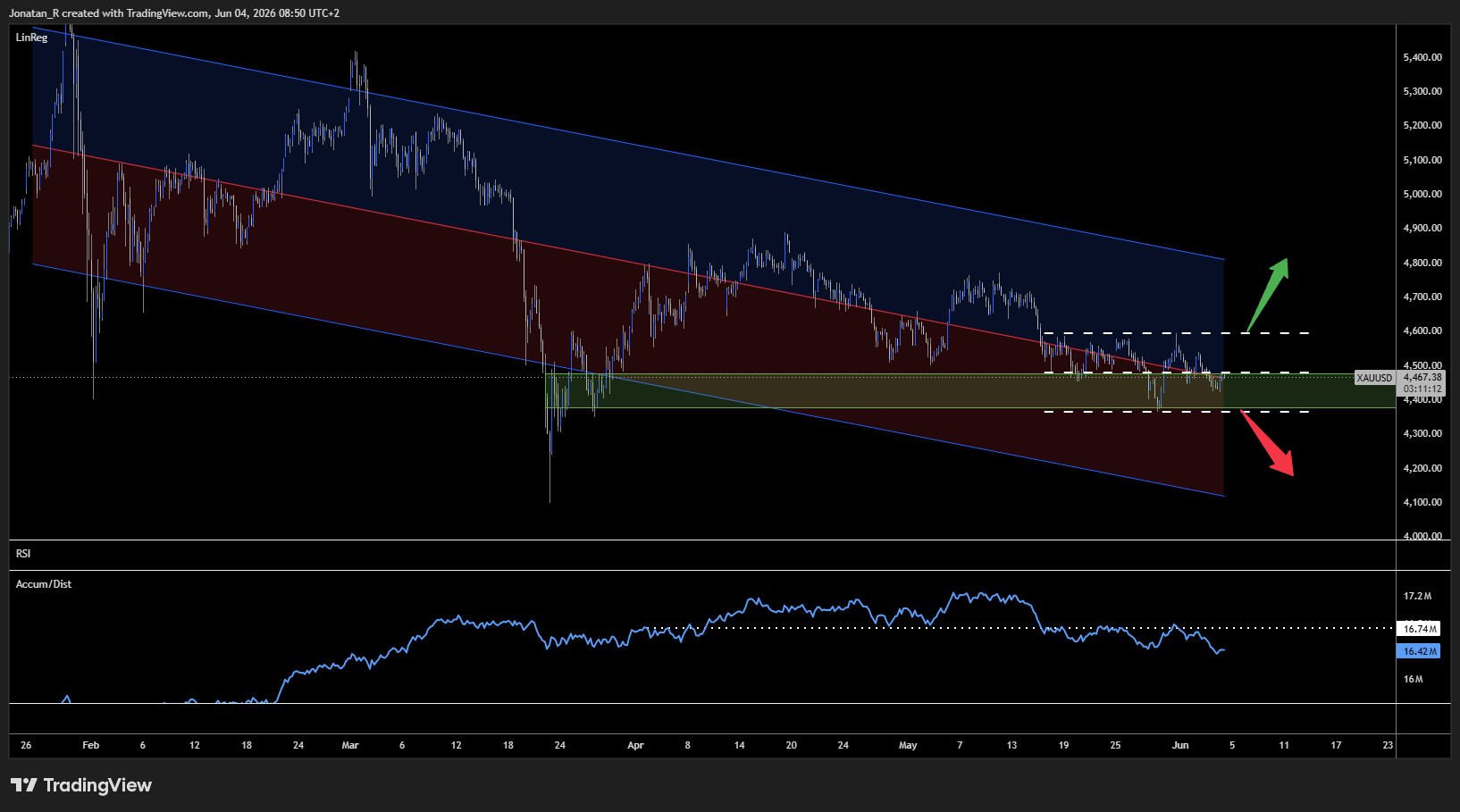
Gold ranging between roughly 4,400 support and 4,600 resistance, inside a descending linear regression channel.
The Accumulation/Distribution line has broken down into a bearish structure, pointing to sellers holding the upper hand for now. A break in either direction, below the 4,400 support or above the 4,600 range highs, could potentially set the next directional move, which places gold at an important inflection point. With NFP ahead, gold could potentially continue to range until a clear catalyst emerges, and for active intraday traders these range boundaries offer well-defined levels to work with.
S&P 500 4-hour chart
The S&P 500 remains in an uptrend on the 4-hour chart, with a sequence of higher highs and higher lows still intact. One feature worth highlighting on the local timeframe is that many of the recent dips have been preceded by a potential bearish divergence between price and RSI, where price pushes to new highs (green arrows) while RSI makes lower highs (red arrows). That pattern showed up again ahead of this latest pullback, and it’s a sign that momentum has been weakening on the up moves.
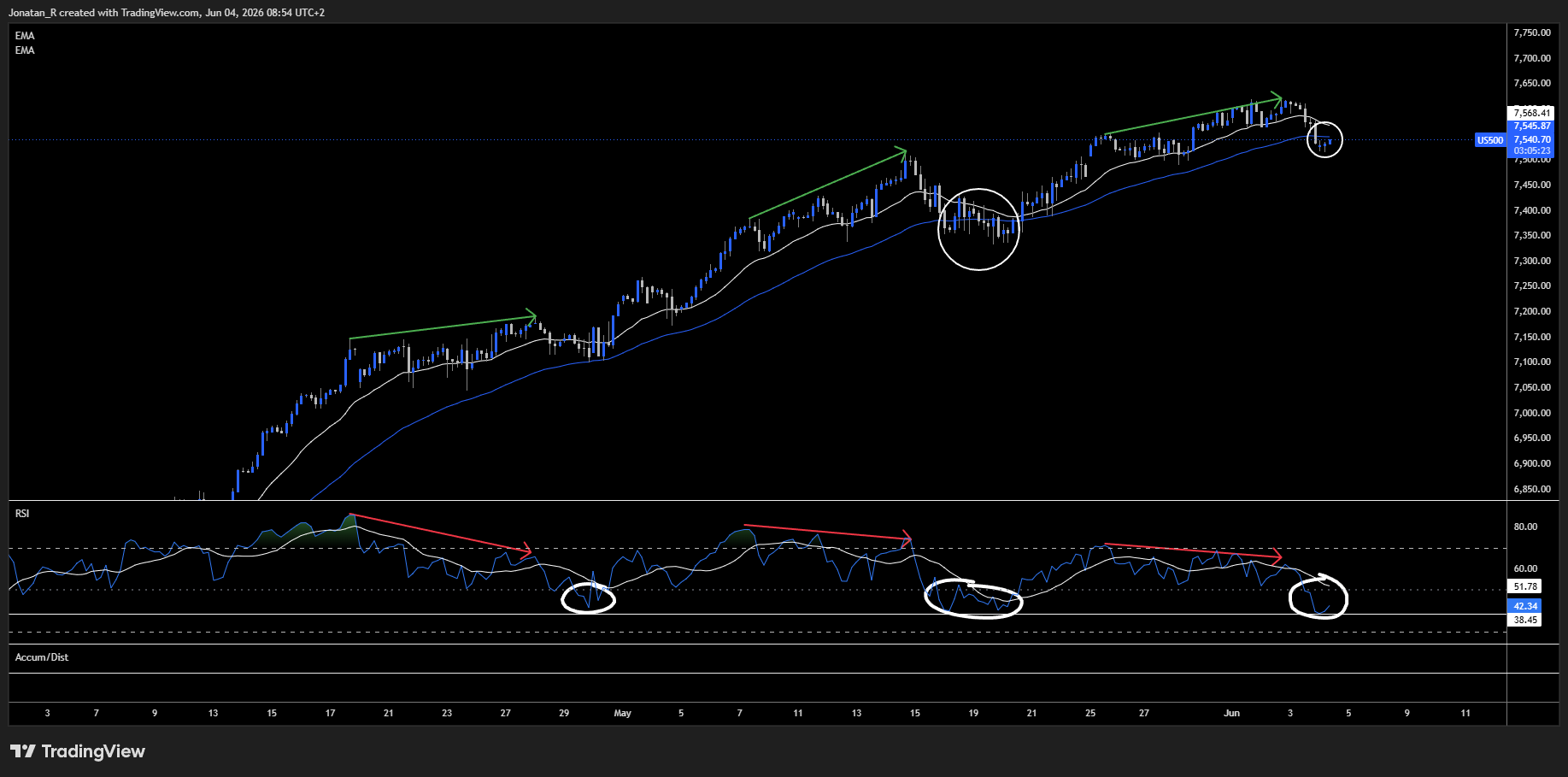
The S&P 500 holding its uptrend while RSI shows repeated bearish divergences at the highs, with price dipping below the 50 EMA.
As marked with the white circles, the index has dipped below its 50-period exponential moving average (EMA) before without breaking clear structure, much as it’s doing now, with RSI dropping below the 50 level and then recovering. The difference this time is that RSI has dropped lower on this dip than on the previous ones. Should RSI fail to reclaim the 50 level, that could potentially be a sign the trend is losing momentum and that a larger dip may follow.
Brent crude 4-hour chart
Brent crude is trading within a well-defined range, with the range lows around $85 and the range highs up in the $100 to $110 area. Price is currently testing the range equilibrium (EQ) around $97, and a rounded bottom formation has taken shape on the 4-hour chart. Interestingly, and in contrast to the S&P 500, oil showed a clear bullish divergence between price and RSI ahead of this bottom, where price made lower lows (red arrow) while RSI made higher lows (green arrow).
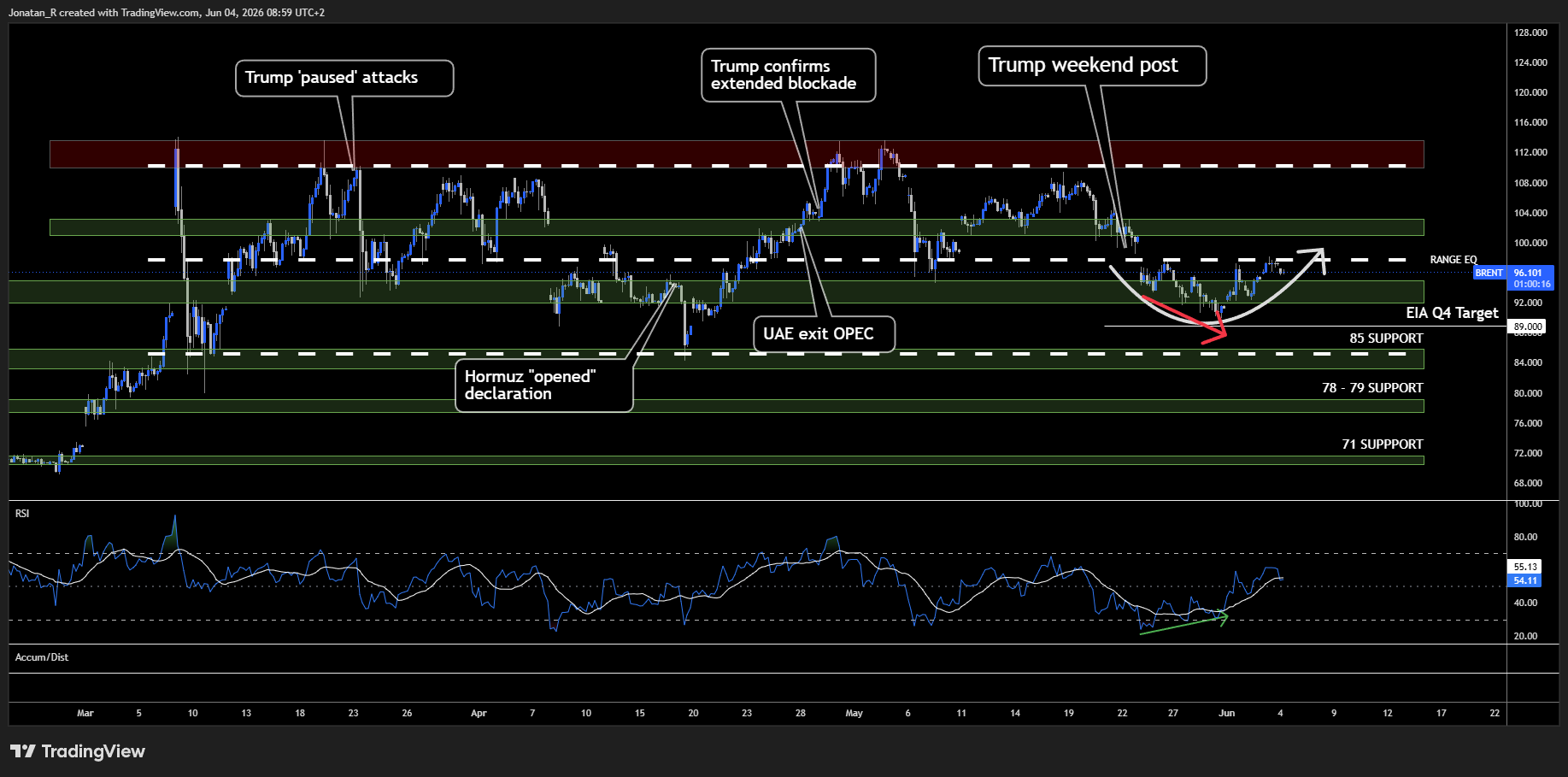
Brent crude testing the range EQ around $97 after a rounded bottom, with the range running from roughly $85 up to the $100 to $110 zone.
Should another catalyst emerge to push oil higher, a test of the $100 level could potentially come into focus, with the range highs around $100 to $110 back in play if the situation deteriorates further. This is close to a mirror image of the dynamic we described in our previous oil analysis, when the war premium was unwinding on diplomatic progress. The recent escalation has begun to rebuild that premium.
Across all four charts, the same two forces, a renewed geopolitical risk premium and a wobble in the market’s largest growth names, are leaving a clear footprint. With NFP due on Friday and the US-Iran situation still fluid, the levels above offer a framework for navigating what could potentially be a volatile end to the week.
Trading involves risk.
Author



 Risk Disclaimer
The content provided here is for informational purposes only. It is not intended as personal investment advice and does not constitute a solicitation or invitation to engage in any financial transactions, investments, or related activities. Past performance is not a reliable indicator of future results.
The financial products offered by the Company are complex and come with a high risk of losing money rapidly due to leverage. These products may not be suitable for all investors. Before engaging, you should consider whether you understand how these leveraged products work and whether you can afford the high risk of losing your money.
The Company does not accept clients from the Restricted Jurisdictions as indicated in our website/ T&C. Some services or products may not be available in your jurisdiction.
The applicable legal entity and its respective products and services depend on the client’s country of residence and the entity with which the client has established a contractual relationship during registration.