10 min read
 Weekly recap:
US Global stocks recap
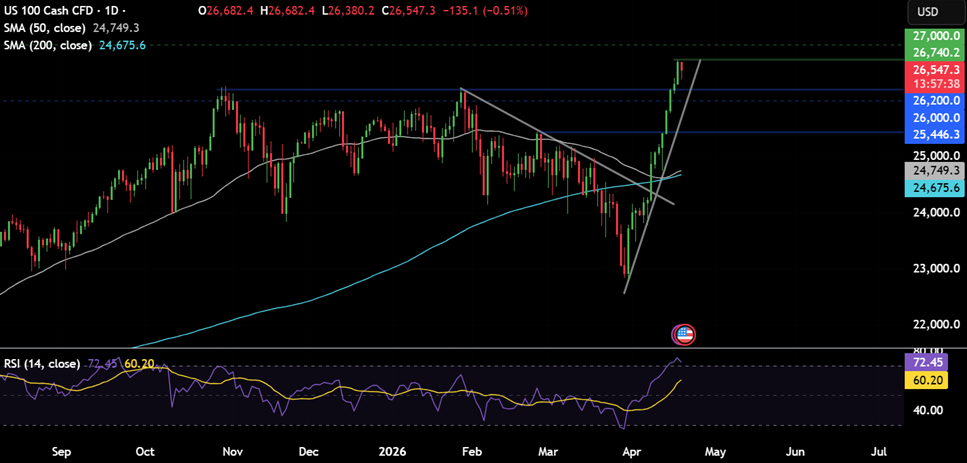
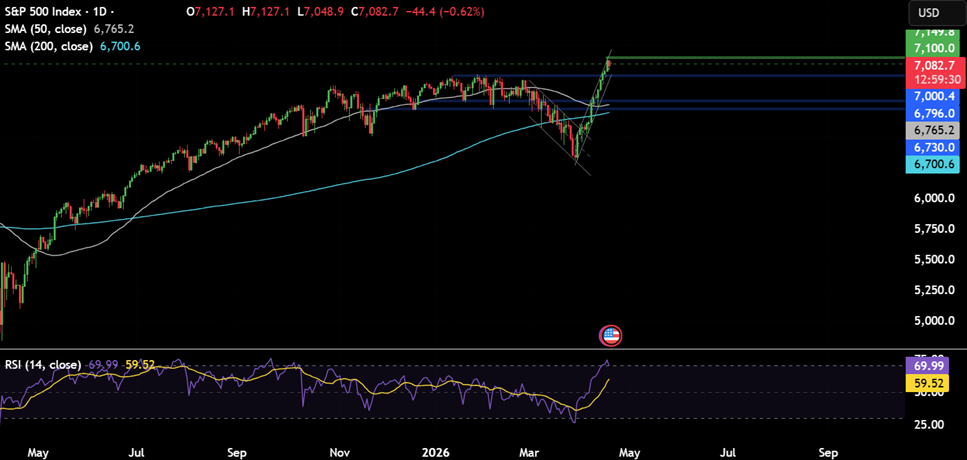
US stocks rallied for a third straight week, with the S&P 500 and the NASDAQ reaching fresh record highs. The strength of the move reflected a significant rise in risk appetite, supported by growing optimism around a potential lasting truce between the US and Iran.
There were also reports that Iran had reopened the Strait of Hormuz on Friday, although the US blockade remained in place, and Iran closed the Strait again on Saturday.
Major US data/themes
On the data front, the US Producer Price Index (PPI) came in softer than expected, rising 0.5% month-on-month versus expectations of 1.2%, in line with February’s reading. This helped ease immediate inflation concerns and reinforced the narrative that price pressures weren’t as high as feared in the near term.
This was also supportive for equities, particularly given the market’s sensitivity to the rate outlook.
US earnings season continued, revealing that the underlying health of the US economy remains strong, though concerns over the outlook persisted.
Gold moves
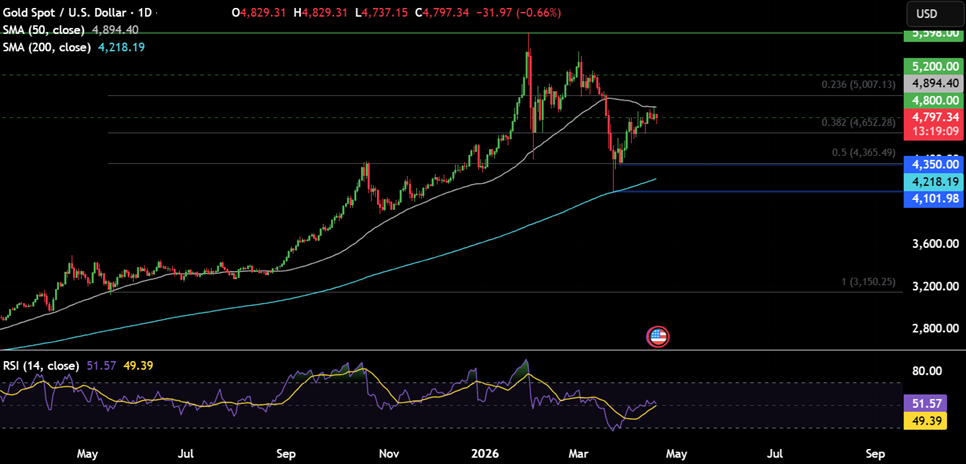
Gold rose a further 1.7% last week, marking a fourth consecutive weekly gain. The move was supported by falling oil prices, declining US Treasury yields, and a weaker US dollar, as well as growing optimism that the conflict in the Middle East could soon end.
The geopolitical situation remains fluid, particularly around the Strait of Hormuz, and this continues to create volatility for the precious metal. Gold has started the week lower amid rising oil prices, reviving inflationary worries.
That said, any renewed progress toward de-escalation in the Middle East could support gold prices again, particularly if it feeds through into lower yields and a softer dollar. The broader trend still appears constructive, and dips may continue to attract buyers.
Oil moves
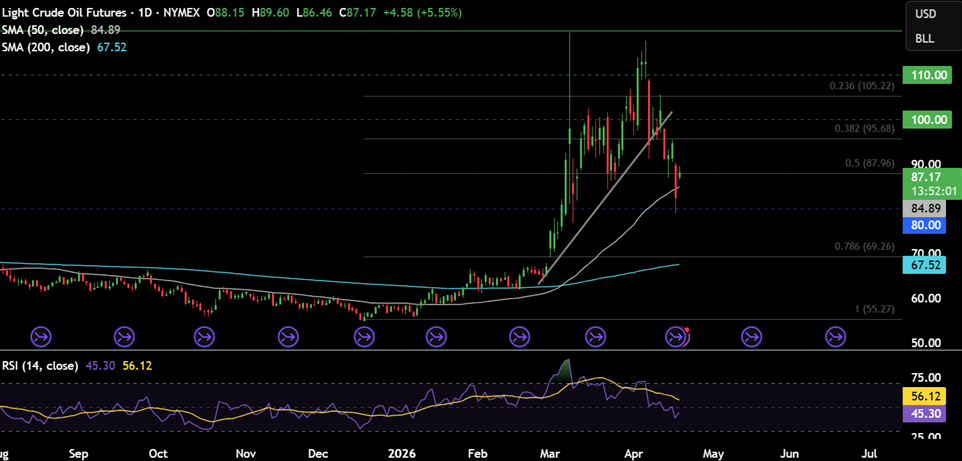
Oil prices continue to be driven by developments in the Middle East, which inject volatility into the market. Prices declined 13% last week after Iran signalled a reopening of the Strait of Hormuz following a temporary ceasefire, easing fears of supply disruptions.
However, that relief proved short-lived. Reports of renewed tensions, including actions affecting vessels attempting to pass through the route over the weekend, suggest that access remains very limited. This has reintroduced supply concerns and pushed prices higher at the start of the week.
The 5% rebound today highlights how sensitive the market remains to geopolitical headlines ahead of the US-Iran ceasefire deadline at 20:00 ET tomorrow. Volatility is likely to persist until there is greater clarity on both the status of the conflict and the permanent reopening of the Strait. Until then, price swings are likely to remain sharp and reactive.
Indian markets
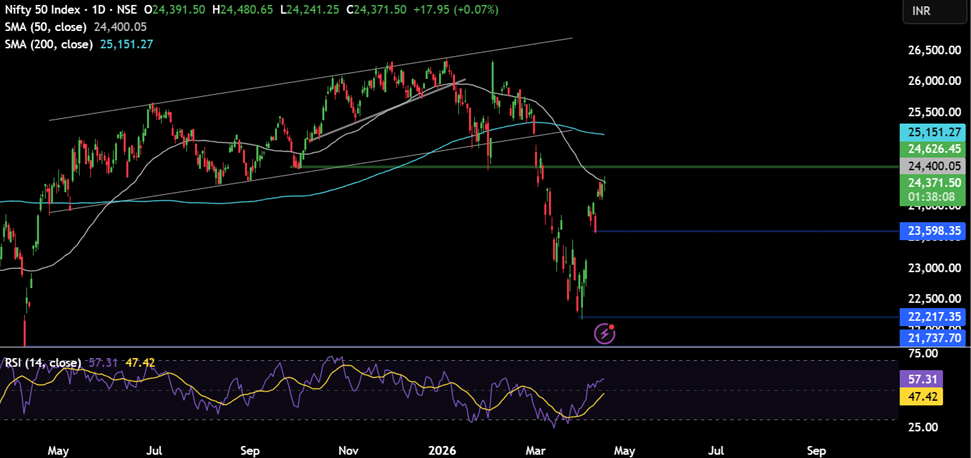
Indian equities extended gains for a second consecutive week, supported by easing geopolitical concerns, with almost all sectors gaining. The Nifty 50 and Sensex both rose by around 1.2% over the week as oil prices dropped 10%.
Movements in crude oil remain a key factor for the market, given India’s sensitivity to energy costs. The IMF lifted India’s GDP forecast to 6.5% growth for FY27, boosting confidence in economic strength.
Foreign investors remain cautious. While selling pressure has eased, flows have not fully reversed, indicating that conviction is limited. Foreign institutional investors (FIIs) remained net sellers over the week, offloading equities worth ₹251 crore. This brought total outflows for April to approximately ₹39,224 crore.
Meanwhile, domestic institutional investors (DIIs) were also net sellers with outflows of ₹6,285.91 crore.
Key Indian market drivers: The coming week is expected to be driven by geopolitical developments as well as US and Indian earnings seasons. In the US, around 90 S&P 500 companies are reporting, including major names such as Tesla, IBM, American Express, and Intel. In India, focus will be on Q4 earnings from key companies such as HCL Technologies, Nestlé India, Infosys, and Reliance Industries.
On the data front, investors will focus on India and US PMIs as well as US retail sales and Kevin Warsh’s testimony before the Senate.
USD/INR fell 0.52% last week amid a broadly weaker USD and improved risk sentiment. The pair is recouping those losses on Monday as the mood sours.
Pakistan markets
Pakistan equities extended their recovery for a second straight week, supported by easing geopolitical tensions and improved sentiment as oil prices fell 13%. The benchmark KSE-100 index rose around 4% week-on-week, closing at 173,939 and moving above its pre-conflict level of 168,062.
Investor sentiment was supported by expectations of progress toward a lasting US–Iran agreement, with further talks anticipated. However, uncertainty remains around key regional developments, particularly the Strait of Hormuz, which continue to influence market confidence.
On the macroeconomic side, Pakistan’s current account posted a surplus of approximately $1.07 billion in March, improving from $231 million in February. However, foreign direct investment declined to $168 million from $214 million.
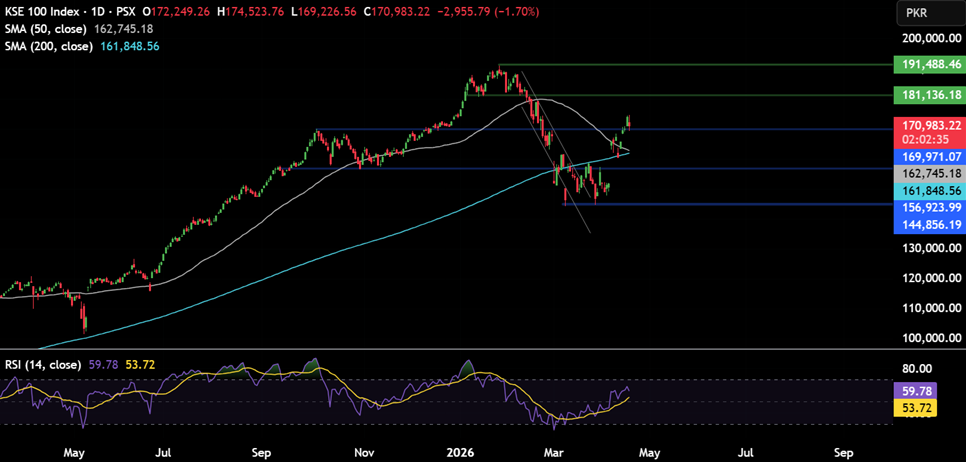
Looking ahead, Pakistan markets will remain focused on developments in US–Iran peace talks brokered by Pakistan and the ongoing corporate earnings season, both of which are likely to shape near-term direction.
Markets are also focused on the State Bank of Pakistan’s upcoming policy decision. Expectations are centred on either holding rates steady or delivering a marginal cut at the April 27 meeting, both of which could provide additional support to equities.
The Pakistani rupee rose 0.75% to close at 281.15 against the US dollar on Friday. Although the Rupee is giving back those gains on Monday.
Week ahead (US & Asia)
Kevin Warsh Senate hearing (Tuesday)
Warsh is expected to face Senate questioning on April 21. The hearing will likely focus on Federal Reserve independence, his relationship with the White House, and his views on inflation, the labour market, and financial regulation.
He has previously outlined a framework that diverges from the current Fed consensus, including openness to lower interest rates alongside balance sheet reduction (quantitative tightening).
He has argued that tighter financial conditions can still be achieved through liquidity withdrawal rather than relying solely on higher policy rates. Given expectations of higher inflation, his views will be scrutinised by the Senate.
There may also be scrutiny around disclosures, potential conflicts of interest, and broader governance issues. Markets will be watching closely how strongly he defends central bank autonomy, particularly amid political pressure to cut rates even if inflation remains elevated.
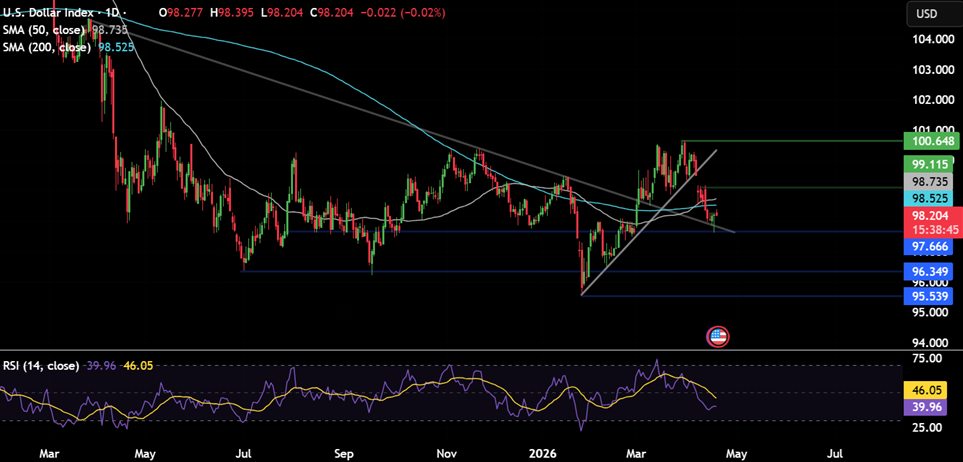
The approval process has already taken longer than expected, adding another layer of uncertainty. Senior Republican on the Senate banking committee, Thom Tillis, refuses to vote for Warsh unless the DoJ drops its inquiry into Powell, on costs that overrun related to renovations at the Fed. The DoJ is refusing to budge, adding to uncertainty, which could weigh on the USD.
US retail sales (Tuesday)
The US economy continues to show relative resilience compared to the UK and euro area, although it is not immune to external shocks. Rising gasoline prices, linked to recent geopolitical developments, could weigh on consumer spending in the near term.
Retail sales are expected to rise 1.3% MoM, up from 0.6% previously, suggesting that the US consumer is holding up despite rising pressure on real incomes. The key question is whether consumption remains robust or begins to soften more meaningfully going forward.
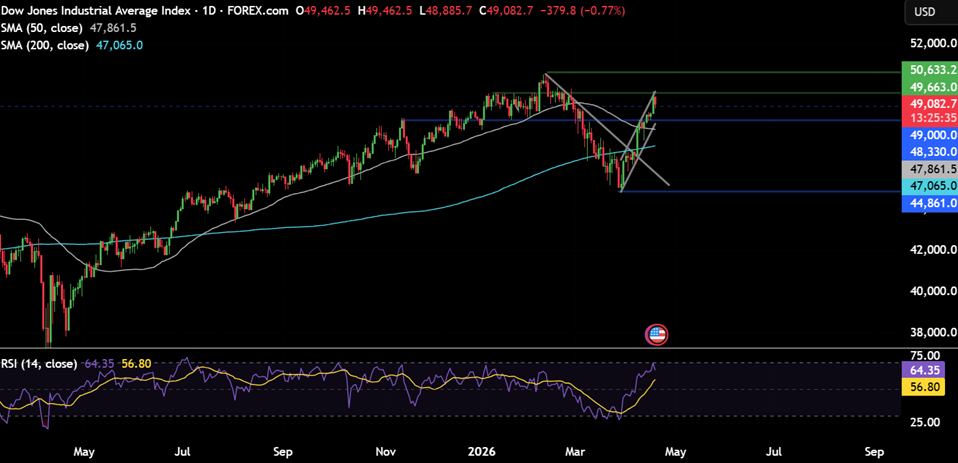
Energy prices have eased significantly from recent highs, and if geopolitical tensions ease further and supply routes reopen, the increased inflationary pressure and any drag on consumption could prove temporary. However, if higher fuel costs persist, this may start to feed more clearly into broader spending patterns. Strong data could support US stocks and the Dow Jones.
India PMIs (Thursday)
Expectations for India’s manufacturing PMI to rise modestly higher to 54 in April, up from 53.9 in March. Meanwhile, the services PMI could weaken further after falling to 57.2 in March.
As a result, the composite PMI, considered a good gauge of business activity, could weaken further after falling to 57 in March, marking the lowest level since October 2022. Weaker domestic demand for goods and services offset a rise in international orders.
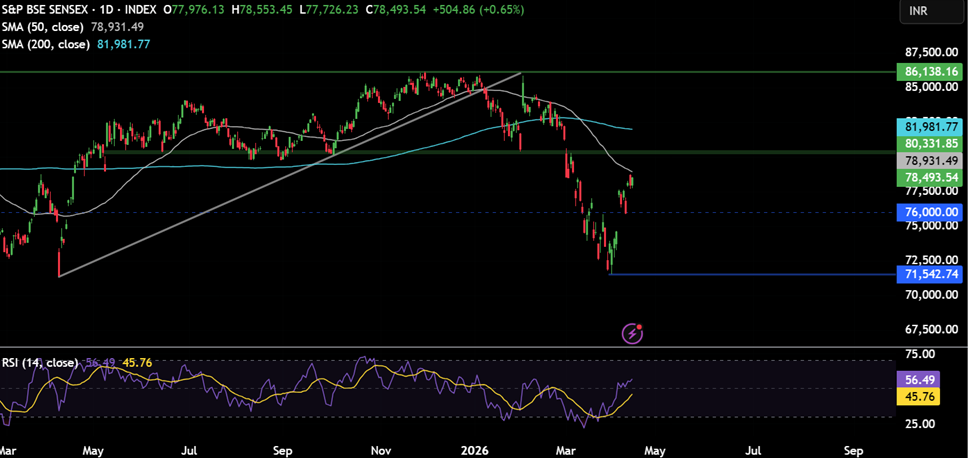
However, unstable market conditions and inflationary pressures from the Iran war have damped growth expectations. India is among the countries particularly vulnerable to higher energy costs from the war. Weak data could pull on the Sensex and the Rupee.
US PMIs (Thursday)
The US composite PMI fell to 50.3 in March, its lowest level in nearly three years, as overall business activity lost momentum. The services PMI dropped to 49.8, entering contraction for the first time since 2023, while manufacturing remained more resilient at 52.3, marking an eighth consecutive month of expansion.
The April release will offer a timely indication of how the US economy is navigating ongoing uncertainty stemming from the Middle East conflict. Expectations are for a modest improvement in the composite PMI, though downside risks remain, particularly if weakness in services persists.
A further slowdown in activity could raise concerns about growth, while any stickiness in inflation would complicate the Federal Reserve’s outlook, reinforcing the current tension between growth and price stability. Weak data could drag on US stocks and the S&P 500.
Trading involves risk.
Author



 Risk Disclaimer
The content provided here is for informational purposes only. It is not intended as personal investment advice and does not constitute a solicitation or invitation to engage in any financial transactions, investments, or related activities. Past performance is not a reliable indicator of future results.
The financial products offered by the Company are complex and come with a high risk of losing money rapidly due to leverage. These products may not be suitable for all investors. Before engaging, you should consider whether you understand how these leveraged products work and whether you can afford the high risk of losing your money.
The Company does not accept clients from the Restricted Jurisdictions as indicated in our website/ T&C. Some services or products may not be available in your jurisdiction.
The applicable legal entity and its respective products and services depend on the client’s country of residence and the entity with which the client has established a contractual relationship during registration.