6 min read
 USD/JPY is back where it started the month. After Japanese authorities intervened in early May and sent the pair sharply lower from above 160, the yen has steadily handed those gains back, and USD/JPY is now trading near 159.5, just below the level where Tokyo last stepped in.
The driver is familiar. The oil-led inflation from the Iran conflict is keeping the Federal Reserve hawkish and the dollar firm, while the yen, the currency of a major energy importer, sits on the wrong side of that shock. With the Bank of Japan meeting on 15 to 16 June now in view, the pair is retesting a ceiling that has held for nearly three years.
What is pressuring the yen
- Oil and inflation: with Brent back above $100, energy-driven inflation is keeping the Fed on hold. Japan imports almost all of its energy, so the same shock feeds straight into its costs. BoJ Governor Kazuo Ueda has flagged the need to watch oil’s impact on inflation, but offered no clear hint of a near-term hike.
- The rate gap: the Fed sits at 3.50 to 3.75% and the BoJ at 0.75%, a differential of roughly 300 basis points that keeps the carry trade pulling buyers back in on dips.
- Intervention buys time, not a trend change: the early-May intervention (an estimated ¥5.5 trillion, around $35 billion) drove a sharp drop, but price has since round-tripped back to the same zone.
The bigger picture: a multi-year range
USD/JPY has traded inside a well-defined range since mid-2023: roughly 140 on the floor, 160 to 162 on the ceiling, with the 150 area acting as the mid-range equilibrium. Behaviour inside that range has been notably cyclical.
The pair is now back testing the upper boundary, the same zone where intervention has repeatedly originated and where the carry trade violently unwound in August 2024.
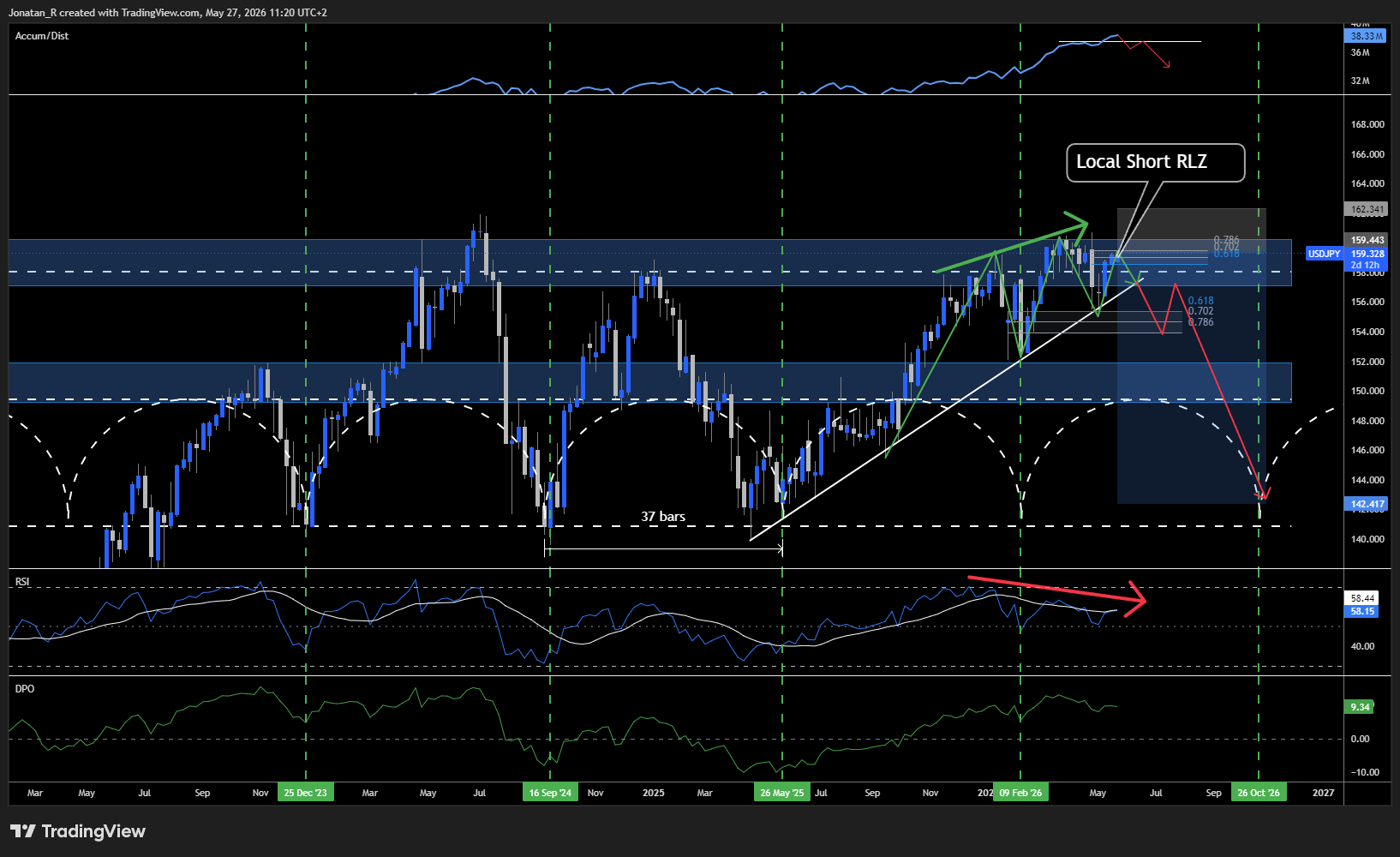
What the weekly chart appears to show
- Momentum divergence: price has been grinding to higher highs into resistance while the weekly RSI makes lower highs. RSI is still holding above 50, so this reads as a potential warning rather than a confirmed shift.
- Resistance confluence: the 159 to 162 band lines up with a cluster of Fibonacci retracement levels and the structural range ceiling.
- Cycle timing: a detrended price oscillator set to the pair’s dominant rhythm (around 37 weeks) is sitting near the top of its range, consistent with a late stage in the up-phase of the cycle, which projects a potential low into around October 2026.
- The signal still pointing higher: accumulation/distribution remains in a weekly uptrend, suggesting buying pressure is still in control. A break of that uptrend, which could come on a move below 156, may be an early sign that momentum is rotating.
The BoJ on 15 to 16 June is the catalyst in focus
The next BoJ decision lands on 15 to 16 June. Markets are pricing high odds of a 25 basis point hike to 1.0%, after the board voted 6 to 3 to hold at 0.75% in April, with three members dissenting in favour of an immediate increase.
A hawkish surprise could narrow the rate gap and potentially trigger a carry-trade unwind, the same dynamic that sent the Nikkei down around 12% in a single session in August 2024. The oil-driven inflation from the Iran conflict is part of what keeps that hike on the table.
Key levels to watch
Resistance:
- 160 to 162 — the multi-year range ceiling and the intervention zone, reinforced by a Fibonacci retracement cluster
- A sustained move above 162 could reopen the multi-decade highs
Support:
- 156 — a near-term level; a break here could coincide with a shift in the momentum signals
- 150 — the range equilibrium and the magnet in the middle of the range
- 142 — deeper range support, near the area the cycle work highlights
- 140 — the range floor
What to watch
- The BoJ decision on 15 to 16 June and any shift in tone on rate normalisation
- Any fresh intervention by Japanese authorities near the 160 ceiling
- The path of oil prices and US inflation, which continue to shape Fed expectations and the rate differential
- Macro prints such as US PCE and growth data for any change in the Fed outlook
For more on how the pair was positioned heading into this round-trip, see our analysis from early May.
Trading involves risk.
Author



 Risk Disclaimer
The content provided here is for informational purposes only. It is not intended as personal investment advice and does not constitute a solicitation or invitation to engage in any financial transactions, investments, or related activities. Past performance is not a reliable indicator of future results.
The financial products offered by the Company are complex and come with a high risk of losing money rapidly due to leverage. These products may not be suitable for all investors. Before engaging, you should consider whether you understand how these leveraged products work and whether you can afford the high risk of losing your money.
The Company does not accept clients from the Restricted Jurisdictions as indicated in our website/ T&C. Some services or products may not be available in your jurisdiction.
The applicable legal entity and its respective products and services depend on the client’s country of residence and the entity with which the client has established a contractual relationship during registration.