9 min read
 Weekly Recap:
US Global stocks recap
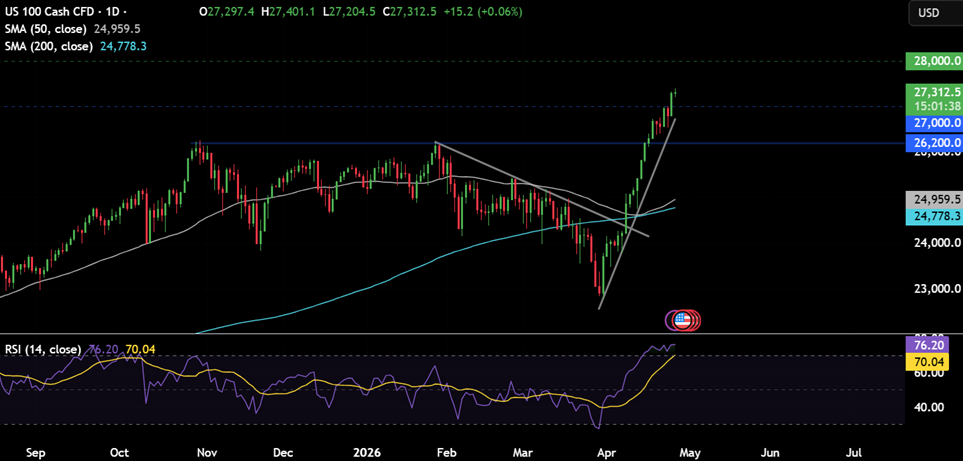
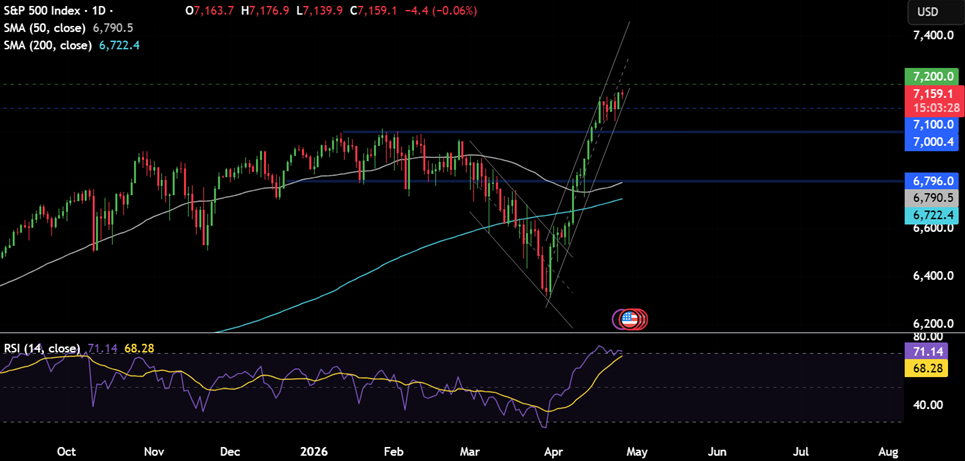
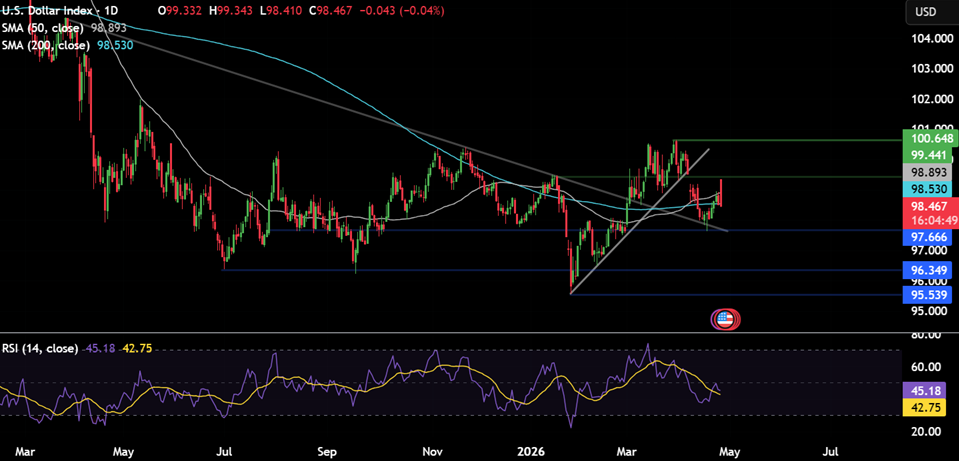
US stocks ended last week broadly higher, with both the S&P 500 and the Nasdaq reaching record highs. Positive economic data, continued strength in AI-related stocks, and upbeat corporate earnings helped offset ongoing uncertainty surrounding the US–Iran conflict. The USD rose after 3 weeks of declines.
Major US data/themes
Earnings season has been a key focus, with around 20% of S&P 500 companies reporting so far. Of those, 84% have beaten estimates, with year-on-year earnings growth running at 15.1%, putting the index on track for a sixth consecutive quarter of double-digit growth.
On the data front, retail sales jumped 1.7% in March, marking the strongest monthly increase since 2023, driven largely by a 15% surge in gasoline sales.
Gold moves
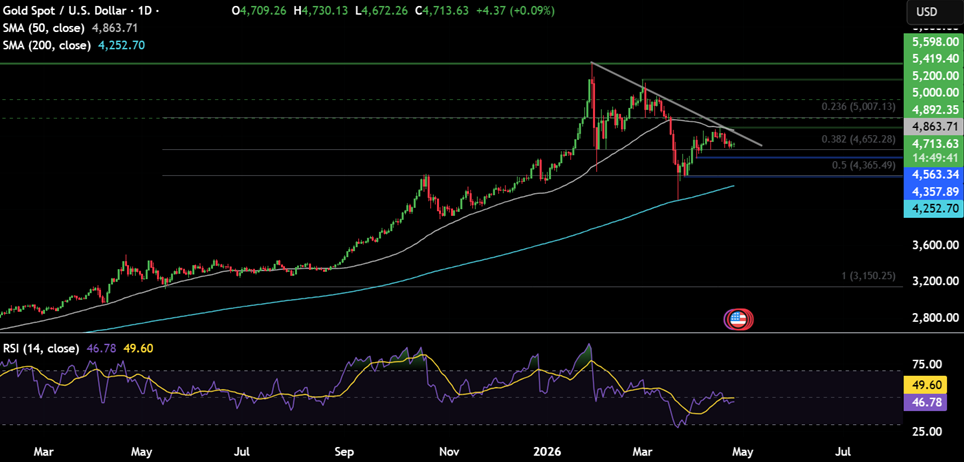
Gold prices fell 2.5% last week, ending a four-week winning streak and dropping to their lowest level in over a week. The decline came as concerns grew that the inflationary fallout from the Middle East conflict could keep interest rates higher for longer.
Ongoing uncertainty—including the risk of a ceasefire breakdown, the continued closure of the Strait of Hormuz, and the collapse of peace talks—has pushed oil prices above $105 per barrel. This has lifted inflation expectations and weighed on demand for non-yielding gold. A stronger US dollar is also pressuring gold, as it tracks higher US Treasury yields.
Looking ahead, attention will turn to the Federal Reserve rate decision. A more hawkish tone, alongside solid GDP data and hotter core PCE figures, could further limit upside in gold.
Oil moves
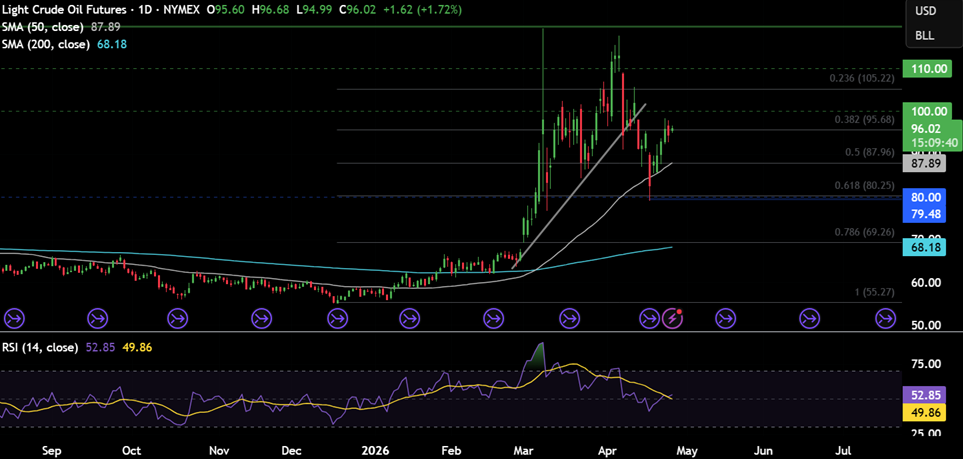
Oil prices rose sharply last week, with WTI up 15% and Brent climbing 17% to above $105 per barrel, as the Strait of Hormuz remains closed, fuelling supply concerns. Renewed military escalation and stalled peace talks continue to unsettle investors.
For over 50 days, around 13 million barrels per day of crude oil have been blocked, creating an unprecedented supply disruption. With storage nearing capacity, refineries are cutting output, and price-sensitive consumers are reducing demand.
JPMorgan estimates a 4.3 million barrel-per-day drop in global demand in April, with around 80% of the decline coming from Asia and the Middle East. The International Energy Agency has warned that European jet fuel stocks could fall to critically low levels by June. Unless the Strait reopens, oil prices are likely to rise further.
Indian markets
Indian markets ended a two-week winning streak, closing lower last week. Rising geopolitical tensions weighed on sentiment, with the Nifty 50 falling 1.8% and the Sensex declining 2.3%.
The move was driven by surging crude oil prices, weakness in the rupee, and continued foreign investor outflows. Sector-wise, IT stocks gave up gains from the previous five weeks, falling over 10%, while energy stocks provided some support.
Foreign institutional investors have remained net sellers throughout April, with total outflows of ₹56,363 crore.
Domestic institutional investors have partially offset this, purchasing ₹39,478 crore worth of equities so far this month.
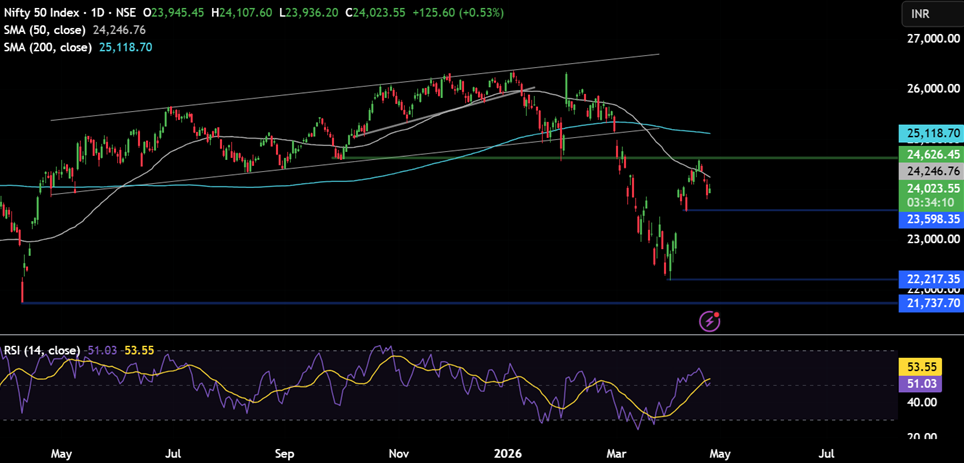
Key Indian market drivers: Indian industrial production data could attract some attention, and Indian domestic political developments will also be in focus, with assembly elections progressing across key states. The second phase of polling in West Bengal is scheduled for April 29, with early trends likely to shape sentiment.
Attention will also be on the Federal Reserve rate decision on Wednesday. While rates are expected to remain unchanged, comments from Jerome Powell will be key. Core PCE inflation, the Fed’s preferred gauge, is due on May 1 and is expected to remain elevated.
Corporate earnings remain important, with a significant number of companies set to report from both India and the US.
USD/INR gained 1.8% last week, settling on Friday at 94.25, amid a stronger USD and as the Rupee struggled owing to FII outflows and rising oil prices.
Pakistan markets
After two weeks of gains, the Pakistan Stock Exchange declined last week as rising tensions in the Strait of Hormuz and higher oil prices weighed on investor confidence. The index closed at 70,672 points, down around 1.9% for the week, and remained under pressure amid delays in a second round of US–Iran negotiations, and despite President Trump extending the ceasefire.
Some domestic developments provided support. Pakistan received a $1 billion tranche from Saudi Arabia as part of a $3 billion support package and repaid $3.45 billion to the UAE on maturing deposits.
The State Bank of Pakistan reported that foreign exchange reserves rose by $18 million to $15.1 billion.
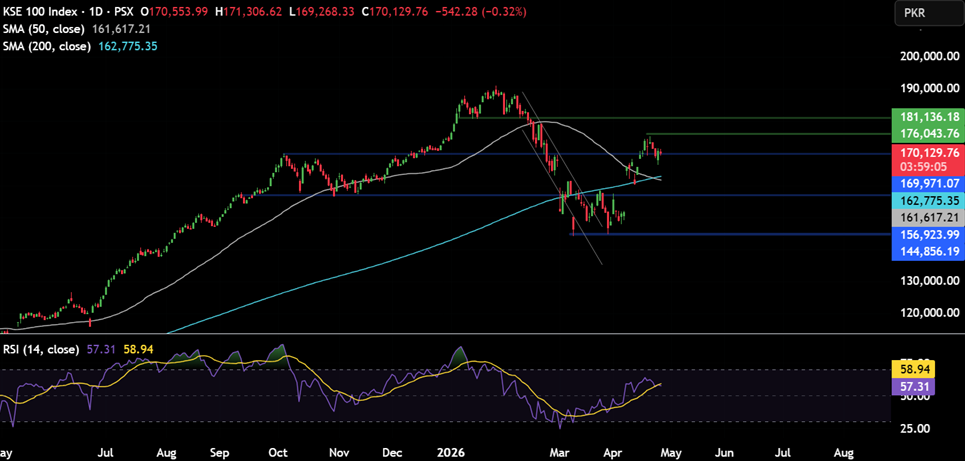
Looking ahead, markets will remain focused on US–Iran developments, the ongoing earnings season, and the upcoming monetary policy decision on Monday.
The Pakistani Rupee rose 0.78% last week against the USD, settling on Friday at 278.95, despite a stronger USD. USD/PKR is falling further at the start of this week.
Week Ahead (US & Asia)
State Bank of Pakistan – Rate decision (Monday)
The State Bank of Pakistan is set to hold its third monetary policy meeting this year on April 27 to decide on interest rates amid changing economic and external conditions. Expectations are tilted towards a possible rate hike.
A recent poll showed that 53% of participants expect an increase of 50–100 basis points, driven by inflation pressures from higher energy prices, while 43% expect no change. Inflation expectations remain elevated, with 51% of respondents projecting inflation above 9% over the next 12 months.
Tech earnings
This week, the spotlight will be on earnings, with five of the “Magnificent Seven” set to report. This includes Microsoft, Alphabet, Amazon, and Meta Platforms on Wednesday, followed by Apple on Thursday.
These tech heavyweights have powered much of the US economy over the past decade, although they came under pressure in the first quarter before recovering in recent weeks. Magnificent Seven’s net income is expected to grow around 25% in 2026, compared to roughly 11% for the rest of the S&P 500, with this outperformance expected to extend into 2027.
The group has returned around 13% over the past month, outperforming the S&P 500’s 9% gain. These results will act as a key test of investor appetite for tech stocks since the Iran conflict began and will also provide insight into how companies are approaching large-scale AI spending plans.
FOMC decision (Wednesday)
The Federal Reserve is expected to leave rates unchanged at 3.50%–3.75%, where they have been since January, as policymakers assess the impact of the Iran conflict.
Markets had previously priced in two to three rate cuts this year, but rising oil prices and inflation risks have reduced expectations to roughly a 50% chance of one cut. Even some of the more dovish policymakers have acknowledged that inflation remains too high. The Fed will not release updated economic projections; these are not expected until June.
This meeting could be one of Powell’s final appearances as Chair, with Kevin Warsh undergoing the confirmation process as his potential successor. Concerns about central bank independence remain a key theme.
Should Powell highlight the resilience of the US economy, this could support the view that the Fed will keep rates high for longer, boosting the USD and pulling Gold and stocks lower.
US Q1 GDP & Core PCE (Thursday)
Attention will also be on US Core PCE inflation, following the recent rise in oil prices. Headline PCE is expected to remain firm in March, but the focus will be on core PCE, which excludes volatile components such as food and energy and provides a clearer view of underlying inflation trends.
Core PCE—the Federal Reserve’s preferred inflation gauge—is expected to rise 0.2% month-on-month, down from 0.4% in February, with the annual rate edging up to around 3.1% from 3.0%. A stronger-than-expected reading could support the US dollar against its major peers and weigh on equity markets.
GDP data is also due. According to the Federal Reserve Bank of Atlanta’s GDPNow model, preliminary Q1 GDP is expected to come in around 1.2%, up from final Q4 growth of just 0.5%, which was impacted by the government shutdown, but down from the stronger 4.4% growth recorded in Q3.
Following the weakness seen in Q4, investors will be watching closely for signs that inflation pressures are gaining traction. However, it is worth noting that consumer spending appears to have held up through the quarter. A rebound in government spending after the Q4 shutdown is also expected to support growth.
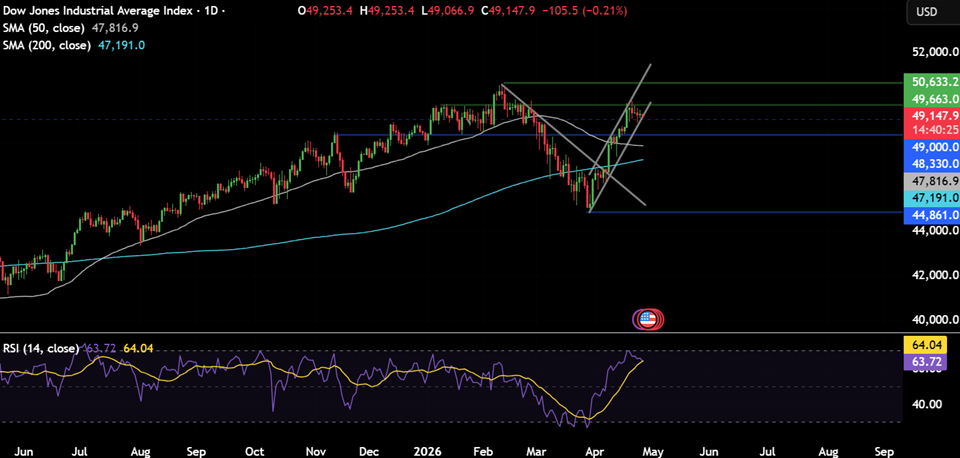
That said, signs of slowing growth combined with sticky inflation present a challenging backdrop for the Federal Reserve—the kind of environment that could keep rate cut expectations at bay and drag on stocks such as the Dow Jones.
Trading involves risk.
Author



 Risk Disclaimer
The content provided here is for informational purposes only. It is not intended as personal investment advice and does not constitute a solicitation or invitation to engage in any financial transactions, investments, or related activities. Past performance is not a reliable indicator of future results.
The financial products offered by the Company are complex and come with a high risk of losing money rapidly due to leverage. These products may not be suitable for all investors. Before engaging, you should consider whether you understand how these leveraged products work and whether you can afford the high risk of losing your money.
The Company does not accept clients from the Restricted Jurisdictions as indicated in our website/ T&C. Some services or products may not be available in your jurisdiction.
The applicable legal entity and its respective products and services depend on the client’s country of residence and the entity with which the client has established a contractual relationship during registration.