9 min read
Bitcoin declined by over 3.5% last week, bringing losses over the past two weeks to 7%. The largest cryptocurrency started last week at 68.8k, briefly rose to 72k, then fell to 66.3k by the end of the week. The price has risen modestly to 67k at the start of the new week.
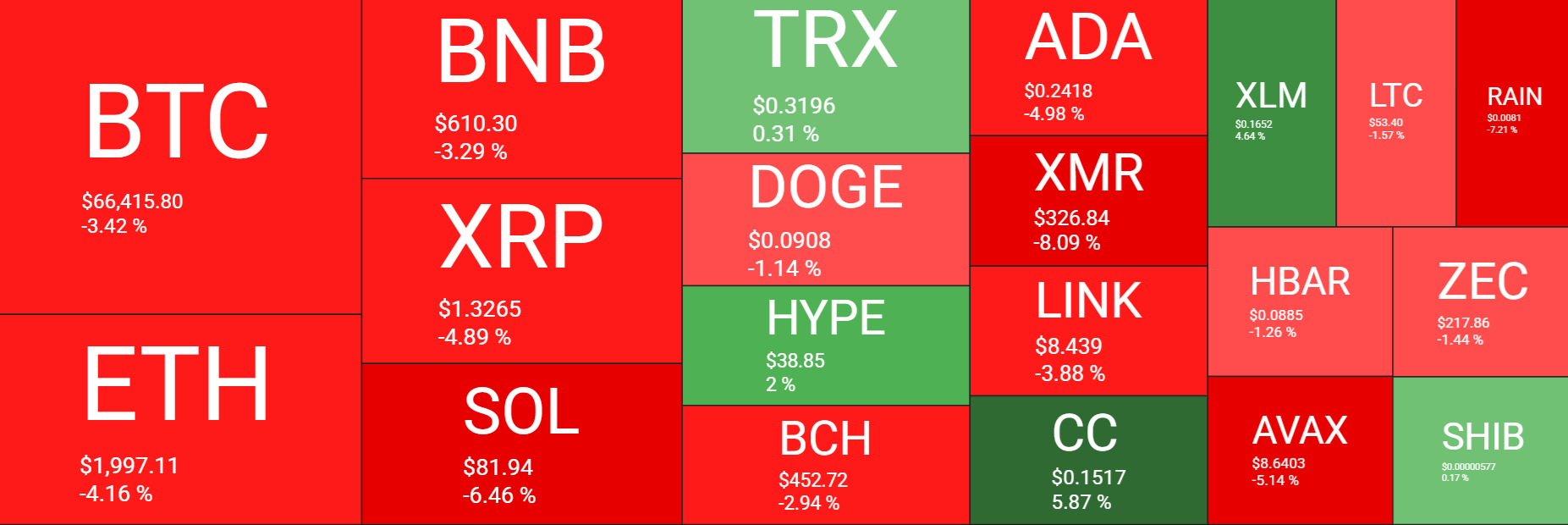
While BTC fell, altcoins were a mixed bag. Ethereum and Ripple took a harder hit, dropping 4.1% and 4.8% respectively, while Solana tumbled over 6%. However, some altcoins gained ground. HYPE rose 2%, and XLM rallied over 4%, diverging from BTC.
The total cryptocurrency market capitalisation has declined to $2.29 trillion, down from a peak of $2.45 trillion on Wednesday, and also a three-week low.
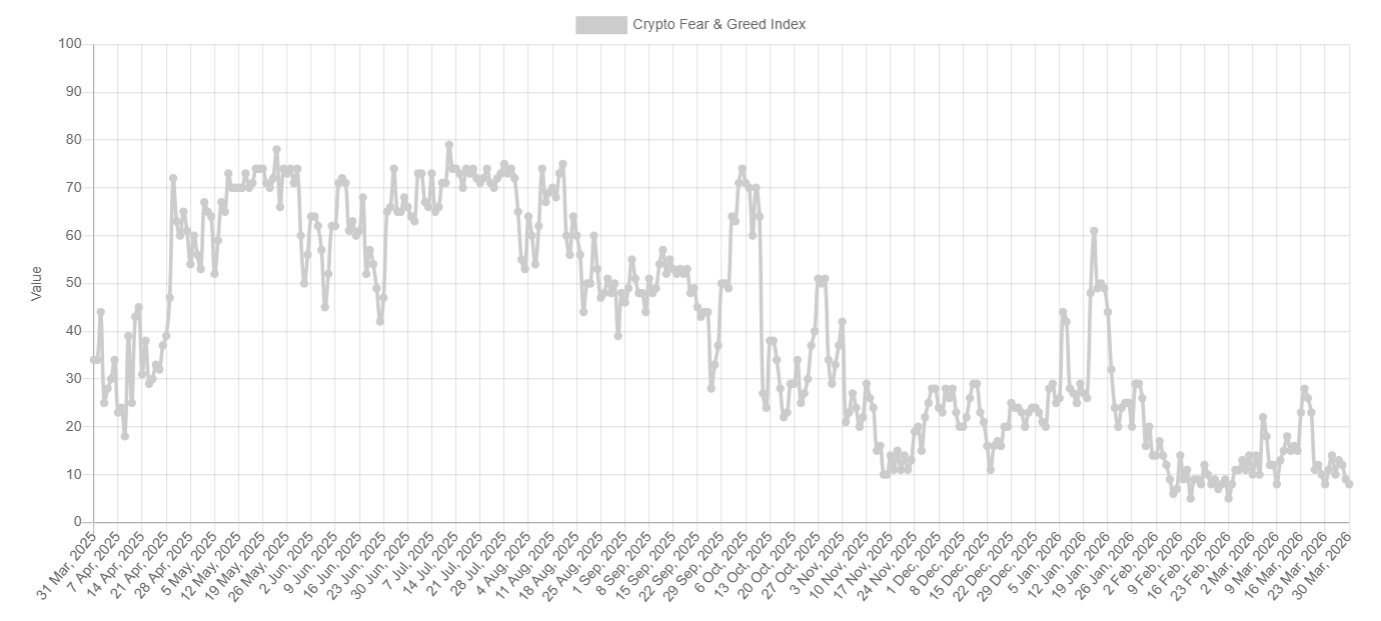
Market sentiment weakened further to 9 on the Alternative.me Fear and Greed index, down from 10 last week and remaining in Extreme Fear.
Institutional flows turn mixed
Institutional flows reflected the more cautious market tone seen last week.
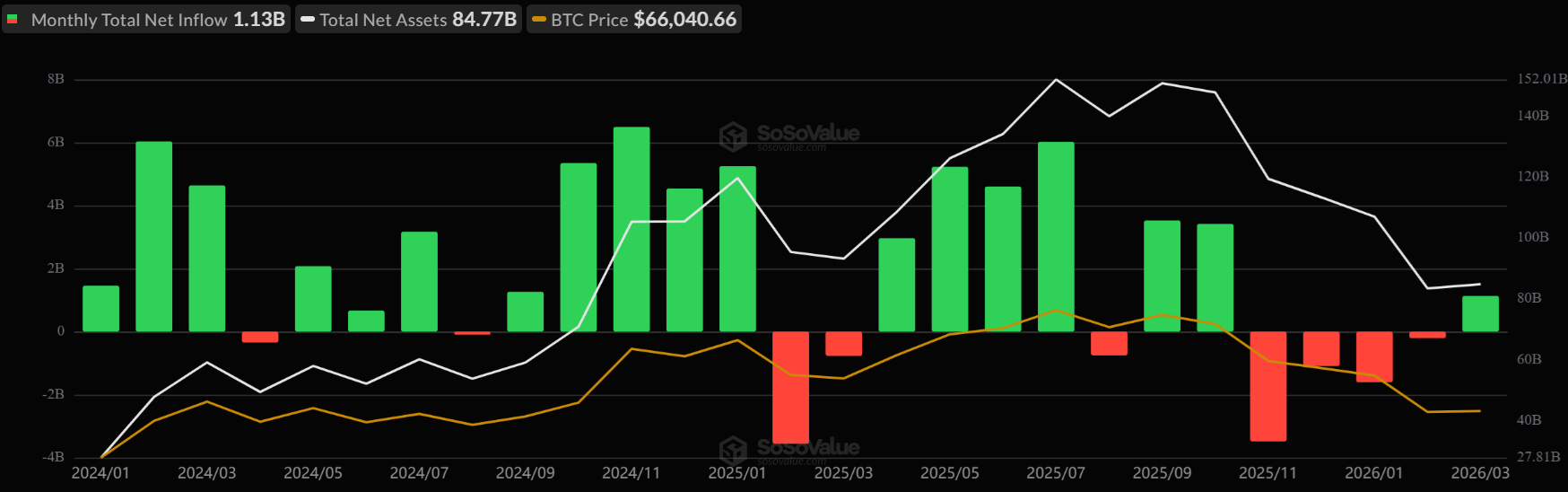
Spot Bitcoin ETFs began last week on a stronger footing, recording net inflows of $167.2 million on Monday. However, sentiment quickly deteriorated, with flows reversing sharply and spot BTC ETFs ending the week with net outflows of $269.1 million — the first weekly outflow after four consecutive weeks of inflows.
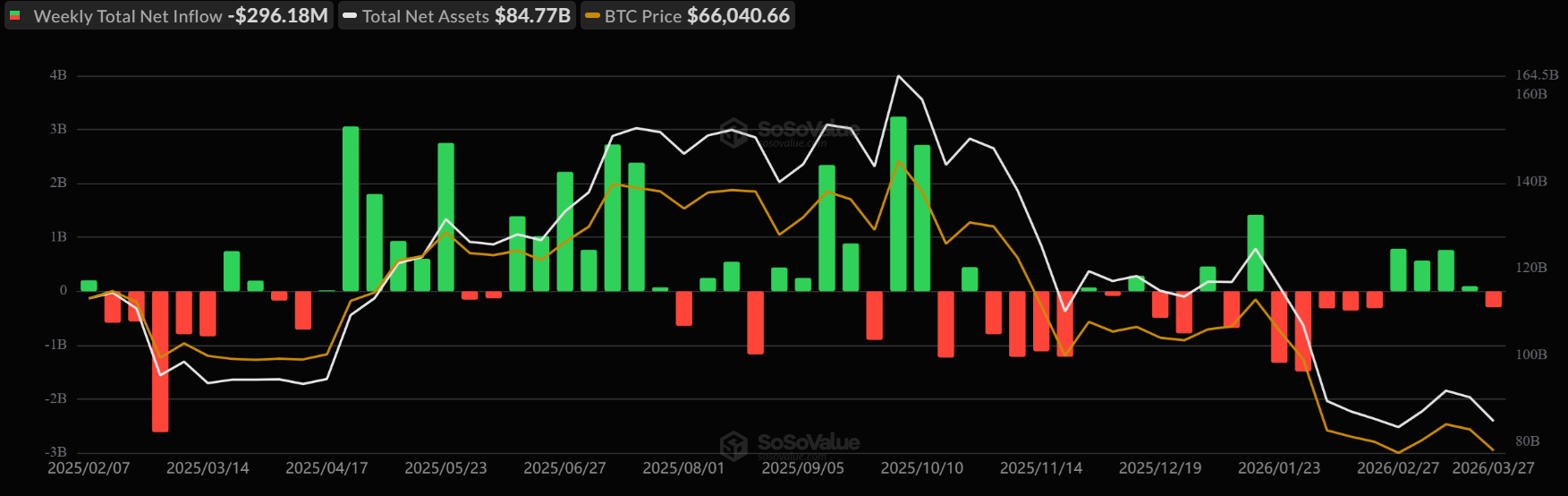
That said, March still recorded $1.13 billion in total net inflows, marking the first month of positive ETF demand after four straight months of outflows. Still, the fading momentum seen this week raises concerns over the near-term outlook. For Bitcoin to avoid a deeper correction, institutional demand will likely need to reaccelerate.
Strategy remains the dominant corporate buyer
On the corporate side, Strategy announced last Monday that it had purchased a further 1,031 BTC for $76.6 million, following a much larger purchase of 22,337 BTC the previous week. That takes the firm’s total Bitcoin holdings to 762,099 BTC. These purchases came despite rising uncertainty across global markets, although Strategy’s average purchase price now stands at $75,694 — above Bitcoin’s current market price.
However, it is becoming increasingly clear that Strategy is effectively the only major driver of corporate Bitcoin treasury demand.
According to a recent CryptoQuant report, Strategy accumulated more than 45,000 BTC over the past 30 days — its most aggressive 30-day buying pace since April 2025. In contrast, other Bitcoin treasury companies purchased just 1,000 BTC over the same period, marking a 99% drop from the peak of 69,000 BTC seen in August last year.
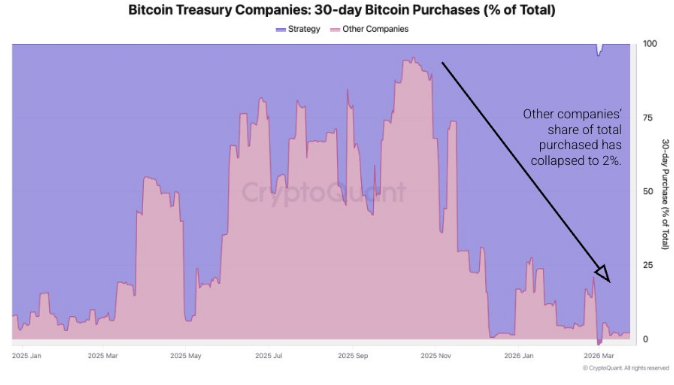
That matters because Strategy alone is unlikely to provide enough support to sustain Bitcoin’s price over the longer term.
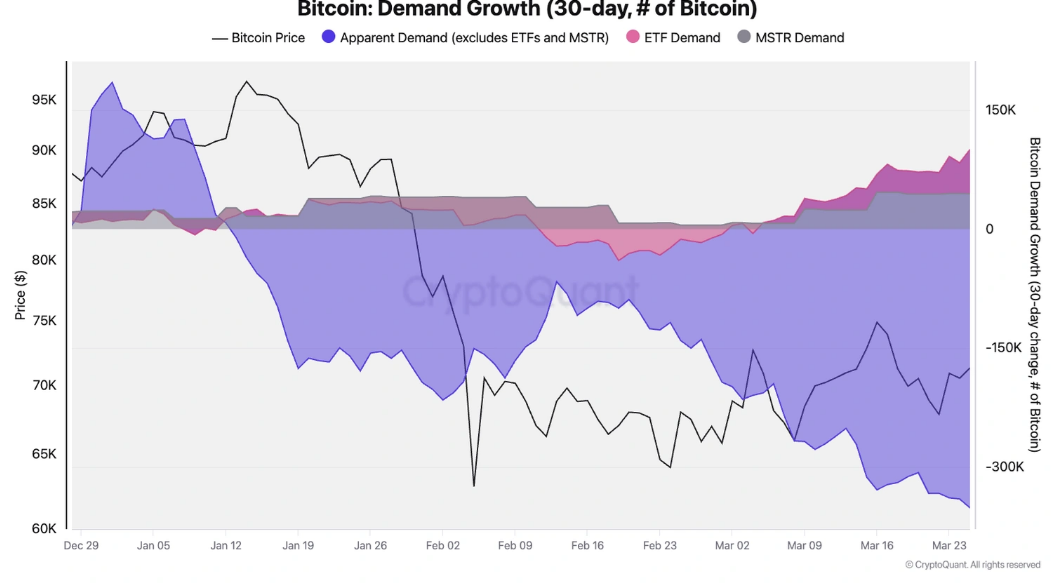
Indeed, Bitcoin demand excluding ETFs and Strategy contracted by 452,000 BTC over the last 30 days — highlighting broader weakness beneath the surface.
Macro backdrop
While Bitcoin rebounded 5% last Monday after US President Trump postponed planned attacks on Iranian energy infrastructure, citing “productive talks” between the two sides, that optimism has since faded.
Trump’s comments initially boosted risk sentiment, helping both US equities and Bitcoin increase on Monday. However, as the week progressed, uncertainty over whether those talks were genuine remained elevated. The TACO (Trump Always Chickens Out) trade failed to materialise, partly because it would also require Iran’s cooperation.
Heading into the new week, hopes of de-escalation are fading. The US is sending an additional 10,000 troops to the region, along with another aircraft carrier, raising concerns that tensions in the Middle East are escalating rather than easing. Iran has responded by warning against any US ground invasion, while Israeli Prime Minister Benjamin Netanyahu is reportedly planning to widen operations into southern Lebanon.
The Strait of Hormuz remains effectively closed, and attention is now also turning to Bab el-Mandeb — another critical energy chokepoint off the coast of Yemen. If the Iran-backed Yemen Houthis become more directly involved in the conflict, there is growing concern they could attempt to disrupt traffic through this route as well, and potentially the Suez Canal, sending oil prices even higher.

These developments are fuelling fears over the inflationary impact of the conflict, which is now being reflected in the global bond market. Treasury yields have surged, with the 10-year US Treasury yield approaching 4.5% — its highest level since July.
That matters for Bitcoin because higher yields tighten financial conditions, reduce liquidity, and make risk assets such as crypto less attractive relative to safer income-generating alternatives. US stocks also fell sharply last week, with the Nasdaq dropping into correction territory, down 10% from its record high.
This week will see US economic data releases, including non-farm payrolls, ISM services, manufacturing PMIs, and retail sales data. The markets will be looking for signs of inflationary pressures building. A strong jobs report, combined with rising inflationary pressures, could see treasury yields rise further and increase expectations for Federal Reserve rate hikes. This could weigh on BTC further.
Why does BTC look vulnerable?
While the macro backdrop is deteriorating and rising treasury yields are headwinds, Bitcoin leverage and on-chain activity could also be reasons for concern.
Bitcoin long positions on Bitfinex have surged to 79,343 BTC, marking the highest level since November 2023 — a move that could be acting as a warning signal. Historically, similar buildups in leveraged long positions have often coincided with local tops, followed by sharp declines.
This metric typically reflects margin traders positioning for further upside, but when long positioning becomes too crowded, the market can become increasingly fragile.
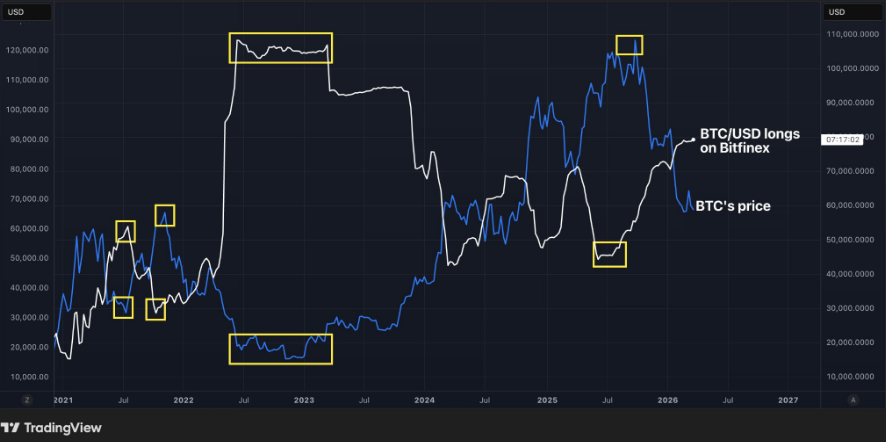
When too many traders are already long, fewer buyers remain to sustain upward momentum, which can cause rallies to stall. In addition, these positions are often leveraged, meaning even a modest decline in Bitcoin’s price can trigger liquidations and set off a broader cascading sell-off.
This is particularly relevant as Bitcoin has recently been trading in a relatively tight range and continues to struggle below key resistance, increasing the risk of a downside break.
On-chain activity is also weakening
Bitcoin is also showing signs of internal weakness, with active addresses falling sharply.
According to CryptoQuant data, the number of active Bitcoin addresses has dropped by more than 30% from peak levels seen in 2025.
The active addresses metric is important because it measures network participation — essentially tracking the number of unique wallet addresses sending or receiving Bitcoin over a given period. It is often used as a gauge of whether network usage and underlying demand are strengthening or weakening.
BTC Technical analysis
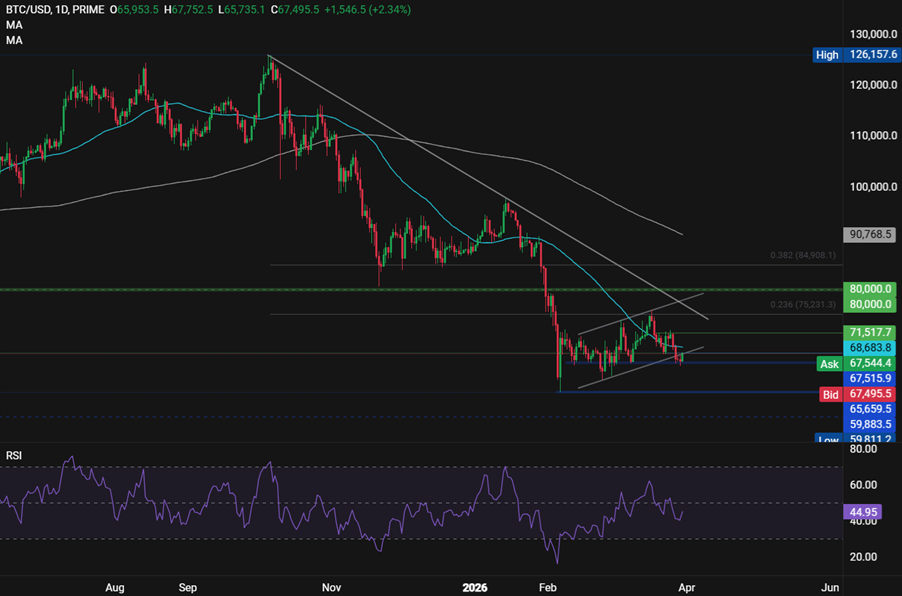
BTC attempted to break out of the bear flag pattern, but found support at 65k and recovered to 67k. The price remains below its 50 SMA in a bearish pattern.
Sellers will look to break below 65k to bring 60k, the 2026 low, into focus.
Any recovery must rise above 68.7k, the 50 SMA, and the lower band of the bear flag. Above here, 71k and 76k come into focus.
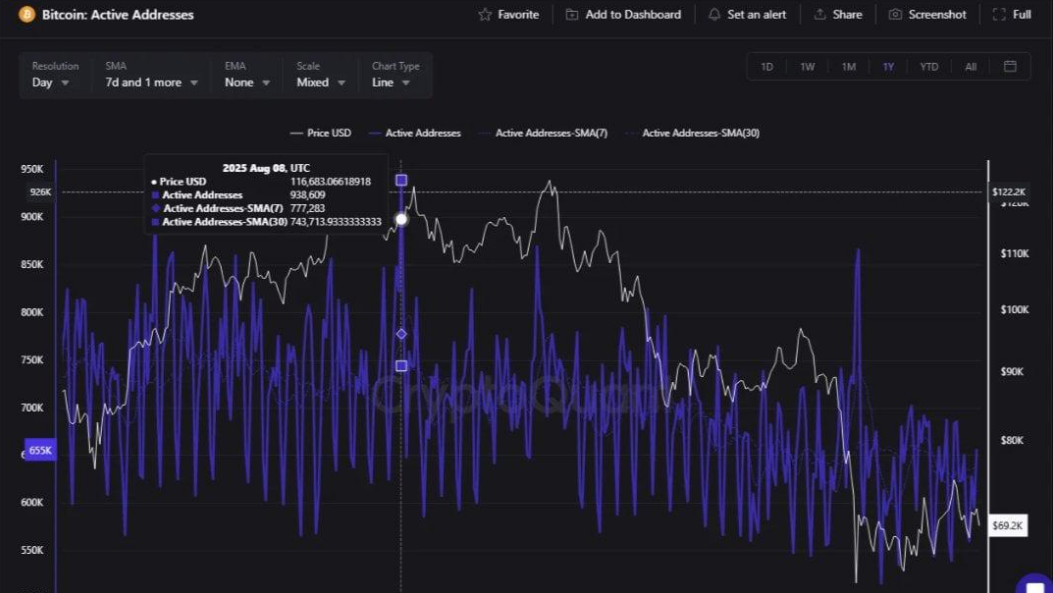
The data shows that Bitcoin recorded 938,609 active addresses on August 8, but that figure had fallen to 655,908 by March 25.
The 7-day moving average has also declined, falling from 777,283 to 612,972, representing a 21.1% drop. Because this decline has persisted for several months, it is unlikely to reflect just short-term volatility. Instead, it points to a more sustained cooling in user activity and participation.
That matters because Bitcoin’s price action has already become more fragile, and weakening network performance adds to concerns that the broader ecosystem is seeing lower capital rotation, fewer transactions, and softer organic demand.
A recovery in network participation may be needed for Bitcoin to stage a more durable rebound.
Trading involves risk.
Author



 Risk Disclaimer
The content provided here is for informational purposes only. It is not intended as personal investment advice and does not constitute a solicitation or invitation to engage in any financial transactions, investments, or related activities. Past performance is not a reliable indicator of future results.
The financial products offered by the Company are complex and come with a high risk of losing money rapidly due to leverage. These products may not be suitable for all investors. Before engaging, you should consider whether you understand how these leveraged products work and whether you can afford the high risk of losing your money.
The Company does not accept clients from the Restricted Jurisdictions as indicated in our website/ T&C. Some services or products may not be available in your jurisdiction.
The applicable legal entity and its respective products and services depend on the client’s country of residence and the entity with which the client has established a contractual relationship during registration.