6 min read
 The structural picture for oil has shifted in just over a week. When we last covered Brent on April 23, the focus was on the peace premium evaporating as the Hormuz situation deteriorated. Since then, two new catalysts have stacked on top of an already constructive setup.
On Tuesday, April 28, the UAE announced it is exiting both OPEC and OPEC+, effective May 1. The UAE has a production capacity of around 4.8 million barrels per day, against a quota that had capped it at roughly 3.2 million. Outside the cartel, that constraint disappears. Alongside Saudi Arabia, the UAE was one of the few OPEC members holding meaningful spare capacity to absorb supply shocks. That balancing function now sits with fewer hands at the worst possible moment.
On Wednesday, April 29, Trump confirmed that the US naval blockade of Iranian ports will be extended until Iran agrees to a nuclear deal. He also rejected Iran’s latest proposal to reopen the Strait of Hormuz. The framing has shifted from a temporary disruption to an open-ended supply constraint, and Brent broke higher in response.
A structurally weakened cartel, an extended blockade, and a conflict that is no closer to resolution. That is the macro setup heading into today’s chart.
The daily chart: testing the range highs
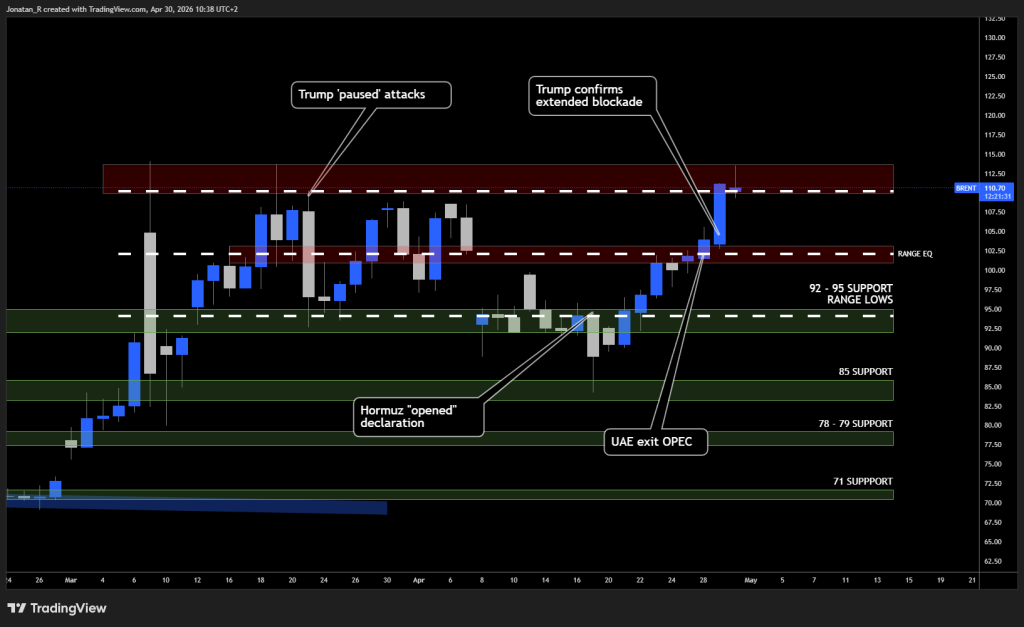
After bouncing off the $85 support, the area where Brent dumped on the brief Strait of Hormuz reopening narrative, the market quickly retraced as it became clear that the reopening was not the risk-off event some had hoped for.
The next two catalysts arrived in quick succession:
- April 28 (UAE exits OPEC): Brent broke above the $102 range EQ, clearing the key resistance and reclaiming the upper half of the range
- April 29 (Trump confirms extended blockade): a large bullish day pushed price up into the range high resistance zone at $110 to $114
Brent is now in the upper half of the broader range, with the range lows sitting at $92 to $95 and the range highs at $110 to $114. The daily is currently testing that upper resistance zone, but has not broken cleanly above it.
The 4H chart: rejection at the highs and a clear reload zone below
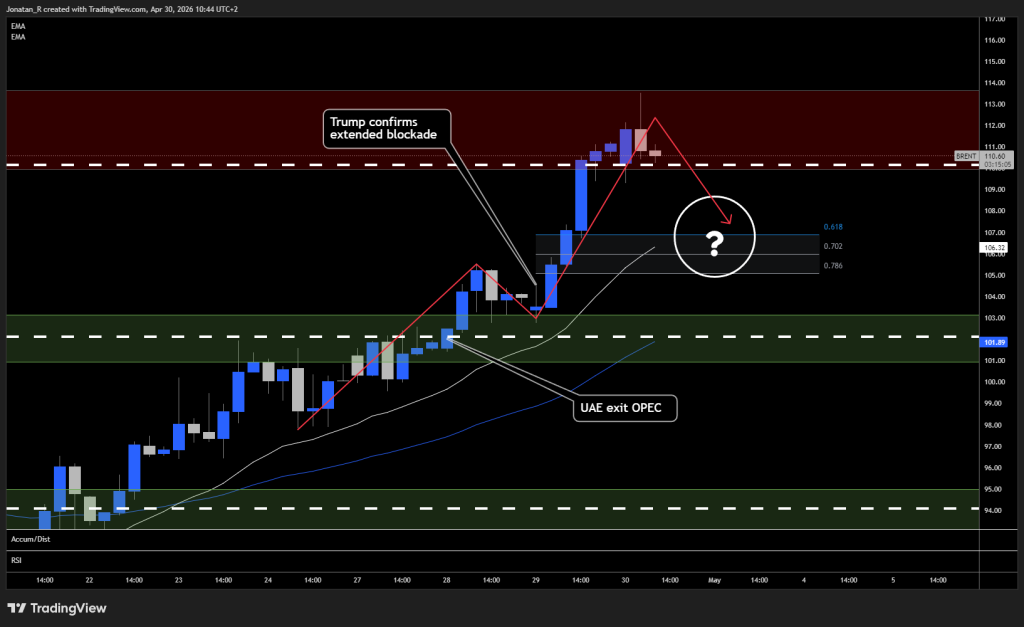
Stepping down to the 4H timeframe, we are seeing a rejection at the range high resistance. The lower timeframe structure gives us a clean level below to watch.
The $106 area stands out as a confluent reload zone:
- Sits between the 0.618 and 0.786 fib retracement of the recent leg up
- Lines up with the 4H 20 EMA, which is curling up from the prior consolidation
If Brent fails to hold above the $110 range and rolls over on the 4H, the path of least resistance could be a move down into that $106 reload zone. That would be a normal pullback within the broader bullish structure, not a breakdown.
A clean break and hold above $114 would be the signal that the range has been resolved to the upside, and could open the door to the next leg higher.
Key levels to watch
Resistance:
- $110 to $114: range highs, currently being tested
- Above $114: clear breakout territory
Support:
- $106: 4H reload zone, fib and 20 EMA confluence
- $102: range EQ, prior resistance flipped to support
- $92 to $95: range lows
- $85: key prior support
- $78 to $79 and $71: deeper support zones
The bottom line
The macro setup for oil has shifted from a war-driven price spike to a structurally tighter market. The UAE’s exit from OPEC and OPEC+ removes a key piece of the cartel’s balancing capacity, while the extended US blockade keeps a meaningful chunk of Middle East supply offline.
Brent is testing the highs of its recent range. A rejection here could send price back to the $106 4H reload zone before the next attempt at the highs. A clean break above $114 would change the technical picture entirely.
Trading involves risk.
Author



 Risk Disclaimer
The content provided here is for informational purposes only. It is not intended as personal investment advice and does not constitute a solicitation or invitation to engage in any financial transactions, investments, or related activities. Past performance is not a reliable indicator of future results.
The financial products offered by the Company are complex and come with a high risk of losing money rapidly due to leverage. These products may not be suitable for all investors. Before engaging, you should consider whether you understand how these leveraged products work and whether you can afford the high risk of losing your money.
The Company does not accept clients from the Restricted Jurisdictions as indicated in our website/ T&C. Some services or products may not be available in your jurisdiction.
The applicable legal entity and its respective products and services depend on the client’s country of residence and the entity with which the client has established a contractual relationship during registration.