5 min read
 Brent crude is grinding back toward the $100 handle, with price now trading close to where it was before Iran’s Hormuz “opened” declaration on April 17 triggered a sharp selloff.
The setup:
- Brent trading around $98, up from the swing low near $86 reached during the April 18-19 weekend reversal
- Trump extended the ceasefire on Tuesday, but Iran has not accepted it and has called the extension “means nothing”
- The US naval blockade of Iranian ports remains in place
- Iran’s Revolutionary Guard seized two more container ships in Hormuz during the first day of the extended ceasefire
- Gulf producer shut-ins are projected to peak at 9.1mn bpd in April according to the EIA
Why the peace premium appears to be evaporating
The selloff that followed the April 8 ceasefire announcement priced in two things: a winding-down conflict and normalising Hormuz flows. Neither assumption appears to be holding up.
- The ceasefire extension is unilateral. Trump’s extension is effectively a US pause on strikes, conditional on Iran presenting a “unified proposal.” Iran has publicly rejected the premise and continues to attack vessels
- Hormuz remains largely closed. Transit dropped to just 3 vessels on April 19, the lowest since the blockade began. Only 8 vessels transited on April 22, including 3 oil tankers. Rystad Energy estimates flows may not reach 90% of pre-war levels until July at the earliest
- Supply is still tightening. Gulf shut-ins averaged 7.5mn bpd in March and are projected at 9.1mn bpd in April. The EIA sees Brent potentially peaking at $115 in Q2
- Products are tightening faster than expected. Yesterday’s EIA report showed gasoline stocks drawing by 4.6mn bbl and distillates by 3.4mn bbl, both well above expectations
The April 15 piece on oil flagged this exact disconnect between the ceasefire narrative and the underlying supply picture.
Daily chart
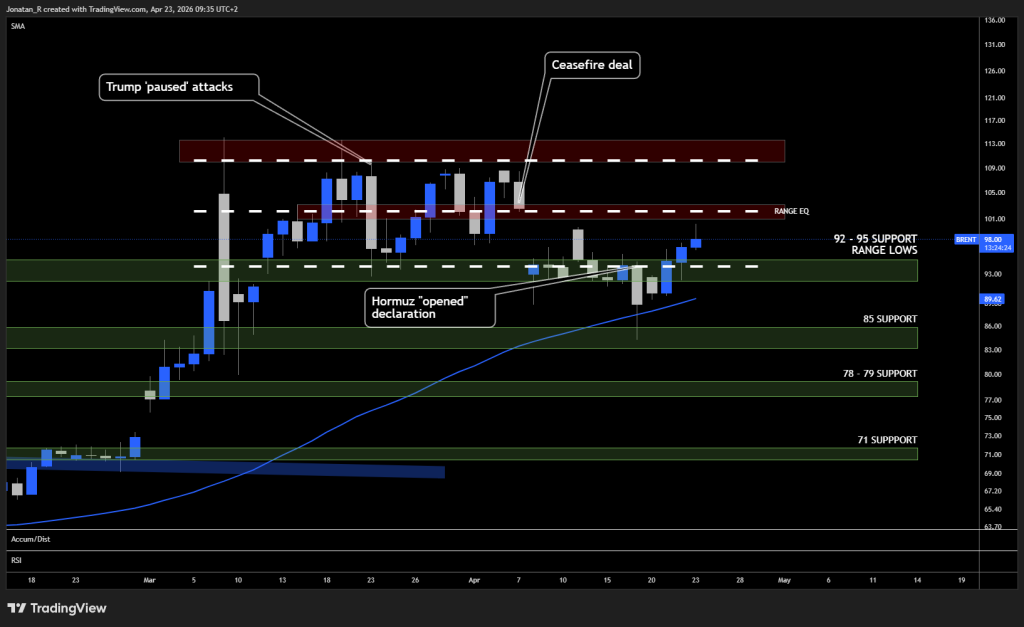
Brent dropped toward the $85 support region in the days following the Hormuz “opened” declaration on April 17, printing a wick that tagged the daily 50 EMA before reversing. Since then, price has covered much of the drop and is now testing the $100 region again, potentially moving back inside the prior range.
Key daily levels:
- Range EQ resistance: $100 to $103 – the immediate battleground
- Range highs resistance: $108 to $113 – the upper range boundary
- Range low support: $92 to $95 – potentially acting as a new base
- $85 support – below the range, tagged on the recent flush
- $78 to $79 support – next level of interest on a deeper break
4H chart
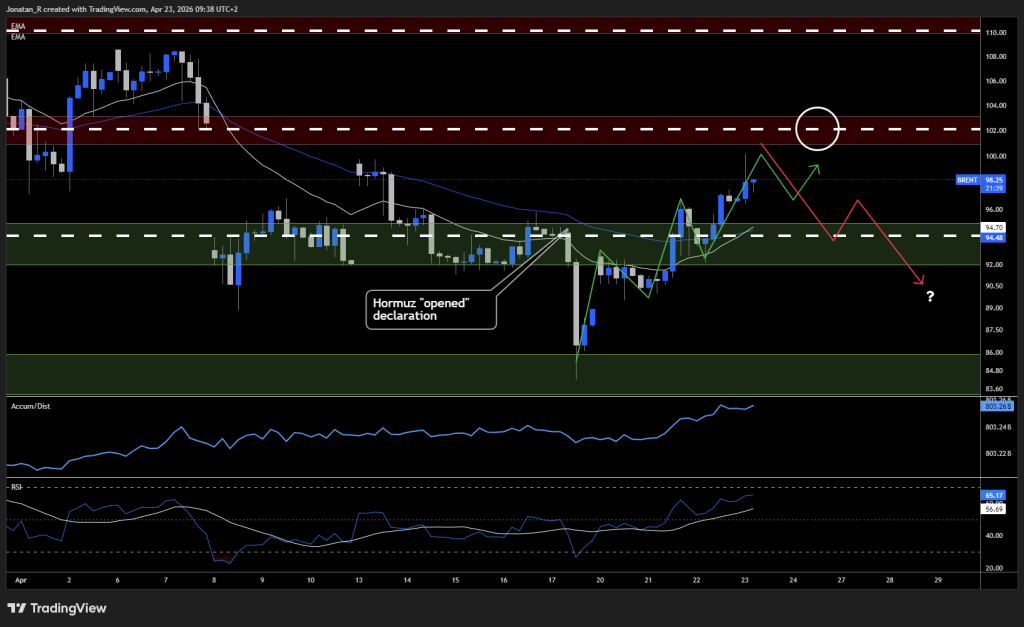
The short-term structure could be described as bullish:
- 20 EMA has crossed back above the 50 EMA
- Accumulation/Distribution breaking to new highs, which could point to sustained buying interest
- RSI back inside the bullish range, currently around 65
Price is now pressing the $100 – $102 resistance zone, which aligns with the daily range EQ. A clean break above $102 could open the door back toward the range highs. A loss of the $92 to $95 support could invalidate the local uptrend and potentially put the $85 region back in play.
What to watch
- $100 to $103 as the immediate resistance. A reclaim as support could open $108 to $113
- $92 to $95 on any pullback. Holding this zone could keep the rebound structure intact
- Hormuz transit data as the clearest real-time signal on whether the blockade is easing or deepening
- The FOMC decision on 29 April. Oil at these levels could reprice the inflation path
- The OPEC+ monthly meeting on 3 May. Any signal on production levels into the post-conflict market could shift the balance of risks
Trading involves risk.
Author



 Risk Disclaimer
The content provided here is for informational purposes only. It is not intended as personal investment advice and does not constitute a solicitation or invitation to engage in any financial transactions, investments, or related activities. Past performance is not a reliable indicator of future results.
The financial products offered by the Company are complex and come with a high risk of losing money rapidly due to leverage. These products may not be suitable for all investors. Before engaging, you should consider whether you understand how these leveraged products work and whether you can afford the high risk of losing your money.
The Company does not accept clients from the Restricted Jurisdictions as indicated in our website/ T&C. Some services or products may not be available in your jurisdiction.
The applicable legal entity and its respective products and services depend on the client’s country of residence and the entity with which the client has established a contractual relationship during registration.