14 min read
 Vaulta (A), the network formerly called EOS, changes hands near $0.066 in early August 2026, a fraction of the price it commanded during the last cycle. It is a layer-1 smart-contract blockchain that ran a delegated proof-of-stake chain for years as one of the original 2018 “Ethereum killers,” then rebranded to Vaulta in 2025 and repositioned around “Web3 banking.” Its EOS tokens swapped one-for-one into a new token, A, during that transition. This page lays out PrimeXBT’s price outlook for EOS/Vaulta through 2030 and out to 2050, the technical levels traders are watching now, and the catalysts that could move it. Every figure is a considered estimate, not a promise, and where the evidence runs thin the text says so plainly.
Vaulta (EOS) outlook at a glance
- 2026 base case: $0.060–$0.090, a year of basing near cycle lows rather than a new trend.
- Main bullish catalyst: the Vaulta Web3-banking pivot winning real adoption, alongside a broad altcoin recovery led by Bitcoin and Fed rate cuts.
- Biggest downside risk: the rebrand fails to regain attention and A loses the $0.056 support, opening the June-2026 low near $0.058 and lower.
- Long-term view: a slow, partial recovery is the base case, but any figure past 2030 is a direction rather than a price and stays far below the 2018 record.
Live Vaulta (EOS) price chart
Trading involves risk.
EOS (Vaulta) price prediction 2026–2030 (yearly forecast)
The table sets PrimeXBT’s expected range for each year. The far more optimistic and far more bearish third-party targets, which rest on incompatible assumptions, are kept in the analyst section rather than blended into this view.
| Year | Minimum | Average | Maximum |
|---|---|---|---|
| 2026 | $0.060 | $0.074 | $0.090 |
| 2027 | $0.078 | $0.114 | $0.159 |
| 2028 | $0.126 | $0.171 | $0.213 |
| 2029 | $0.118 | $0.153 | $0.197 |
| 2030 | $0.121 | $0.163 | $0.211 |
EOS (Vaulta) price prediction 2026
PrimeXBT’s 2026 outlook keeps Vaulta close to its early-August level of $0.066, a range of $0.060–$0.090 averaging near $0.075. That is a market building a base near multi-year lows, not one starting a run. Extreme-fear sentiment and a price below both major moving averages argue against a sharp move up before the trend structure repairs.
For the rest of 2026, the month-by-month path holds A in a narrow band that firms only gradually into year-end:
| Month (2026) | Minimum | Average | Maximum |
|---|---|---|---|
| August | $0.060 | $0.066 | $0.072 |
| September | $0.063 | $0.070 | $0.076 |
| October | $0.066 | $0.073 | $0.080 |
| November | $0.070 | $0.077 | $0.085 |
| December | $0.074 | $0.082 | $0.090 |
EOS (Vaulta) price prediction 2027
2027 is the first genuine recovery year in this outlook: a range of $0.078–$0.159 with an average near $0.115. The step up assumes the broader altcoin market turns with Bitcoin and that Vaulta’s banking pivot converts some of its stated ambitions into measurable usage. Neither is guaranteed, which is why the band stays wide.
| Month (2027) | Minimum | Average | Maximum |
|---|---|---|---|
| January | $0.078 | $0.087 | $0.096 |
| February | $0.082 | $0.092 | $0.102 |
| March | $0.087 | $0.097 | $0.108 |
| April | $0.091 | $0.102 | $0.114 |
| May | $0.095 | $0.107 | $0.120 |
| June | $0.099 | $0.112 | $0.126 |
| July | $0.103 | $0.117 | $0.132 |
| August | $0.107 | $0.122 | $0.137 |
| September | $0.110 | $0.126 | $0.142 |
| October | $0.114 | $0.131 | $0.148 |
| November | $0.117 | $0.135 | $0.154 |
| December | $0.121 | $0.140 | $0.159 |
EOS (Vaulta) price prediction 2028
2028 holds the cyclical high in this five-year window: a range of $0.126–$0.213 and an average near $0.175, the strongest yearly average in the forecast. If a new market-wide upswing arrives on the usual four-year rhythm, this is where it lands for A. Even so, the level implied here remains a small fraction of the token’s former peak.
| Month (2028) | Minimum | Average | Maximum |
|---|---|---|---|
| January | $0.126 | $0.147 | $0.167 |
| February | $0.132 | $0.154 | $0.176 |
| March | $0.137 | $0.161 | $0.184 |
| April | $0.143 | $0.168 | $0.192 |
| May | $0.148 | $0.175 | $0.201 |
| June | $0.154 | $0.182 | $0.209 |
| July | $0.155 | $0.184 | $0.213 |
| August | $0.153 | $0.181 | $0.210 |
| September | $0.150 | $0.179 | $0.208 |
| October | $0.148 | $0.177 | $0.206 |
| November | $0.145 | $0.174 | $0.204 |
| December | $0.143 | $0.172 | $0.201 |
EOS (Vaulta) price prediction 2029
2029 is the cool-down after the cycle high: a range of $0.118–$0.197 averaging near $0.150. The pullback is milder than the crashes in Vaulta’s history, on the assumption that a working banking use-case would put a firmer floor under the token than pure speculation ever did.
| Month (2029) | Minimum | Average | Maximum |
|---|---|---|---|
| January | $0.139 | $0.168 | $0.197 |
| February | $0.135 | $0.164 | $0.193 |
| March | $0.131 | $0.160 | $0.188 |
| April | $0.127 | $0.155 | $0.184 |
| May | $0.123 | $0.151 | $0.179 |
| June | $0.119 | $0.147 | $0.175 |
| July | $0.118 | $0.145 | $0.173 |
| August | $0.118 | $0.146 | $0.175 |
| September | $0.118 | $0.147 | $0.176 |
| October | $0.119 | $0.148 | $0.178 |
| November | $0.119 | $0.149 | $0.179 |
| December | $0.119 | $0.150 | $0.181 |
EOS (Vaulta) price prediction 2030
PrimeXBT’s 2030 view spans $0.121–$0.211, averaging near $0.165. At a five-year horizon the path below is a trajectory rather than a set of dated targets, so read the monthly shape loosely. The through-2030 base case is recovery, not a return to the money A once traded for.
| Month (2030) | Minimum | Average | Maximum |
|---|---|---|---|
| January | $0.121 | $0.152 | $0.184 |
| February | $0.122 | $0.155 | $0.187 |
| March | $0.123 | $0.157 | $0.191 |
| April | $0.125 | $0.159 | $0.194 |
| May | $0.126 | $0.162 | $0.197 |
| June | $0.127 | $0.164 | $0.200 |
| July | $0.128 | $0.165 | $0.203 |
| August | $0.128 | $0.166 | $0.204 |
| September | $0.129 | $0.167 | $0.206 |
| October | $0.129 | $0.168 | $0.208 |
| November | $0.129 | $0.169 | $0.209 |
| December | $0.129 | $0.170 | $0.211 |
Vaulta (EOS) long-term price prediction: 2035, 2040–2050
Nobody can price a decade of Vaulta with a straight face. Whether the Web3-banking pivot compounds into a real business or quietly stalls is unknowable today, and that single question swamps every model, so treat the numbers below as a slope, not a promise. On the constructive read, the long-range path grinds higher without ever recovering the 2018 high: an average near $0.28 by 2035, near $0.42 by 2040, and near $0.70 by 2050. Every one of those still sits far under the $22.71 the token printed in 2018.
| Year | Minimum | Average | Maximum |
|---|---|---|---|
| 2035 | $0.207 | $0.280 | $0.353 |
| 2040 | $0.286 | $0.420 | $0.554 |
| 2050 | $0.420 | $0.700 | $0.980 |
What analysts and models say (compared)
Forecasts for this coin barely occupy the same page. Algorithmic models see it grinding lower, while narrative-driven forecasters price in a full banking-sector re-rating. Averaging the two would invent a consensus that does not exist, so they sit side by side.
| Source | Method | EOS/Vaulta view |
|---|---|---|
| CoinCodex | Algorithmic | Bearish: 2026 avg ~$0.068, falling to a 2030 avg near $0.017 |
| BeInCrypto | Algorithmic | Moderate: 2026 avg ~$0.10, roughly $0.13 by 2029 |
| Coinpedia | Editorial / scenario | Bullish on execution: ~$0.10 in 2026, up toward ~$3.25 by 2030 if the network reforms land |
The gap is the point. CoinCodex reads the chart, sees a token below every major average with extreme-fear sentiment, and extrapolates the downtrend. Coinpedia reads the roadmap and prices what Vaulta could become if regulated Web3 banking works, a swing of nearly two orders of magnitude by 2030 from the same starting price. PrimeXBT’s own outlook sits between them, closer to the models on the near term and open to a modest re-rating later, because the pivot is real but its traction is still unproven.
Track record of this forecast
This is the first PrimeXBT price forecast published for EOS/Vaulta. From the next monthly review, this section will hold the previous forecast against A’s actual price on the update date and account for any miss instead of quietly moving the goalposts. A forecast that never grades itself is worth less than one that does.
Vaulta (EOS) technical analysis
As of publication, A trades below both of its most-watched moving averages: under the 50-day simple moving average near $0.0736 and under the 200-day near $0.0816. Price sitting beneath both is a downtrend that has not yet turned. The RSI reads about 47, squarely neutral, so the token is neither oversold enough to snap back nor overbought. The Fear & Greed Index sits near 25, in extreme fear.
The support and resistance levels that matter now: support at $0.061, then $0.056, with the June-2026 low near $0.058 and a deeper floor toward $0.048; resistance at $0.074, then $0.083, and $0.087 above that. Reclaiming the 50-day average near $0.074 would be the first sign the selling has paused; taking back the 200-day near $0.082 would signal the longer trend is genuinely repairing. For a primer on reading these signals, see PrimeXBT’s guide to crypto technical analysis.
Correlation with other assets
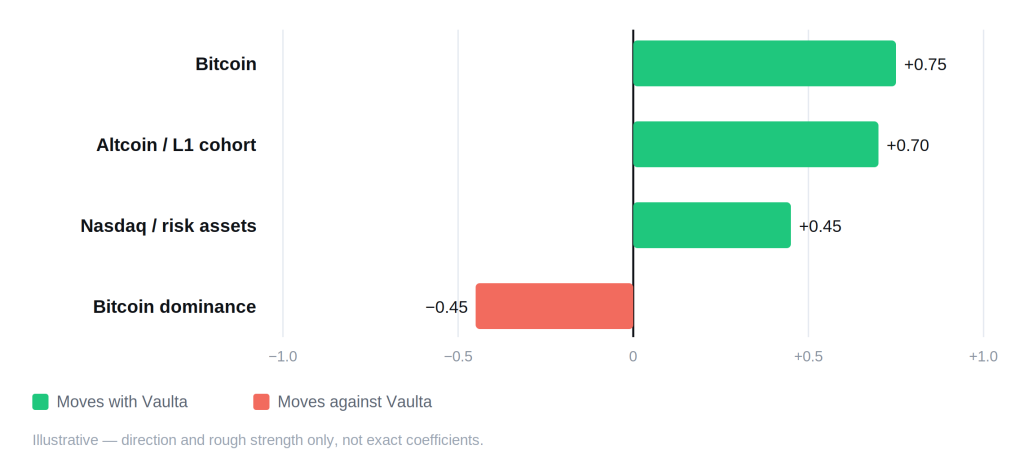
Vaulta trades as a high-beta satellite of Bitcoin. When Bitcoin rallies, A tends to rise harder in percentage terms, and when Bitcoin sells off it usually falls faster. It also moves as part of the broad altcoin and layer-1 cohort, the group of smart-contract chains that compete for the same capital and attention, so its fortunes are tied to whether money is rotating into alternatives to Bitcoin at all. Rising Bitcoin dominance works against it: when traders crowd back into Bitcoin, a faded former “ETH killer” like A is among the first names sold. Since institutions entered crypto, the token also tracks risk-on appetite in equities, the Nasdaq especially, which is why Fed policy reaches its price quickly. What sets Vaulta apart from a top-ten coin is how much its chart now hinges on its own news: with relevance diminished, a credible banking partnership or a stalled rollout can move A more than the macro tape does. Read these as tendencies that drift with the market, not fixed numbers.
Fundamental factors
Vaulta carries one of crypto’s heaviest histories. Its predecessor, EOS, launched after a Block.one token sale that ran for roughly a year through 2017 and 2018 and raised on the order of $4 billion, the largest ICO on record at the time. The chain ran on EOSIO software, since renamed Antelope, using delegated proof-of-stake in which a small set of elected block producers validate transactions, with the EOS Network Foundation stewarding development after Block.one stepped back. For years the promise of high throughput never translated into the developer gravity that Ethereum kept.
The 2025 rebrand to Vaulta is an attempt to change that story. The project narrowed its pitch from a general-purpose layer-1 to “Web3 banking,” aiming at tokenized real-world assets, payments, stablecoins, consumer DeFi, and Bitcoin-linked services through the exSat integration. Holders can still stake A to help secure the chain and earn yield. Whether any of this earns durable usage is the open question, and the traction so far is early rather than proven, so the pivot belongs in the bull case as potential, not as an accomplished fact.
Supply is the quieter risk. As EOS, the token had no hard cap and issued new coins through ongoing inflation on top of a circulating base already above a billion, a structural headwind that spot Bitcoin never carries. The rebrand introduced revised tokenomics with a maximum supply capped at 2.1 billion A and roughly 1.65 to 1.7 billion in circulation now, so most of the eventual float already trades. A cap is a genuine improvement over open-ended issuance, but a large existing supply still means demand has to work harder to move price than it does for scarcer assets.
Upcoming catalysts
Only confirmed, dated events are listed. Vaulta has published no fixed date for a major protocol or listing milestone at the time of writing, so macro policy is the clearest scheduled driver, given how closely A now tracks risk assets.
| Date | Event | Potential impact |
|---|---|---|
| September 15–16, 2026 | FOMC meeting (with economic projections) | Bull if the Fed signals cuts; bear if it holds rates higher for longer |
| October 27–28, 2026 | FOMC meeting | Rate path steers risk appetite across the altcoin market |
| December 8–9, 2026 | FOMC meeting (with economic projections) | Year-end policy signal that frames 2027 positioning |
FOMC dates follow the Federal Reserve’s published 2026 schedule. No Vaulta-specific catalyst is listed with a date because none has been confirmed, and an estimated date would be a guess rather than information.
Bull case vs bear case
Bull case:
- The Web3-banking pivot lands real partners in tokenized assets, payments, or stablecoins, giving A a use beyond speculation.
- Bitcoin leads a broad altcoin recovery and capital rotates back down the risk curve into layer-1 tokens.
- The Fed shifts to rate cuts, lifting appetite for risk assets including small-cap crypto.
- The 2.1 billion supply cap and staking demand slow the sell pressure that dogged EOS for years.
Bear case:
- The rebrand fails to convert into usage and Vaulta stays a former narrative the market has moved past.
- Bitcoin dominance climbs and faded layer-1s bleed against it.
- A large circulating supply keeps a lid on any rally as long-term holders sell into strength.
- Sentiment stays fearful and the token drifts back toward its 2026 lows.
Invalidation levels. The bull case weakens if A loses the $0.056 support on a closing basis, which would expose the June-2026 low near $0.058 and the $0.048 zone below it. The bear case starts to fail on a sustained reclaim of the 50-day average near $0.074, and is invalidated more convincingly on a break back above the 200-day near $0.082, the line that would mark the downtrend as broken. Both triggers are the levels named in the technical section, applied as decision points.
Historical performance
EOS was one of the loudest launches of the last cycle and one of its sharpest disappointments. The token peaked at $22.71 in April 2018, near the top of the ICO era, then spent years grinding down as the ecosystem failed to hold developers. The 2025 Vaulta rebrand sparked a brief rally, with A reaching roughly $0.78 in May 2025 on the announcement, before the token slid back to new lows near $0.058 by mid-2026. Measured from the 2018 high, A trades more than 99% below its record. History here is a warning about how far a well-funded narrative can fall, not a promise that the next chapter rhymes with the last.
Is EOS (Vaulta) a good investment in 2026?
Whether Vaulta fits a portfolio comes down to what a buyer is actually betting on. PrimeXBT’s outlook sees A basing near $0.066 through 2026, with an average near $0.075 and no breakout in the near term. The underlying picture is a token trading below both major averages, in extreme fear, with a supply overhang, set against a rebrand that could either revive it or fade. That is a high-risk, high-uncertainty profile: the upside case leans entirely on the banking pivot working, and the downside case needs nothing more than the status quo. PrimeXBT’s explainer on whether EOS is a good investment works through the trade-offs in more depth.
How to trade Vaulta (EOS) on PrimeXBT
On PrimeXBT you can take a position on Vaulta in either direction. CFDs on EOS can be traded long or short, so a bearish view is as tradable as a bullish one, see the guides to trading EOS, short selling, and how A stacks up against its old rival in EOS versus Ethereum. Leverage magnifies gains and losses alike, and a low-priced, thin token can move fast, so position sizing and a stop-loss matter on every trade. Trade on your own analysis and risk tolerance, and never risk more than you can afford to lose.
Trading involves risk.
How we build this forecast
This outlook is assembled by PrimeXBT’s analysts rather than lifted from a single price feed. We start from where A trades today, read its position against the 50- and 200-day moving averages and the nearby support and resistance, weigh the fundamentals, the Vaulta banking pivot, the staking demand, the supply cap and the overhang, and set all of it against the macro backdrop, chiefly the path of U.S. interest rates and Bitcoin’s own trend. The yearly ranges combine that technical read with the fundamental and macro picture; the long-range figures lean on trajectory rather than precision.
None of this is a guarantee. Small-cap crypto is volatile, the inputs shift, and a single piece of project news can move A faster than any forecast expects. Treat every number here as a considered estimate rather than a target, and note that we revisit and update this outlook monthly as the data changes.
How much will EOS be worth in 2026?
PrimeXBT's outlook is a range of $0.060–$0.090 for 2026, averaging near $0.075. That reflects a token basing near multi-year lows rather than starting a new trend.
How much will EOS be worth in 2030?
The 2030 view is roughly $0.121–$0.211, averaging near $0.165. At this horizon any single figure is a direction rather than a target, and third-party models range from far lower to far higher.
What will EOS be worth in five years?
See 2030 above. Five years out the plausible outcomes fan out widely, from a continued grind lower to a partial recovery if the Vaulta banking pivot gains real usage, so treat the average near $0.165 as a midpoint of a wide band, not a promise.
Is EOS a good investment in 2026?
It is a high-risk, high-uncertainty one. The token trades below its major moving averages in extreme-fear sentiment with a large supply, and the bull case depends almost entirely on the Vaulta rebrand converting into adoption. The case runs both ways, and the outlook is roughly flat into year-end.
Author



 Risk Disclaimer
The content provided here is for informational purposes only. It is not intended as personal investment advice and does not constitute a solicitation or invitation to engage in any financial transactions, investments, or related activities. Past performance is not a reliable indicator of future results.
The financial products offered by the Company are complex and come with a high risk of losing money rapidly due to leverage. These products may not be suitable for all investors. Before engaging, you should consider whether you understand how these leveraged products work and whether you can afford the high risk of losing your money.
The Company does not accept clients from the Restricted Jurisdictions as indicated in our website/ T&C. Some services or products may not be available in your jurisdiction.
The applicable legal entity and its respective products and services depend on the client’s country of residence and the entity with which the client has established a contractual relationship during registration.