7 min read
 Key takeaways:
- Gold has slipped back below the $4,300 mark to trade around the $4,200 area, down roughly 9% over the past month, though it remains up close to 30% year on year.
- A stronger-than-expected US jobs report has pulled forward Federal Reserve rate-hike expectations, lifting the dollar and yields and weighing on non-yielding gold.
- The US-Iran conflict has, counterintuitively, become a net headwind for gold by keeping oil and inflation elevated.
- US CPI for May is released today at 12:30 UTC and could set the tone into next week’s Fed meeting.
Macro backdrop
Gold has come under sustained pressure over the past month, slipping to its lowest level in around two months. The move could be viewed less as a change in the longer-term trend and more as a sharp correction, with the metal still up close to 30% on a year-on-year basis.
The proximate trigger appears to be last week’s US labour market data. The May nonfarm payrolls report showed 172,000 jobs added against a forecast of roughly 85,000, with the unemployment rate holding at 4.3%. That strength has reinforced the case for the Federal Reserve to keep policy tight, and markets have moved to price in a potential quarter-point rate hike by year-end. Market-implied odds of a hike have risen sharply in the days since the release.
For gold, that repricing matters through two reinforcing channels. Higher interest rates raise the opportunity cost of holding an asset that pays no yield, while a firmer dollar, now trading near its highest level since early April, tends to weigh on dollar-denominated gold by making it more expensive for overseas buyers. Together, rising yields and a stronger dollar have acted as twin headwinds, part of the same risk-off backdrop that has rippled across markets in recent weeks.
The geopolitical picture has added a further, less intuitive layer. A Middle East conflict would normally be expected to support safe-haven demand, yet the US-Iran standoff has so far worked against gold. With Brent crude holding above $90 a barrel, elevated energy prices have kept inflation expectations high, which in turn reinforces the case for higher-for-longer rates. That inflation-and-rates channel appears to have outweighed the traditional safe-haven bid, leaving the conflict as a net negative for the metal for now. Signs of de-escalation have only trimmed whatever risk premium remained.
Attention now turns to today’s inflation data. US CPI for May is due at 12:30 UTC, following an April reading of 3.8% year on year, the highest since May 2023, with core inflation at 2.8%. Some forecasts point to a further acceleration in May. A hot print could cement the rate-hike repricing and add pressure to gold, while a softer figure could give the metal room to stabilise. Producer price data follows tomorrow, and the Federal Reserve’s policy meeting on 16 to 17 June sits just beyond as the next major hurdle.
Gold weekly chart
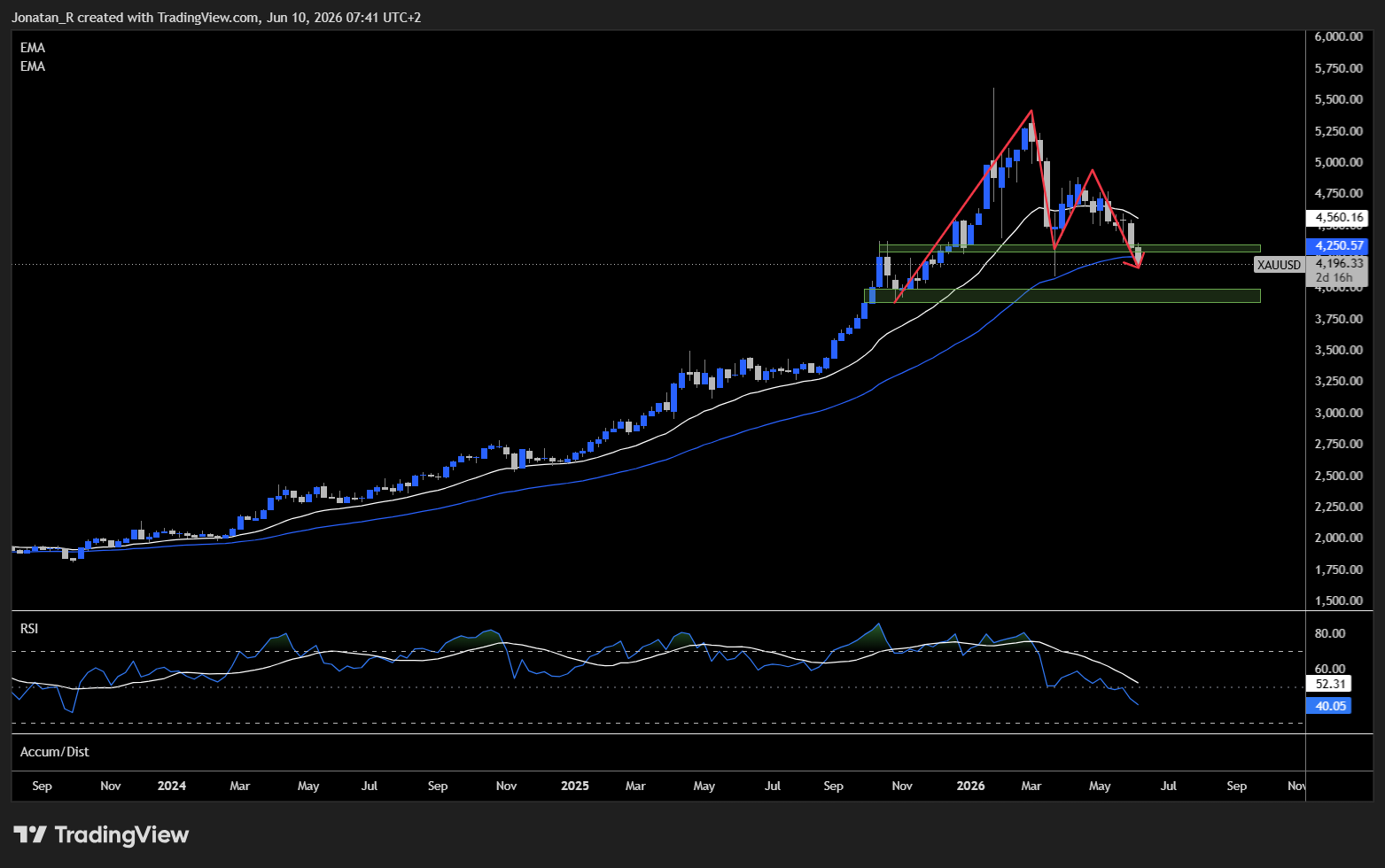
Caption: Gold has broken below the 4,300 level and the weekly 50 EMA, with the RSI slipping under 50 for the first time in well over two years.
On the weekly timeframe, the break below the 4,300 level and the weekly 50 EMA could be viewed as an early shift in market structure. After an extended run of higher highs and higher lows, price has started to carve out lower highs, and a move to lower lows from here could point to a potential break of structure on the higher timeframes. That would mark a notable change in character after such a strong uptrend, and could be read as a sign of trend weakness rather than a routine pullback.
Momentum appears to be confirming the move. The weekly RSI has dropped below the 50 level, an area it has not traded in since around October 2023. A sustained move below 50 could suggest the longer-term momentum backdrop is softening.
To the downside, the next major area of support appears to sit around 4,000. A hold there could allow the broader uptrend to reassert itself, while a decisive break below could open the door to further weakness.
Gold 4-hour chart
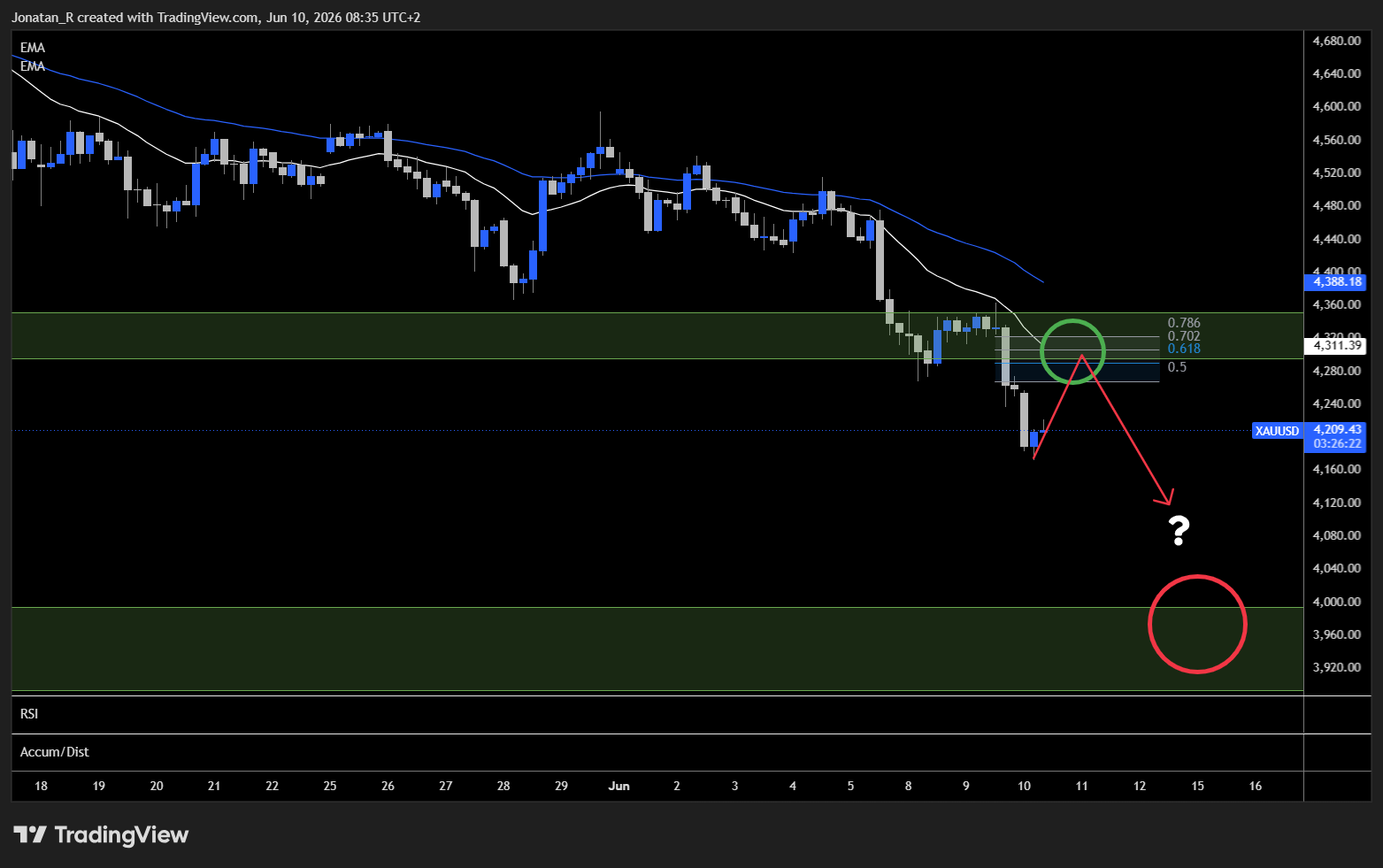
Caption: After a clean breakdown, gold is trading near 4,210, with the 4,300 reload zone now acting as potential resistance overhead and the 4,000 area in focus below.
On the 4-hour timeframe, gold has produced a clean breakdown and is now trading near 4,210. The 4,300 region sits just above as the first area of interest, where the 20 EMA lines up with a local reload zone to form a potential resistance band.
A pullback into that 4,300 zone could be met with selling, keeping the near-term bias on the back foot. A decisive reclaim of the level, on the other hand, could be viewed as an early sign of strength and a hint that the move lower is losing steam.
If selling pressure continues to build instead, the 4,000 level below could come into play, an area that also stands out as the next major support on the higher timeframe.
Trading involves risk.
Author



 Risk Disclaimer
The content provided here is for informational purposes only. It is not intended as personal investment advice and does not constitute a solicitation or invitation to engage in any financial transactions, investments, or related activities. Past performance is not a reliable indicator of future results.
The financial products offered by the Company are complex and come with a high risk of losing money rapidly due to leverage. These products may not be suitable for all investors. Before engaging, you should consider whether you understand how these leveraged products work and whether you can afford the high risk of losing your money.
The Company does not accept clients from the Restricted Jurisdictions as indicated in our website/ T&C. Some services or products may not be available in your jurisdiction.
The applicable legal entity and its respective products and services depend on the client’s country of residence and the entity with which the client has established a contractual relationship during registration.