7 min read
 The European Central Bank (ECB) raised interest rates for the first time in nearly three years, and after an initial muted reaction, EUR/USD recovered to close the day on a firmer footing. The pair now sits at the centre of a tug-of-war between a freshly hawkish ECB and a US dollar that has been reluctant to weaken.
Key takeaways
- The ECB raised its deposit facility rate to 2.25%, its first hike since 2023, citing persistent, energy-driven inflation pressures.
- The euro initially struggled before recovering, with the ECB bounce lifting EUR/USD off its lows.
- Hot US inflation and safe-haven dollar demand remain the main counterweights, leaving the pair caught between two opposing forces.
- On the charts, the 1.165 equilibrium area is the key resistance to reclaim, while 1.14 marks the range lows below.
Macro backdrop
The headline event was the ECB’s decision to lift its deposit facility rate to 2.25%, the first increase since 2023. The central bank pointed to persistent inflation pressures, particularly the energy price shock linked to the conflict in the Middle East, while also flagging concerns over eurozone growth. Updated staff projections now see headline inflation averaging close to 3% in 2026, revised higher from March. President Lagarde stressed that there is no pre-set path for rates, with inflation risks tilted to the upside and growth risks to the downside.
The market is treating this as the start of a cycle rather than a one-off. Pricing currently points to a second hike potentially arriving by September, with a third possible before year-end. That shift in expectations appears to be what eventually steadied the euro, even if the immediate reaction to the decision was subdued.
Working against the single currency is a US dollar that has refused to roll over. May US inflation, released on 10 June, came in at 4.2% year-on-year, the highest annual reading since April 2023, with energy costs a notable driver. A print like that keeps the Federal Reserve boxed in, with little room to cut, which has helped the dollar hold firm and capped EUR/USD on rallies. With both central banks now responding to the same energy-driven inflation shock, the usual rate-differential story is partly neutralised.
The near-term swing factor is the Middle East. Brent crude fell sharply on Thursday after reports that planned US strikes on Iran had been suspended and that a deal to reopen the Strait of Hormuz could potentially be signed within days. A de-escalation could cut both ways for EUR/USD: easing tensions may drain some of the safe-haven demand supporting the dollar, but they could also take pressure off the inflation backdrop that is driving the ECB’s hawkish stance in the first place.
Daily timeframe
On the daily chart, EUR/USD continues to trade within a broad higher-timeframe range, bounded by the range lows around 1.14 and the range highs above 1.18. The midpoint of that range, the equilibrium near 1.165, is the level in focus. Price broke below this equilibrium area on 5 June and is now testing it again from below as resistance. The zone is a notable confluence: the 50% and 0.618 Fibonacci retracement levels sit inside it, aligned with the 20 and 50 EMA.
The daily RSI remains in a bearish range, which is typical while an asset trades in the lower portion of its range.
Yesterday’s ECB hike brought some bullish price behaviour off the lows, but the move ran straight into the 50% retracement, which has acted as resistance and lines up with a descending trendline that has guided price lower since mid-April. A rejection here could open the door back towards the 1.14 range lows. A reclaim of the 1.165 equilibrium area, by contrast, would mark a more meaningful shift, potentially breaking the downward structure in place since mid-April and bringing the range highs above 1.18 back into view.
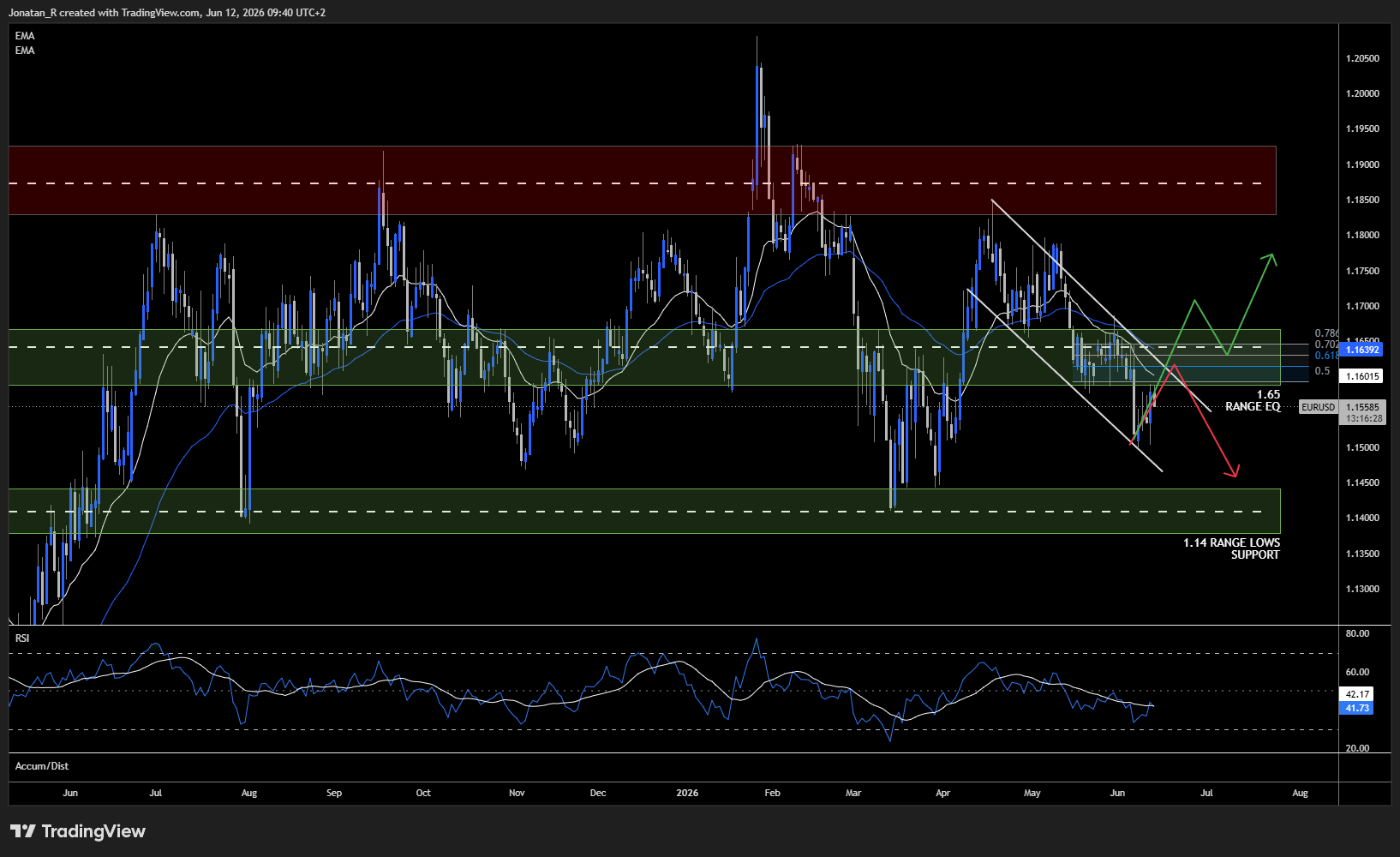
EUR/USD daily timeframe, showing the broad range between 1.14 and 1.18, the 1.165 equilibrium with the 50% and 0.618 fibs and 20/50 EMA, and the descending trendline from mid-April.
4-hour timeframe
Zooming in, price broke below the 1.1590 level and moved quickly down to immediate support around 1.1505, a drop of roughly 75 pips. From there, EUR/USD formed equal lows while the 4-hour RSI printed higher lows, a bullish divergence, before bouncing on the ECB decision.
That bounce has the look of a double bottom, but it has yet to produce a clean breakout. The 1.16 level above is the one to reclaim. A sustained move back above it would suggest the bounce could translate into a genuine breakout structure on the higher timeframes, while a failure to reclaim it keeps the immediate support around 1.1505 in focus.
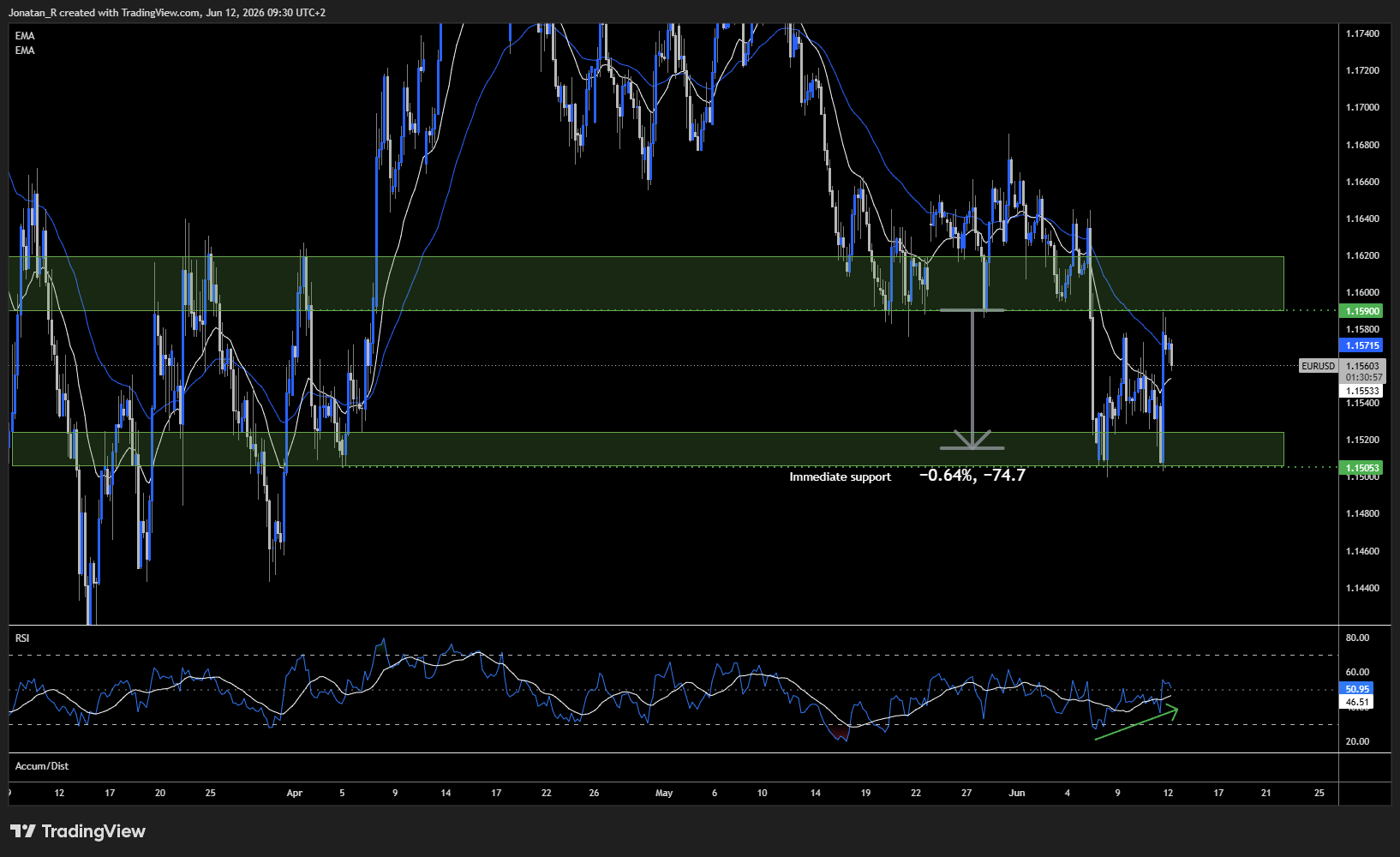
EUR/USD 4-hour timeframe, showing the break below 1.1590, the move to immediate support at 1.1505, the equal lows with RSI bullish divergence, and the 1.16 reclaim level.
Key levels to watch
- Resistance: 1.1590 and 1.16 (4H), then the 1.165 equilibrium zone, and the range highs above 1.18
- Support: 1.1505 (4H immediate), then the 1.14 range lows
What to watch
- Whether EUR/USD can reclaim the 1.16 to 1.165 area, which could confirm the ECB bounce and challenge the downtrend from mid-April.
- A rejection at the 50% retracement and trendline, which could send price back towards the 1.14 range lows.
- Middle East headlines over the weekend and the dollar’s response, given how much of the recent move has hinged on safe-haven flows.
Trading involves risk.
Author



 Risk Disclaimer
The content provided here is for informational purposes only. It is not intended as personal investment advice and does not constitute a solicitation or invitation to engage in any financial transactions, investments, or related activities. Past performance is not a reliable indicator of future results.
The financial products offered by the Company are complex and come with a high risk of losing money rapidly due to leverage. These products may not be suitable for all investors. Before engaging, you should consider whether you understand how these leveraged products work and whether you can afford the high risk of losing your money.
The Company does not accept clients from the Restricted Jurisdictions as indicated in our website/ T&C. Some services or products may not be available in your jurisdiction.
The applicable legal entity and its respective products and services depend on the client’s country of residence and the entity with which the client has established a contractual relationship during registration.