9 min read
 On Friday we published a preview of the Jackson Hole symposium and the one speech everybody was waiting for. That speech has now happened. Here’s what Federal Reserve Chairman Kevin Warsh said, what moved, and what it means for the week ahead.
Short version: he gave no forward guidance at all, exactly as he’d promised. And markets still walked away distinctly more hawkish than they arrived.
He told you upfront he wasn’t going to tell you anything
Warsh opened by laying out his agenda for the morning, then added a line that set the tone for everything after it. Call it an outline, he said. Call it a trail map. Just don’t call it forward guidance.
That wasn’t a throwaway remark. It’s his whole philosophy.
A big part of the address was an argument that forward guidance, where the Fed tells markets in advance roughly what it plans to do, has outstayed its usefulness. He thinks it was necessary during the 2008 crisis and has been overused ever since. His view is that it makes both sides lazy. Markets stop reading the economy and start reading the Fed, and then the Fed reads market prices that are only reflecting what the Fed said in the first place. He called it a hall-of-mirrors problem.
His conclusion was blunt. Markets shouldn’t be looking primarily to the central bank for their next trade.
For anyone trading Bitcoin (BTC), Gold (XAU), Forex (FX) or global indices, that’s worth sitting with. Under Jerome Powell you could often trade the guidance. Under Warsh, you’re going to have to trade the data.
The part that moved prices
Warsh then gave his read on the economy, and this is where it got interesting.
On jobs, he was relaxed. Unemployment is at 4.1%, claims are near multi-decade lows, and in his words the labour market is consistent with full employment.
On inflation, he was not relaxed.
- The 12-month change in the Personal Consumption Expenditures (PCE) price index is running at 3.7%, against a 2% target
- The six-month change is 4.1%, so the more recent trend is worse, not better
- Of the 199 components in the PCE basket, 54% rose more than 3% over the past year. Before the pandemic that figure averaged 32%
- He said this summer’s softer readings don’t tell him underlying trends have meaningfully improved
Then came two lines that did most of the damage.
First, he said he’d be hard pressed to describe broad financial conditions as restrictive. In plain terms: he doesn’t think current interest rates are actually slowing anything down.
Second, he set his standard. He needs to be confident inflation is heading to target clearly and at sufficient speed. Otherwise, in his phrase, the Fed has work to do.
That’s not a promise to hike. But it’s about as close as a man who refuses to give guidance is going to get.
What moved
- Gold (XAU) fell around 3.5% on the day, its largest decline since the August rally began
- Bitcoin (BTC) dropped around 5.6% from the week’s high, though it’s still up over 20% on the month
- The US Dollar Index gained 0.56% to close at 99.65, its biggest daily rise in about a month
- The 2-year Treasury yield jumped just over 12 basis points to 4.36%, the largest short-end move in two months
- The 10-year Treasury yield rose about 5 basis points to 4.73%
- The 30-year Treasury yield climbed only 2 basis points to 5.21%, barely moving
- The S&P 500 slipped 0.26% and still finished the week higher
Two things stand out.
The curve flattened. Short-dated yields jumped, long-dated yields hardly moved. That’s the market saying it now expects tighter policy soon, while becoming slightly less worried about inflation running loose over the long run. For Warsh, that’s close to an ideal reaction. The long end had been his problem all month.
Equities shrugged. A speech that took 3.5% off gold took a quarter of a percent off the S&P 500.
The size of the moves tells you more than the direction
Look at the three charts below and pay attention to scale rather than the minus signs.
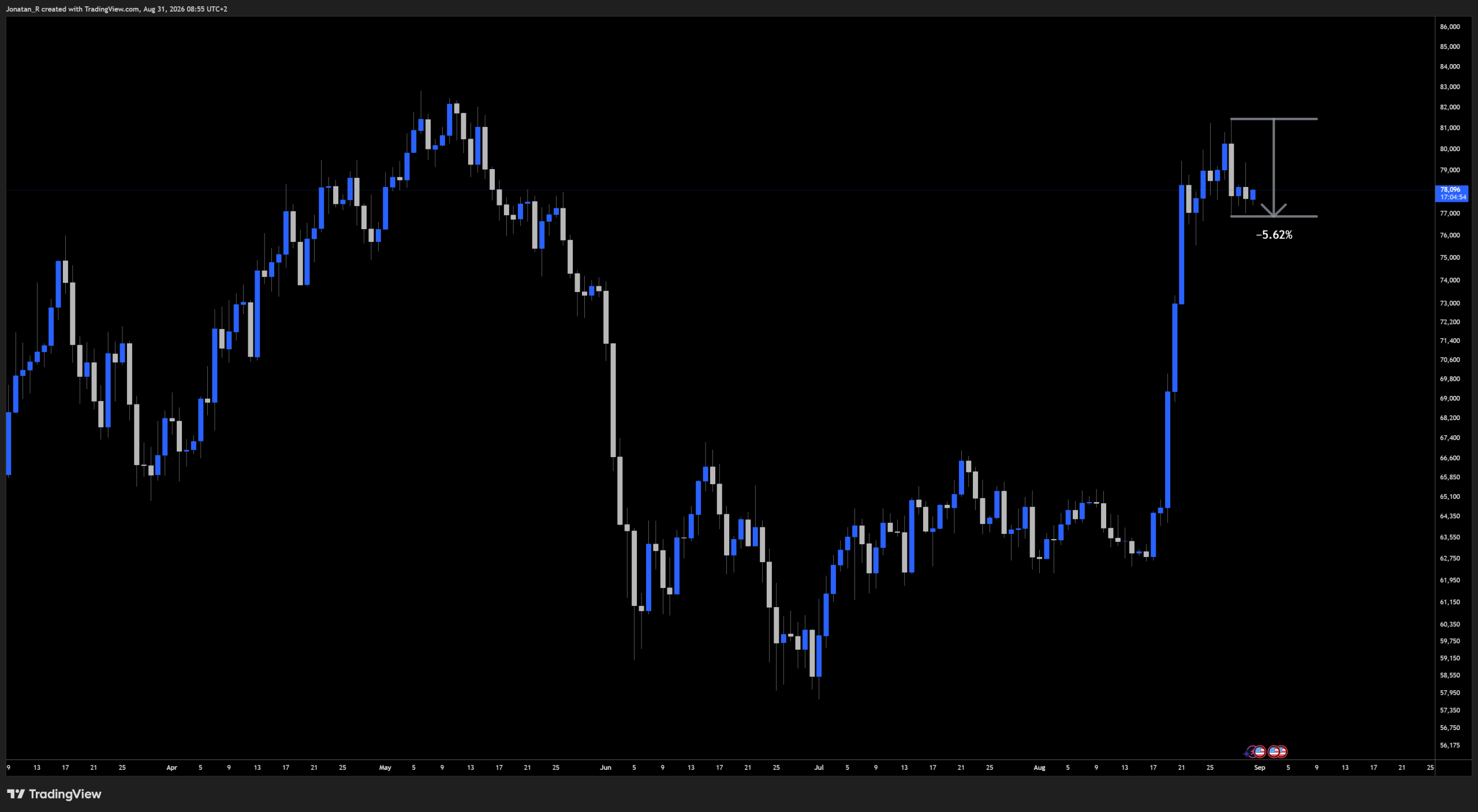
Bitcoin gave back around 5.6% from the week’s high, and it’s now trading near $78,000. That looks like the largest number of the three, but for Bitcoin a move of this size is an ordinary week. The bigger context is the sharp advance from mid-August, most of which is still intact.
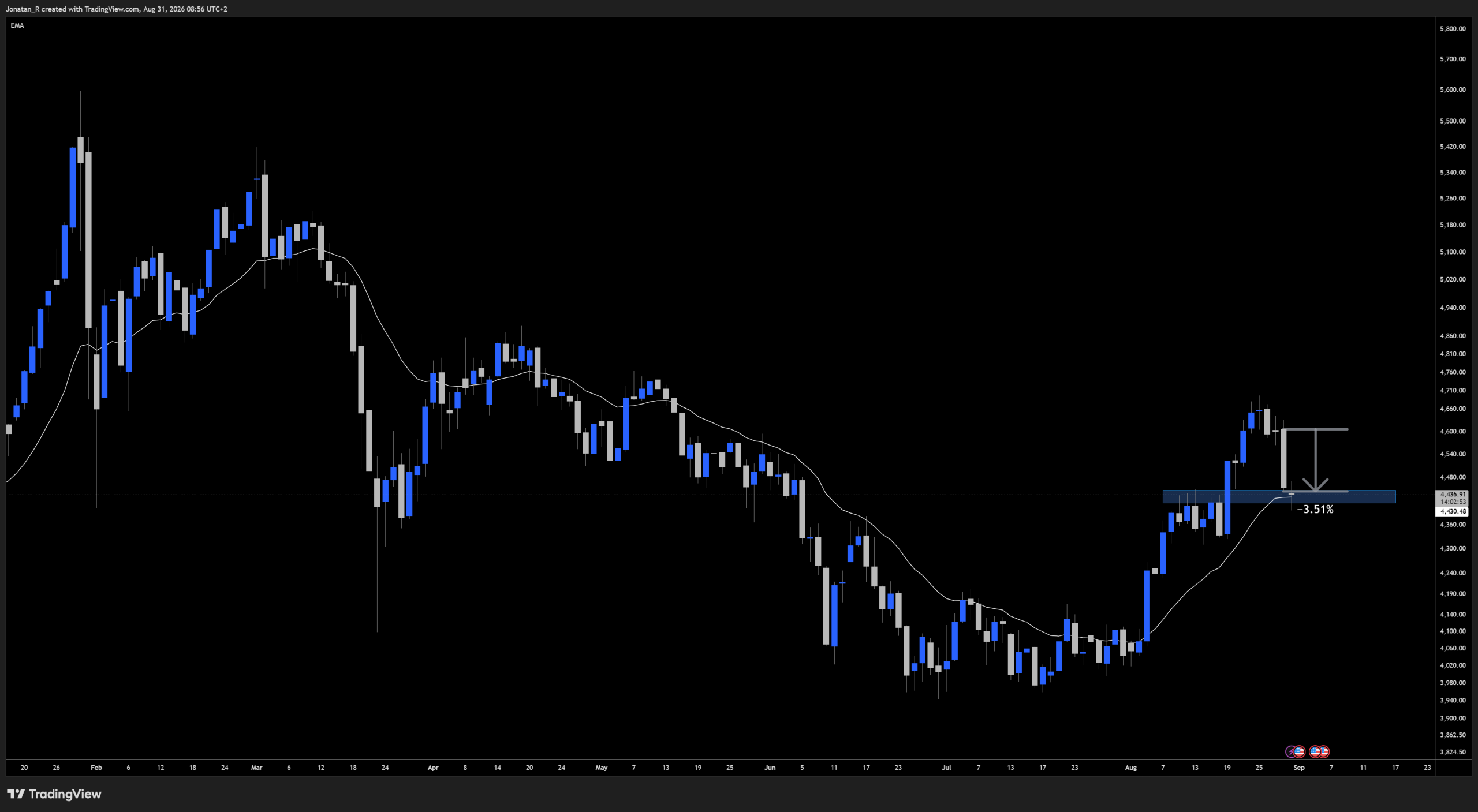
Gold fell around 3.5% and landed directly on a support area that has been in play for months, with the daily 20 EMA sitting in the same region. For an asset that normally moves in fractions of a percent, this is a very large day. Relative to its own structure, gold took the harder hit of the two.
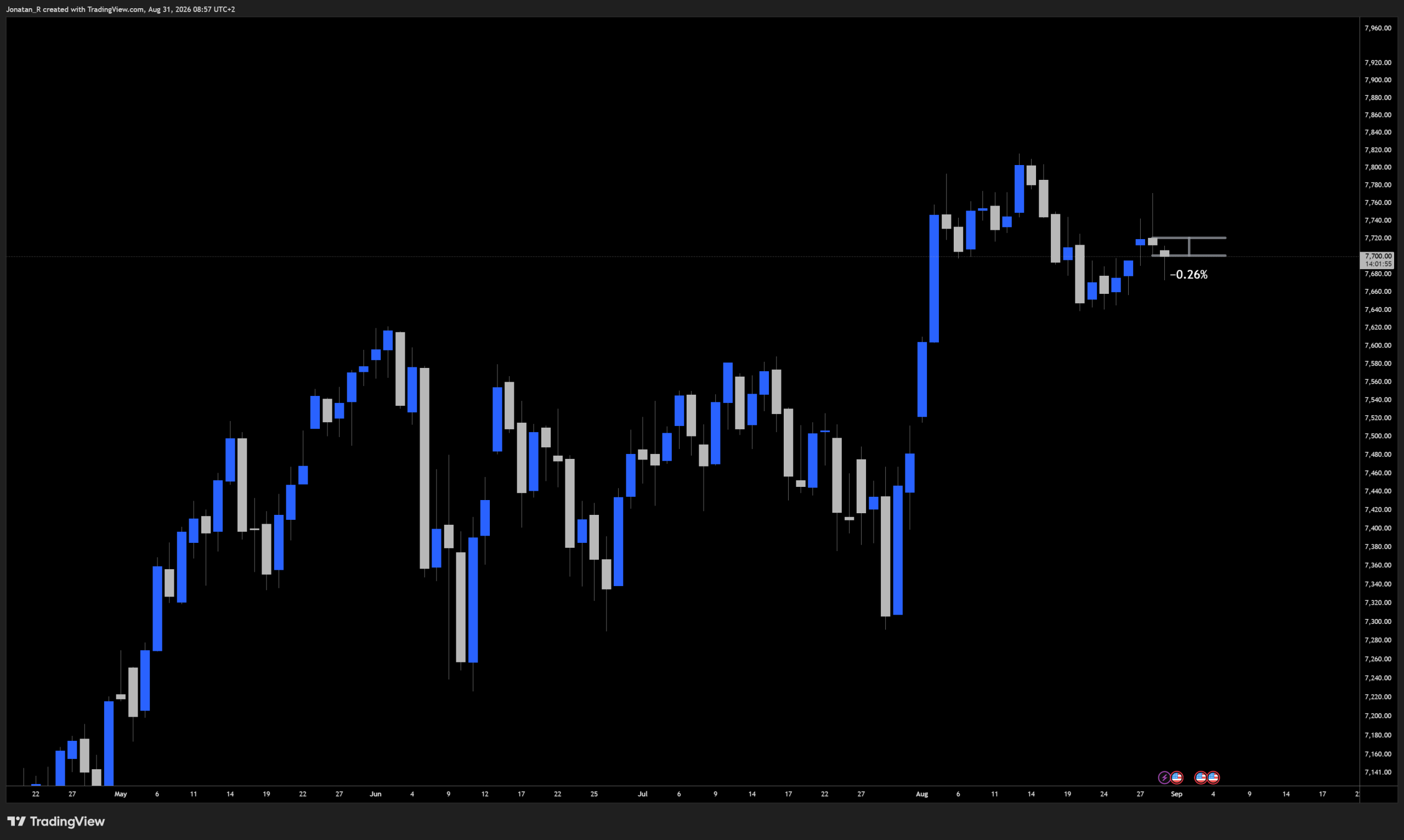
The S&P 500 finished down 0.26%. Effectively unchanged. The index still closed the week higher.
The pattern here is worth registering. The speech hit the assets that had rallied on the idea of an accommodating Fed, and left the assets that rally on a functioning economy more or less alone. That’s a fairly precise reaction, not a broad risk-off move.
Why gold and Bitcoin took it hardest
Because they’d been the biggest winners of the thing Warsh just declined to endorse.
Through August, the US Treasury announced it would at least double the size of its buybacks of 10 to 30-year government debt, starting on 9 September. Markets read that as an attempt to push long-term borrowing costs down by other means, and started asking whether the Fed might eventually help. That question drove a lot of money into assets that do well when currencies look soft. Gold was on track for its strongest month since 1999. Bitcoin rallied more than 20%.
Warsh didn’t mention any of it. No endorsement, no criticism, nothing. He instead spent his time arguing that the Fed’s job is price stability and that the central bank alone owns responsibility for inflation.
For traders who’d bought gold and Bitcoin on the expectation of a more accommodating Fed, that silence was the answer.
September is now genuinely a coin flip
Before the speech, futures priced roughly a 35% chance of a quarter-point hike at the September meeting. After it, that jumped to around 57%.
The prediction markets disagree slightly. Both Kalshi and Polymarket have it closer to a hold, in the high 40s for a hike. So there’s real money on both sides.
The next Federal Open Market Committee (FOMC) meeting is 15 to 16 September 2026. Between now and then, the data does the talking. That’s exactly the world Warsh says he wants.
What to watch this week
- Tuesday 1 September: ISM Manufacturing and JOLTS job openings, the first read on demand and labour tightness
- Wednesday 2 September: ADP employment and the Fed Beige Book, for regional colour on prices and hiring
- Thursday 3 September: ISM Services, covering the stickiest part of the inflation picture
- Friday 4 September: August nonfarm payrolls, the one that matters
Friday’s jobs report is the last major labour reading before the FOMC decides. Forecasts are for something around 55,000 jobs added and unemployment ticking up to 4.2%, after the economy unexpectedly shed jobs in July.
Here’s the tension. Warsh has said the labour market is fine and inflation is the problem. A soft payrolls number complicates that story badly. A firm one clears his path.
There’s also a geopolitical layer. Oil opened higher in Asia on Monday after US strikes on Iranian positions near the Strait of Hormuz over the weekend. Higher energy prices feed straight into the inflation data Warsh says he’s watching, which isn’t a helpful development for a central bank already above its target.
The takeaway
Warsh ended his speech saying he’s committed to a discipline, not to a decision.
That’s the sentence to remember. He isn’t going to signal. He’s going to react to data, and he’s told you which data he cares about most, which is prices.
Practically, that means two things for the weeks ahead. Economic releases could produce sharper moves than they used to, because there’s no guidance cushioning the surprise. And the assets that rallied hardest on the idea of a softer Fed, gold and Bitcoin in particular, may stay sensitive to anything that firms up the hawkish case.
Friday 4 September is the next real test.
Trading involves risk.
Author



 Risk Disclaimer
The content provided here is for informational purposes only. It is not intended as personal investment advice and does not constitute a solicitation or invitation to engage in any financial transactions, investments, or related activities. Past performance is not a reliable indicator of future results.
The financial products offered by the Company are complex and come with a high risk of losing money rapidly due to leverage. These products may not be suitable for all investors. Before engaging, you should consider whether you understand how these leveraged products work and whether you can afford the high risk of losing your money.
The Company does not accept clients from the Restricted Jurisdictions as indicated in our website/ T&C. Some services or products may not be available in your jurisdiction.
The applicable legal entity and its respective products and services depend on the client’s country of residence and the entity with which the client has established a contractual relationship during registration.