8 min read
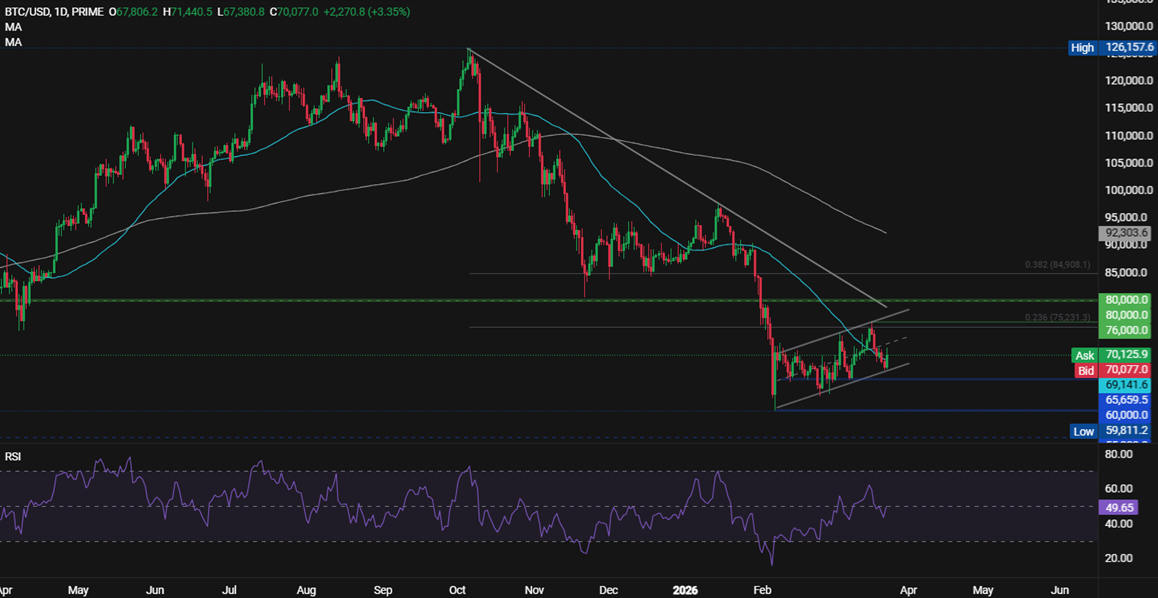
Bitcoin fell by more than 3% last week, snapping a two-week modest. The largest cryptocurrency started the previous week at 68.8k and rose to a 6-week high of 76k. However, bulls were unable to hold the gains, and the price rebounded lower to 68k over the weekend before recovering to 70k at the time of writing.
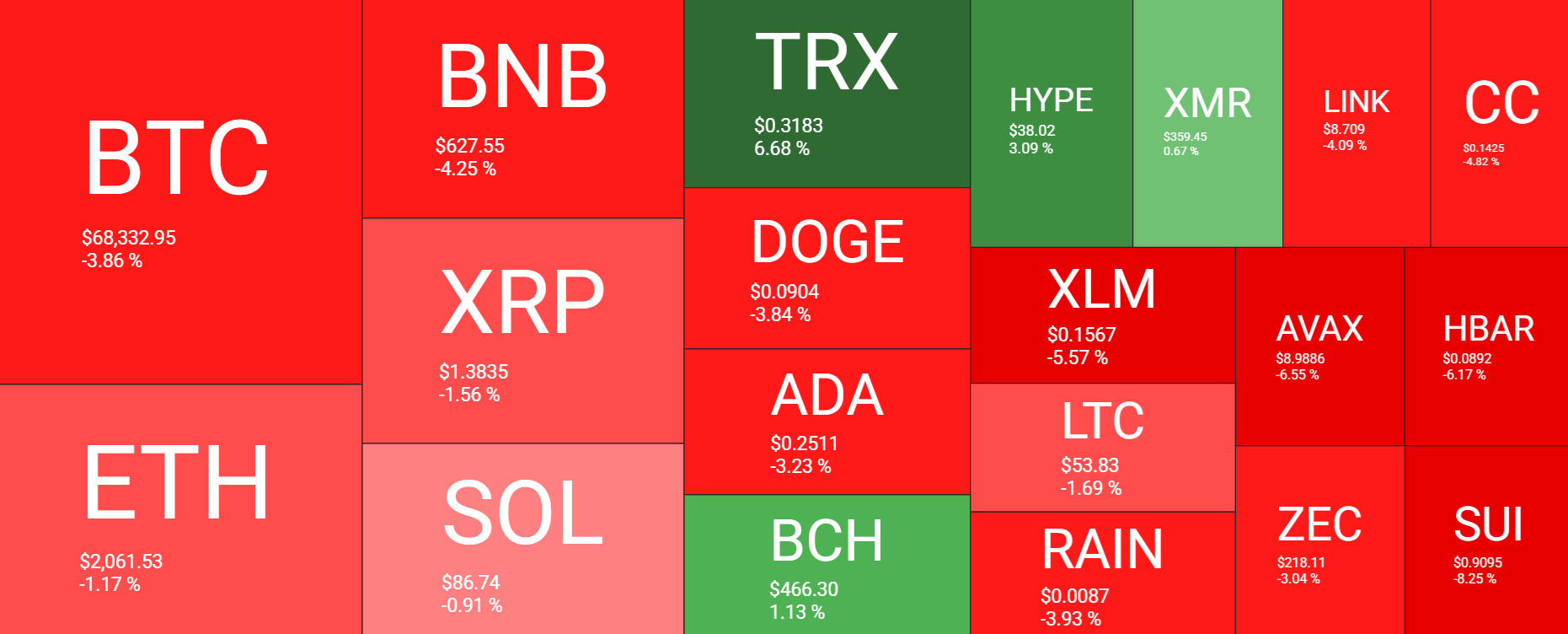
While Bitcoin and BNB saw steeper declines, Ethereum fell just over 1% across the past 7 days, and Solana less than 1%. Several smaller altcoins even booked gains across the week, with TRX rising over 6%.
The total cryptocurrency market capitalisation rose to $2.58 trillion at the start of the previous week, then fell steadily to $2.35 trillion at the time of writing. This is still well above the $2.18 trillion level from a month ago.
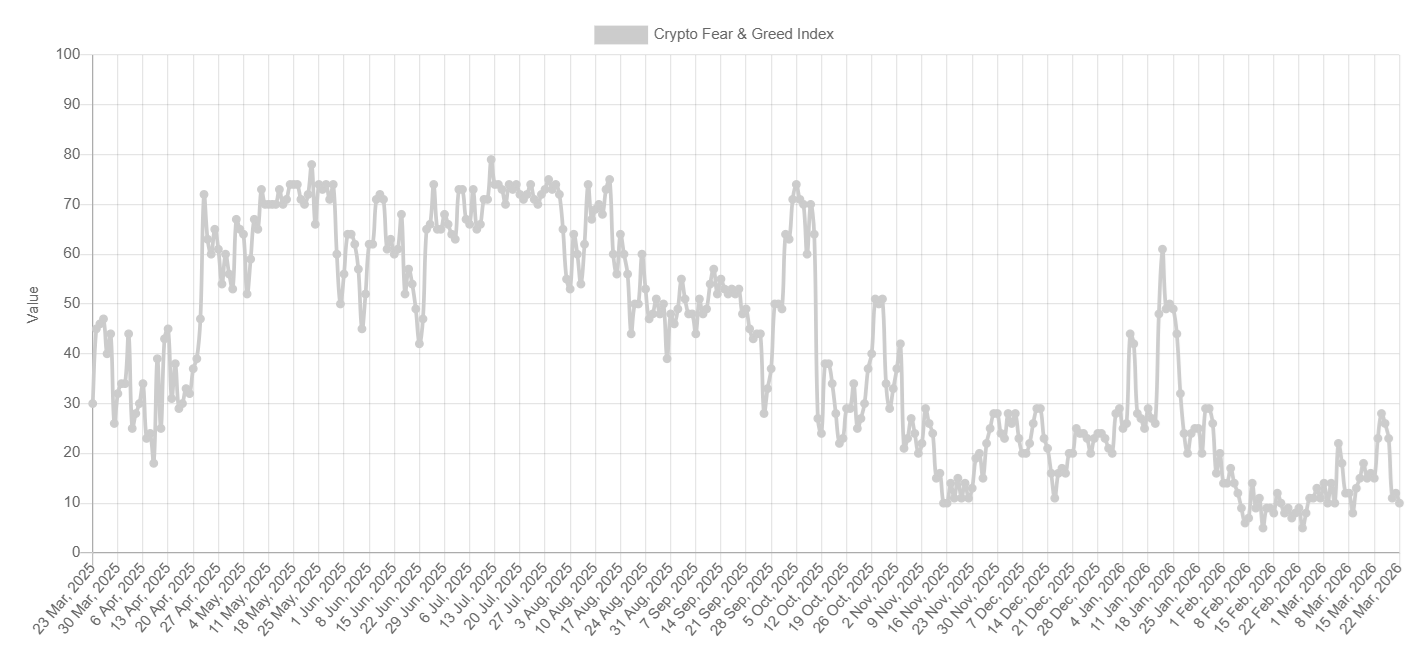
Sentiment analysis shows that the mood towards crypto has deteriorated, falling back to 10 on the Alternative.me Fear and Greed Index. This is down from a high of 28 last week but above the record low of 5 last month, and remains in the Extreme Fear category.
Institutional demand fades
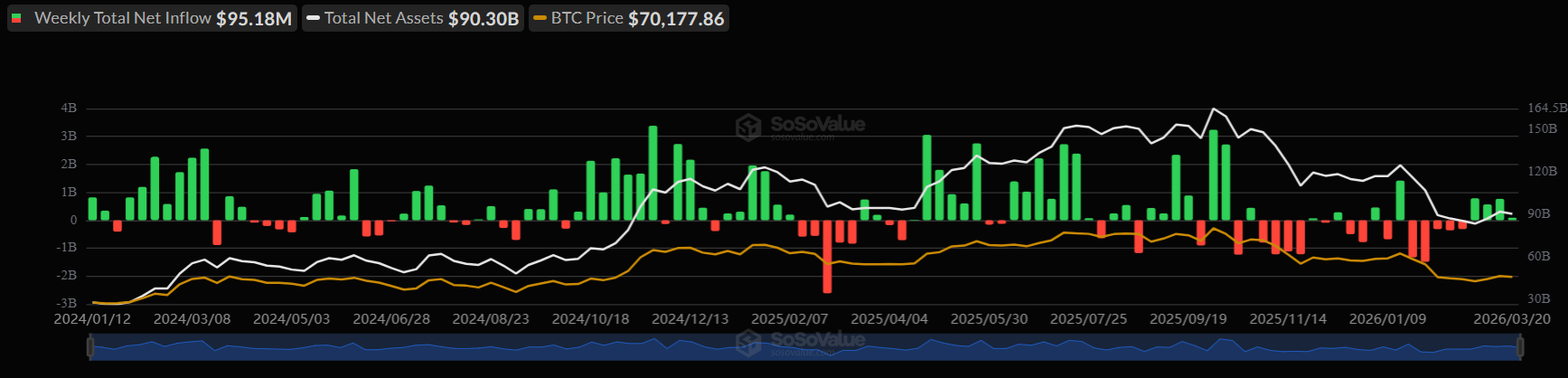
BTC ETFs booked weak net inflows of $95.18 million across the week, marking the fourth straight week of net inflows and totalling approximately $2 billion. This marks the longest weekly inflow streak of 2026 and the most sustained period of buying since August September 2025, when BTC ETFs attracted more than $3.8 billion in fresh capital.
However, delving deeper into last week’s data, BTC saw net inflows on the first two days of the week, which were nearly offset by three straight days of net outflows as institutional demand faded. BTC ETF inflows would need to ramp up for the Bitcoin price to see a sustained recovery.
Macro backdrop
Bitcoin’s recent pullback from the $76K high has been driven primarily by a shift in the macro environment rather than crypto-specific factors.
The move lower followed the Federal Reserve’s March meeting, where policymakers left interest rates unchanged in the 3.5%–3.75% range but adopted a more hawkish tone. The Fed revised its inflation forecasts higher and warned that persistent price pressures could delay future rate cuts.
As a result, market expectations have shifted sharply. Rate cuts are now being pushed further out, and according to the CME FedWatch tool, markets are even pricing in a 15% probability of a rate hike at next month’s meeting — a scenario that was not being considered just a week ago. This marks one of the fastest repricings of Fed expectations in recent years.
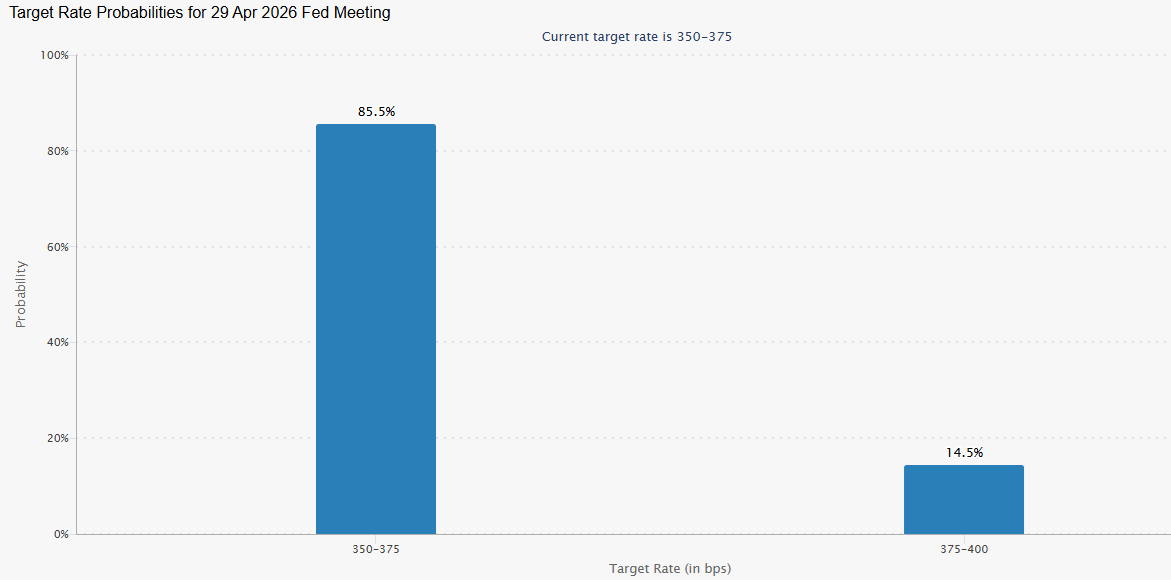
This shift has direct implications for Bitcoin and other risk assets. Lower interest rates typically support risk-taking by increasing liquidity, while a higher-for-longer rate environment tends to tighten financial conditions.
Geopolitical tensions in focus
The more hawkish Fed stance comes alongside escalating geopolitical tensions. Over the weekend, President Trump issued an ultimatum to Iran to reopen the Strait of Hormuz, while Iran responded with threats targeting regional energy infrastructure. These developments pointed to further escalation rather than de-escalation. On Monday, Trump hailed productive talks with Iran over the weekend. However, Iran denied that the talks even occurred, raising questions over the next move.
Oil prices have reacted accordingly, with heightened volatility, Brent crude rising sharply — at one point reaching $119 per barrel — as markets price in the risk of a prolonged supply disruption, before falling and then reversing. Elevated oil prices lift inflation risk and treasury yields.
Focus shifts to the bond market & liquidity concerns build
At the centre of the current market stress is the US Treasury market.
Yields have moved sharply higher, with the 10-year Treasury yield rising to 4.437%. On Friday, yields saw one of the largest single-day increases in recent months. Since the start of the war, yields have climbed more than 45 basis points. Higher yields tighten financial conditions and can trigger deleveraging across asset classes, drawing capital away from non-yielding or riskier assets.
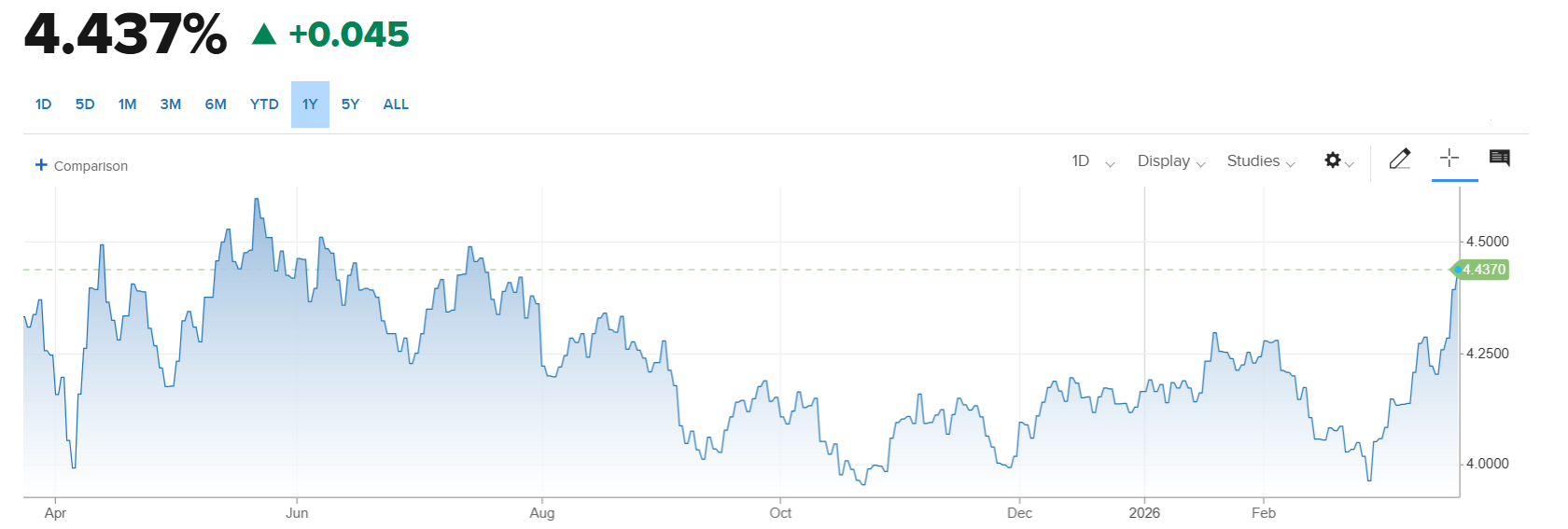
There are early signs that institutional investors are shifting defensively, reducing exposure to risk assets and raising cash levels.
Gold plunged 10% last week, its worst weekly performance since 1983, and extended those declines on Monday, falling a further 5% before paring some losses. The precious metal is down 20% this month as rising yields and tightening liquidity are outweighing traditional safe-haven dynamics.
Meanwhile, US stocks (Dow Jones) have fallen 7% this month, and the EU Stoxx50 is down 12% since the Iran war started. Any confirmation that a ceasefire is near could see the macro challenges unwind.
Otherwise, as liquidity concerns grow, attention will turn to where capital rotates next — and whether Bitcoin can continue to show relative resilience in an increasingly challenging macro environment.
Divergence breaks down
During the first half of March, as the US–Iran conflict unfolded, Bitcoin significantly outperformed both gold and equities, supporting the view that a major capital rotation could be underway. However, recent sentiment suggests otherwise, with crypto markets falling in tandem with gold and US equities last week.
Both the Crypto Fear & Greed Index and the S&P 500 Fear & Greed Index are signalling extreme fear. It is relatively rare to see these indicators align, and such convergence often points to broader market stress and a more cautious investor outlook.
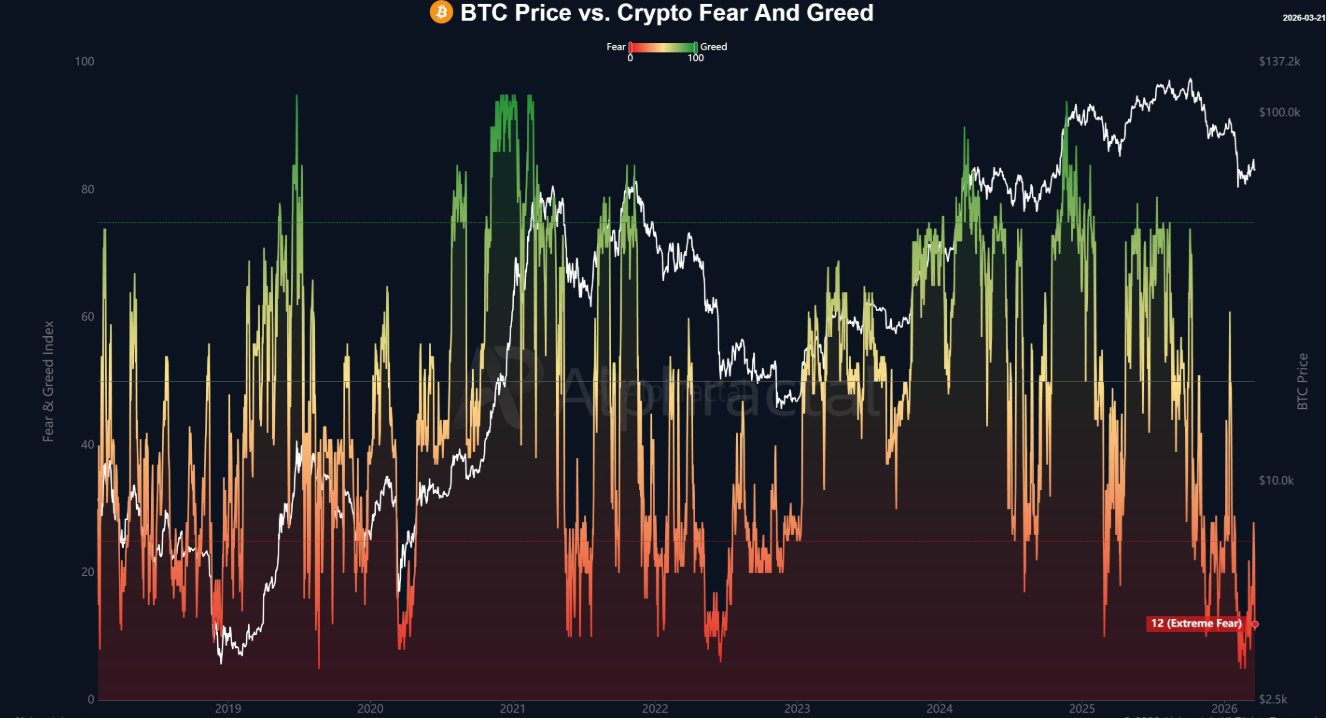
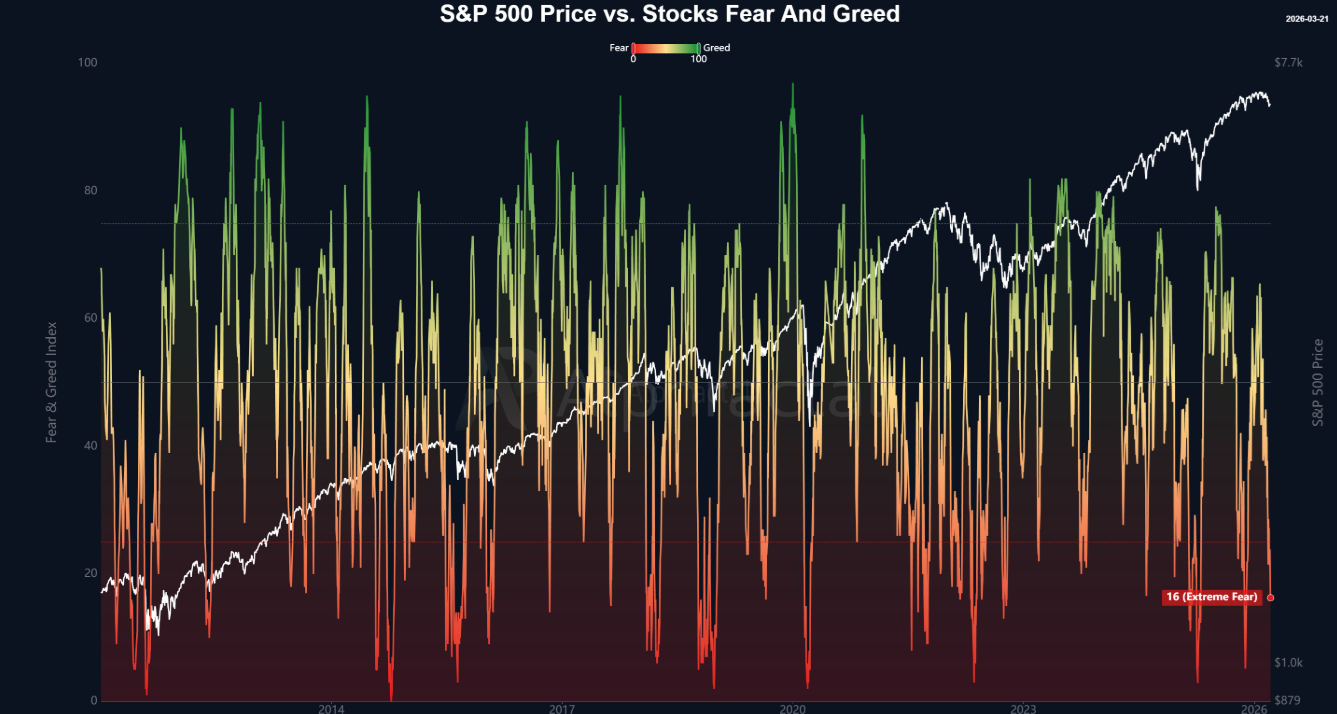
As the correlation between Bitcoin and the S&P 500 turns positive, this adds another reason for caution. The shift suggests that both assets could continue to move in sync in the coming week.
On-chain data shows whales & LTHs accumulate as BTC falls
Despite Bitcoin coming under pressure and dropping to a two-week low, on-chain data shows that whales and long-term holders are accumulating aggressively.
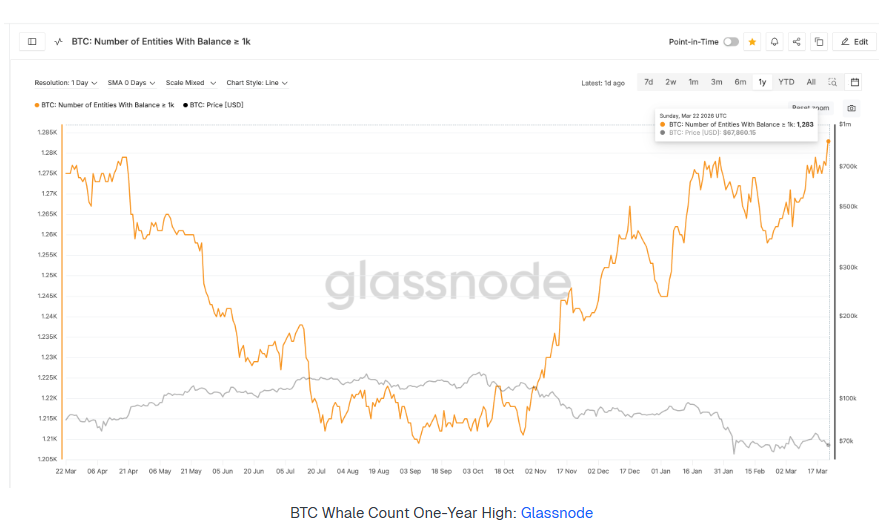
Bitcoin whales are adding to their positions rather than exiting, with the number of entities holding at least 1,000 BTC rising to 1,283 as of 22 March, according to Glassnode data. This is the highest level in a year. The increase has been steady since early March but accelerated over the weekend, when the count jumped from 1,277 to 1,283 — implying that around 6,000 BTC were added in just two days. While relatively small, this is still notable as it highlights whale optimism.
Long-term holders — those who have held BTC for over 365 days — are showing a similar pattern.
The daily long-term holder net position change turned positive in early March and reached 144,374 BTC by March 22, up from 129,262 BTC, marking a 12% increase in accumulation.
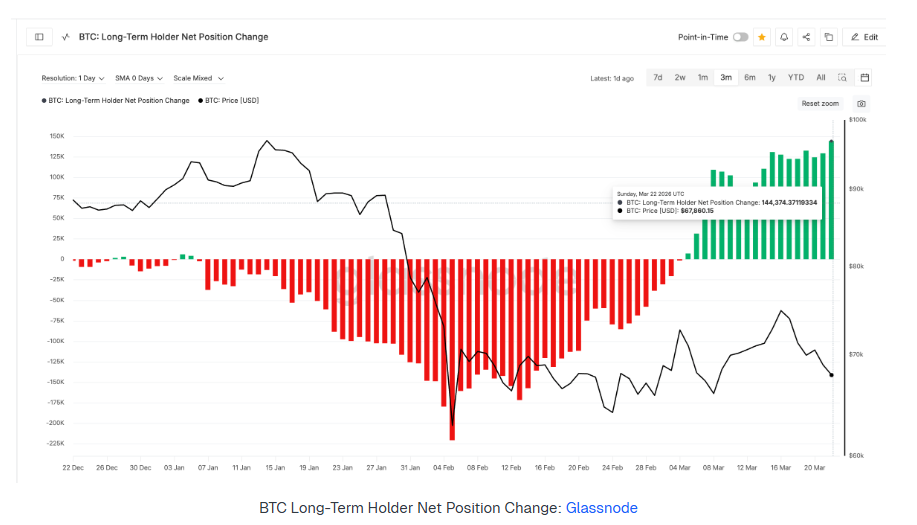
This suggests that whales and long-term holders are treating the recent decline as a buying opportunity rather than a risk event. This could offer some support to the price.
BTC technical analysis
From a technical perspective, BTC trades in a rising channel and has recovered above the 50-day SMA, which is a positive signal. Buyers will look to extend the positive move towards 76k. However, a break below the 50 SMA at 69 could open the door to the lower band of the rising channel at $68K and then $65K, triggering a deeper sell-off towards $60K.
However, Bitcoin’s next move now depends less on crypto and more on macro. This keeps Iran headlines as a key driver for BTC, treasury yields, and the wider market.
Trading involves risk.
Author



 Risk Disclaimer
The content provided here is for informational purposes only. It is not intended as personal investment advice and does not constitute a solicitation or invitation to engage in any financial transactions, investments, or related activities. Past performance is not a reliable indicator of future results.
The financial products offered by the Company are complex and come with a high risk of losing money rapidly due to leverage. These products may not be suitable for all investors. Before engaging, you should consider whether you understand how these leveraged products work and whether you can afford the high risk of losing your money.
The Company does not accept clients from the Restricted Jurisdictions as indicated in our website/ T&C. Some services or products may not be available in your jurisdiction.
The applicable legal entity and its respective products and services depend on the client’s country of residence and the entity with which the client has established a contractual relationship during registration.