8 min read
 Technical picture
Bitcoin keeps getting rejected from the blue 20-day EMA and grinds lower, with the daily candle at $59,640 just above the recent low of $58,039. A clean break of that low opens the path toward the next major support at $53,412, a level that held during the 2024 cycle and is now the line the market tests for the structural pivot.
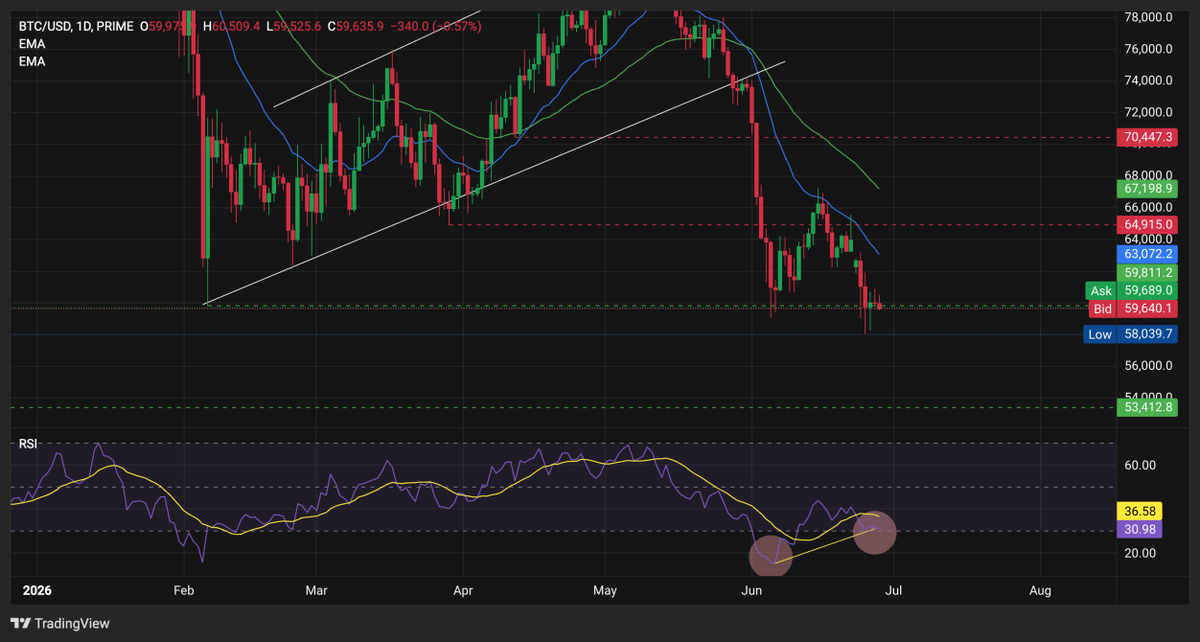
On the RSI side, a small bullish divergence is starting to form versus the early-June low, the first technical hint that a reversal may begin from somewhere around here. One divergence is rarely enough on its own, however, and a genuine cycle turn on BTC has historically required two or three of them stacking up on the daily before price confirms.
Crypto heatmap
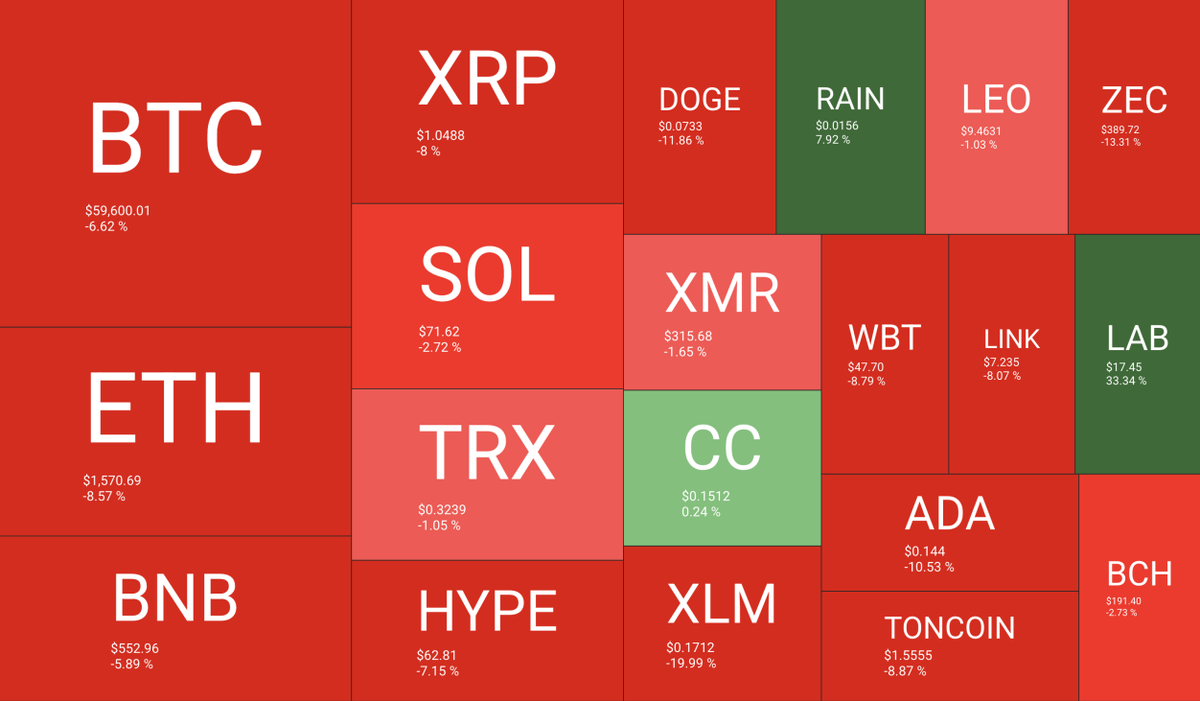
The weekly heatmap is back to almost entirely red, reflecting the leg lower that took BTC from $64K toward $58K.
Source: https://quantifycrypto.com/heatmaps
BTC is down 6.62% to $59,600, ETH lost 8.57% to $1,570, and SOL slipped 2.72% to $71.62. The worst on the board is XLM at minus 19.99%, then ZEC at minus 13.31% and DOGE at minus 11.86%. Meaningful green is limited to LAB at plus 33.34% on idiosyncratic flow, plus small bids in RAIN and CC. The red tape ties directly to the ETF and Strategy picture below.
Bitcoin dominance
Bitcoin dominance has only ticked down by about 1% over the past week, sitting at 58.56% on the daily after a small 5-day move of minus 1.06%.
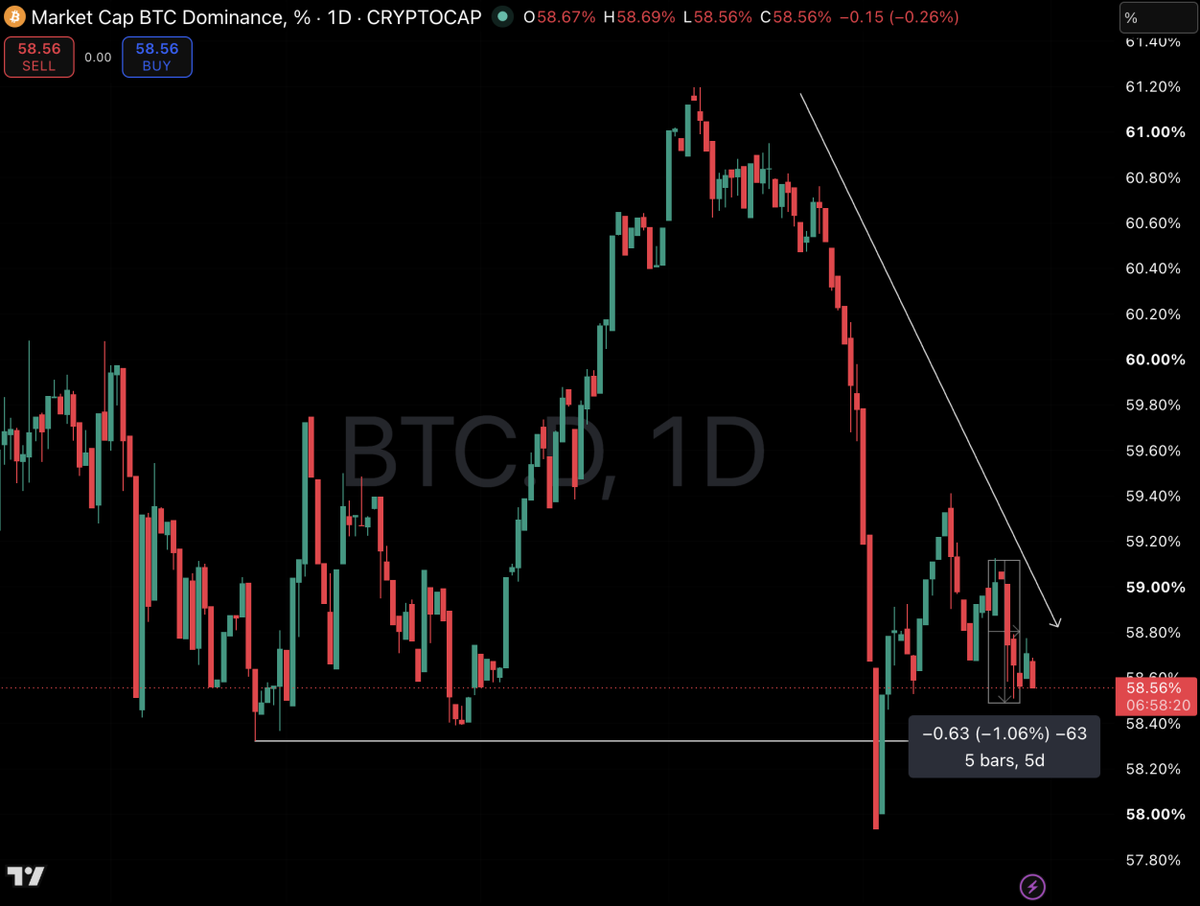
A drop in dominance during a falling tape can mean two things: liquidity rotating into altcoins, or altcoins panic-selling harder than BTC. The cross-coin moves on the heatmap above clearly support the second reading, with no broad altcoin bid emerging despite the dominance slip.
Altcoin Season Index
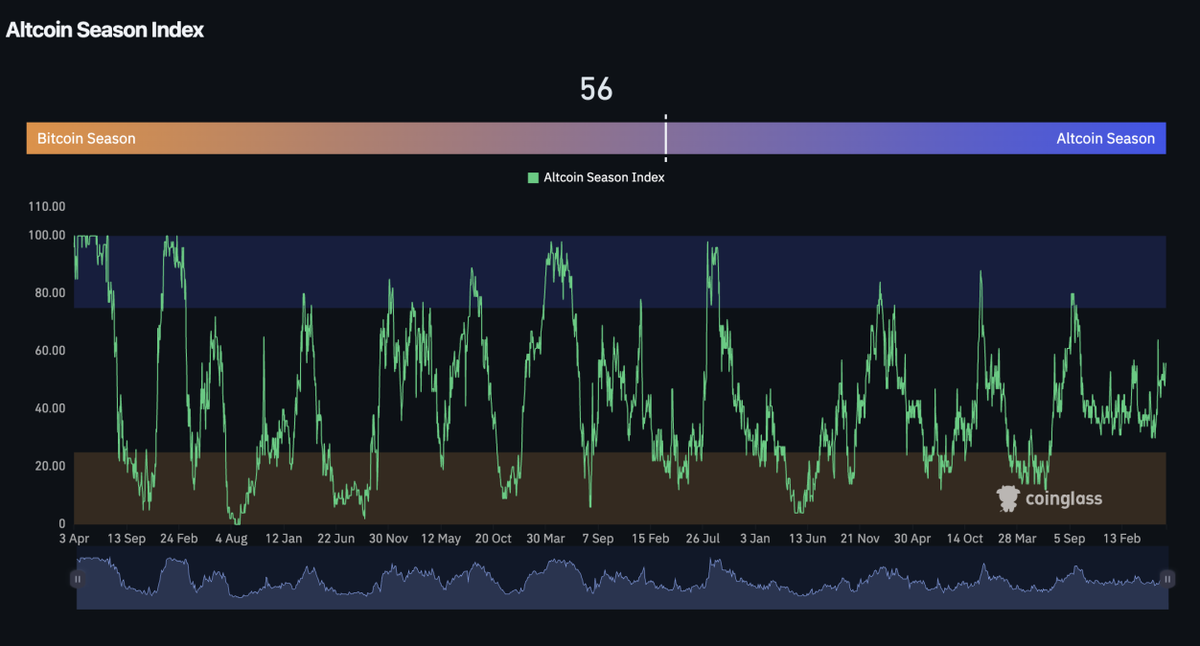
The Altcoin Season Index sits at 56, unchanged from last week, just above the 50 midpoint.
Source: https://www.coinglass.com/pro/i/alt-coin-season
The flat reading is consistent with the picture above: dominance is drifting lower not because altcoins are outperforming, but because everything is selling off together. It is hard to call a rotation into alts when alts themselves are deep in the red.
Fear and Greed slides back to Extreme Fear
The Crypto Fear and Greed Index has reversed back down to 17 after climbing to 22 last week and 11 the week before. It sits squarely back in Extreme Fear, mechanically following the latest leg of price weakness.
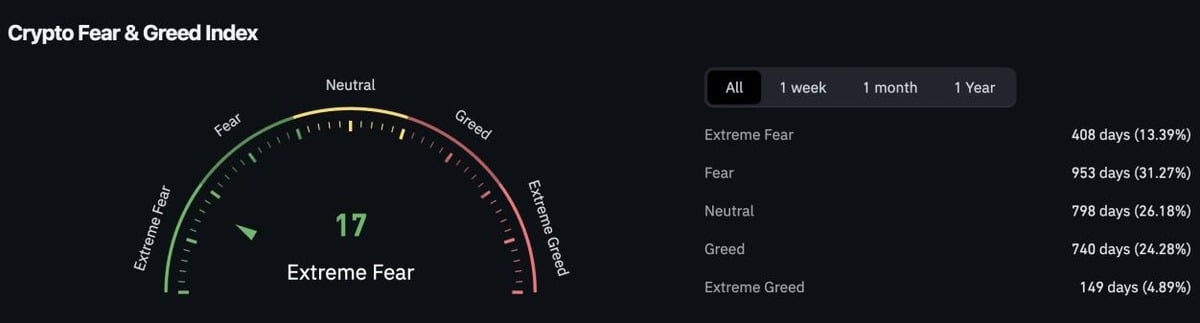
Source: https://www.coinglass.com/pro/i/FearGreedIndex
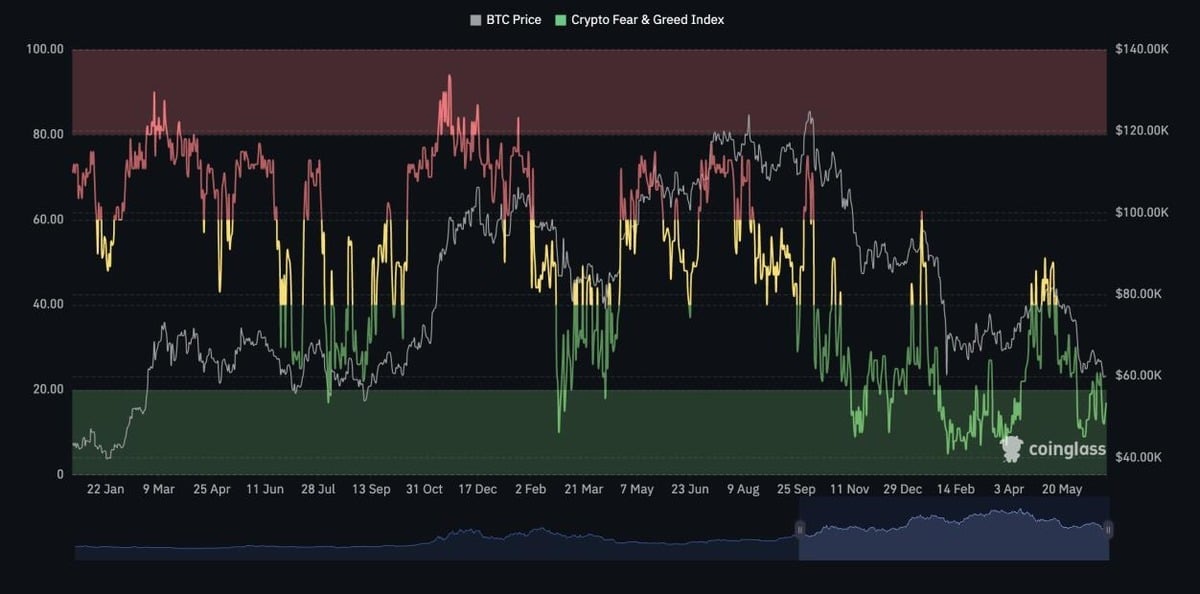
On the long-term overlay, the dial is back inside the green band that has historically marked the best multi-month entry windows. Fear alone is not the bottom signal, but the public has zero appetite for risk right now, and paired with the ETF and Strategy stress covered below, it is the context long-horizon investors look back on as a value zone.
Saylor and the Strategy bid
Michael Saylor is still publicly signalling more BTC purchases. Strategy added 520 BTC for around $35 million in the week of June 22, bringing total holdings to 847,363 BTC with an average cost of $75,653 and a reserve value of $50.88 billion as of June 28. The position is now sitting on a 20.63% unrealised loss, roughly $13.2 billion.
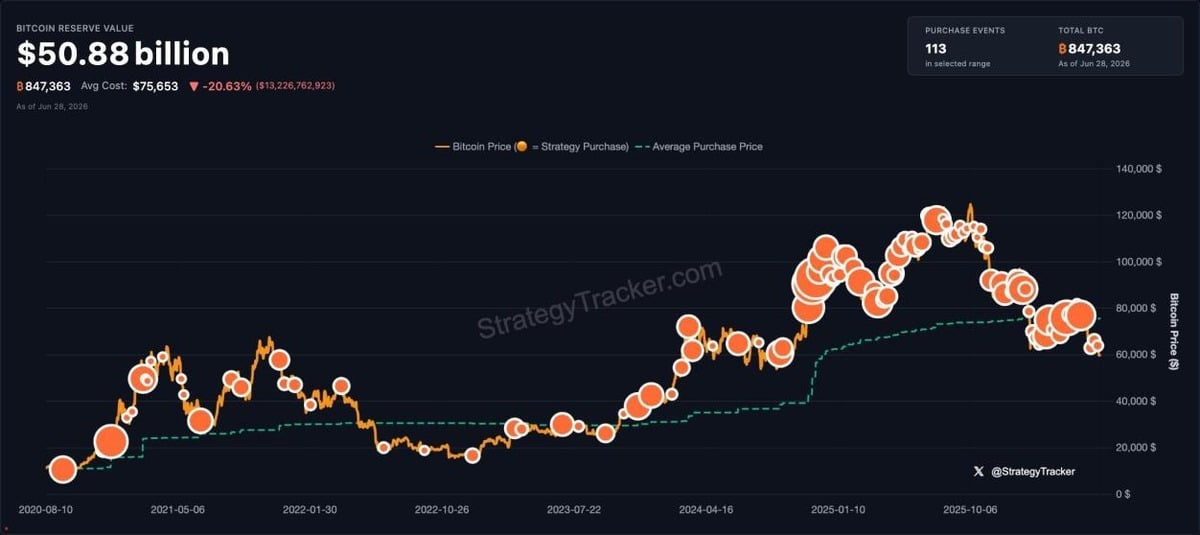
Around the position, pressure is building. Rosen Law Firm opened a securities-fraud probe into Strategy, Ripple CEO Brad Garlinghouse criticised the model on CNBC, and CryptoQuant urged Strategy to pause BTC buying and rebuild cash. STRC dividend coverage has reportedly collapsed from over seven years to roughly fourteen months as the preferred-stock bill ballooned from $300M to $1.2B annually. The story on desks is that the BTC drawdown is at least partly a coordinated push from larger players who want to force Strategy to crack on funding. That is narrative, not confirmed fact, but the pressure is real.
MSTR price dynamics
The MSTR stock chart looks worse than BTC. The share price has dropped about 85% from the high of $543, closing at $81.53 over the past roughly 1.6 years on the chart. By comparison, BTC is down about 53% from its $126K ATH set in October 2025. That gap quantifies how much of the leverage in MSTR is bleeding into the stock relative to the underlying asset.
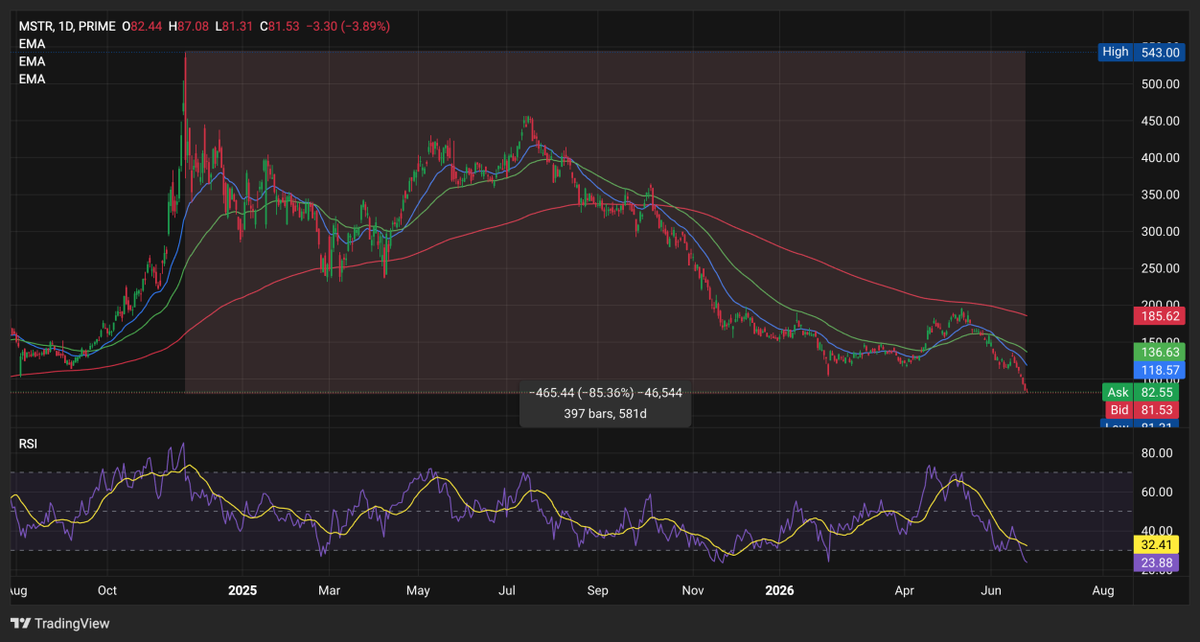
This does not mean Bitcoin or MSTR is going to zero. It does mean the market is repricing the entire treasury-leverage trade, and historically such moments have produced attractive entry windows for long-horizon investors. The MSTR RSI sits at 23, the most oversold reading on the chart.
Bitcoin yearly returns
Looking at the longer-term return table, the picture still looks healthy in context, even with 2026 sitting at minus 31% year to date.
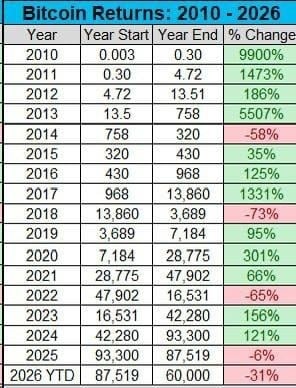
Bitcoin had down years in 2014 at minus 58%, 2018 at minus 73%, and 2022 at minus 65%. Each was followed by a sharp recovery. The 2025 result of minus 6% combined with year-to-date 2026 at minus 31% is a meaningful but not extreme drawdown, which fits the late-stage stress frame rather than an existential break.
Record 30-day ETF outflows
Galaxy Research flagged a new all-time record in the 30-day net flow for US spot Bitcoin ETFs, with the latest reading at minus $6.4 billion on June 18, the most negative window since the ETFs launched in January 2024 (rank #1 of 582 trailing windows).
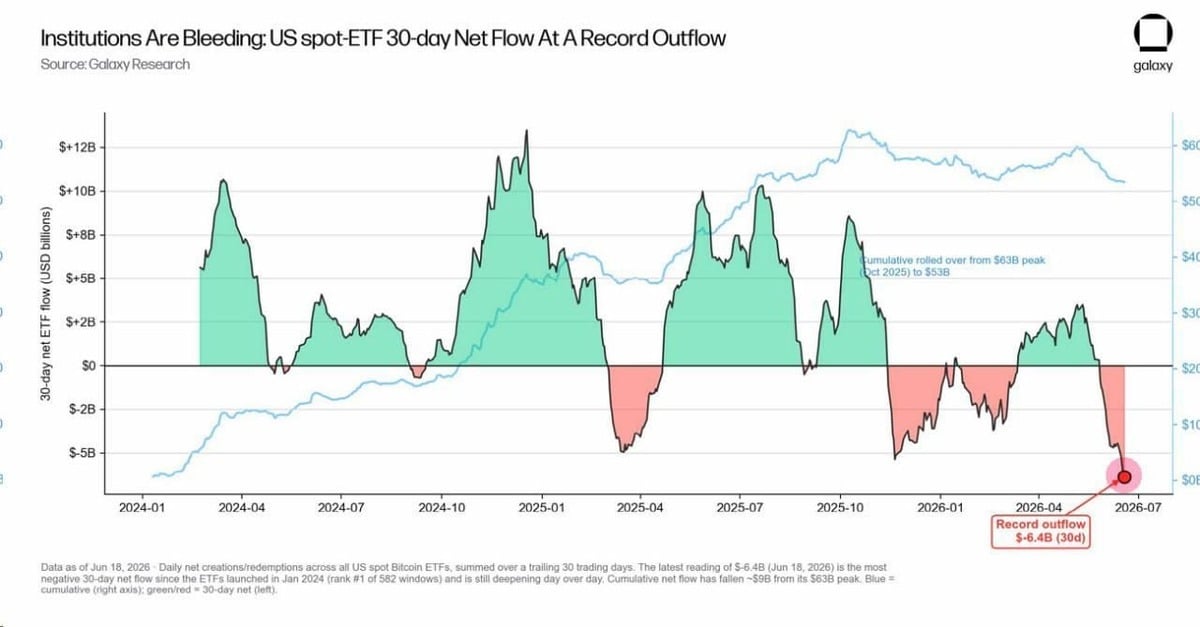
Cumulative net flow has rolled from a $63 billion peak in October 2025 to about $53 billion, and the reading is still deepening day over day. This is the demand side of the Wintermute thesis above: institutional capital is exiting at a pace not seen at any prior point in the product life, an unambiguously bearish short-term signal.
Conclusion
Pulling it together, the picture stays bearish. BTC is grinding toward $58K, the heatmap is broadly red, dominance is bleeding without a real altcoin bid, sentiment is back in Extreme Fear, ETF outflows hit a new record, Strategy is under multi-front pressure, and MSTR is down 85% from its high. Even bullish details like the single RSI divergence on BTC are not enough to outweigh the broader stress.
For long-horizon investors, BTC could still grind higher over the next two to three years, but the short and medium-term picture is poor and no bullish inflection is visible yet. Good news is absorbed neutrally and bad news sharply. The signal to watch is the moment the market stops reacting to bad news and starts to consolidate. That is when the regime can change.
Trading involves risk.
Author



 Risk Disclaimer
The content provided here is for informational purposes only. It is not intended as personal investment advice and does not constitute a solicitation or invitation to engage in any financial transactions, investments, or related activities. Past performance is not a reliable indicator of future results.
The financial products offered by the Company are complex and come with a high risk of losing money rapidly due to leverage. These products may not be suitable for all investors. Before engaging, you should consider whether you understand how these leveraged products work and whether you can afford the high risk of losing your money.
The Company does not accept clients from the Restricted Jurisdictions as indicated in our website/ T&C. Some services or products may not be available in your jurisdiction.
The applicable legal entity and its respective products and services depend on the client’s country of residence and the entity with which the client has established a contractual relationship during registration.