7 min read
 Oil is falling sharply as ceasefire optimism collides with the most bearish demand forecast since the pandemic. Here’s what traders need to know:
- WTI fell nearly 8% on Tuesday to close at $91.28, while Brent settled at $94.79, down over 4%
- The IEA just forecast the first annual decline in global oil demand since 2020, slashing its outlook from +640,000 bpd growth to a contraction of 80,000 bpd
- Global oil supply plunged 10.1 million bpd in March, the largest disruption in history according to the IEA
- Iran is reportedly considering a temporary pause in Hormuz shipments to advance negotiations, while Trump indicated talks could restart “within the next two days”
- US crude inventories rose by approximately 3.7 million barrels last week (API data), extending a multi-week streak of builds
- The ceasefire expires on 21 April, six days from now
In our last oil analysis, we covered the initial ceasefire-driven collapse from above $100. Since then, the picture has evolved significantly. Prices briefly recovered toward $104 on the Hormuz blockade announcement, but that rally has now been fully unwound as deal optimism and demand destruction concerns take hold.
The IEA’s warning
The IEA’s April Oil Market Report, released on Tuesday, paints one of the most bearish pictures for oil demand in years. The agency now expects Q2 demand to fall by 1.5 million bpd, the sharpest quarterly decline since the COVID-19 pandemic. March demand already contracted by an estimated 800,000 bpd year-on-year, with April expected to deteriorate further to 2.3 million bpd.
The damage has been concentrated primarily in the Middle East and Asia-Pacific, where petrochemical producers have curtailed operations as feedstock supply dried up, flight cancellations have surged, and multiple governments have imposed conservation measures. Asian refineries have cut runs by approximately 6 million bpd in April alone.
The IEA described this as the largest oil supply disruption in history and warned that if the Strait of Hormuz remains closed beyond May, demand destruction could average 5 million bpd for the rest of the year.
IEA Executive Director Fatih Birol warned that April could be “even worse than March” for the energy sector.
Deal hopes vs reality
Despite the IEA’s grim outlook, markets are pricing in growing optimism that a deal is possible. Trump indicated talks could restart “within the next two days” in Pakistan after last weekend’s negotiations broke down. Iran is reportedly weighing a temporary halt in Hormuz shipments to facilitate progress. Vice President Vance said the ball was “in Iran’s court” after Washington put “a lot on the table.”
Saudi Arabia has urged the US to lift the Hormuz blockade and return to diplomacy. The ceasefire, which took effect on 7 April, expires on 21 April, giving both sides six days to reach a framework or risk a return to full escalation.
The tension for oil traders is clear: prices are falling on hope, but the physical damage to supply chains, refinery operations, and global inventories is already significant and could take months to unwind. The IEA estimates it could take approximately two months to stabilise Hormuz exports even after the waterway reopens, and some production in Iraq and Kuwait may not return at all due to infrastructure damage.
Daily chart analysis
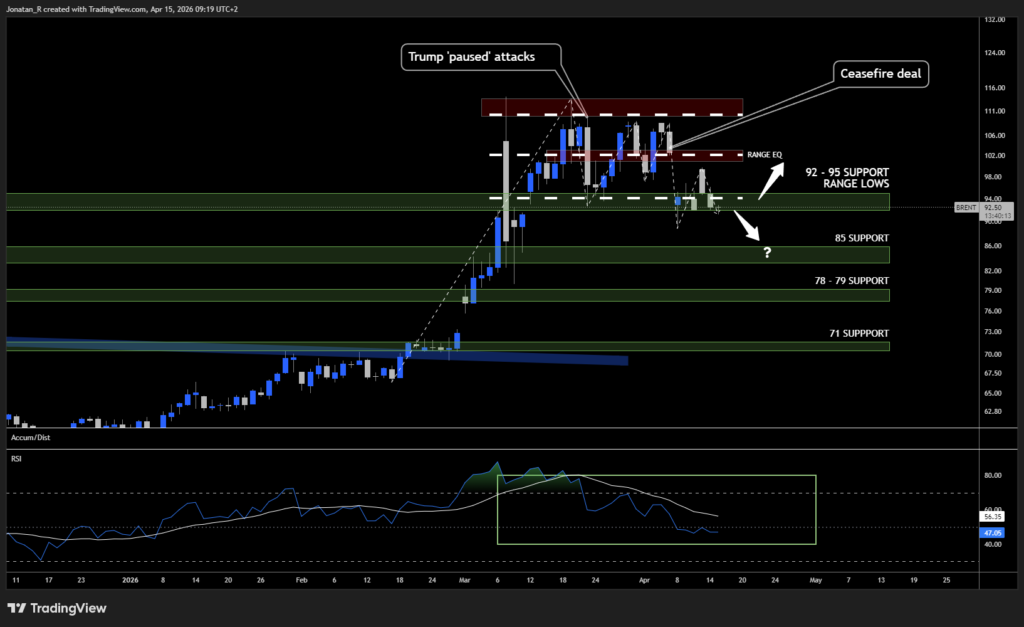
On the daily timeframe, Brent crude has been drifting lower within a broad consolidation range between roughly $92 and $112. The move lower has been gradual rather than impulsive, reflecting the tug-of-war between geopolitical supply fears and growing demand destruction.
The RSI has broken below 50 but remains within its bullish range. This is a key detail: momentum is weakening, but the broader structure has not yet turned outright bearish. If the RSI holds above 40, the bullish range (using Andrew Cardwell’s framework) could remain intact.
Price is currently testing the $92–$95 support zone, which represents the range lows. This is the most important level on the chart right now. The range equilibrium around $100–$101 has already been lost and is now acting as resistance, a sign of weakness within the range.
If $92 breaks, the next area of interest is $85, followed by the $78–$79 support zone further below. A break below range support could confirm a shift in market structure and potentially open the door to a retest of pre-war levels around $71.
If $92 holds, the first resistance above is the $102 area, which aligns with the range equilibrium. Reclaiming this level could be the first sign of stabilisation, though any move higher may face selling pressure near $108–$112, the upper end of the consolidation range.
What to watch
- The ceasefire deadline on 21 April is the single most important variable. A deal extension or framework agreement could send oil sharply lower, while a collapse back into escalation could drive a rapid retest of the $108–$112 range highs
- Hormuz traffic flow could be the earliest signal of whether de-escalation is translating into physical supply relief
- The $92 support level on the daily chart. A break below this level could shift the technical bias from range-bound to bearish
- The weekly EIA inventory report (due today) following the API’s latest weekly build
Trading involves risk.
Author



 Risk Disclaimer
The content provided here is for informational purposes only. It is not intended as personal investment advice and does not constitute a solicitation or invitation to engage in any financial transactions, investments, or related activities. Past performance is not a reliable indicator of future results.
The financial products offered by the Company are complex and come with a high risk of losing money rapidly due to leverage. These products may not be suitable for all investors. Before engaging, you should consider whether you understand how these leveraged products work and whether you can afford the high risk of losing your money.
The Company does not accept clients from the Restricted Jurisdictions as indicated in our website/ T&C. Some services or products may not be available in your jurisdiction.
The applicable legal entity and its respective products and services depend on the client’s country of residence and the entity with which the client has established a contractual relationship during registration.