6 min read
 Stocks have broken to fresh all-time highs. The S&P 500 closed at a record 7,022.95 on Wednesday, completing a remarkable V-shape recovery from the Iran war drawdown, while the Nasdaq Composite has now logged 11 straight days of gains, its longest winning streak since 2021.
But is this breakout being fuelled by just a handful of mega-cap leaders, or is there genuine broad market participation behind the move? In this article, we dive into breadth analysis to take a closer look.
Here’s what we’ll cover:
- A full breadth analysis of the S&P 500, covering volume, advance/decline data, cumulative new highs versus lows, and the percentage of stocks above their 200-day moving average
- The same breadth breakdown applied to the Nasdaq
- What the internals could be telling us about the strength and sustainability of this rally
S&P 500 breadth analysis
The S&P 500 has broken out to a fresh all-time high at 7,040, completing a full V-shape recovery from the Iran war drawdown. Under the hood, however, the picture looks more mixed.
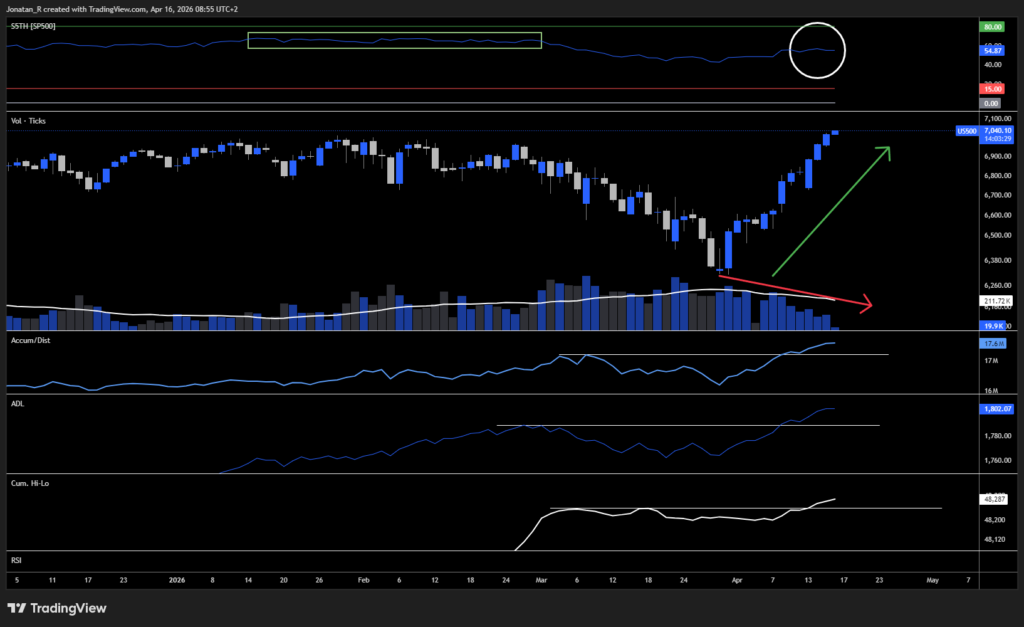
Bullish signals:
- The Accumulation/Distribution indicator has broken to new highs, suggesting volume-weighted buying at the index level could be confirming the price breakout.
- The Advance/Decline line has also broken to new highs. On a day-to-day basis, more S&P 500 stocks are advancing than declining.
Bearish signals:
- Volume has declined throughout the V-shape recovery. The volume moving average is sloping downward as price rises. A classic weak-volume breakout, where conviction could be fading as the index makes new highs.
- The cumulative new highs vs new lows indicator is barely at new highs. Based on S&P 500 constituents, the line has only marginally exceeded its prior peak. When the same indicator is based on all US stock markets, it is nowhere near new highs.
- The percentage of S&P 500 stocks above their 200-day moving average sits at around 55. At the January all-time high, this figure was closer to 65 to 68. The index is now higher, but fewer of its constituents are above their long-term trend.
The breakout is confirmed at the price level, but the internals appear weaker than they were at the January peak. The market is making new highs on narrower leadership, a pattern that has historically preceded periods of consolidation or correction.
Nasdaq breadth analysis
The Nasdaq 100 has rallied to a fresh all-time high at 26,311, with a V-shape recovery that looks even sharper than the S&P 500’s. The breadth picture tells a similar story, but with signals that appear more pronounced to the downside.
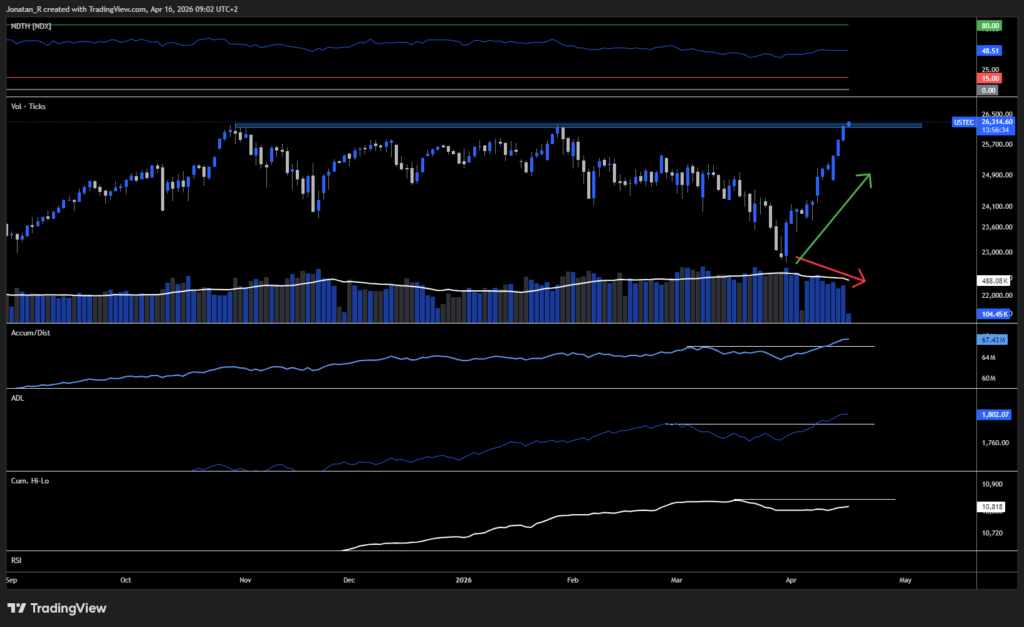
Bullish signals:
- The Accumulation/Distribution indicator has broken to new highs, mirroring the S&P 500 and suggesting volume-weighted buying at the index level.
- The Advance/Decline line has broken to new highs. Day-to-day participation across Nasdaq 100 stocks appears broad.
Bearish signals:
- Volume has declined sharply throughout the V-shape recovery, with the most recent session printing well below the moving average.
- The cumulative new highs vs new lows indicator is below its prior peak, despite the index trading at a new all-time high. Unlike the S&P 500, where this indicator at least marginally confirmed, the Nasdaq version is actively diverging.
- The percentage of Nasdaq 100 stocks above their 200-day moving average sits at 48.51, below the 50 midline. More than half of Nasdaq 100 constituents are below their long-term trend, even as the index itself prints new all-time highs. At the November and January peaks, this reading was running noticeably higher.
The Nasdaq’s breakout looks more top-heavy than the S&P 500’s. A small group of mega-cap tech names appears to be leading the index higher while the broader group of Nasdaq stocks has been lagging. Historically, this is the kind of setup that has often preceded pauses or pullbacks.
Putting it all together
Both indices have broken to fresh all-time highs, and some breadth signals confirm the move. But the same warning pattern emerges across both: volume is fading, fewer stocks are making new 52-week highs than at the prior peaks, and fewer stocks are trading above their long-term trend than when the indices last set records.
The price breakout is confirmed. But the rally looks narrower than the headline numbers suggest, and the margin for error could be thinner than it appears.
Trading involves risk.
Author



 Risk Disclaimer
The content provided here is for informational purposes only. It is not intended as personal investment advice and does not constitute a solicitation or invitation to engage in any financial transactions, investments, or related activities. Past performance is not a reliable indicator of future results.
The financial products offered by the Company are complex and come with a high risk of losing money rapidly due to leverage. These products may not be suitable for all investors. Before engaging, you should consider whether you understand how these leveraged products work and whether you can afford the high risk of losing your money.
The Company does not accept clients from the Restricted Jurisdictions as indicated in our website/ T&C. Some services or products may not be available in your jurisdiction.
The applicable legal entity and its respective products and services depend on the client’s country of residence and the entity with which the client has established a contractual relationship during registration.