5 min read
 Brent crude oil has slipped to the lower end of its recent range as optimism over a US-Iran deal continues to build. The war premium that drove crude higher through the conflict now appears to be unwinding, though the path lower hinges on an agreement that has not yet been signed.
The key developments:
- The catalyst is diplomatic. Over the weekend, President Trump said talks were proceeding in a “constructive” manner and that an agreement to reopen the Strait of Hormuz had been “largely negotiated.” That sent Brent back below the $100 level.
- The deal is not done. Both sides remain at odds over the timing of sanctions relief, control of the strait, and the fate of Iran’s enriched uranium. Each fresh “constructive” headline has been partially retraced as those disputes resurface.
- The physical market is still tight. Even if a deal is reached, supply could be slow to recover. The IEA notes global inventories are drawing at a record pace, with the market in deficit until later in the year, which could keep a floor under prices.
The picture is two-sided. A clean reopening of Hormuz could accelerate the unwind of the war premium, while any slippage in talks could potentially snap that premium back quickly.
Daily chart
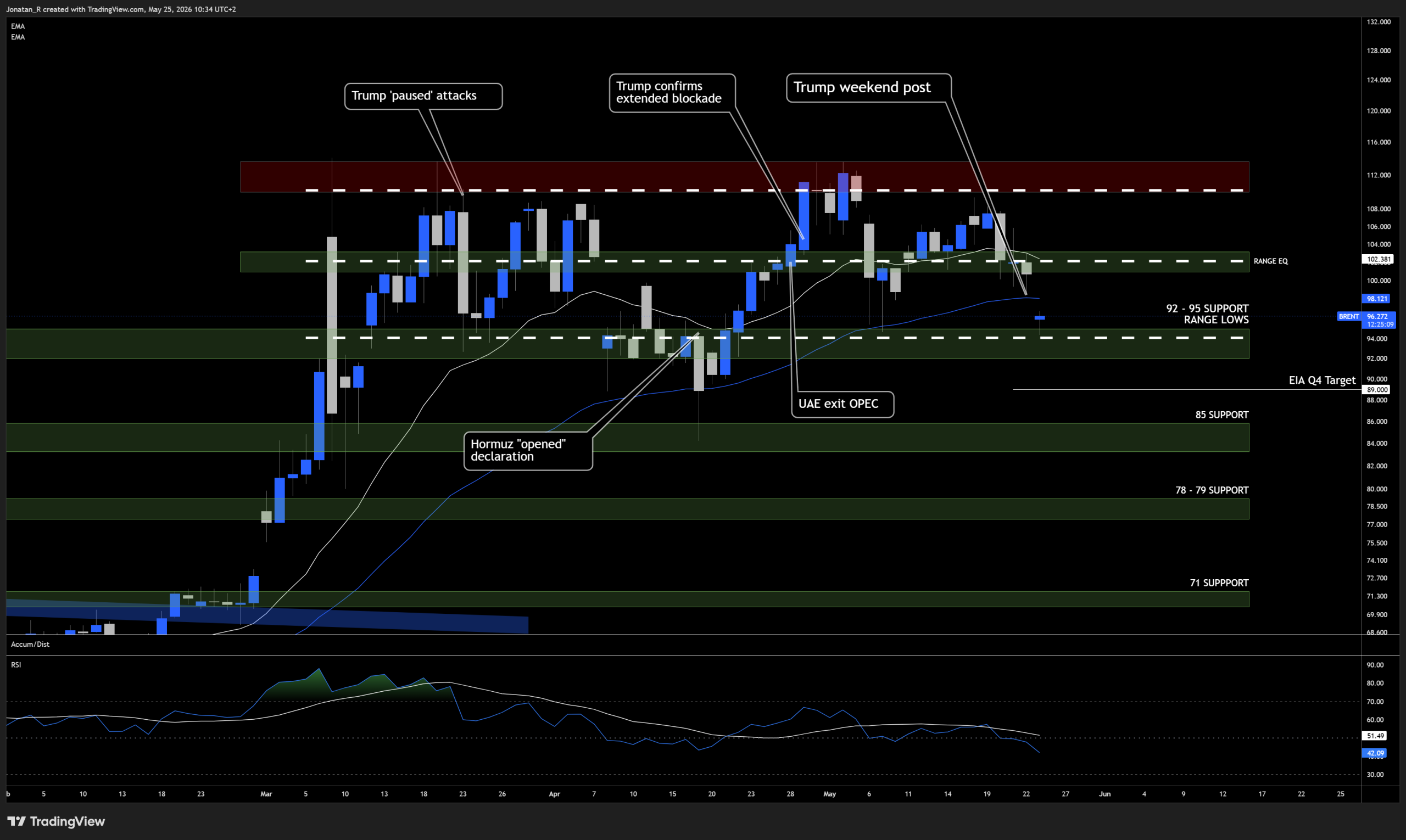
On the daily timeframe, Brent has fallen back toward the 92 to 95 range lows after Trump’s weekend post on the potential peace deal, slipping beneath the range EQ around 102 and the short-term moving averages in the process.
The chart tells a familiar story. Through the conflict, price has repeatedly spiked and faded around Iran headlines:
- Trump “paused” attacks and the Hormuz “opened” declaration drove moves that later unwound
- Trump confirming the extended blockade pushed price back into the upper 108 to 112 resistance zone
- The latest leg lower came on the weekend post, with the UAE’s exit from OPEC adding to the backdrop
In each case, price has tended to retrace once the headlines proved less durable than the initial reaction suggested. The current move sits within that same pattern, which is worth keeping in mind while the deal remains unconfirmed.
If talks continue in a constructive direction, price could potentially extend toward the 85 support area, which also sits near the EIA’s Q4 target around 89. The RSI has slipped below its midline toward 42, reflecting the loss of short-term momentum.
Even if the geopolitical picture improves, the underlying supply shock could take months to normalise, which may keep a floor under prices regardless of the headline direction.
Key levels to watch
Resistance:
- 102 the range EQ, recently lost and now the first level back overhead
- 108 to 112 the upper boundary of the range and the recent rejection zone
Support:
- 92 to 95 the range lows, the immediate area in focus
- 85 the next major horizontal support below, near the EIA’s Q4 target around 89
- 78 to 79 deeper structural support
- 71 the broader uptrend floor
What to watch
- Any confirmation or breakdown of the deal, particularly on the timing of sanctions relief and control of the strait
- Headlines on the Strait of Hormuz reopening, the single biggest driver of the supply picture
- The OPEC and non-OPEC ministerial on 7 June, with governance in focus following the UAE’s exit
- Further IEA, OPEC, or EIA updates on inventory draws and the pace of any supply recovery
- The 92 to 95 range lows as the immediate technical decision point
For more on how the war premium returned to oil earlier this month, see our previous oil analysis.
Trading involves risk.
Author



 Risk Disclaimer
The content provided here is for informational purposes only. It is not intended as personal investment advice and does not constitute a solicitation or invitation to engage in any financial transactions, investments, or related activities. Past performance is not a reliable indicator of future results.
The financial products offered by the Company are complex and come with a high risk of losing money rapidly due to leverage. These products may not be suitable for all investors. Before engaging, you should consider whether you understand how these leveraged products work and whether you can afford the high risk of losing your money.
The Company does not accept clients from the Restricted Jurisdictions as indicated in our website/ T&C. Some services or products may not be available in your jurisdiction.
The applicable legal entity and its respective products and services depend on the client’s country of residence and the entity with which the client has established a contractual relationship during registration.