6 min read
 The Japanese yen touched its weakest level since 1986 this week, with USD/JPY reaching an intraday high of 162.78 on 1 July before a sharp reversal on Thursday sent traders scrambling to work out whether Tokyo had stepped back into the market.
The pair’s Thursday move (a drop of as much as 0.9% before paring some of that decline) had the hallmarks of previous intervention episodes, but nothing was confirmed. Japan’s Ministry of Finance declined to comment, and even traders were split on what had happened. Some pointed to a possible “rate check”, where authorities call dealers for yen pricing, often seen as a precursor to action. Others suggested the move could simply reflect nerves ahead of Thursday’s jobs data and Friday’s US holiday, when thinner liquidity tends to amplify any price swings.
Reuters reported, citing two sources familiar with the matter, that Japanese officials could be shifting their approach entirely: away from the verbal warnings that preceded April’s intervention, and toward unannounced action designed to catch short-yen positioning off guard. Japan’s top currency diplomat has reportedly held off on the escalating rhetoric seen ahead of the country’s last intervention, a silence some analysts believe is deliberate. None of this has been officially confirmed by Japanese authorities.
What is confirmed is that the earlier intervention didn’t hold. Japan deployed a record ¥11.73 trillion (around $73.6 billion) defending the yen between late April and late May, according to Ministry of Finance data, but USD/JPY has since unwound those gains entirely and pushed to fresh multi-decade highs regardless.
The structural driver behind the move remains the same one that’s defined USD/JPY all year: a wide policy rate gap between the Federal Reserve, holding at 3.50-3.75%, and the Bank of Japan at 1.0% following June’s hike. That gap continues to reward carry trades that borrow in yen and buy dollar assets, and it’s proven difficult for verbal warnings or even direct intervention to offset on their own.
Thursday’s US jobs data added a partial counterweight. June nonfarm payrolls rose by just 57,000, well below the 110,000 expected and the weakest reading in four months, with April and May revised down by a combined 74,000. A softer print pares back some bets on further Fed tightening, though it wasn’t soft enough to meaningfully close the rate gap with Japan on its own.
Weekly
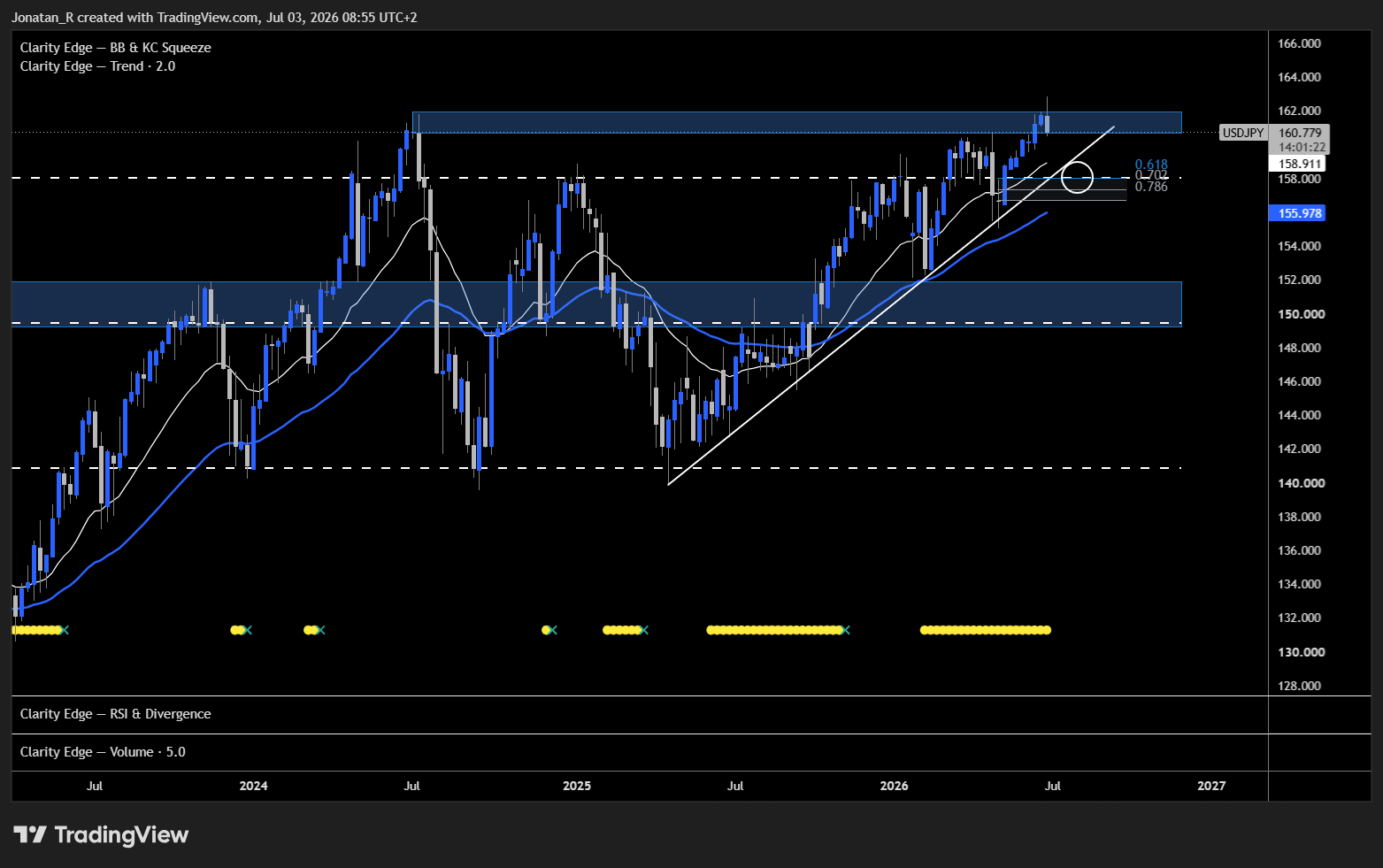
USD/JPY is currently printing a potential bearish engulfing candle on the weekly timeframe, with a long upper wick and a candle body that’s engulfing the prior week’s, right at a significant horizontal level. This could be an early signal of a reversal.
It’s worth noting that at the time of writing, this candle still has around 14 hours left to close, and price action could shift materially before then. For now, it has the look of a rejection.
Below, an ascending trendline runs beneath price between the weekly 20 and 50 EMAs, an area that also lines up with the 0.618 Fibonacci retracement. Should this level give way, the next logical higher timeframe level below sits at around 158.
Daily
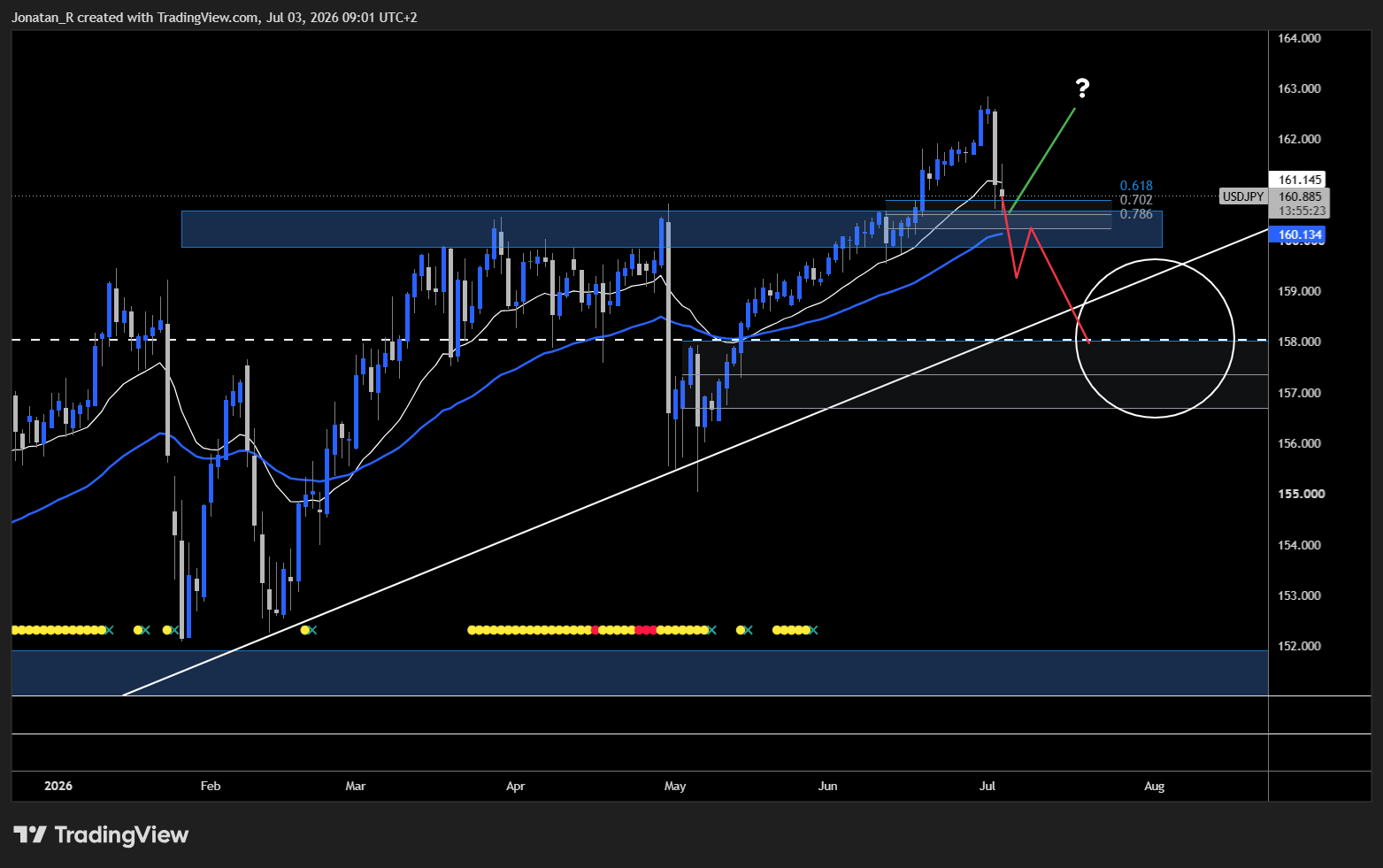
On the daily chart, USD/JPY is retesting the 160.5 level, an area of confluence with the local reload zone and the daily 20/50 EMA cluster, together forming a reasonably solid horizontal support.
Whether this level holds could say something about the effectiveness of any recent central bank action. If it holds and no fresh intervention emerges from Japanese authorities today (with US markets closed for the July 4 holiday and liquidity thin), that could suggest yesterday’s suspected intervention, if it happened, hasn’t had the lasting effect authorities would want. Conversely, a break lower today that later turns 160.5 into resistance could indicate their efforts are gaining traction.
The bigger test remains the weekly 158 level. A break there would mark a breach of the pair’s higher timeframe uptrend.
With central bank risk layered on top of thin holiday liquidity, volatility could pick up from here, cutting both ways for traders positioned on either side.
Key takeaways
- USD/JPY hit 162.78 on 1 July, its highest level since 1986, before a sharp Thursday reversal that traders suspect, but cannot confirm, was Japanese intervention
- Reuters sources say Tokyo may be shifting toward unannounced “ambush” intervention rather than telegraphed warnings, though this remains unconfirmed by officials
- Japan’s earlier ¥11.73 trillion (~$73.6bn) intervention in April-May was fully unwound, underscoring how the Fed-BoJ rate gap keeps overpowering official efforts
- A soft June NFP print (57,000 vs 110,000 expected) offered a partial counterweight to dollar strength
- Weekly: a potential bearish engulfing candle is forming at a key level, with a break lower opening the next higher timeframe support around 158
- Daily: price is retesting 160.5 support, a level that could offer clues on whether any intervention is working; a break lower keeps the door open toward the weekly 158 zone
Trading involves risk.
Author



 Risk Disclaimer
The content provided here is for informational purposes only. It is not intended as personal investment advice and does not constitute a solicitation or invitation to engage in any financial transactions, investments, or related activities. Past performance is not a reliable indicator of future results.
The financial products offered by the Company are complex and come with a high risk of losing money rapidly due to leverage. These products may not be suitable for all investors. Before engaging, you should consider whether you understand how these leveraged products work and whether you can afford the high risk of losing your money.
The Company does not accept clients from the Restricted Jurisdictions as indicated in our website/ T&C. Some services or products may not be available in your jurisdiction.
The applicable legal entity and its respective products and services depend on the client’s country of residence and the entity with which the client has established a contractual relationship during registration.