10 min read
 Weekly Recap
US Global stocks recap
US equities extended their gains last week. The S&P 500 closed at a record high on Friday, achieving its eighth straight weekly advance, the longest since December 2023. The Dow Jones rose 294 points, or 0.58%, to a new record of 50,580. The S&P 500 gained 0.4% for the week, while the Nasdaq posted its seventh weekly gain in eight weeks.
Friday’s gains were driven by progress in US-Iran peace talks and strong Q1 corporate earnings. Merck led Dow Jones gainers with a 5.64% increase, while NVIDIA shares fell 1.86% after its earnings report.
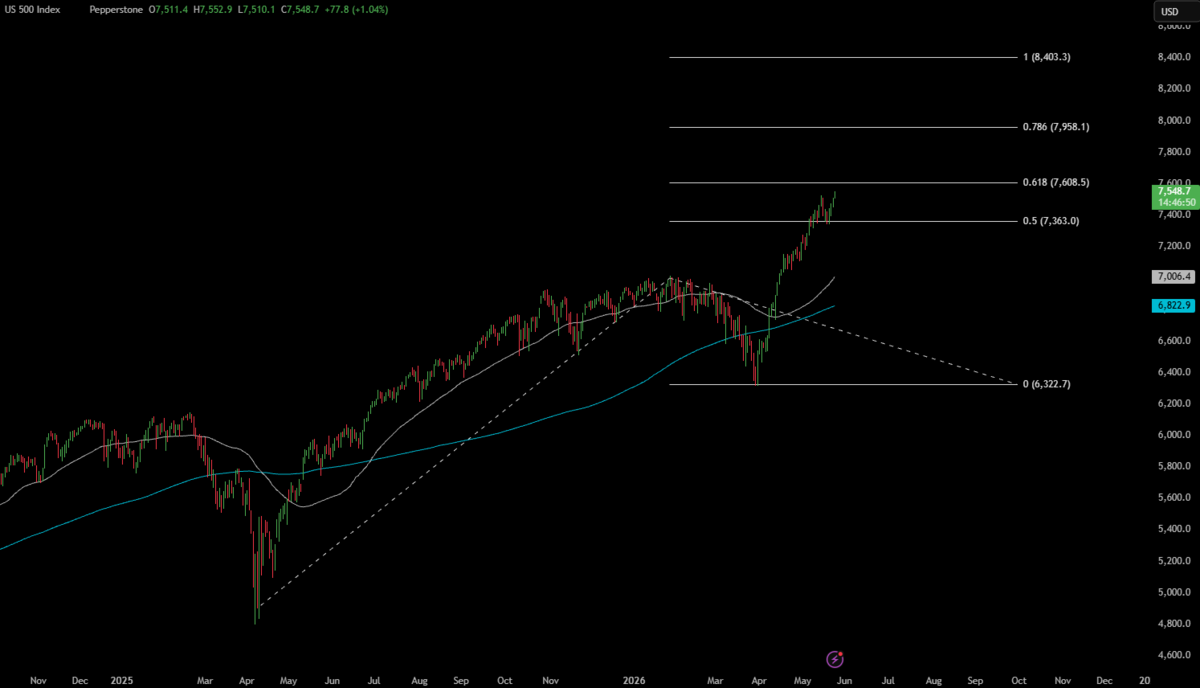
The week was marked by volatility. Treasury yields hit a one-year high on Monday, pressuring the S&P 500 and US 100. A false report on Wednesday about an imminent US-Iran resolution triggered a sharp intraday reversal. Despite these swings, stocks closed higher as oil prices declined and Treasury yields stabilized.
Major US data/themes
The April FOMC minutes released on Wednesday signaled a hawkish stance, indicating officials may remove the easing bias from their policy statement. This could precede rate hikes if inflation remains above the 2% target. Three camps emerged, with Hammack, Kashkari, and Logan forming a clear hawkish group, all keeping rate hikes on the table.
Markets responded by removing expectations for 2026 rate cuts. CME FedWatch now shows over 60% odds of a 25-basis-point rate hike in December. Fed Governor Christopher Waller indicated he no longer supports maintaining an easing bias.
NVIDIA reported fiscal Q1 2027 results after Wednesday’s close, beating expectations with revenue of $81.62 billion against a $79.12 billion consensus, up 85% year-on-year, and non-GAAP EPS of $1.87 versus $1.77 forecast. Data Center revenue surged 92% to $75.25 billion. CEO Jensen Huang told the call that “demand has gone parabolic” thanks to agentic AI, while CFO Colette Kress guided Q2 revenue to $91 billion.
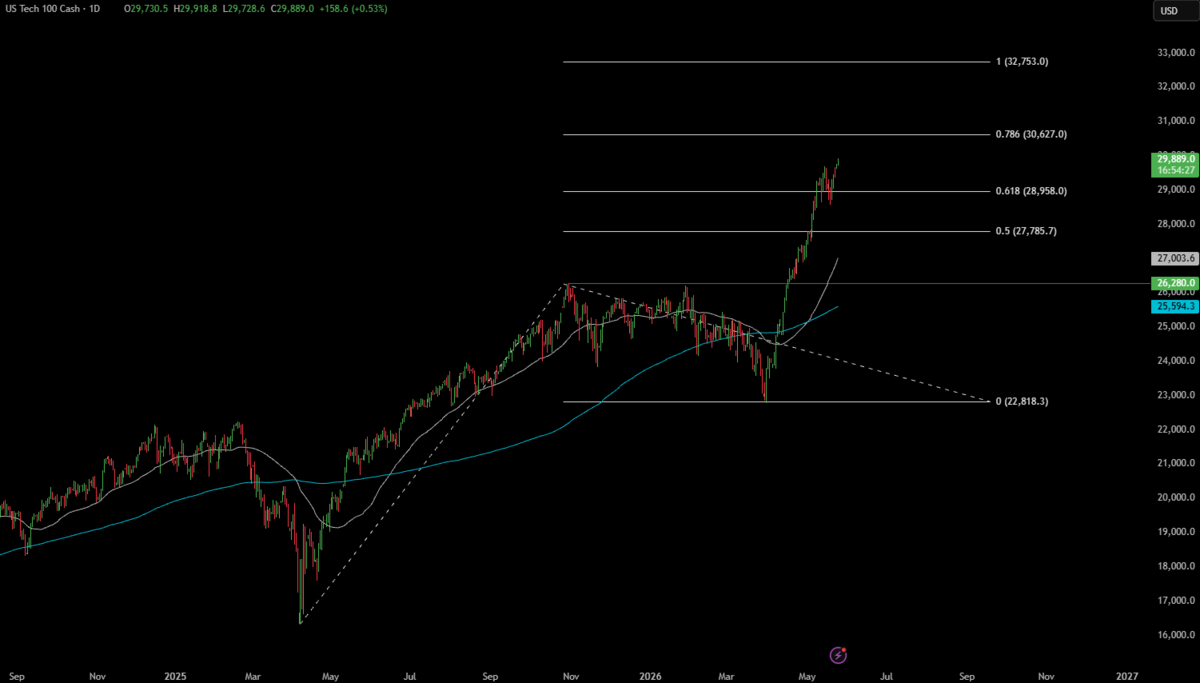
Despite strong results, NVIDIA shares closed lower the next day due to profit-taking and renewed concerns about Iran, ending Monday at $222.32. Hawkish FOMC minutes and robust AI earnings continue to support the Nasdaq at record valuations, though stretched positioning leaves the index vulnerable to weaker data.
Gold moves
Gold ended the week largely unchanged near $4,521 per ounce on Friday, caught between opposing factors. Hawkish FOMC minutes and rising Treasury yields exerted pressure, while diminished hopes for a US-Iran deal supported safe-haven demand.
Gold fell to test the $4,500 level on Thursday after reports that Iran’s Supreme Leader ordered enriched uranium to remain in Iran, contradicting Israeli demands for its transfer abroad as part of any peace agreement. Daily price swings reached as high as $84 in either direction during the week. The 10-year US Treasury yield closed near 4.59% on Friday, near one-year highs, while the US Dollar Index held within a 99.0-99.4 range. Both dynamics structurally weighed on Gold. Markets are now pricing roughly a 55% chance of at least one 25-basis-point Fed hike by October, with a further increase possible by December.
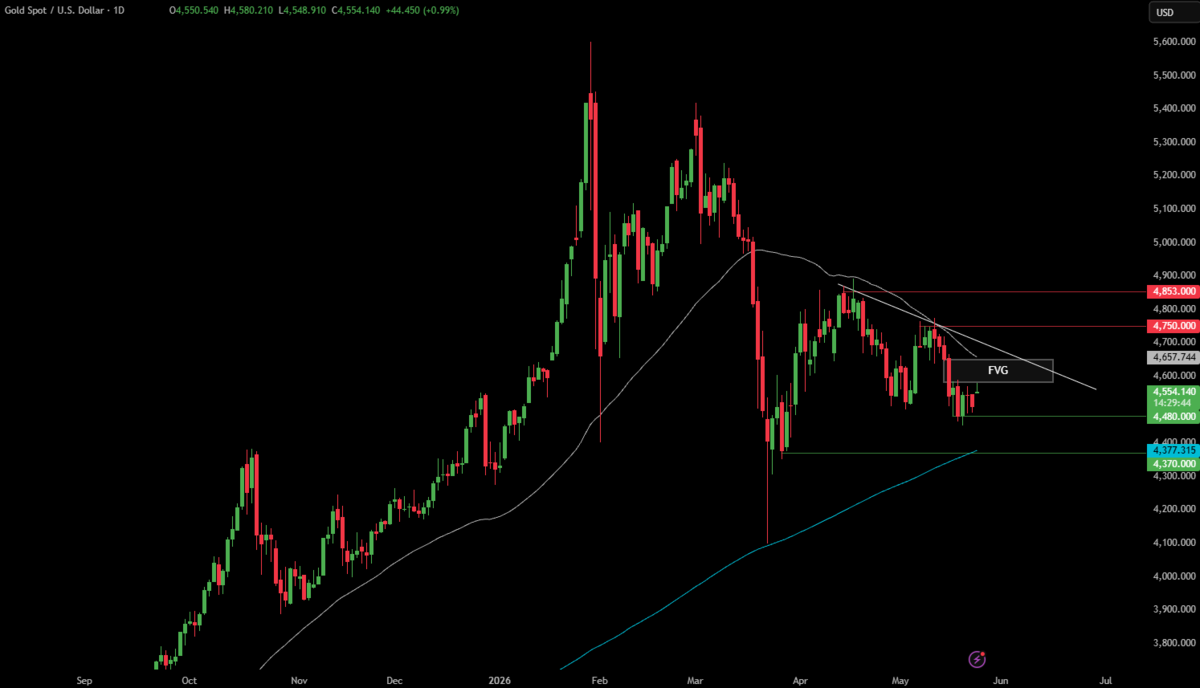
A strong Core PCE reading on Thursday would reinforce the hawkish Fed outlook and keep Gold under pressure toward the $4,480 support level. Conversely, a softer print or renewed tensions with Iran could lift Gold toward the $4,600 resistance level.
Oil moves
Brent fell by more than 5% for the week, closing at $100.5 per barrel on Friday. The decline followed signals of progress in US-Iran talks, with US Secretary of State Marco Rubio citing “slight progress” and “good signs” that an agreement could be reached.
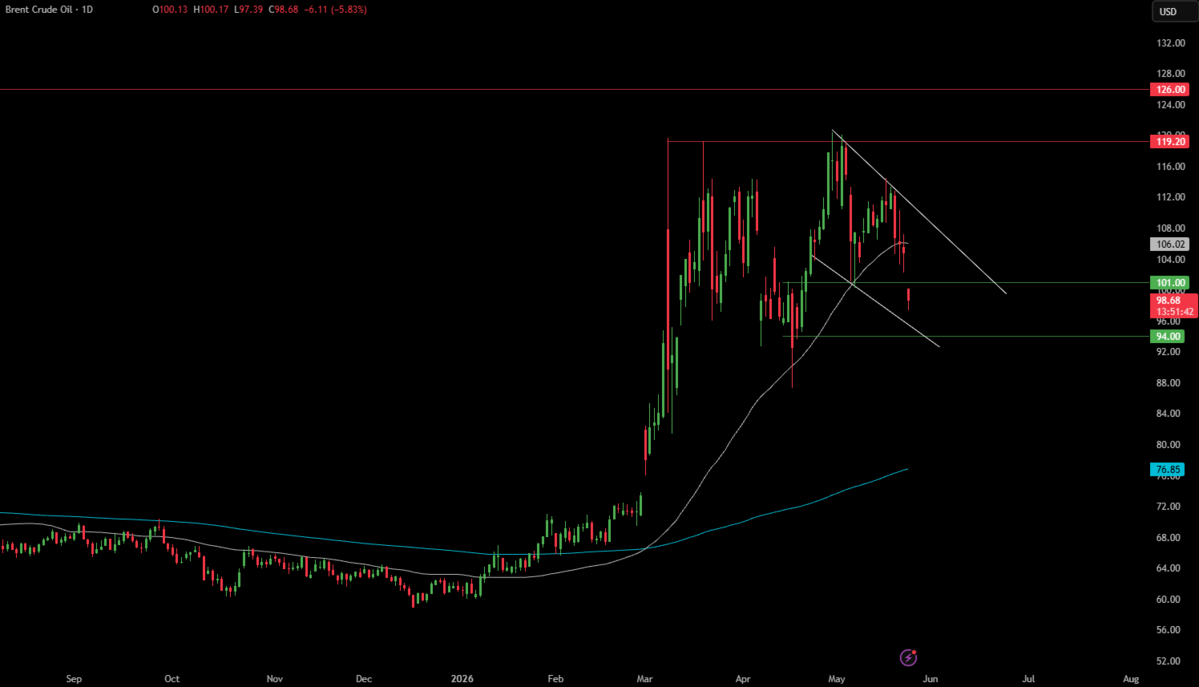
Prices tumbled on Monday after President Trump confirmed he had paused planned strikes on Iran to allow more time for negotiations. The biggest market relief came midweek amid reports of a draft resolution “near”—though the report was later flagged as bogus, prices retained much of the gain.
The week’s developments show the conflict remains unresolved. Tehran and Washington continue to disagree over Iran’s enriched uranium stockpile and proposed tolls on the Strait of Hormuz. Rubio warned that any deal would be “unfeasible” if Iran seeks permanent control over shipping through the strait. Iran is reportedly working with Oman on a permanent toll framework, which Trump has rejected.
Indian markets
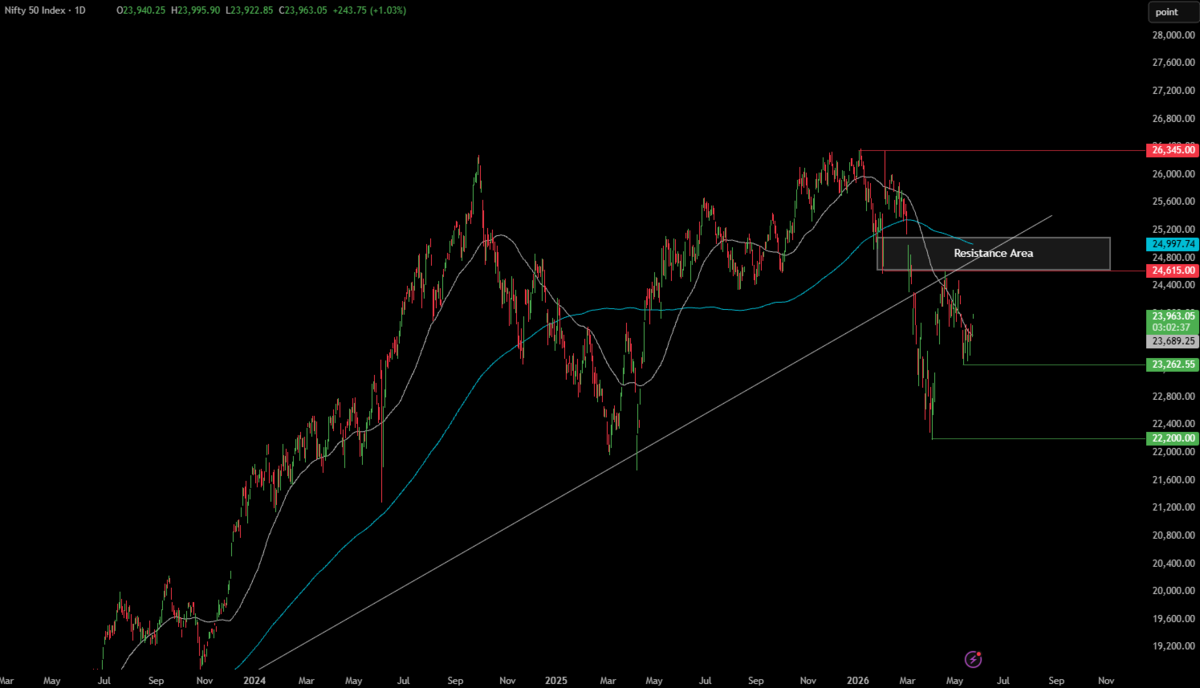
Indian benchmark indices posted modest gains for the week despite ongoing global uncertainty and continued foreign fund outflows. The Nifty 50 closed at 23,719.30 on Friday, up 64.60 points or 0.27%, while the Sensex rose 231.99 points to 75,415.35. Both indices recorded weekly gains of 0.2-0.3%.
The gains were driven by strong domestic institutional buying alongside selective sectoral strength in banking, FMCG, and IT stocks. The Indian rupee strengthened against the US dollar on Friday, providing additional support to sentiment, while easing oil prices and US-Iran diplomatic progress contributed to the rally.
Foreign portfolio investor outflows in 2026 have now crossed ₹2.19 lakh crore, restricting the Reserve Bank of India’s ability to defend the rupee aggressively. Domestic institutional investors continued to absorb the selling pressure, with Friday alone seeing DII buying of ₹6,003 crore against FII selling of ₹4,440 crore.
Week Ahead (US & Asia)
US Core PCE (Thursday)
The April Core PCE Price Index release on Thursday, May 28, is the week’s highest-impact data point and the Fed’s preferred inflation gauge. Markets will scrutinize the print against the backdrop of April CPI accelerating to 3.8% year-on-year and PPI posting its steepest monthly spike since early 2022.
A hot print would reinforce the hawkish stance laid out in last week’s FOMC minutes and further validate market pricing for a December rate hike. CME FedWatch currently indicates over 60% odds of a 25-basis-point increase at the December meeting, with some traders pricing a second hike by year-end. The simultaneous release of the Q1 GDP second estimate that morning may either compound or offset the inflation signal.
The yen has been particularly exposed to US rate dynamics, with USD/JPY trading near recent highs as the two-year Treasury yield held at a 14-month high. Bank of Japan officials have signaled limited willingness to intervene in the near term, leaving the pair vulnerable to incremental Fed-driven moves.
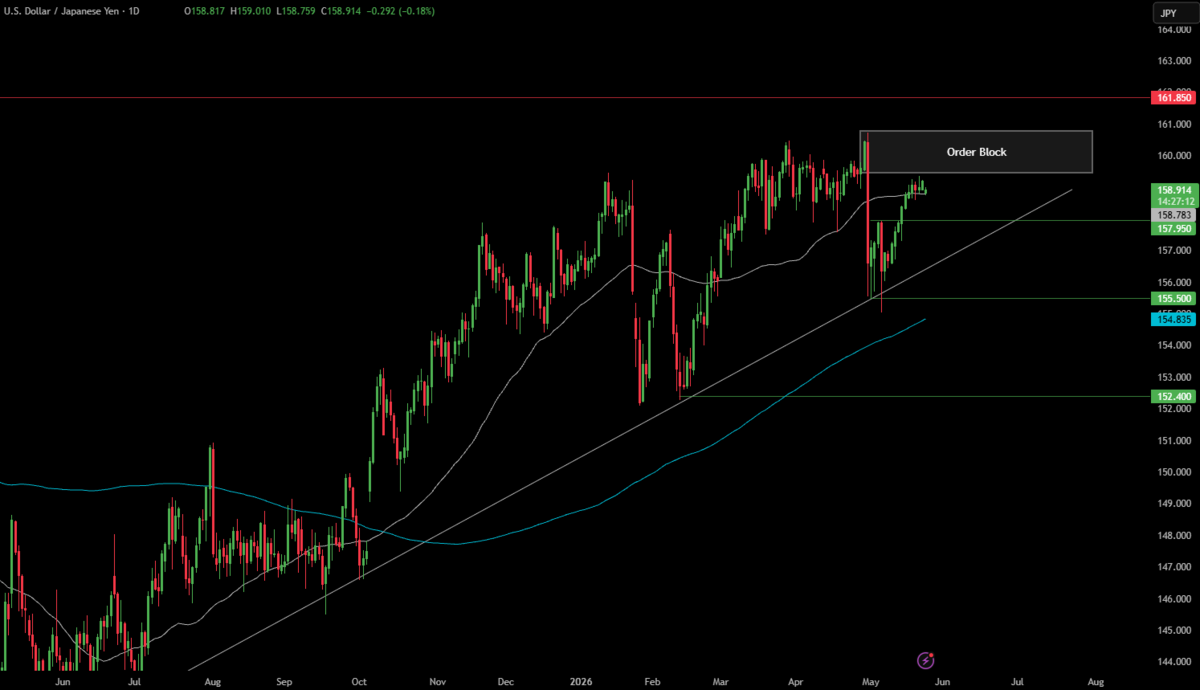
A hot Core PCE print would push USD/JPY toward 160, while a softer reading or dovish accompanying commentary from Fed speakers could ease pressure on the pair and pull it back toward 155.50.
India Q4 GDP (Friday)
India’s Q4 FY26 GDP and full-year FY26 estimates will be released by the Ministry of Statistics on Friday, May 29. Q3 FY26 GDP grew 7.8% year-on-year, with ICRA projecting Q4 growth could ease to 7.0% as agricultural and non-manufacturing sectors slow. The Q4 print will mark the final data point for fiscal year 2025-26, with full-year growth expected to be near 7.6%.
The release comes at a crucial time for the Indian rupee. USD/INR has traded near record highs after reaching 96.0188 on May 15, and any sign of sharply slowing growth would add to pressure from year-to-date foreign outflows exceeding ₹2.19 lakh crore. The Reserve Bank of India has actively defended the currency through dollar sales by state-run banks, while the government raised customs duties on gold and silver imports to 15% on May 13 to curb non-essential dollar demand.
In its April 8 policy decision, the RBI kept the repo rate unchanged at 5.25% and maintained a neutral stance, while raising its FY26 GDP forecast to 7.6%. FY27 inflation is projected at 4.6%, with ongoing oil price pressure as the main risk.
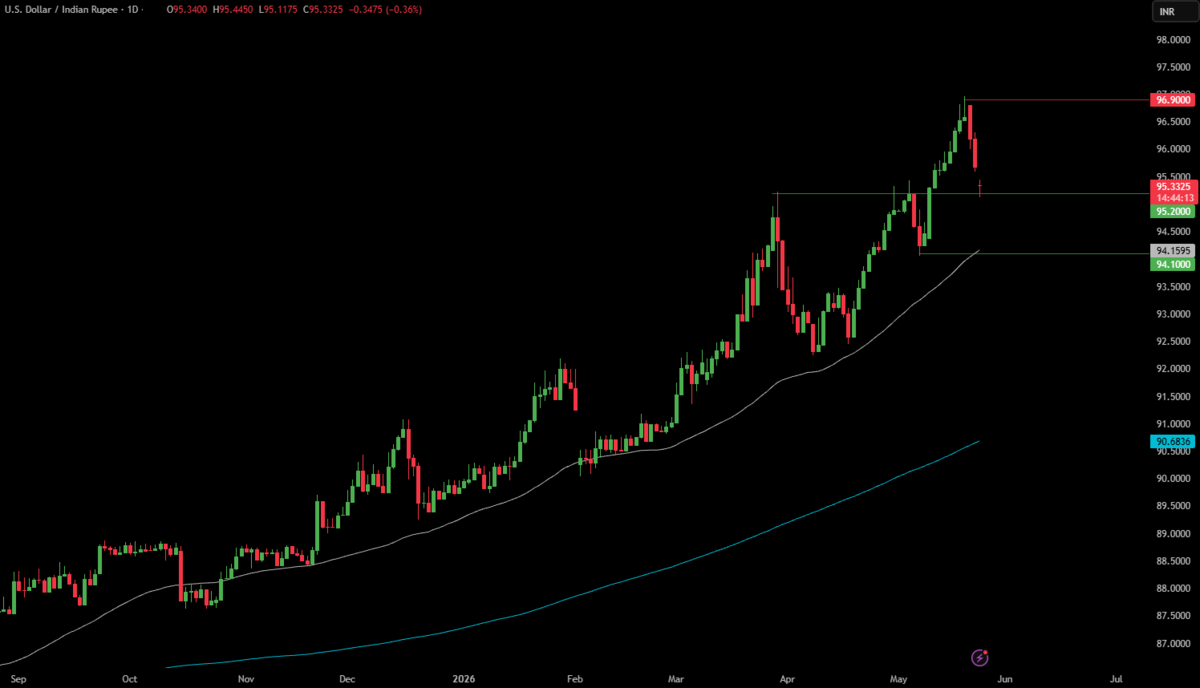
A weaker-than-expected Q4 result, combined with ongoing oil price pressure, could push USD/INR back toward 96 and test the RBI’s willingness to defend current levels. A stronger print would offer modest relief to the rupee and strengthen India’s growth narrative among emerging markets.
Pakistan FY27 Budget approach (All week)
Pakistan’s FY2026-27 federal budget is the key policy event for South Asian markets, with the IMF mission holding face-to-face negotiations throughout the week ahead of the expected budget presentation in early June. IMF Mission Chief Iva Petrova confirmed that talks will continue, with the Fund pushing for broader tax reforms and ongoing energy-sector adjustments.
The KSE-100 had a turbulent prior week, falling 3.2% week-on-week to close at 167,844 on Friday, May 22, despite a 1,091-point relief rally on Tuesday after Trump paused planned strikes on Iran. Selling pressure persisted through Friday, when the index shed 670 points, with weakness concentrated in commercial banks, cements, and investment names. Pakistan’s external position strengthened materially: State Bank of Pakistan FX reserves jumped $1.214 billion to $17.081 billion for the week ending May 15, supported by the $1.3 billion IMF disbursement and Panda Bond proceeds.
The IMF has set a primary surplus target for Pakistan of 2% of GDP by June 2026 and a federal revenue target of PKR 17.145 trillion for FY27, a 13.5% increase from current levels. Reports suggest the government plans to raise the petroleum levy target by 18% to PKR 1.73 trillion and increase defense spending by PKR 100 billion. Energy tariff reforms include semi-annual gas adjustments starting in July 2026 and annual electricity adjustments starting in January 2027.
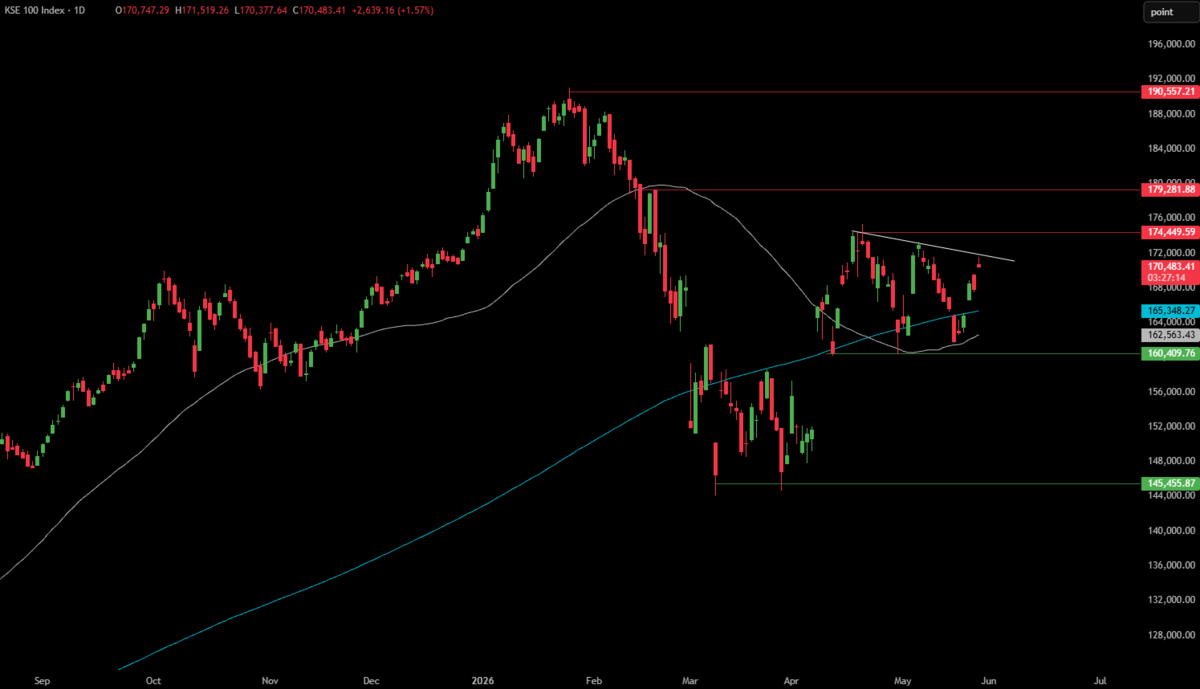
Constructive IMF talks and a clear budget framework could lift the KSE-100 above 170,000. Conversely, signs of fiscal slippage, missed revenue targets, or resistance to benchmarks would weigh on the index and could push it toward the key 165,000 support level.
Bottom line
The growth-inflation balance dominates the week ahead, with Core PCE and India’s Q4 GDP both due Thursday-Friday, alongside ongoing Pakistan budget negotiations.
India’s Q4 release and Pakistan’s IMF dialogue will determine the regional setup, with the rupee already near 96 and the KSE-100 dependent on fiscal credibility.
Trading involves risk.
Author



 Risk Disclaimer
The content provided here is for informational purposes only. It is not intended as personal investment advice and does not constitute a solicitation or invitation to engage in any financial transactions, investments, or related activities. Past performance is not a reliable indicator of future results.
The financial products offered by the Company are complex and come with a high risk of losing money rapidly due to leverage. These products may not be suitable for all investors. Before engaging, you should consider whether you understand how these leveraged products work and whether you can afford the high risk of losing your money.
The Company does not accept clients from the Restricted Jurisdictions as indicated in our website/ T&C. Some services or products may not be available in your jurisdiction.
The applicable legal entity and its respective products and services depend on the client’s country of residence and the entity with which the client has established a contractual relationship during registration.