10 min read
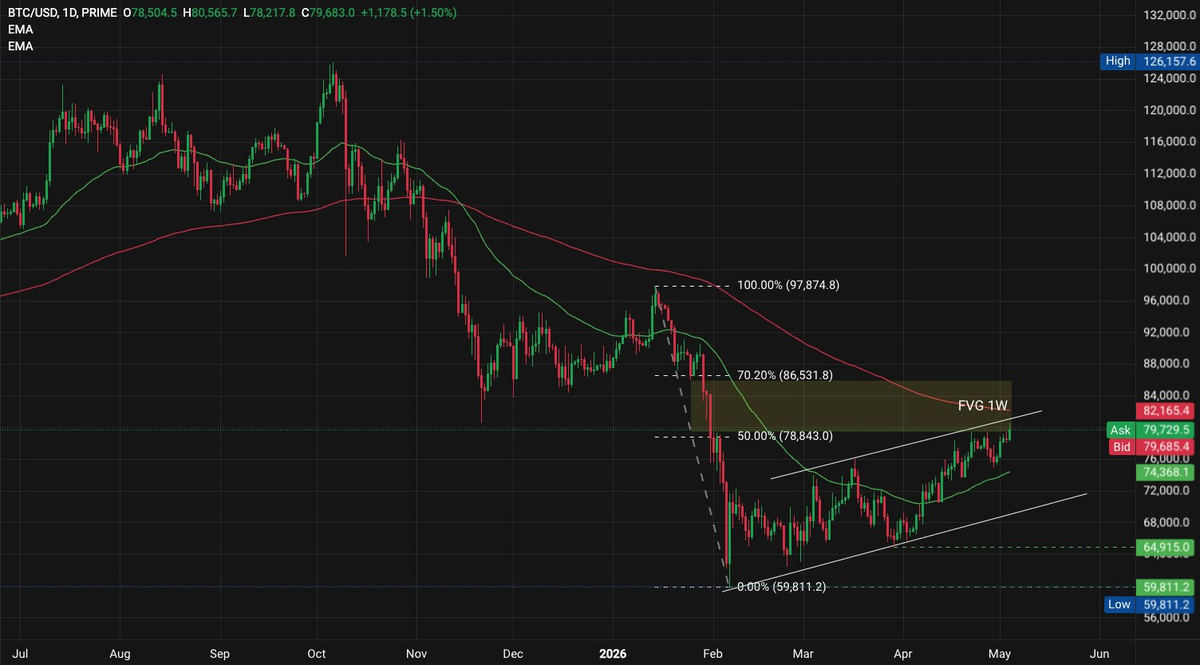
 Bitcoin is forming a bull flag on the daily chart, gradually completing a classic corrective structure seen in previous cycles. The flagpole ran from the February low near $62K to the April high near $79.5K. Price is now consolidating just below the $80K resistance in a tight range.
A breakout above $80K with volume would break the flag and open the path toward $86K (0.702 fib) and $97.8K. A breakdown below $75.8K (20-day EMA) would confirm the flag and re-expose the $72K support.
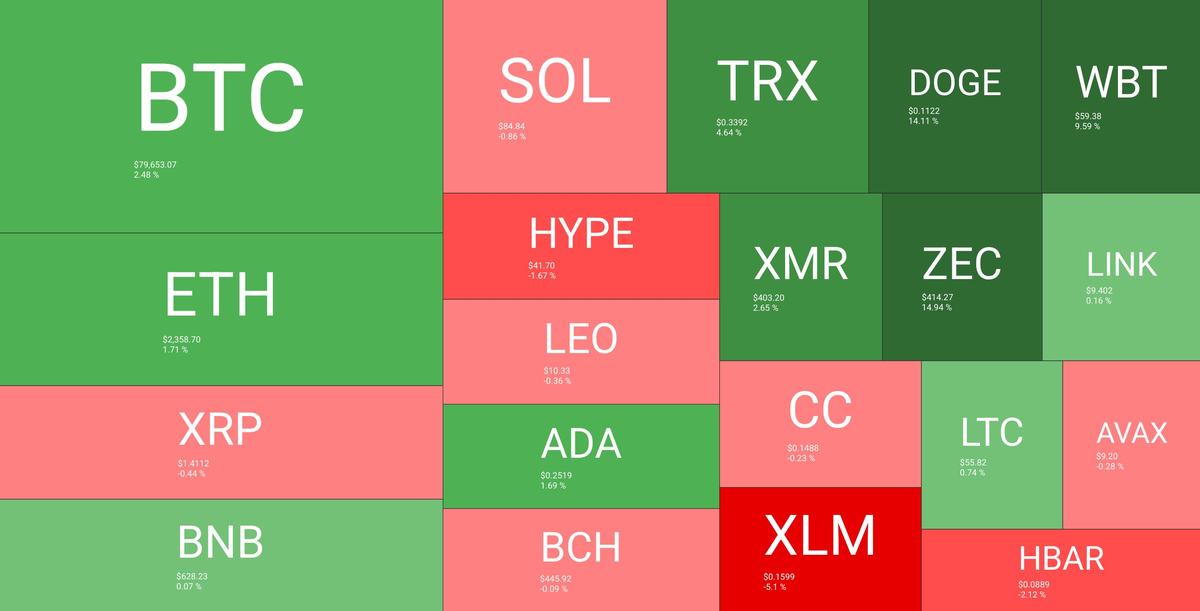
While Bitcoin recorded gains, the broader crypto market was more mixed. Ethereum rose 1.7%, underperforming most altcoins. XRP, SOL and BCH remained in a tight range, while TRX, DOGE, and ZEC rose 4.64%, 14.11%, and 14.94%, respectively.
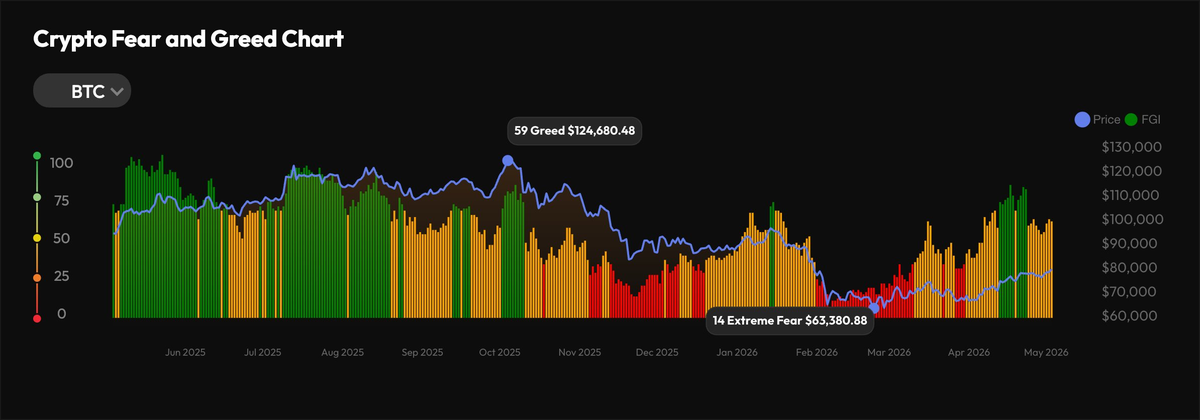
The sentiment remains mildly bearish
The Crypto Fear and Greed Index spent 47 consecutive days below 20 between February and early April 2026, bottoming at 8 (Extreme Fear) on 7 April as BTC traded near $63K. As of 3 May, the index has recovered to 45 (Fear), coinciding with BTC climbing back to the $78-79K range.
This is the longest stretch of Extreme Fear since the FTX collapse in late 2022. Historically, every time the index dropped below 10, Bitcoin averaged a 48% gain in the following 90 days. However, the recovery to 45 has come entirely on futures-driven demand, not spot accumulation, which limits the reliability of the sentiment signal as a standalone entry trigger.
Macro backdrop: geopolitics drives volatility
The US-Iran conflict continues to set the tone for all risk assets. Beyond the direct oil shock, Bitcoin is experiencing a secondary effect: capital flight from the Middle East. Physical gold is difficult to move across borders under conflict conditions. Bitcoin, by contrast, allows fast cross-border transfers with no physical logistics. This is likely contributing to BTC showing relative strength against equities since the war began on 28 February.
There is also a direct crypto angle. Iran attempted to use Tether (USDT) and Bitcoin to collect tolls from ships transiting the Strait of Hormuz. Tether responded by blocking those wallets in what the company described as its largest-ever asset freeze ($300+ million). This episode highlights how crypto is becoming a geopolitical instrument in international disputes, and how much influence the US government can exert over a nominally private company like Tether.
For Bitcoin specifically, the war creates a two-sided dynamic. Elevated oil prices and sticky inflation keep the Fed frozen and suppress risk appetite in Western markets. At the same time, real demand from conflict-zone capital flight may be providing a structural floor that pure macro analysis does not fully capture.
S&P500, NASDAQ and lagging crypto market
US equities, and the Nasdaq in particular, have been recovering strongly while Bitcoin remains range-bound. The S&P 500 is back near 7,230 with RSI approaching overbought territory. This divergence is unusual: in the previous bull cycle (2023-2025), Bitcoin closely tracked Nasdaq moves, especially during risk-on periods.
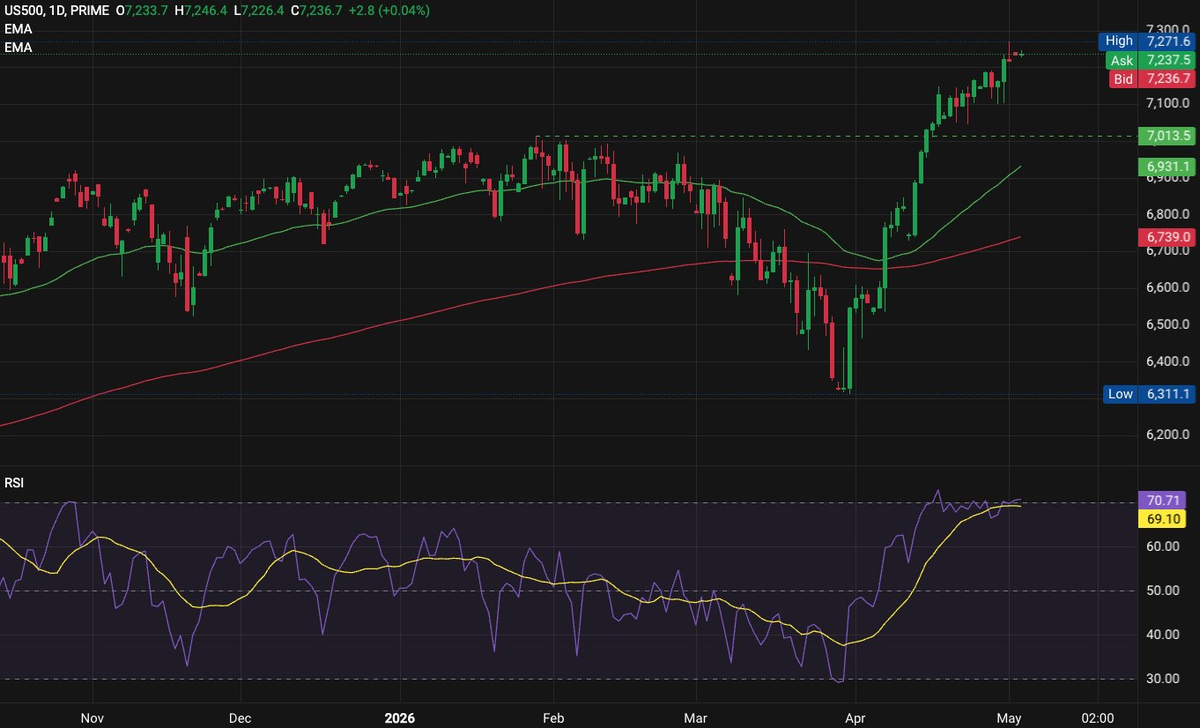
The current decoupling signals that market attention has shifted away from Bitcoin toward other high-growth assets. The primary driver of equity gains currently is Big Tech, specifically companies with direct AI exposure, including Nvidia, Microsoft, Google, and Meta. Nvidia in particular, has become the defining asset of the current investment cycle, as it sits at the centre of the global AI compute buildout. When money is flowing into concentrated AI plays, crypto tends to be a lower priority in portfolio allocation.
Historically, a prolonged decoupling between Nasdaq and Bitcoin has resolved in one of two ways: either Bitcoin catches up as risk appetite broadens, or equities correct and drag crypto lower with them. The current setup is leaning toward the former only if macro conditions improve.
Headline-driven market grows more complex
The US-Iran conflict — triggered by joint US-Israeli strikes on 28 February — continues to dominate macro direction. The Strait of Hormuz remains effectively closed, with shipping at roughly 5% of normal volume. Over the weekend, Trump launched “Project Freedom,” a US military-escorted operation to guide stranded ships through the strait; Iran immediately warned it would be treated as a ceasefire violation.
Diplomatic progress stalled again: Iran’s 14-point proposal offering to reopen the strait in exchange for lifting the US blockade was dismissed by Rubio, and Trump canceled the Kushner/Witkoff Pakistan trip. Brent crude sits near $107, down from a $126 intraday spike last Thursday but still far above pre-conflict levels near $70.
The core issue remains unchanged. As long as the strait stays closed, oil stays elevated, inflation stays sticky, the Fed stays frozen, and rate cuts stay off the table — a structurally challenging backdrop for Bitcoin. Any credible reopening would pull oil and yields lower simultaneously, making it the most direct near-term bullish catalyst for BTC.
Rate hikes are in focus
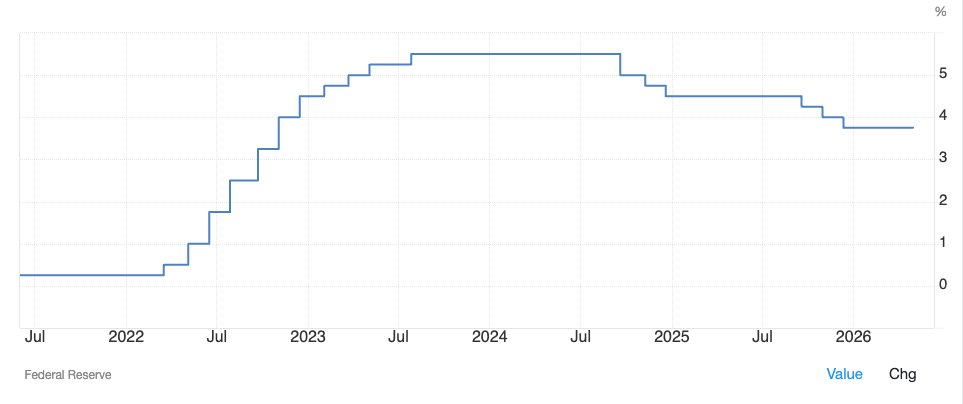
The Fed kept the federal funds rate unchanged at 3.5%–3.75% for a third consecutive meeting in April 2026. The decision was not unanimous: the vote was 8-4, the first time four officials dissented since October 1992. Investors now expect no rate cuts over the course of 2026, based on derivatives market pricing — a sharp shift from expectations of 1–2 cuts at the start of the year.
This week adds a second variable: Kevin Warsh takes over as Fed Chair on May 15, with the first FOMC meeting under new leadership on 16–17 June, where updated rate projections will be released. Markets will begin front-running his policy stance well before that date. Now the key risk is for the market to understand what narrative the new FED chairman will pursue. The chatter within the FOMC about potential rate hikes (if oil-driven inflation persists) would be negative for all risk assets, including Bitcoin.
Global M2 money supply fails to deliver
The US M2 money supply reached an unprecedented $118.8 trillion in April 2026, a $18 trillion increase since the start of the year. Despite this significant liquidity expansion, Bitcoin has not responded in the way historical patterns would suggest.
Historical data shows a 60–70 day lag between global liquidity surges and Bitcoin price rallies. With global M2 accelerating, many analysts see this as a bullish setup for Bitcoin in Q2–Q3 2026, assuming the pattern re-establishes itself after the current decoupling phase. However, the current picture rather signals digital gold weakness.
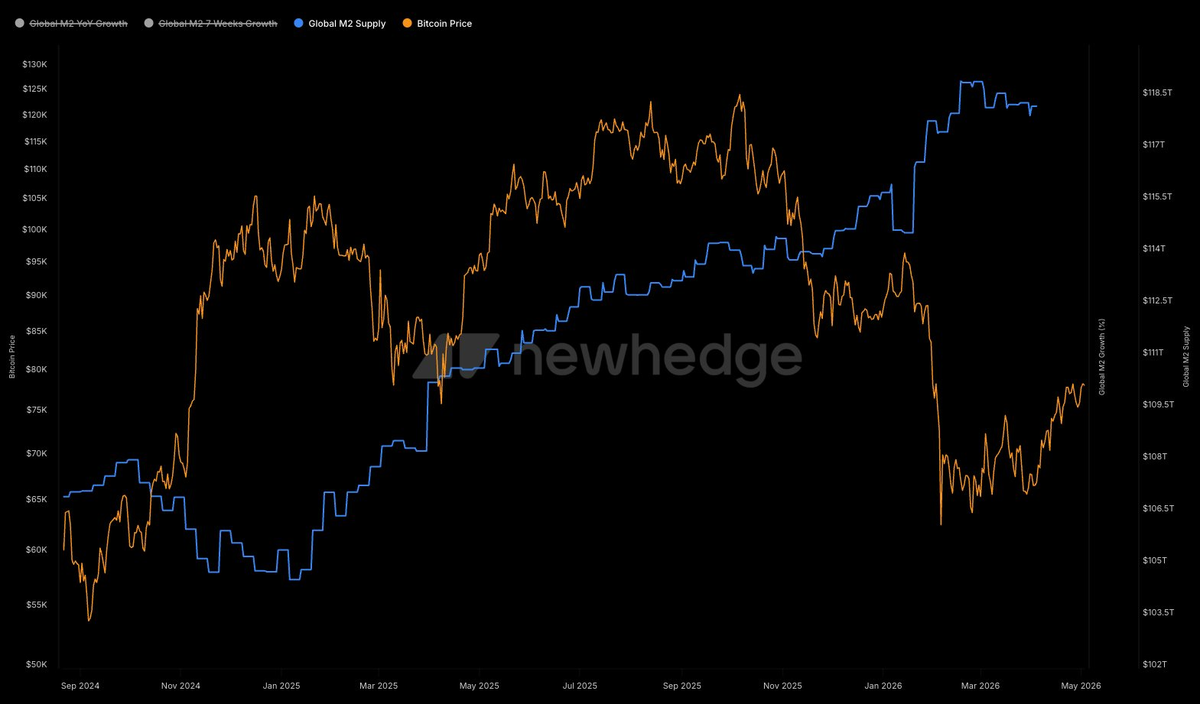
The debate is live: the bullish camp trusts the historical lag model; the bearish camp sees the decoupling as structural, potentially linked to Bitcoin’s institutional maturation and new macro dependencies.
Seasonality vs reality
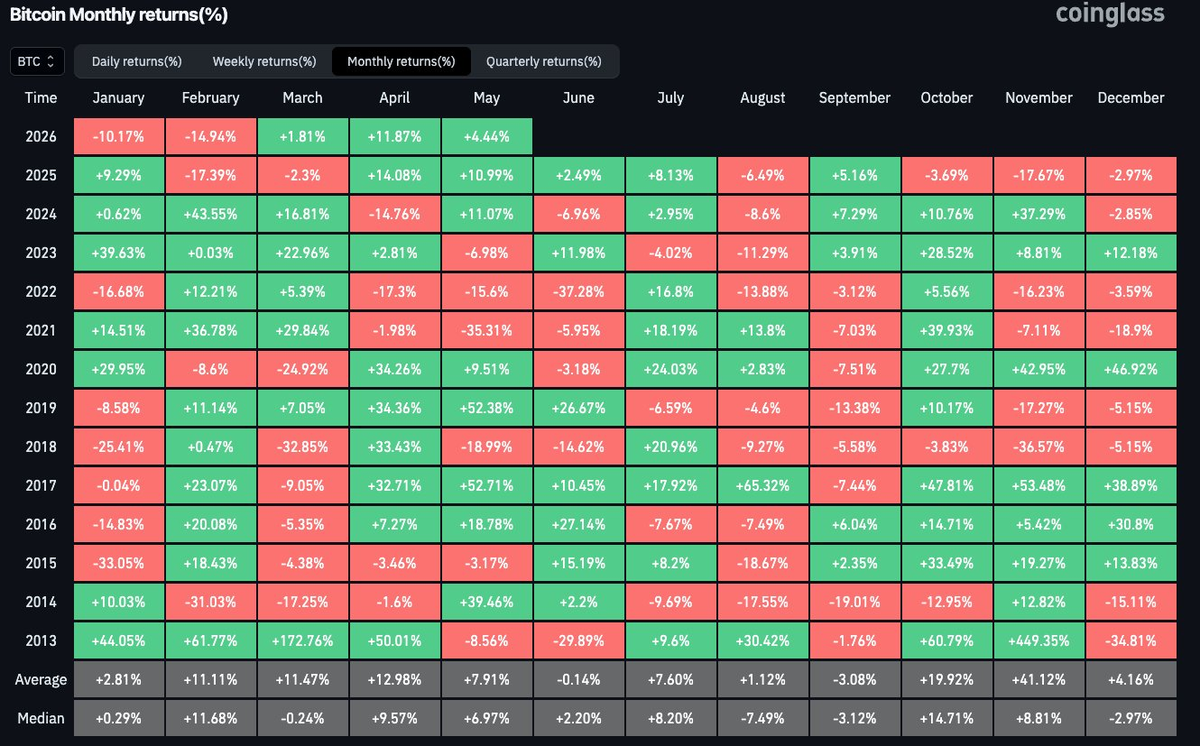
May is historically one of Bitcoin’s stronger months: average return +7.91%, median +6.97%, with 7 green closes out of 13 years on record. The “sell in May” narrative is overstated by the data — the big red years (2021: -35%, 2022: -15.6%, 2018: -19%) are outliers, not the norm.
Strong April recoveries like 2019 (+34% April, +52% May) and 2016 (+7% April, +19% May) are arguably the closer analogs to 2026’s +11.87% April. BTC is already +4.44% in May as of May 4. So, despite the fundamental data, May can prove bears wrong about Bitcoin.
The critical test for this month is the $79,500 level. Every time BTC failed to break above its April high within the first five days of May since 2018, the month closed lower by an average of 20%. If that level is cleared on a weekly close, the path toward $84K to $97K opens. If not, a retracement toward $70K to $72K becomes more likely.
Demand structure: Futures leading, spot lagging
This is arguably the most important structural signal in the current market.
Bitcoin’s current demand structure shows a clear divergence: futures (ERP) demand is rising while spot demand continues to contract. CryptoQuant Head of Research Julio Moreno described this dynamic as “a warning sign,” noting that the April rally was driven entirely by speculative futures positioning, not genuine spot accumulation. The Bull Score Index fell from 50 to 40 in April — dropping below neutral and confirming bearish on-chain fundamentals even as price rose.
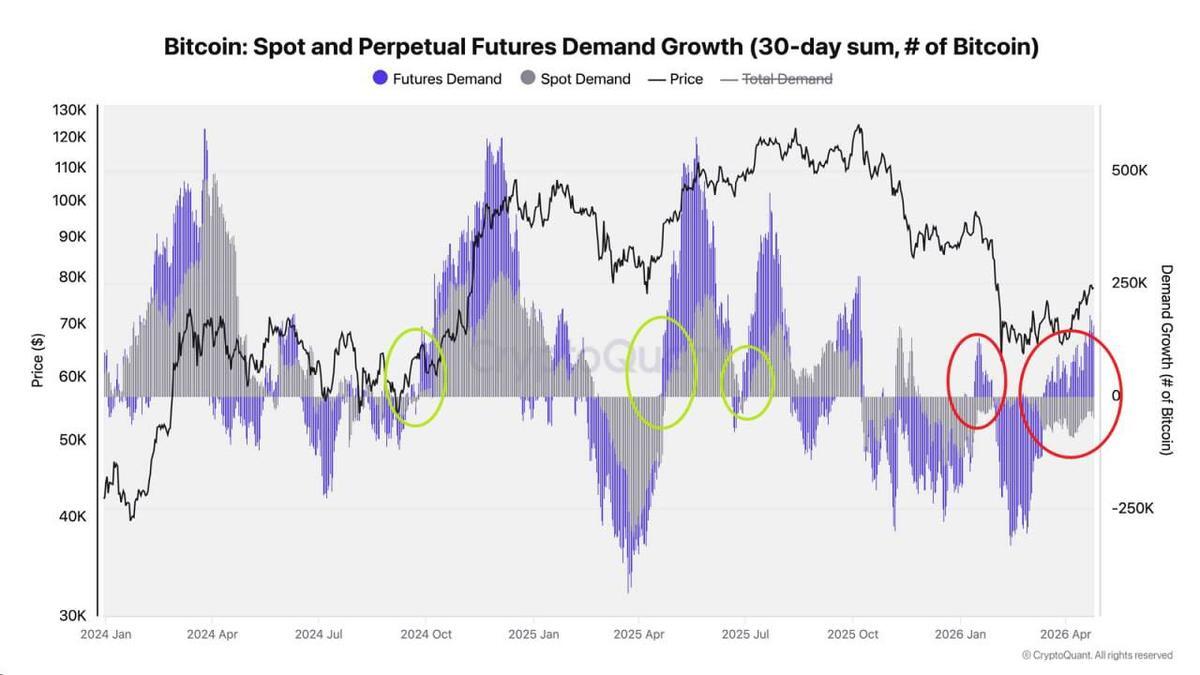
The April price recovery from $62K to $79K was built almost entirely on futures positioning, not genuine spot accumulation. Until spot demand turns visibly positive, the rally lacks structural support and remains vulnerable to a leverage unwind.
Bitcoin holders are largely in profit
After peaking near 100% at the October 2025 ATH of $126K, the ‘Percent Addresses in Profit’ metric has dropped to approximately 75% — the sharpest decline since the 2022 bear market. Historically, the 75–80% zone marks a mid-bull correction, not capitulation: genuine bear market bottoms have pushed this reading to 40–60%.
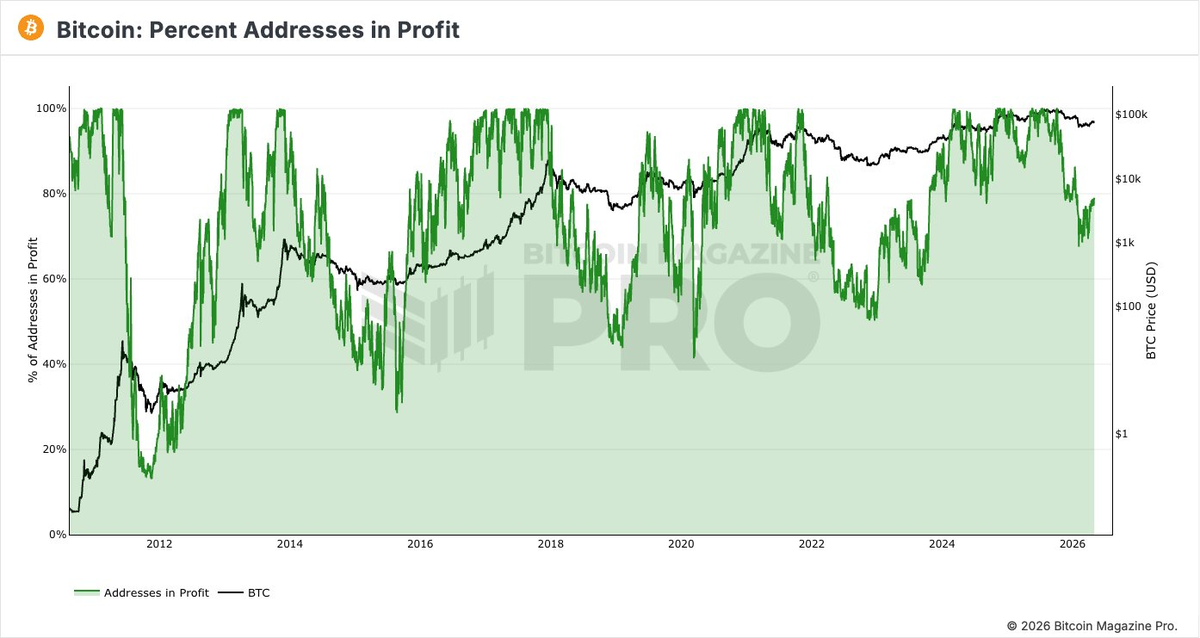
This aligns with the MVRV and realized price data — the average holder remains roughly 65% in profit, but STH cohort stress is real. The metric reads neutrally bullish: market structure is not broken, but there is room for further downside before this becomes a high-conviction accumulation signal.
Conclusion
The current Bitcoin price action from both a technical and fundamental perspective looks more like a dead-cat bounce than the start of a new trend. The April recovery from $62K to $79K was built on futures speculation, not spot demand. On-chain metrics are neutral to bearish. The macro backdrop remains hostile: the Strait of Hormuz is still closed, inflation is sticky, the Fed is frozen, and a new Fed Chair takes over in 11 days with an unknown policy direction.
The bull case requires three things to happen: spot demand turning positive, the $80K level breaking on a weekly close, and at least a partial resolution of the geopolitical situation. None of these are in place today. Until they are, the risk-reward for aggressive long positions is unfavorable. The safer approach is to watch for confirmation rather than anticipate a breakout that has not yet materialized.
Trading involves risk.
Author



 Risk Disclaimer
The content provided here is for informational purposes only. It is not intended as personal investment advice and does not constitute a solicitation or invitation to engage in any financial transactions, investments, or related activities. Past performance is not a reliable indicator of future results.
The financial products offered by the Company are complex and come with a high risk of losing money rapidly due to leverage. These products may not be suitable for all investors. Before engaging, you should consider whether you understand how these leveraged products work and whether you can afford the high risk of losing your money.
The Company does not accept clients from the Restricted Jurisdictions as indicated in our website/ T&C. Some services or products may not be available in your jurisdiction.
The applicable legal entity and its respective products and services depend on the client’s country of residence and the entity with which the client has established a contractual relationship during registration.