8 min read
 Technical picture
Bitcoin broke through the lower bound of the ascending channel that held since February and tested the 60,000 area, with the daily candle showing a low near $59,062 before a 2.27% rebound back to $62,208. For most bulls this is a hard blow, since the structure that defined the entire spring rally is now broken. A short-term bounce is technically reasonable from here because the daily RSI prints around 22, which is deeply oversold and historically rare.
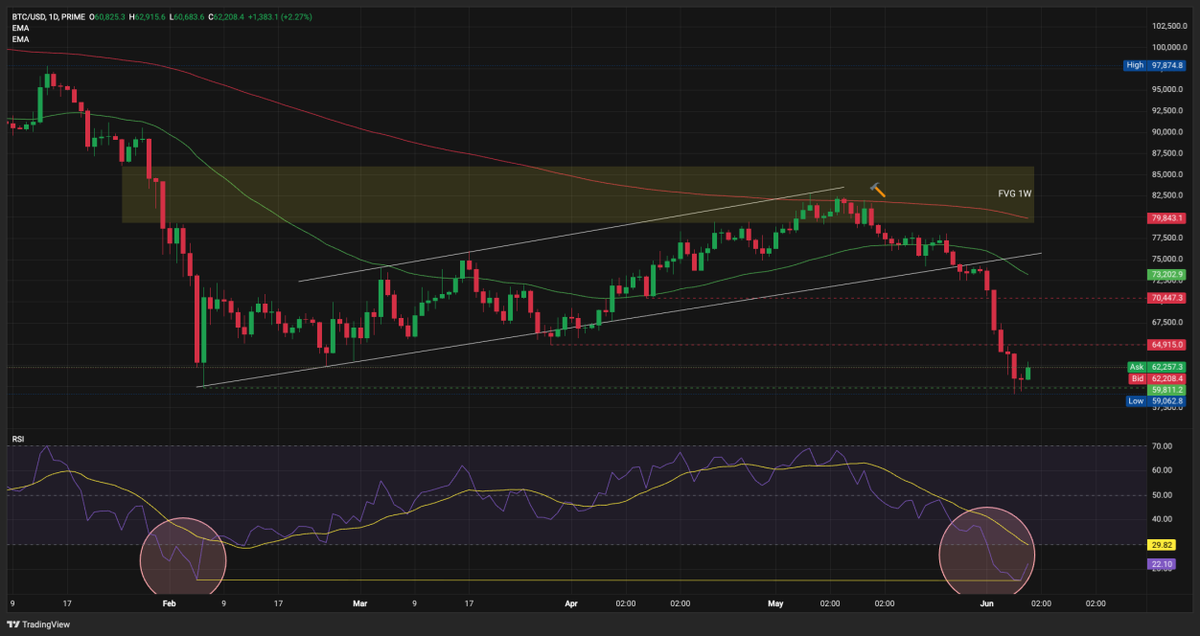
The 50,000 zone looks like the natural apogee of long liquidations if the slide continues, but a further leg down from current levels is unlikely on technicals alone given how stretched the RSI is. The first ceiling for any recovery sits at the broken 64,915 support, with the 73,202 area as the next obstacle if buyers push through.
Crypto heatmap
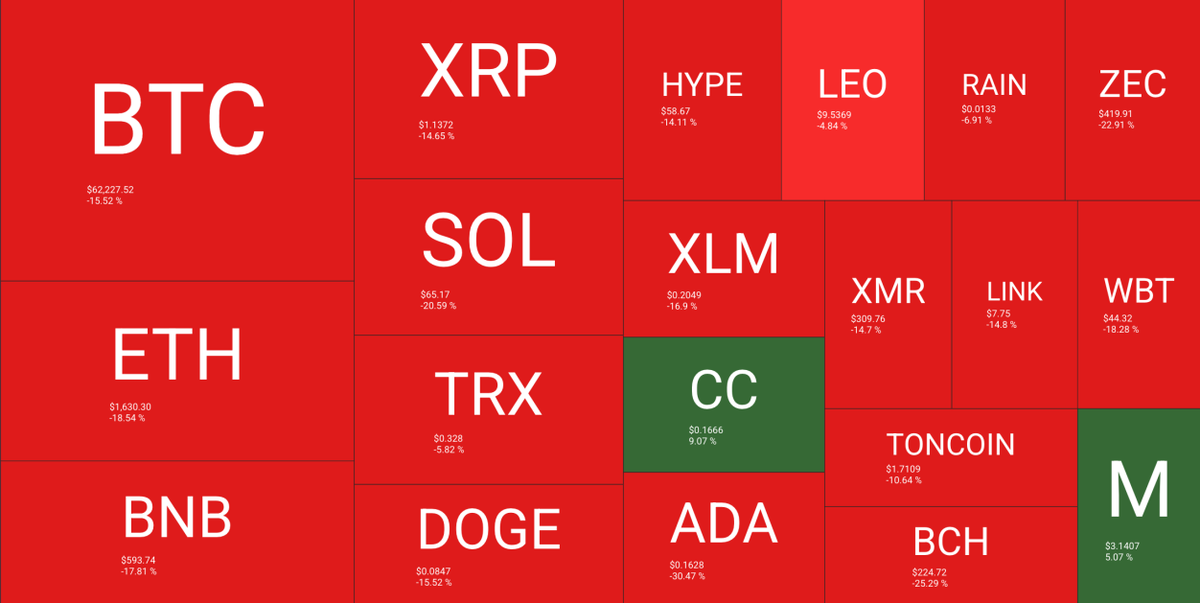
The weekly heatmap is almost entirely red. Bitcoin is down 15.52% to $62,227, Ethereum off 18.54% to $1,630, and Solana down 20.59% to $65.17. The worst performer of the week is Cardano with a 30.47% loss to $0.1628, followed by Bitcoin Cash at minus 25.29% to $224.72 and Zcash at minus 22.91% to $419.91. The selloff in BCH was a contagion move from the broader BTC drawdown combined with a clean break of multi-month technical support, which forced cascading liquidations rather than a project-specific catalyst.
Source: https://quantifycrypto.com/heatmaps
Two names stand out in green on an otherwise red board: CC up 9.07% to $0.1666 and M up 5.07% to $3.14. With a roughly 25% drop in Bitcoin over less than a month producing this much pain across the top 20, breadth is as weak as it has been all year.
Bitcoin dominance
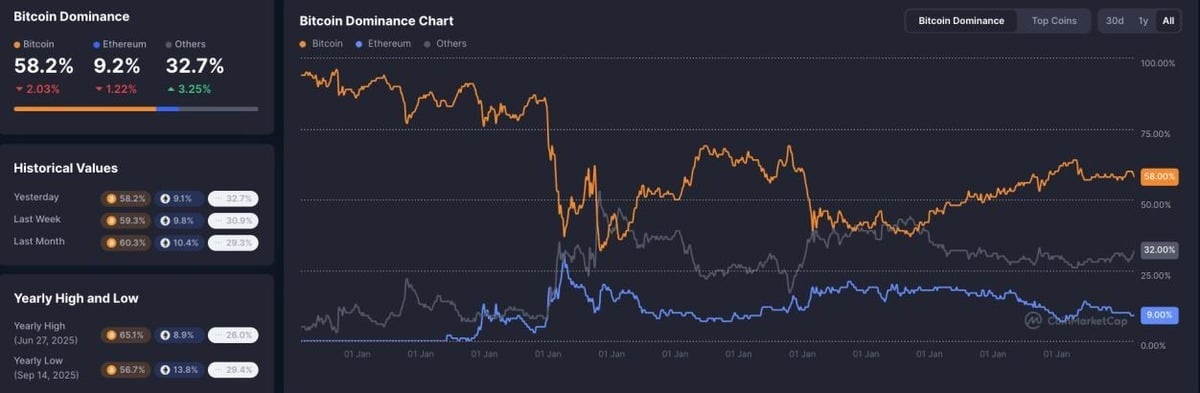
Bitcoin dominance sits at 58.2%, down 2.03% over the period, while Ethereum dominance ticked down 1.22% to 9.2% and Others added 3.25% to 32.7%. The week-on-week table confirms the rotation: last week BTC was at 59.3% and Others at 30.9%, so capital is leaking out of Bitcoin into the broader complex rather than concentrating in any single leader.
Source: https://coinmarketcap.com/charts/bitcoin-dominance/
The yearly range remains intact, with the high of 65.1% from June 2025 and the low of 56.7% from September 2025. With dominance now closer to the lower end of that range, any further slide would put altcoins in position to attract relative-strength flows, but only if BTC stabilizes first.
Altcoin Season Index
Source: https://www.coinglass.com/pro/i/alt-coin-season
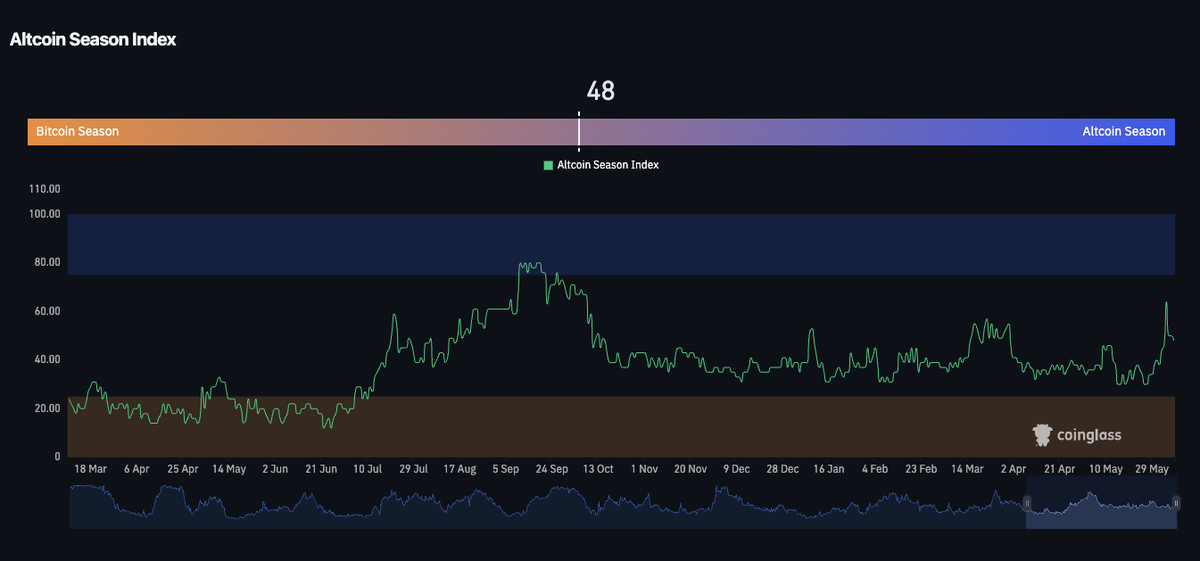
The Altcoin Season Index reads 48, in Bitcoin Season territory but very close to the 50 midpoint. A reading above 75 would mark a true altcoin season, so the gauge is signaling that capital is still tied to Bitcoin direction even though dominance is sliding. The recent bounce from the low 20s shows altcoins beating BTC on relative terms during the selloff, which is consistent with a beta wash-out rather than a genuine rotation.
Absolute fear on the market
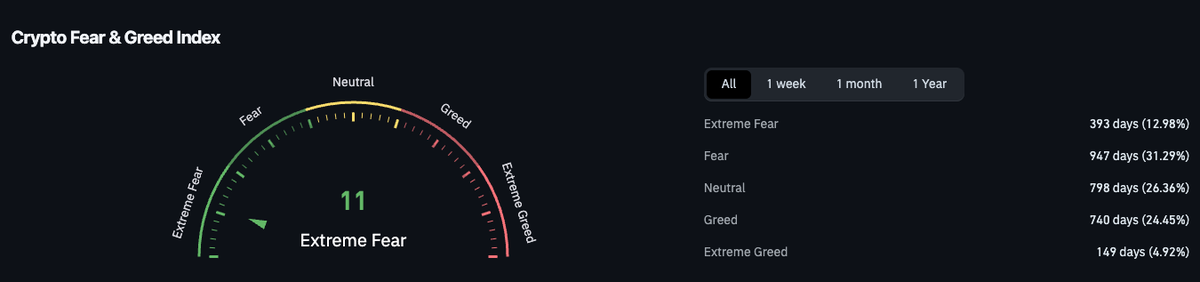
Source: https://www.coinglass.com/pro/i/FearGreedIndex
The Crypto Fear and Greed Index reads 11, deep in the Extreme Fear zone and a sharp move from the Neutral readings of just a few weeks ago. Extreme Fear has historically occupied only about 13% of all days the index has been tracked, so this is a tail reading rather than ordinary weakness.
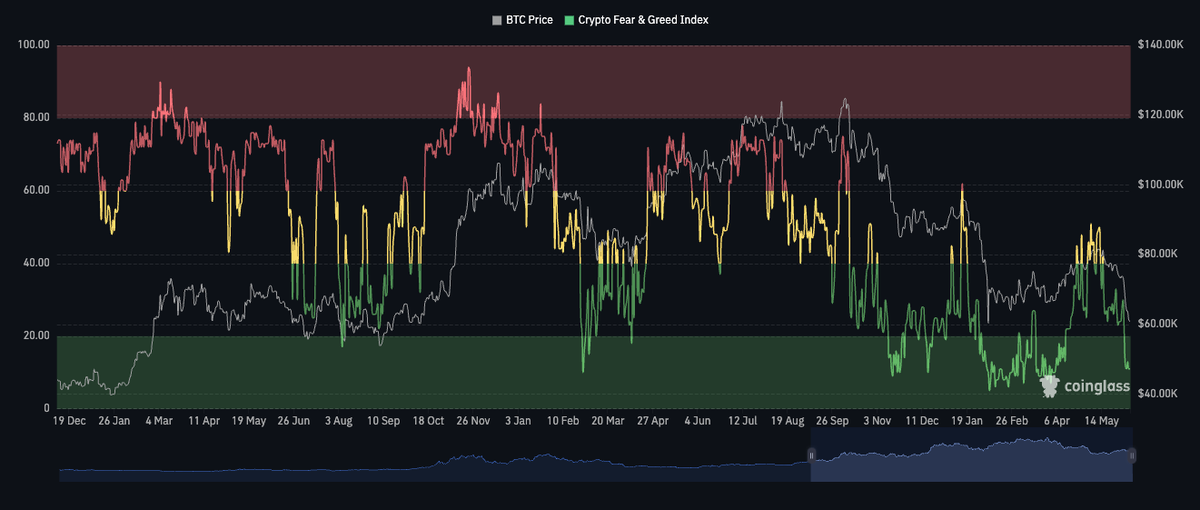
The long-term overlay of the index against BTC price shows that every prior multi-week visit to the green Extreme Fear band coincided with a local bottom on a 6 to 12 month horizon. Fear alone does not call the low, but for long-term investors building positions, the current zone has historically offered some of the more attractive entry prices on the chart.
Strategy news and the Saylor question
Michael Saylor posted “A good time to add more dots” on June 7, hinting at further purchases. The paradox: the market has flipped the bullish trigger from buying to selling. Between May 26 and May 31, Strategy sold 32 BTC for $2.5 million at an average price of $77,135, the first net disposal in the company history. The proceeds funded the dividend on STRC, the preferred stock paying 11.50% annualized.
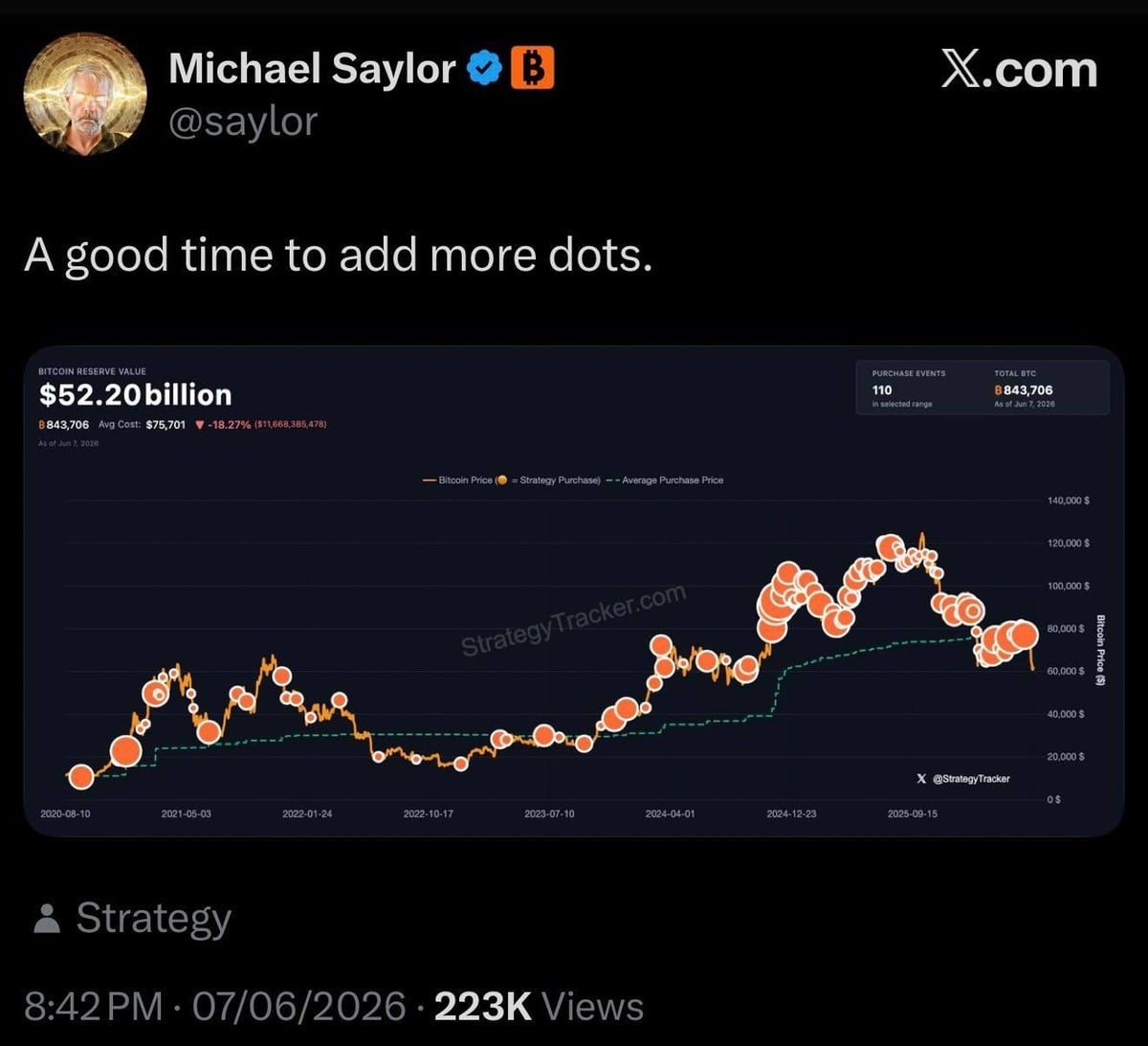
That sale is roughly $2.5 million, far below the $1 billion and $2 billion thresholds traders are watching. A $2 billion sale would cover about 18 months of STRC dividends in a single transaction and would remove the funding overhang. A sale of zero would suggest no buffer is being built and would weigh on sentiment. Total holdings stand at 843,706 BTC at an average cost of $75,701, currently underwater by 18.27% or about $11.7 billion in unrealized losses.
Bearish divergence on equities
The S&P 500 printed a sharp reversal on the daily chart, with a 2.71% drop on the latest session that took the index to 7,356. The RSI shows a bearish divergence against the price highs and the 5-day move now reads minus 3.74%, the largest one-day drop since March. If the index closes below the 20-day EMA near 7,300, the path opens toward the 200-day EMA at 6,900, which is also where the rising trendline from the April low intersects.
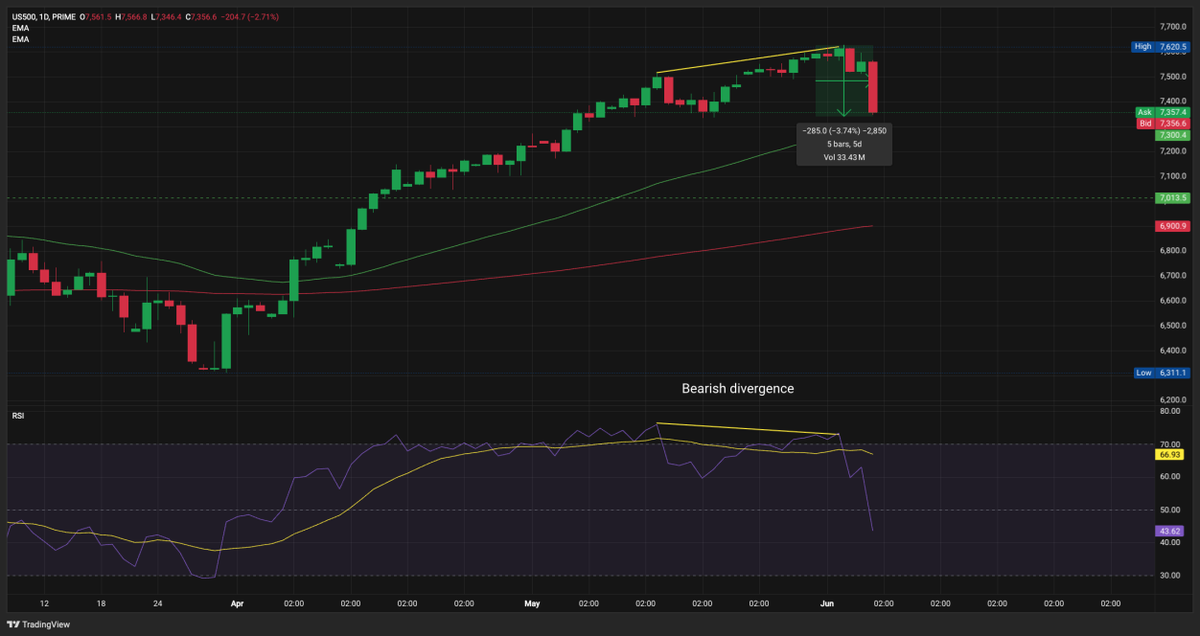
Equity weakness matters for crypto because the correlation has stayed high all year. A genuine break of the equity uptrend would remove the macro tailwind that helped Bitcoin recover from its April lows.
Long liquidations are dominating
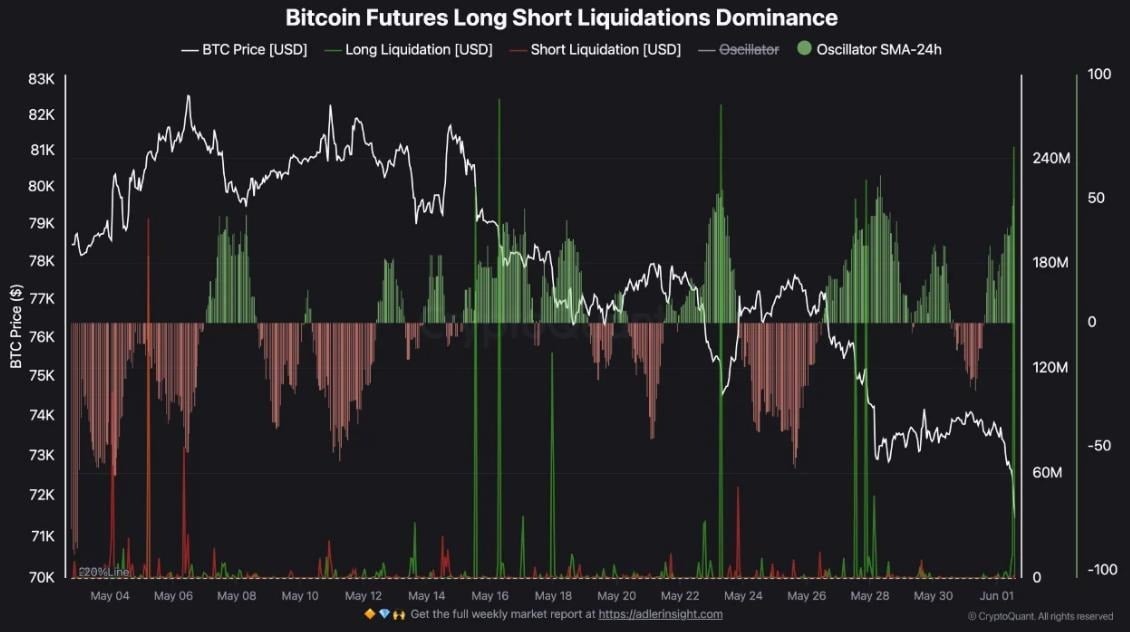
The CryptoQuant chart of long-short liquidation dominance shows persistent green bars through the second half of May and into early June, meaning longs have been the side getting wiped out as price retraced from $82,000 toward $71,000 over the displayed window. The recent weeks have shown a near-complete cleanout of aggressive counter-trend longs, with each bounce attempt failing to attract follow-through.
Source: https://cryptoquant.com/
The metrics now point to a capitulation zone for leveraged longs, the kind of positioning reset that has typically marked the end of a flush rather than the start of one.
Trading volumes signal crypto winter
Source: https://cryptoquant.com/
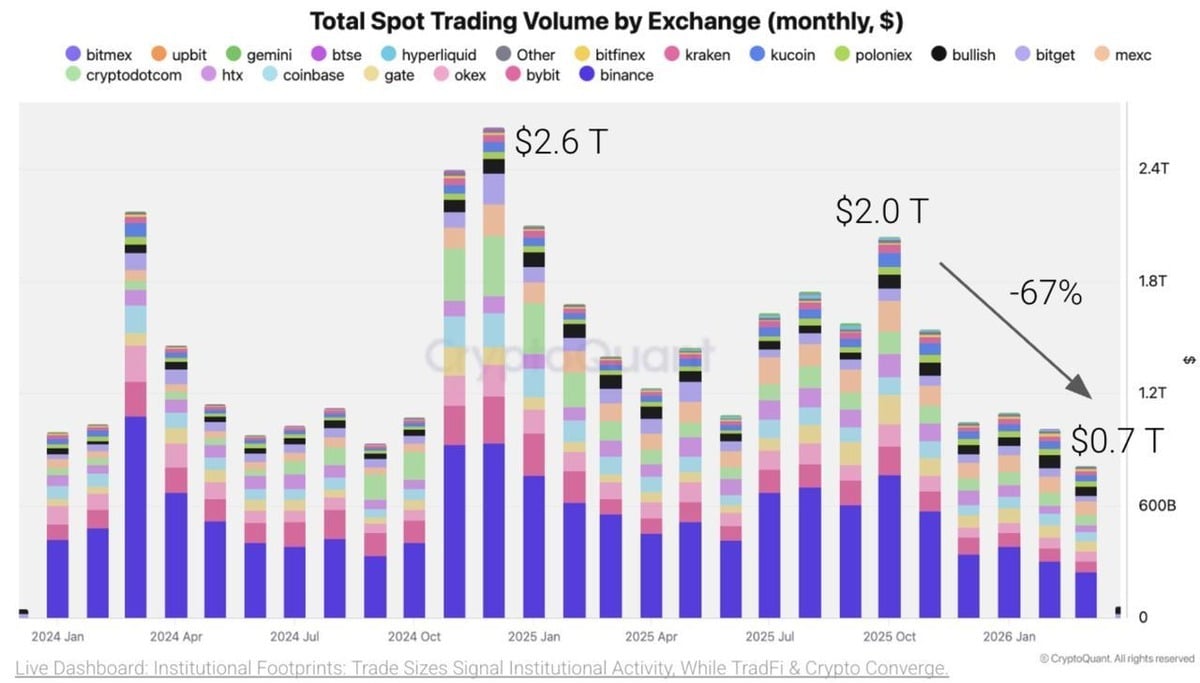
Centralized exchange spot volume dropped to roughly $0.7 trillion for the latest month, down 67% from the $2.0 trillion level reached in late 2025 and the lowest monthly reading since October 2023. The chart shows the contraction is broad-based across exchanges, with Binance still capturing the largest share of what trading remains.
As activity slows, liquidity has concentrated on a small group of venues. Gate ranks among the deepest exchanges across both spot and perpetual futures markets in 2026, reinforcing its position as a major hub for large-scale execution. Institutional liquidity continues to consolidate around a handful of dominant exchanges, with average trade sizes climbing even as overall participation falls.
Conclusion
The short-term setup is heavy: Bitcoin sits below the broken channel, sentiment is pinned at 11 in Extreme Fear, the S&P 500 is rolling over with a bearish RSI divergence, and Strategy has crossed the symbolic line of selling Bitcoin to fund preferred dividends. For long-horizon investors, the same conditions historically marked attractive entry zones, and the daily RSI near 22 is too stretched to make further downside the high-probability path.
Bitcoin can still slide another 10 to 20%, which would line up with the $50,000 long-liquidation apogee. But moments of broad capitulation have, in past cycles, been the entries long-horizon holders look back on as the easy ones. The job for now is to keep a cool head and let positioning rather than emotion drive any decision.
Trading involves risk.
Author



 Risk Disclaimer
The content provided here is for informational purposes only. It is not intended as personal investment advice and does not constitute a solicitation or invitation to engage in any financial transactions, investments, or related activities. Past performance is not a reliable indicator of future results.
The financial products offered by the Company are complex and come with a high risk of losing money rapidly due to leverage. These products may not be suitable for all investors. Before engaging, you should consider whether you understand how these leveraged products work and whether you can afford the high risk of losing your money.
The Company does not accept clients from the Restricted Jurisdictions as indicated in our website/ T&C. Some services or products may not be available in your jurisdiction.
The applicable legal entity and its respective products and services depend on the client’s country of residence and the entity with which the client has established a contractual relationship during registration.