7 min read
 Key takeaways
- Bitcoin’s recovery has stalled at the $64,000 resistance region and turned lower, just as a fresh escalation in the Middle East conflict revived risk-off pressure across markets.
- The bounce off the late-June lows near $58,000 had been driven by a soft US jobs report and the first US spot Bitcoin ETF inflows in weeks, but overnight US-Iran strikes lifted oil and threaten the softer-Fed backdrop underpinning it.
- Price is now falling back toward the $60,000 support region, and holding the $60,000 to $62,500 area is what bulls would need to keep Bitcoin within its broader range.
Bitcoin had been staging a tentative recovery. After sliding to its lowest levels since 2024 late in June, when it lost its $60,000 floor, the largest cryptocurrency clawed its way back into the low $60,000s through early July. The move owed less to anything crypto-specific than to a broad repricing of risk. A soft June US jobs report, showing just 57,000 non-farm payrolls added, eased fears of further Federal Reserve tightening under Chair Kevin Warsh and knocked the dollar, giving risk assets room to breathe.
The institutional bleeding also appeared to slow. US spot Bitcoin ETFs turned net positive in early July, snapping a run of outflows that had stretched for roughly two weeks. It was a welcome shift after a brutal stretch: June was the funds’ worst month on record, with around $4.5 billion pulled, and year-to-date outflows still sit near $5.4 billion. A couple of green days do not undo that, but they suggested capital could return when the macro backdrop cooperated.
That fragile recovery has now run into a fresh shock. Overnight, the long-running Middle East conflict escalated sharply. After Iran attacked commercial vessels in the Strait of Hormuz, US forces struck more than 80 Iranian targets, and Iran responded with strikes on US military bases in Kuwait and Bahrain. Washington also moved to revoke the licence that had let Iran sell crude openly on world markets. A ceasefire that had held for roughly three months, and the peace talks meant to follow, now look in serious doubt.
For crypto, the danger runs through oil and rates. Oil prices, which had cooled considerably in recent weeks, jumped on the news, and a sustained move higher could revive the very inflation fears markets had just begun to price out. That matters because the softer Fed expectations behind Bitcoin’s bounce rest on inflation continuing to fade. A renewed energy shock could instead harden the case for higher-for-longer, the opposite of what risk assets need.
The result is a market pulled two ways. On one side sit improving ETF flows, a softer labour market and long-term holders returning to accumulation. On the other sit a geopolitical flare-up, a firmer dollar and a corporate-treasury bid under scrutiny after Strategy’s recent sale of Bitcoin to fund dividend payments. Not everyone is convinced the worst has passed, with Citigroup recently trimming its 12-month Bitcoin target to around $82,000. With June inflation data due on 14 July and the next Federal Reserve meeting on 28-29 July, the coming weeks could decide whether this rebound builds into something durable or fades back toward the lows.
Daily chart
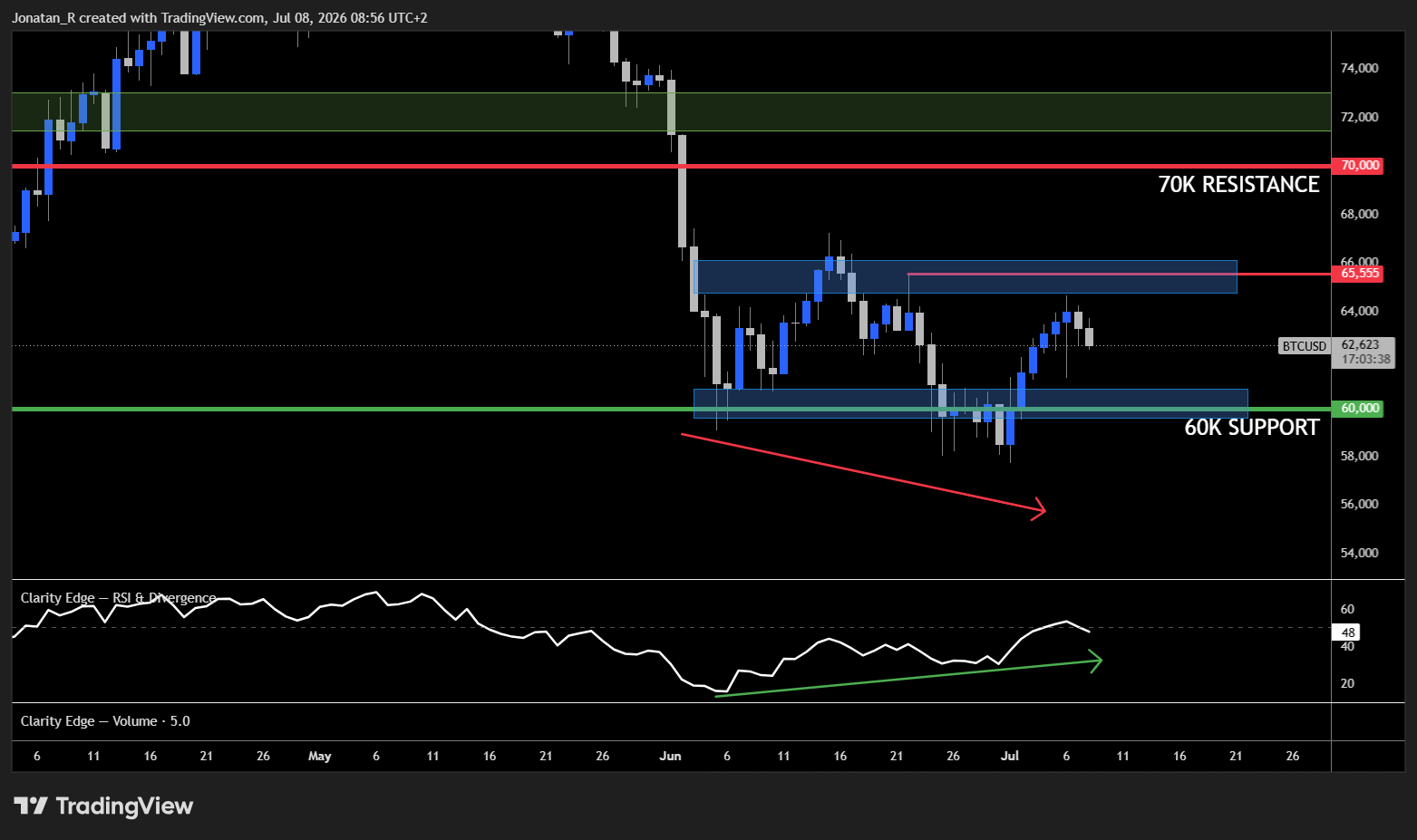
On the daily chart, Bitcoin put in a decent bounce off the $58,000 support region, the area that marked its lowest levels since 2024. A bullish divergence between the daily RSI and price had been building through that low, and it appears that setup may have played out on the recent bounce.
The move higher ran into clear resistance around the $64,000 region. The timing of the geopolitical escalation could hardly have been sharper, arriving just as Bitcoin was pressing into that resistance. Price has since turned lower and is now falling back toward the $60,000 support region.
This keeps Bitcoin within a broader range between $60,000 and $65,000. A hold of $60,000 is what bulls would want to see to keep the recovery structure intact, with buyers needing to step in around that support to defend the range.
4-hour chart
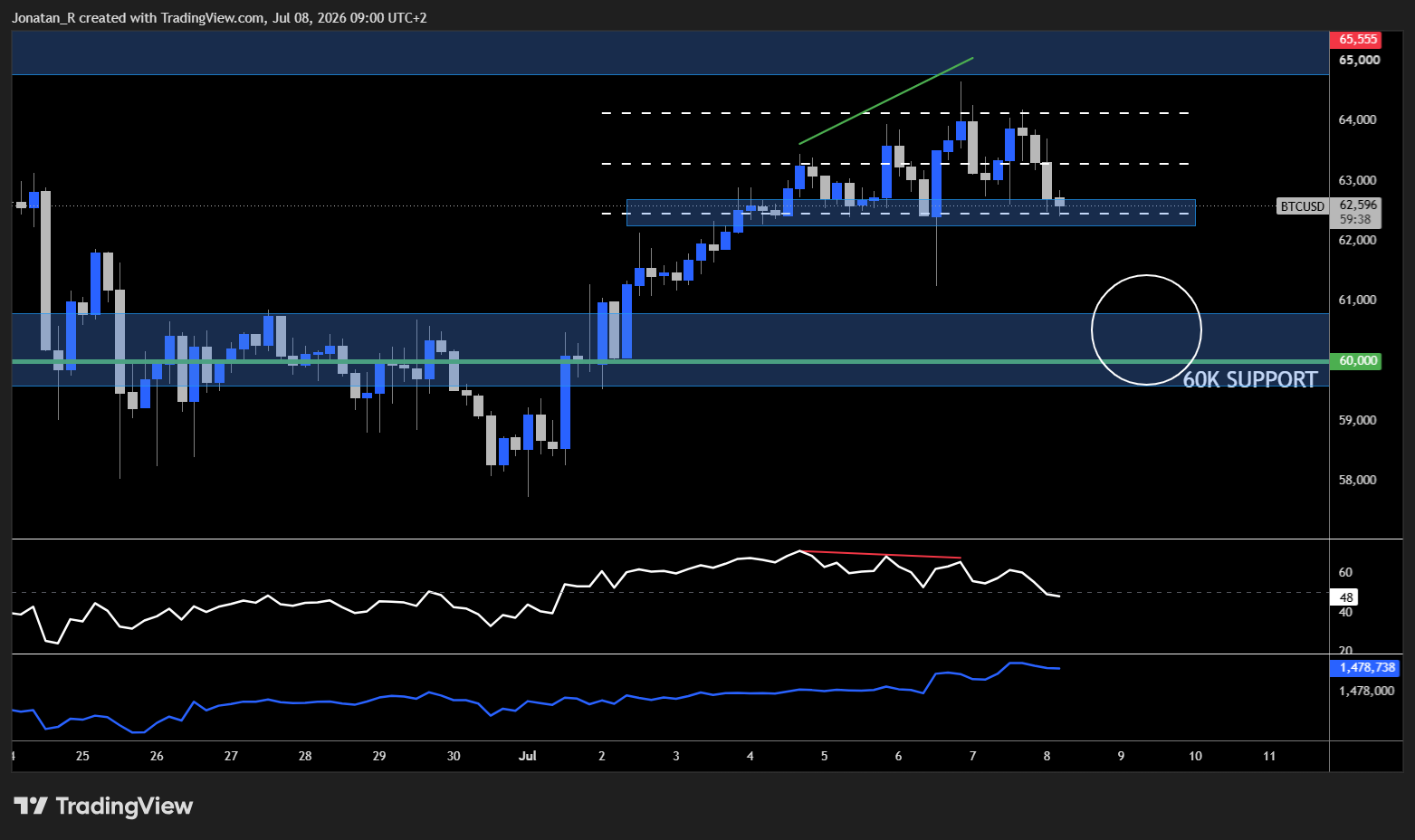
Zooming into the 4-hour chart, Bitcoin is testing the lows of a potential shorter-term range, with the range lows around $62,500 and the range highs around $64,000. A bearish divergence formed just before price printed the recent top, which helps explain the rejection.
Beneath the surface, though, the picture is not one-sided. The accumulation/distribution line (the blue line) shows a constructive, bullish structure, suggesting that even with this rejection the bulls appear to have the stronger hand within the range overall.
The immediate test is whether Bitcoin can hold the $62,500 range low. A failure to hold that area could act as the start signal for a move lower, opening up a test of the $61,000 to $60,000 region, which ties back to the major support on the daily.
Key levels to watch
- $64,000 to $65,000: range resistance, where the rebound stalled just as the geopolitical shock landed
- $62,500: 4-hour range low, being tested now; losing it could open downside
- $61,000 to $60,000: major support region and the line bulls would need to defend to keep the range intact
- $58,000: the late-June low and the deeper support if $60,000 gives way
Trade Now
Trading involves risk.
Author



 Risk Disclaimer
The content provided here is for informational purposes only. It is not intended as personal investment advice and does not constitute a solicitation or invitation to engage in any financial transactions, investments, or related activities. Past performance is not a reliable indicator of future results.
The financial products offered by the Company are complex and come with a high risk of losing money rapidly due to leverage. These products may not be suitable for all investors. Before engaging, you should consider whether you understand how these leveraged products work and whether you can afford the high risk of losing your money.
The Company does not accept clients from the Restricted Jurisdictions as indicated in our website/ T&C. Some services or products may not be available in your jurisdiction.
The applicable legal entity and its respective products and services depend on the client’s country of residence and the entity with which the client has established a contractual relationship during registration.