5 min read
 EUR/USD has slipped to around 1.16, its lowest in over a month, and the breakdown is happening even as markets move to price in an ECB rate hike. Normally a hawkish central bank supports its currency. The reason it isn’t working this time comes down to why the ECB is hiking, and to an energy shock that hits Europe and the US very differently.
- The ECB looks set to hike for the wrong reason. Markets are pricing roughly an 86% chance of a 25bp hike on 11 June, a sharp turnaround from late March when a hold was expected. This is a defensive hike, not a confident one. Eurozone inflation rose to 3.0% in April, primarily on a sharp acceleration in energy prices, while growth was just 0.1% in the first quarter. The ECB is tightening to stop an energy spike from spreading, not because the economy is strong.
- The same oil shock hits the two economies in opposite directions. The US is largely energy self-sufficient, so the spike barely touches its industrial costs. The eurozone imports most of its energy, so higher oil feeds straight into factory, transport, and household costs.
- US activity is pulling ahead. US manufacturing jumped to 55.3 in May, its strongest in around four years, while eurozone manufacturing slowed to 51.4. Both are still expanding, but the gap is widening. Some of the US strength reflects companies front-running feared price rises and supply disruption by stockpiling early, a boost the eurozone has already seen fade.
Higher eurozone yields from the hike repricing are offering the euro some support, but for now it isn’t enough to offset a firmer dollar, hawkish Fed pricing, and safe-haven demand on the Iran uncertainty. The result is a steady grind lower rather than a sharp drop.
EUR/USD daily chart
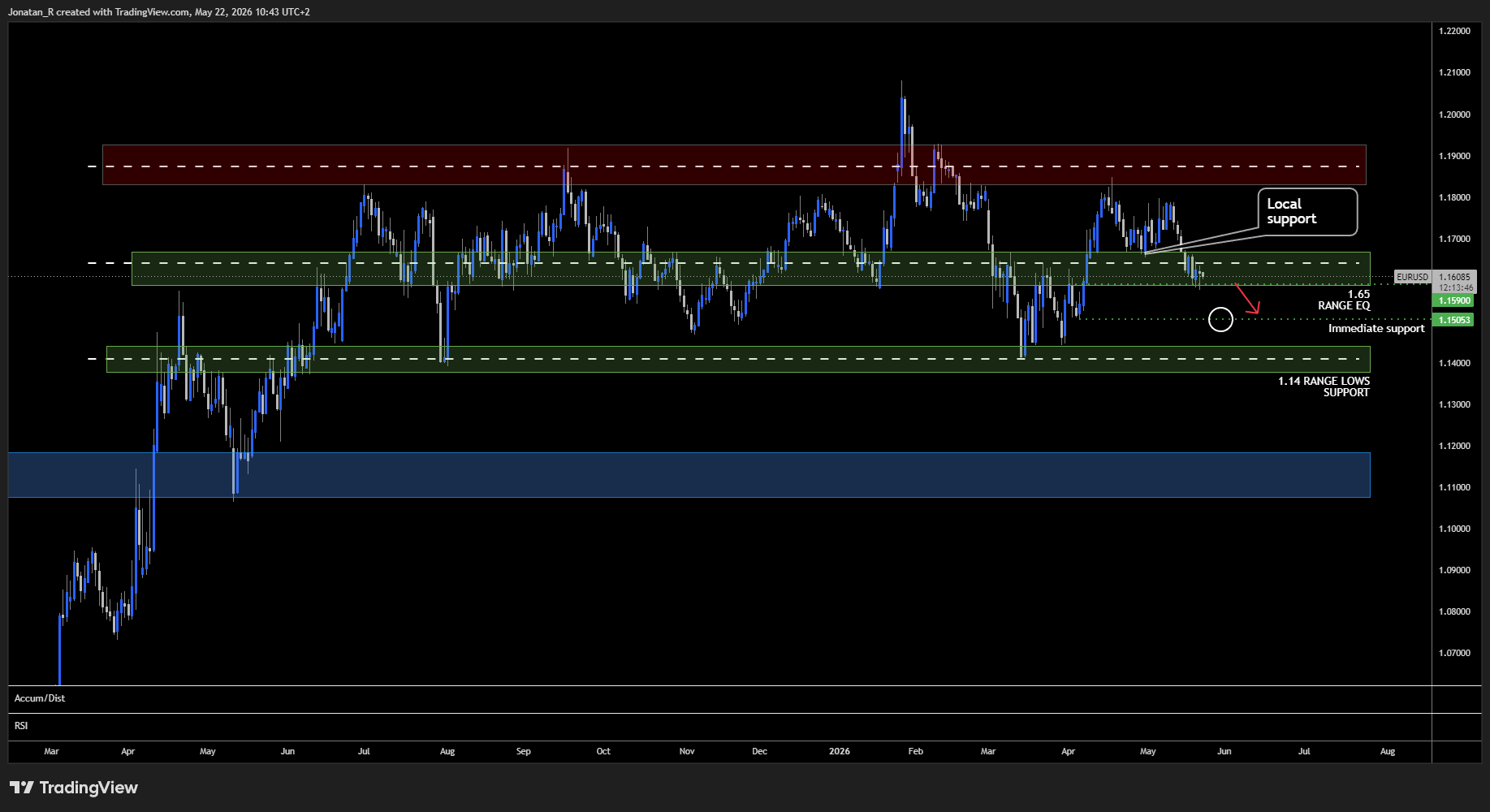
On the daily, EUR/USD has been trading within a high timeframe range since around May last year. The structure is clear:
- Range highs sit near 1.19
- Range equilibrium sits near 1.165
- Range lows sit near 1.14
Price has broken below local support around 1.167 and is now testing the 1.159 support that marks the lower edge of the range equilibrium. This is the level bulls need to defend. If 1.159 fails, the immediate support area near 1.15 becomes the next logical level, and a deeper move could potentially bring the 1.14 range lows back into focus.
EUR/USD 4-hour chart
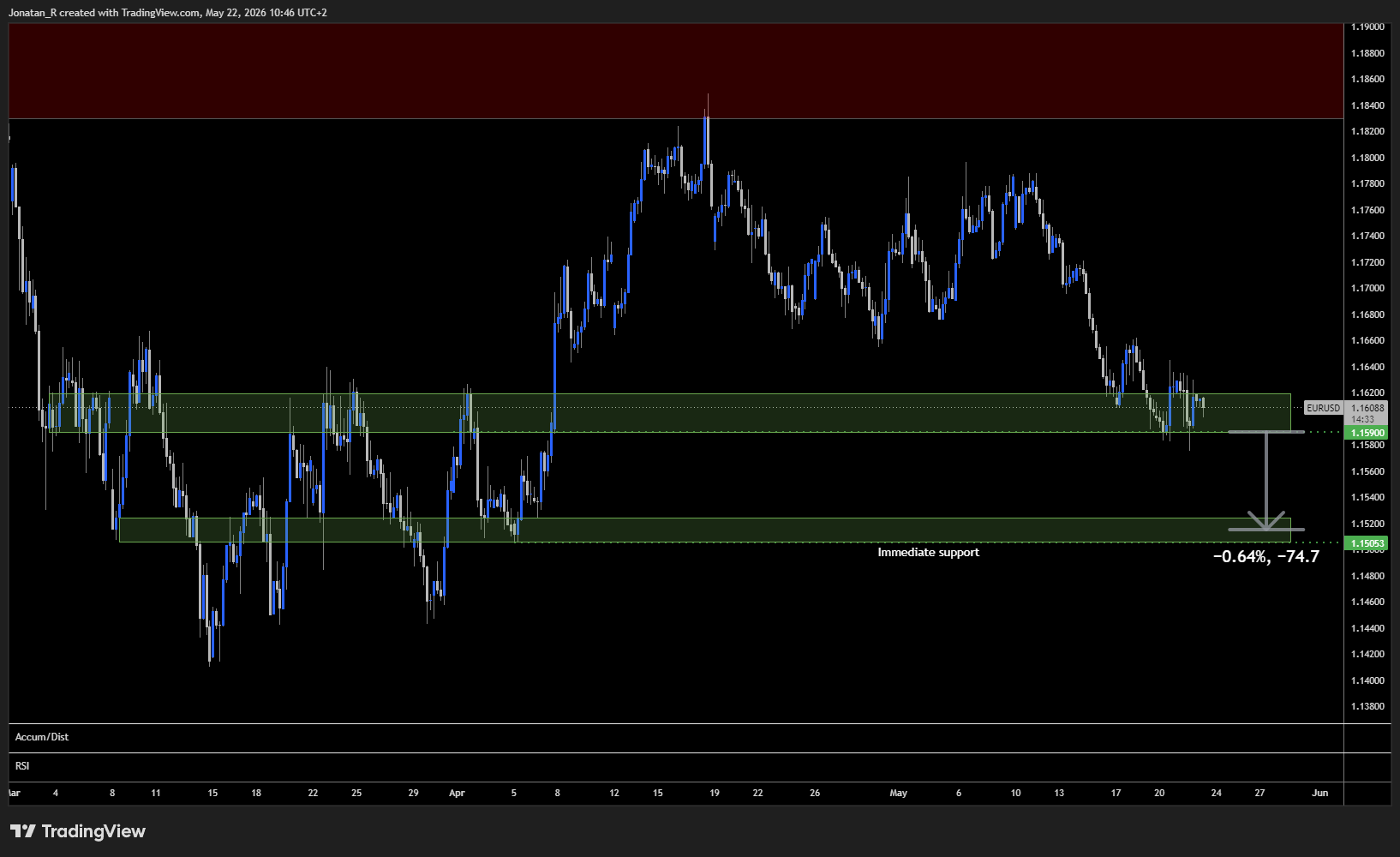
The 4-hour chart shows the same structure more cleanly. Price is holding the 1.159 support, with the next clear support not appearing until the 1.15 area below. There is little in between to slow a move, so a break of 1.159 could potentially open a roughly 75 pip move down towards 1.15. While 1.159 holds, the pair stays inside its range equilibrium.
Key levels to watch
- Resistance: range equilibrium near 1.165, then local support turned resistance near 1.167
- Support being defended: 1.159
- Immediate support below: 1.15
- Major support: range lows near 1.14
The wider story to watch is whether the energy shock eases. If the Iran situation de-escalates and oil falls back, the inflation pressure forcing the ECB’s hand could fade, which may change the rate picture on both sides. Until then, the dollar’s growth and yield advantage continues to set the tone.
For more on how the pair was positioned ahead of this move, see our previous EUR/USD analysis.
Trading involves risk.
Author



 Risk Disclaimer
The content provided here is for informational purposes only. It is not intended as personal investment advice and does not constitute a solicitation or invitation to engage in any financial transactions, investments, or related activities. Past performance is not a reliable indicator of future results.
The financial products offered by the Company are complex and come with a high risk of losing money rapidly due to leverage. These products may not be suitable for all investors. Before engaging, you should consider whether you understand how these leveraged products work and whether you can afford the high risk of losing your money.
The Company does not accept clients from the Restricted Jurisdictions as indicated in our website/ T&C. Some services or products may not be available in your jurisdiction.
The applicable legal entity and its respective products and services depend on the client’s country of residence and the entity with which the client has established a contractual relationship during registration.