5 min read
 The Nikkei 225 has steadied today after a bruising start to the week, with technology and semiconductor shares leading the recovery. The bigger question now is whether this could be a dip within a strong uptrend or the start of something deeper, with a Bank of Japan (BoJ) rate decision sitting just around the corner.
Key takeaways
- The Nikkei dropped close to 4% on Monday in a third straight down session, as crowded AI and semiconductor positions unwound across Asia.
- It has rebounded almost 2% today, led by chip names, after Wall Street’s semiconductors recovered and Middle East tensions appeared to ease.
- The BoJ meets on 15 to 16 June, with reports suggesting it could deliver its first rate rise of the year.
- On the charts, the pullback could be viewed as a dip within a broader uptrend, with 65,600 the key level to reclaim.
The macro backdrop
Monday was a difficult session across the region. A wave of selling hit AI and semiconductor stocks, dragging the Nikkei down close to 4% and sending South Korea’s Kospi lower by more than 8%, as investors unwound crowded positions in the names that had led the rally.
The mood appears to have improved today. Japanese chip stocks have rebounded sharply, with Tokyo Electron among the biggest gainers, after US semiconductors recovered on Monday and signs emerged that Israel and Iran could be stepping back from further strikes. Lower oil prices have helped ease some of the inflation concern that had been weighing on sentiment.
The next catalyst is close. The BoJ meets on 15 to 16 June, and reports suggest it could raise its policy rate for the first time this year. After the Nikkei’s recent push to record territory, which we covered here, the combination of a possible rate rise and a still-volatile tech tape keeps the picture two-sided.
Nikkei daily chart
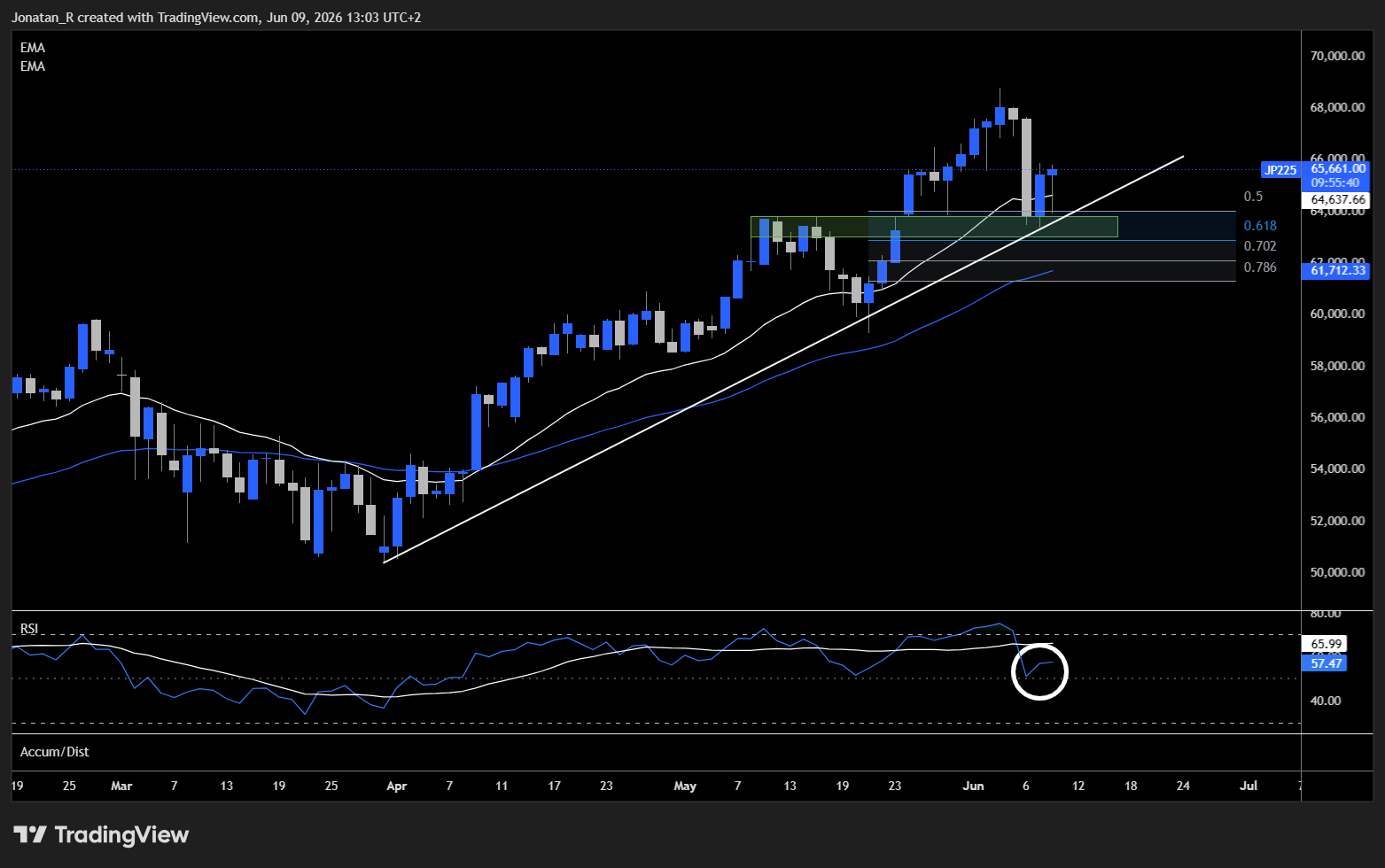
Nikkei 225 daily, showing the bounce from the support confluence around 64,000 with the 20 EMA, rising trendline and 50% Fibonacci retracement, and RSI holding the 50 level.
On the daily timeframe, the pullback appears to have found support in a confluence zone around 64,000, where a horizontal support area, the rising trendline, the 20 EMA and the 50% Fibonacci retracement all line up. Price has since rebounded from that area.
The RSI also held the 50 level rather than breaking below it, which could be viewed as a sign that momentum stayed constructive through the dip. Taken together, the move could be read as a pullback within an otherwise strong uptrend rather than a trend change.
Nikkei 4-hour chart
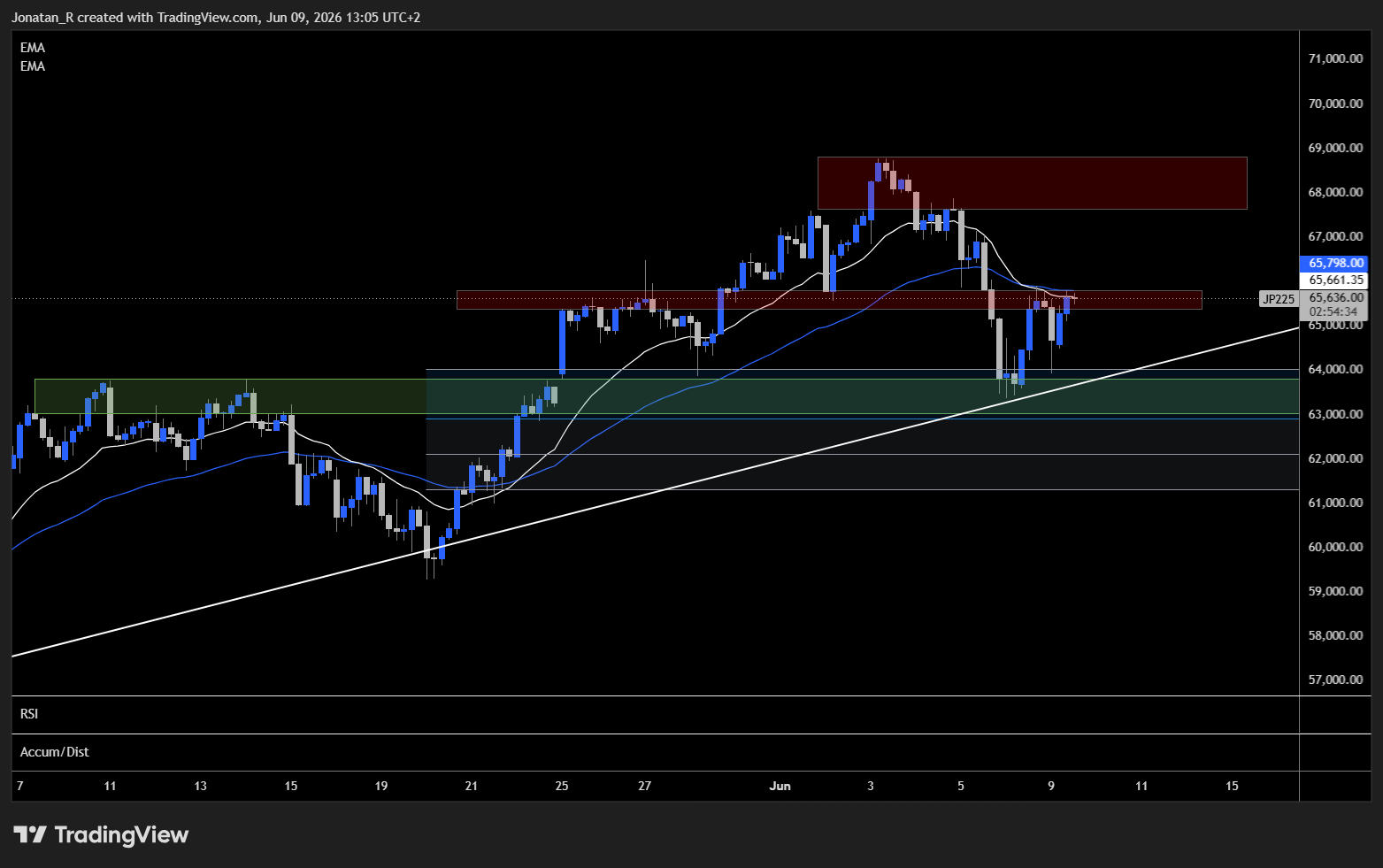
Nikkei 225 4-hour, showing price testing local resistance around 65,600 at the 20 and 50 EMAs after printing a higher low, with the early-June record highs near 68,000 above.
Zooming in, price is now testing local resistance around 65,600, where the 4-hour 20 and 50 EMAs also sit. This is the level bulls would need to reclaim to keep the recovery intact.
Price has also just printed a local higher low, which keeps the short-term structure intact for now. A clean reclaim of 65,600 could open the door to another push towards the local highs near the early-June record around 68,000. A failure to break back above resistance, on the other hand, could leave price ranging beneath it.
Trading involves risk.
Author



 Risk Disclaimer
The content provided here is for informational purposes only. It is not intended as personal investment advice and does not constitute a solicitation or invitation to engage in any financial transactions, investments, or related activities. Past performance is not a reliable indicator of future results.
The financial products offered by the Company are complex and come with a high risk of losing money rapidly due to leverage. These products may not be suitable for all investors. Before engaging, you should consider whether you understand how these leveraged products work and whether you can afford the high risk of losing your money.
The Company does not accept clients from the Restricted Jurisdictions as indicated in our website/ T&C. Some services or products may not be available in your jurisdiction.
The applicable legal entity and its respective products and services depend on the client’s country of residence and the entity with which the client has established a contractual relationship during registration.