7 min read
 This week, the two most powerful central banks in the world are showing us what they discussed behind closed doors. A central bank is the institution that sets interest rates for a country or region. In the US, that’s the Federal Reserve (Fed). In the eurozone, it’s the European Central Bank (ECB).
On 7 October at 18:00 UTC, the Fed released its minutes, a detailed summary of what officials said at their last meeting. The ECB releases its version, called an account, today at 11:30 UTC.
Both banks raised interest rates in September to fight rising prices, mostly caused by higher energy costs. But they’re giving different hints about what they’ll do next, and that matters for currencies like the euro and the US dollar.
Why interest rates matter
When prices rise across the economy, we call it inflation. Central banks aim to keep inflation around 2% a year. When it climbs higher, they often raise interest rates, which makes borrowing more expensive. People and businesses then tend to spend less, which can help cool prices down.
Higher interest rates can also make a currency more attractive, because investors may earn more by holding it.
What the Fed minutes showed
In September, the Fed raised its main interest rate by 0.25 percentage points to a range of 3.75% to 4.00%. This was its first increase since July 2023. Here’s what the minutes revealed:
- Everyone agreed: all 12 voting members supported the increase.
- More may be coming: most officials thought another increase would likely be needed before the end of the year.
- Playing it safe: many officials saw higher rates as a form of insurance, in case inflation stays high for longer than expected.
- Rates aren’t that high yet: several officials said current rates aren’t putting much brake on the economy.
- What’s pushing prices up: officials pointed to higher energy prices, past tariffs (taxes on imported goods) and heavy spending on artificial intelligence (AI).
- Jobs look solid: unemployment had fallen to 4.1% in July and August.
What has changed since then
These minutes show what officials were thinking in mid September. Since then, some US data has come in weaker than expected.
The Fed’s preferred inflation measure, called personal consumption expenditures (PCE), rose 3.4% over the past year in August. Core PCE, which leaves out food and energy because their prices jump around a lot, rose 3.0%. Both were lower than expected. A September jobs report also came in soft.
Traders use financial contracts called futures to bet on what the Fed will do. As of 5 October, these suggested only around a one in five chance of a rate increase in October, but about an 81% chance of at least one increase by 9 December. In simple terms, the market still expects another hike, just maybe a little later.
The ECB’s September decision
The ECB also raised its interest rates by 0.25 percentage points on 10 September. Its key rate, the deposit rate, is now 2.50%. This is the rate banks earn when they park money with the ECB, and it guides borrowing costs across the eurozone. It was the ECB’s second increase this year.
ECB President Christine Lagarde said the bank hasn’t committed to any set plan for future rates. It will decide meeting by meeting.
Since then, eurozone inflation has jumped:
- Prices rose 3.8% over the year to September, higher than the 3.6% expected.
- Energy prices were up 18.8%.
- Core inflation rose to 2.5% from 2.4%, which may suggest higher prices are starting to spread beyond energy.
What to look for in today’s ECB account
- Do more officials want higher rates? Before the meeting, some big banks such as Deutsche Bank and JP Morgan expected another increase in December, while Barclays expected rates to stay at 2.50%.
- Are wages being pushed up? If higher energy costs lead to higher wages, inflation could become harder to bring down. Any worry about this could point to more rate increases.
- Are markets expecting too much? Traders have been pricing in a top rate of around 3.00%. If officials seem uncomfortable with that, the euro could weaken.
Keep in mind the ECB meeting took place before September’s inflation jump, so today’s account may not fully show how worried officials are now.
What it could mean for EUR/USD
EUR/USD shows how many US dollars one euro can buy. When it falls, the euro is getting weaker against the dollar.
EUR/USD has dropped about 4.5% from its August high near 1.170, to 1.1177 on 7 October. Most of that fall came after the Fed raised rates in September. The euro kept falling even after eurozone inflation came in higher than expected. So far, markets seem to be paying more attention to the Fed’s firm tone.
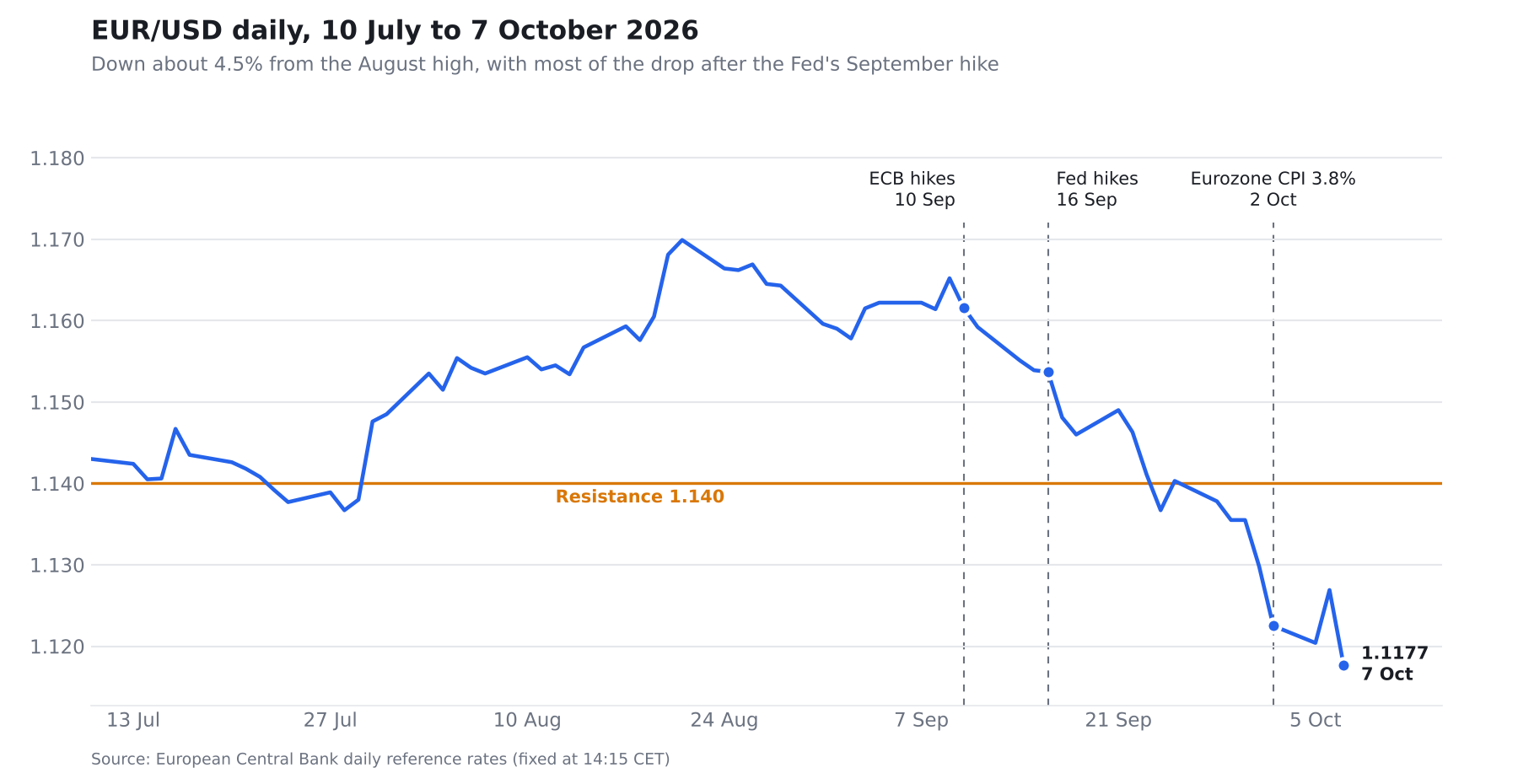
On the chart, the 1.140 level stands out. In late July and again in late September, the price bounced off this level, which made it a floor. Traders call that support. The price has since dropped below it. When a floor breaks, it can turn into a ceiling that’s hard to get back above. Traders call that resistance. If the euro tries to recover, 1.140 is the first level to watch.
Right now, US interest rates are about 1.25 to 1.50 percentage points higher than eurozone rates. That gap tends to support the dollar. But US inflation is cooling while eurozone inflation is rising, which could change the picture over time.
- If the ECB account sounds tough on inflation: the euro could get some support and may move back towards 1.140.
- If the ECB account sounds cautious: the dollar may keep its advantage, especially if US data improves again.
The next big test comes on 14 October, when new US inflation data could show whether the Fed still needs to raise rates again.
Author



 Risk Disclaimer
The content provided here is for informational purposes only. It is not intended as personal investment advice and does not constitute a solicitation or invitation to engage in any financial transactions, investments, or related activities. Past performance is not a reliable indicator of future results.
The financial products offered by the Company are complex and come with a high risk of losing money rapidly due to leverage. These products may not be suitable for all investors. Before engaging, you should consider whether you understand how these leveraged products work and whether you can afford the high risk of losing your money.
The Company does not accept clients from the Restricted Jurisdictions as indicated in our website/ T&C. Some services or products may not be available in your jurisdiction.
The applicable legal entity and its respective products and services depend on the client’s country of residence and the entity with which the client has established a contractual relationship during registration.