8 min read
US companies reported their fastest growth in more than five years in September, and their costs rose at the steepest pace in almost four years. Friday’s flash Purchasing Managers’ Index (PMI) surveys will show whether that carried into October.
The timing makes this release more important than usual. The Federal Reserve (Fed) announces its next rate decision on Wednesday, 28 October, and the European Central Bank (ECB) follows on Thursday, 29 October.
Release times, Friday, 23 October
- Eurozone flash PMIs: 08:00 UTC
- US flash PMIs: 13:45 UTC
What a PMI tells you
A PMI is a monthly survey of company managers. They’re asked simple questions. Is output rising or falling? Are new orders coming in? Are you hiring? Are your costs going up?
- Above 50 means activity is growing
- Below 50 means activity is shrinking
The flash version is an early estimate based on around 85% of responses, published before the month ends. That makes it one of the earliest reads on the economy each month.
Why this release matters more than usual
- The Fed is in its blackout period. Officials don’t give speeches in the run up to a meeting, so the data has to do the talking.
- There’s no more US inflation data before the decision. The next Consumer Price Index (CPI) report is due on 10 November, after the Fed has decided.
- Rates are rising again. The Fed raised its target range to 3.75% to 4.00% on 16 September, its first hike since 2023. September CPI then came in at 3.7%, above the 3.6% forecast.
After that CPI report, the market’s odds of an October hike briefly rose above 40%, according to CME FedWatch. As of this morning, they’re down to 12.7%, while the odds of at least one hike by the 9 December meeting stand at 88.1%. So Friday is less about October and more about whether the data keeps a December hike on track.
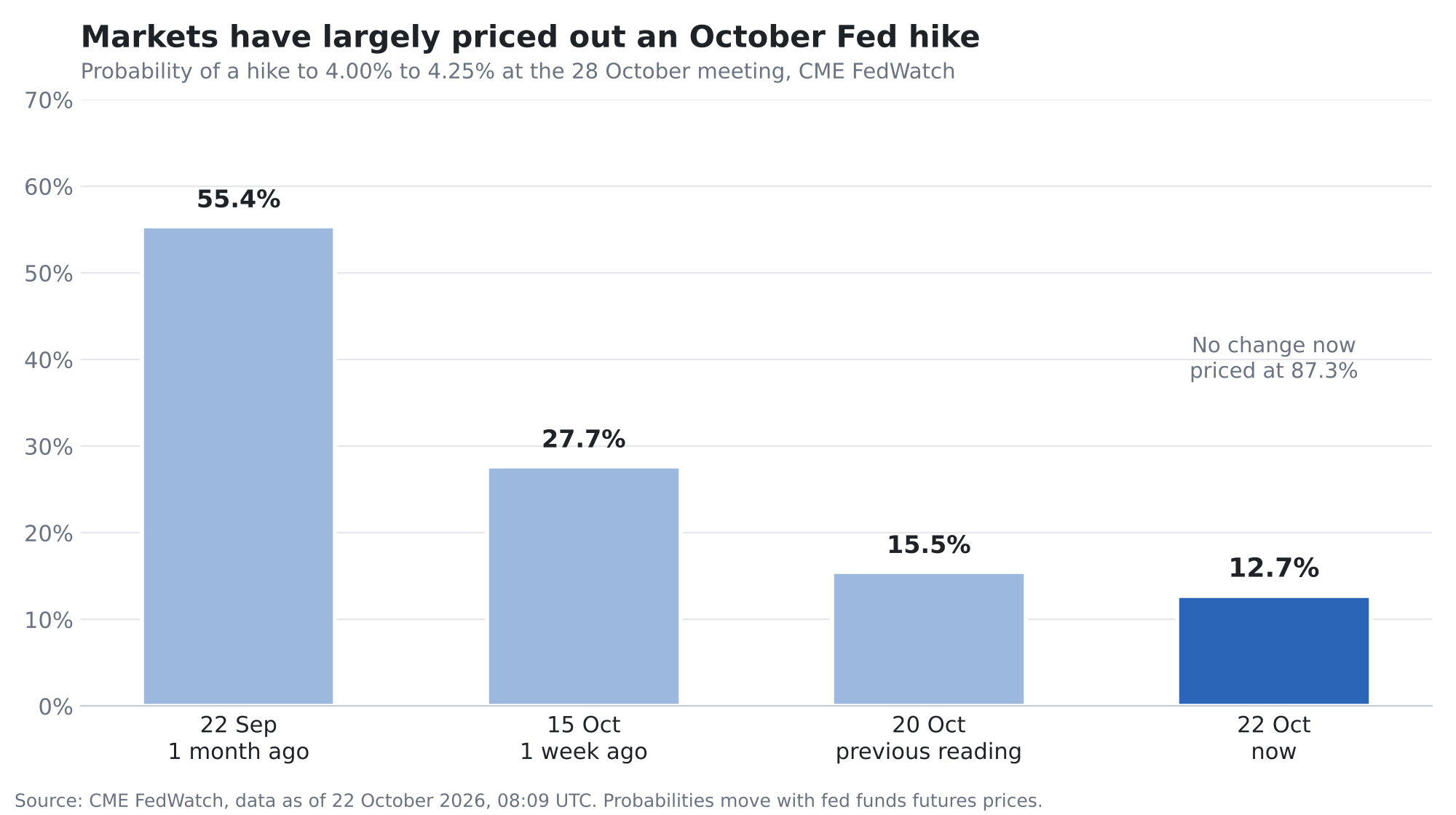
CME FedWatch odds of a hike at the 28 October meeting have fallen from 55.4% a month ago to 12.7%, with no change now priced at 87.3%. Markets have shifted their focus to December instead.
The US: growth at a five year high
September’s final readings showed:
- Composite PMI at 58.4, up from 56.0, the strongest since July 2021
- Services at 58.8, the sharpest rise in activity since July 2021
- Manufacturing at 55.9, the highest since May 2022
- Hiring at its fastest pace since June 2022
- Input costs rising at the steepest rate in nearly four years, partly due to higher fuel and transport costs
S&P Global, which compiles the survey, said the mix of strong growth, hiring and rising costs sent a hawkish signal for interest rates. In plain terms, it pointed towards higher rates rather than lower.
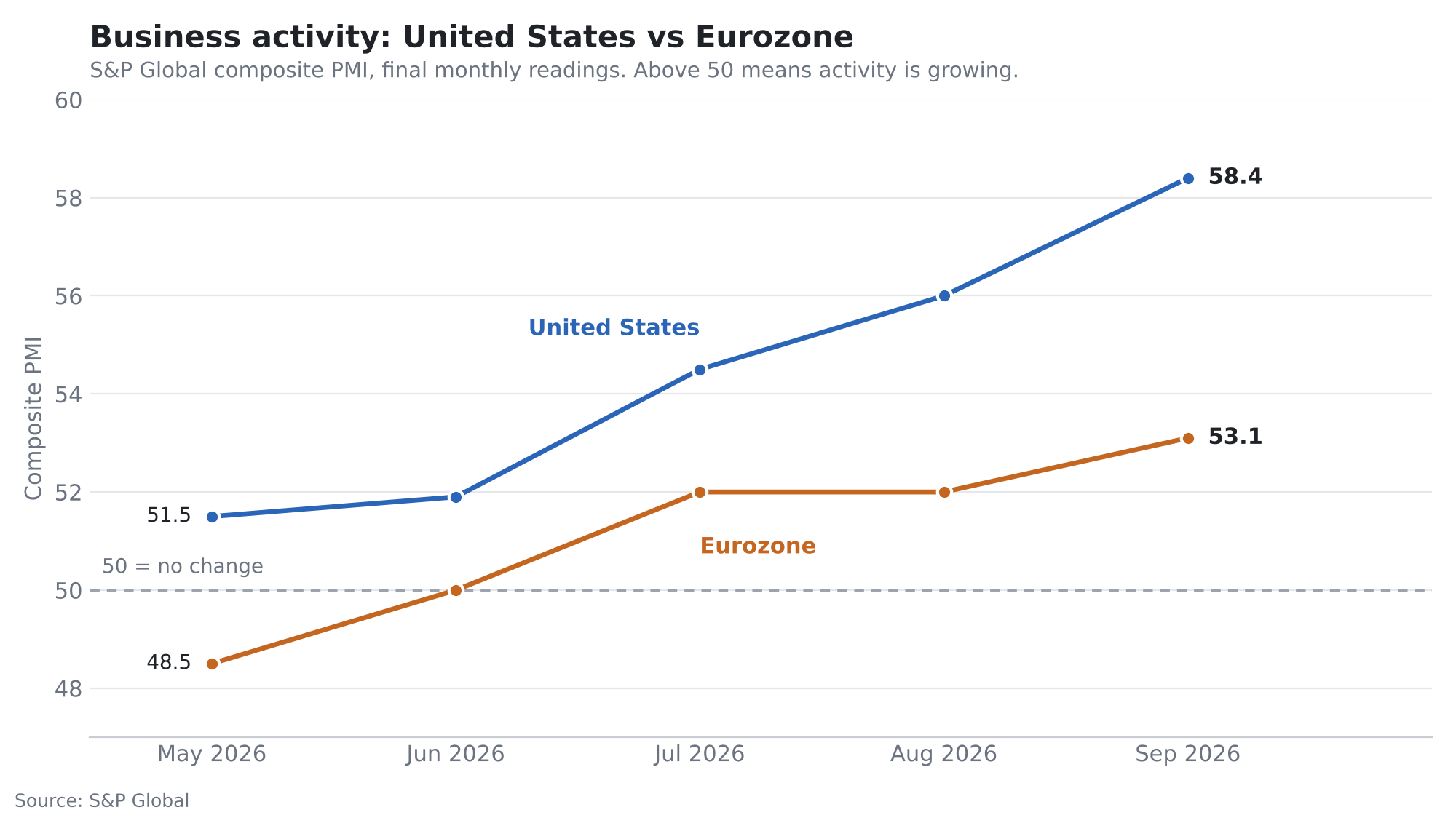
Business activity has picked up on both sides of the Atlantic since May, but the US has pulled clearly ahead. The Eurozone only moved back above 50, the line between growth and contraction, in July.
The Eurozone: growing, but more slowly
- Composite PMI at 53.1, up from 52.0, the highest in 41 months
- Services at 53.0, a ten month high
- Manufacturing at 52.9
- Input costs and selling prices rising at their fastest since May
S&P Global said the survey pointed to GDP growth of about 0.4% a quarter. The ECB raised its deposit rate to 2.50% in September, its second hike of 2026, and market pricing shows almost no chance of another move on 29 October.
The euro has had a difficult month. EUR/USD fell to its lowest level in over a year on 14 October, and weekend unrest in France has added to pressure on the single currency.
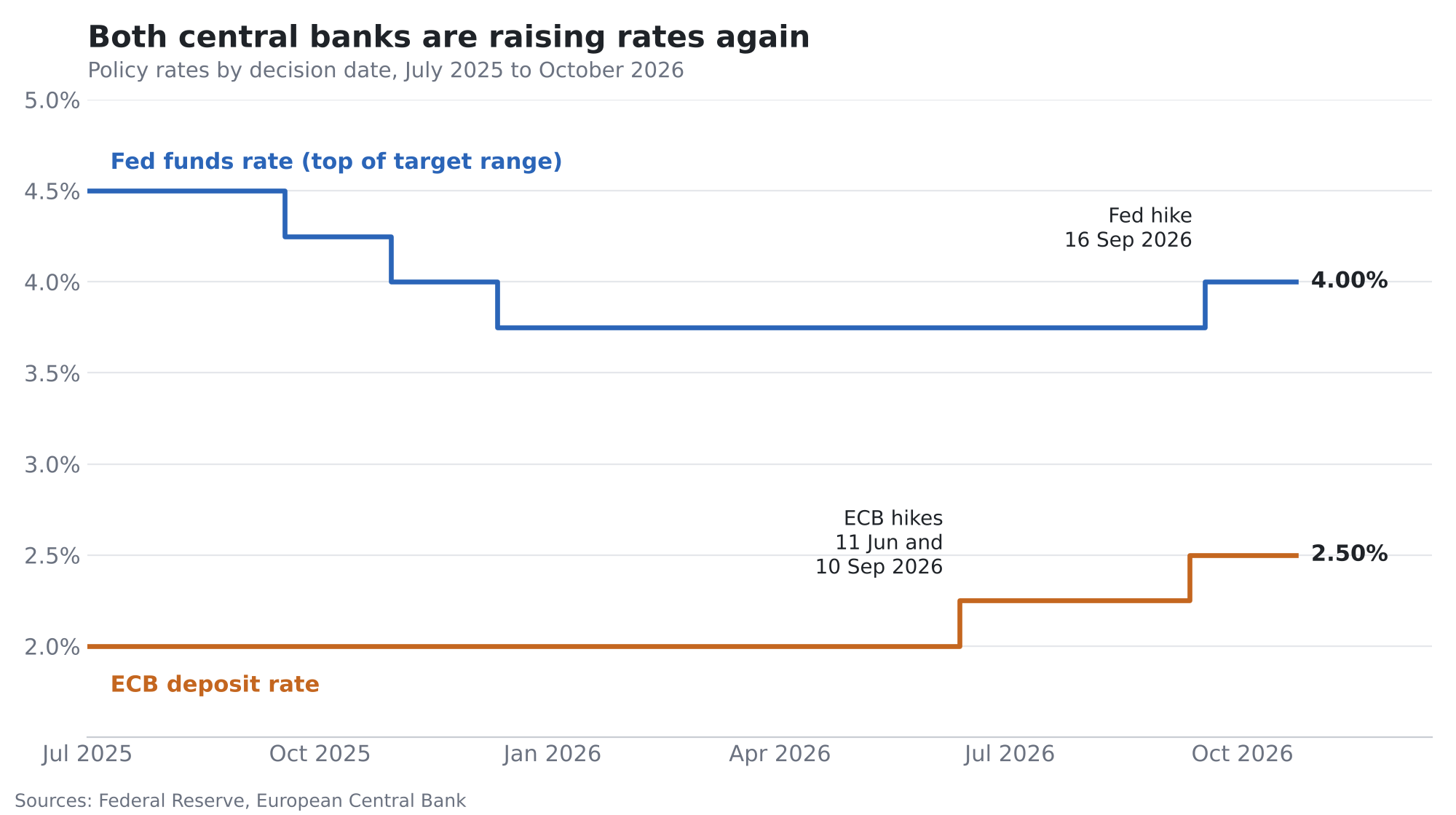
After a run of cuts in 2025, both the Fed and the ECB have turned back to raising rates this year to fight energy driven inflation. Strong business surveys could add to the case for further hikes.
What’s expected for October
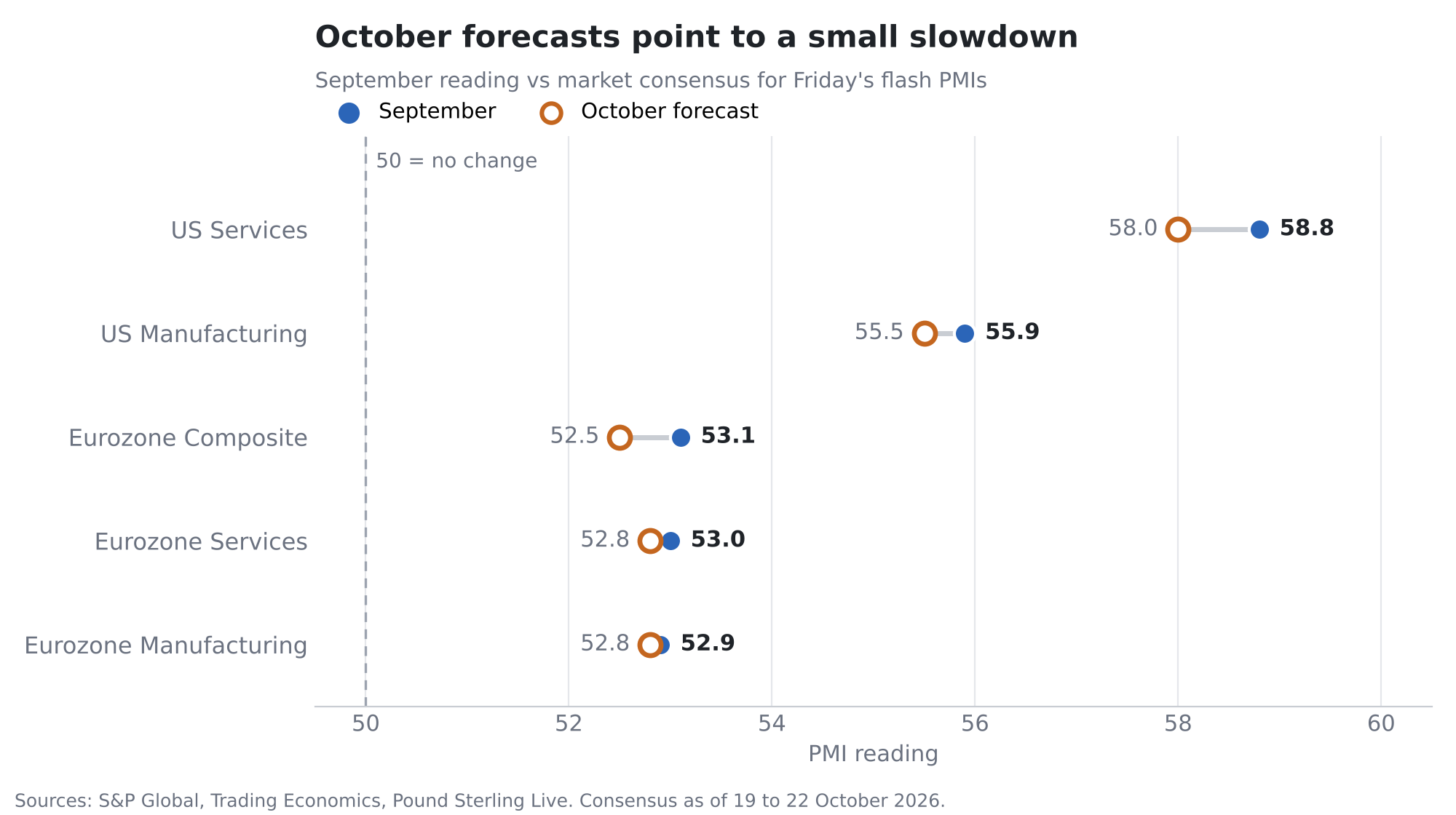
Market consensus as of 19 to 22 October. Forecasts can change before the release, and flash readings often land away from consensus.
Forecasts point to a small slowdown from high levels. US services is expected to ease the most, from 58.8 to around 58.0. Even so, every reading would stay well above 50.
What to watch inside the reports
- The headline composite: is growth still speeding up, or has it peaked?
- Input prices and prices charged: early clues on inflation. If companies keep passing on higher costs, it supports the case for higher rates.
- Employment: strong hiring suggests demand is holding up.
Flash numbers can be revised. In September, the US manufacturing reading was cut from 57.0 to 55.9 in the final data.
What different results could mean
- US growth stays strong and price gauges rise again: this could firm up expectations for a December hike and bring some talk of an October move back. The US Dollar (USD) could strengthen, which may weigh on Gold (XAU), Bitcoin (BTC) and US stocks.
- US activity cools more than expected: this could ease pressure on the Fed and raise doubts about December. The dollar could soften.
- The Eurozone surprises either way: this mainly matters for EUR/USD, although the US release later the same day can easily outweigh it.
EUR/USD: key levels to watch
EUR/USD has been in a downtrend since its August high of 1.1711, with a series of lower highs and lower lows. The pair hit its lowest level of 2026 at 1.1113 on 14 October, but buyers have defended the 1.1150 area since then, and no daily close this month has come in below it. On the way up, the pair has struggled to get past the 1.1270 area, which capped last week’s rebound.
With price trading around 1.1230, Friday’s PMIs could decide which side of that range gives way first.
- Bullish scenario: a break above 1.1270 could open the way towards 1.1337, the 1 October high. Firm Eurozone data alongside softer US numbers could support that move.
- Bearish scenario: a break below 1.1150 could bring the 2026 low at 1.1113 back into view. Strong US data that firms up Fed hike bets could add to that pressure.
Levels to watch: 1.1337 | 1.1270 | 1.1150 | 1.1113
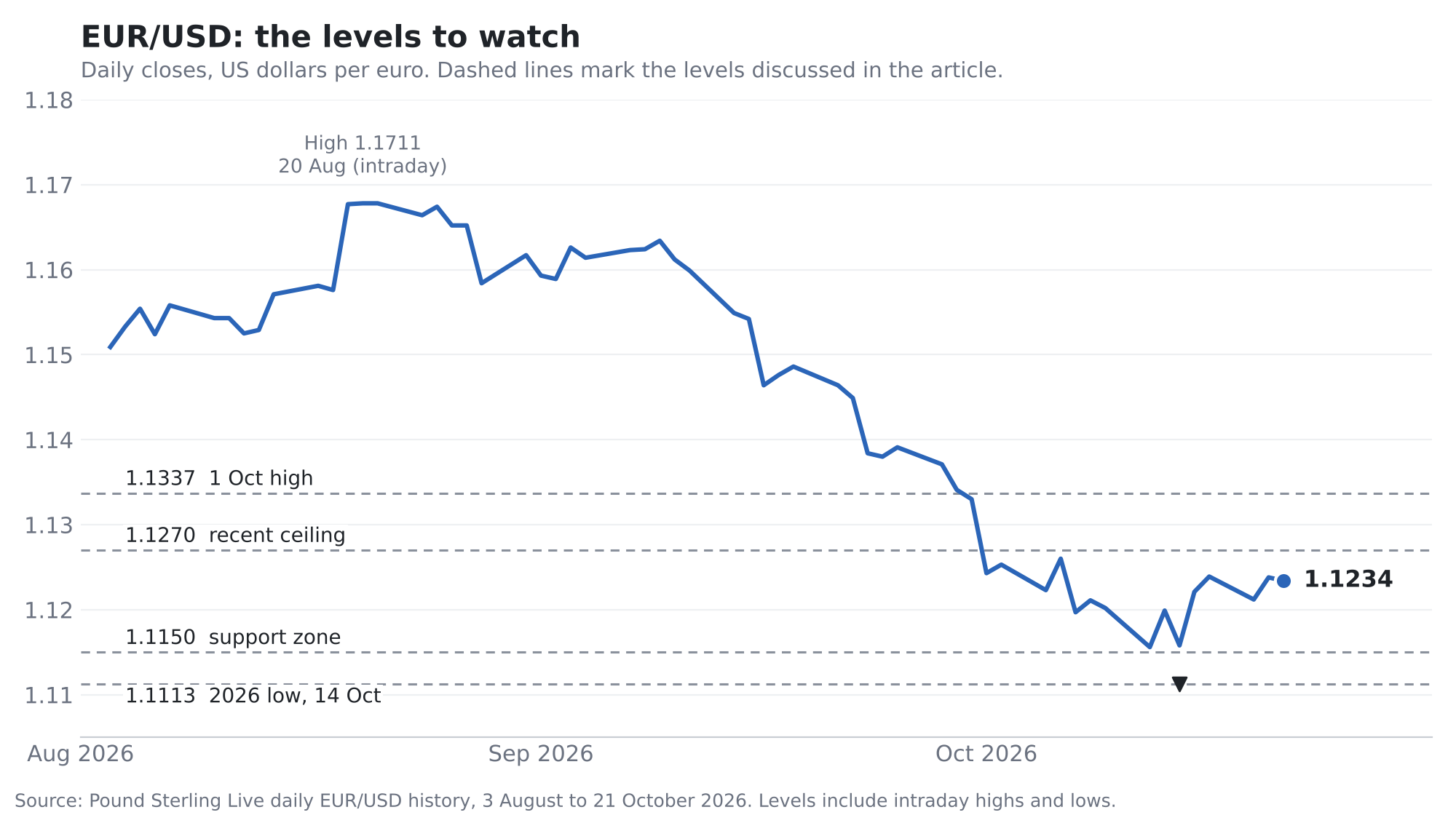
EUR/USD has fallen about 4% from its August high and has mostly traded between 1.1150 and 1.1270 over the past two weeks.
With the Fed decision five days away and no Fed speakers to guide markets, Friday’s surveys may carry more weight than usual.
Trade Now
Trading involves risk.
Author



 Risk Disclaimer
The content provided here is for informational purposes only. It is not intended as personal investment advice and does not constitute a solicitation or invitation to engage in any financial transactions, investments, or related activities. Past performance is not a reliable indicator of future results.
The financial products offered by the Company are complex and come with a high risk of losing money rapidly due to leverage. These products may not be suitable for all investors. Before engaging, you should consider whether you understand how these leveraged products work and whether you can afford the high risk of losing your money.
The Company does not accept clients from the Restricted Jurisdictions as indicated in our website/ T&C. Some services or products may not be available in your jurisdiction.
The applicable legal entity and its respective products and services depend on the client’s country of residence and the entity with which the client has established a contractual relationship during registration.