7 min read
 he Nasdaq is being pulled in two directions. A hawkish first meeting from new Fed Chair Kevin Warsh has revived rate-hike fears, just as easing geopolitical tension and cooling oil prices give risk assets a reason to recover. The result is an index caught between two opposing forces.
Key takeaways:
- The Fed held rates at 3.50% to 3.75% on 17 June, but the updated projections leaned hawkish, with nine of 18 officials now pencilling in at least one rate hike this year.
- Warsh dropped the Fed’s forward guidance and declined to submit his own rate projection, signalling a more flexible and less predictable policy path.
- Treasury yields pushed higher, with the 10-year climbing back towards 4.50%, a headwind for the rate-sensitive, high-growth names that dominate the Nasdaq.
- A chip-led bounce on Thursday recovered some of the post-Fed losses, leaving the index finely balanced.
A less predictable Fed
At his first meeting as Fed Chair on 17 June, Warsh kept rates on hold at 3.50% to 3.75%, the fourth consecutive hold. The surprise sat in the projections. The median dot moved higher and nine of 18 policymakers now expect at least one rate hike before the end of the year, with several seeing more than one. Warsh also stripped the easing bias from the statement and declined to provide his own forecast, in keeping with his long-held scepticism of forward guidance.
Markets repriced quickly. The 10-year Treasury yield climbed back towards 4.50%, and market-implied odds of a rate hike by year-end rose sharply. Higher yields tend to weigh most on high-growth, high-valuation companies, the kind that make up much of the Nasdaq, because their future earnings are discounted more heavily. That leaves the index especially sensitive to this shift.
That unpredictability cuts both ways. Alongside the decision, Warsh launched five task forces to review how the Fed handles communications, its balance sheet, data, productivity and jobs, and inflation. The revamped, shorter statement leaned on themes he has long favoured, including strong productivity growth and the prospect of easing energy costs, both of which he has argued could bring inflation lower over time. For that reason, some analysts see the current hawkish guidance as less than a firm commitment, and a stance that could soften over the coming quarters if those forces play out. In other words, today’s hawkish Fed may not be a permanent one, which matters for the longer-term backdrop even as the near-term rate risk stays to the upside.
Easing geopolitics and cooling oil
Pulling the other way is a clear de-escalation in the Middle East. The US-Iran peace deal is set to be signed today in Switzerland, formalising the agreement reached earlier this month that reopened the Strait of Hormuz and lifted the US naval blockade. We covered the initial risk-on move across markets when the deal was first announced.
With the war premium unwinding, oil has slid to multi-month lows, easing one of the inflation pressures that had kept the Fed cautious. That backdrop helped equities rebound on Thursday, led by a recovery in chip stocks after fresh signals of US-based chip investment. US markets are closed today for the Juneteenth holiday, so the next test of these levels could come early next week.
The SpaceX hook on the horizon
SpaceX also remains a live story for the index. Following its record-breaking listing, the company is on track to qualify for the Nasdaq 100 around 6 July under the index’s fast-entry rules, an event that could trigger a wave of passive buying. That potential catalyst sits on the horizon as the Nasdaq works through the current Fed-versus-geopolitics tension.
Nasdaq daily chart: rejection at resistance, but accumulation builds beneath
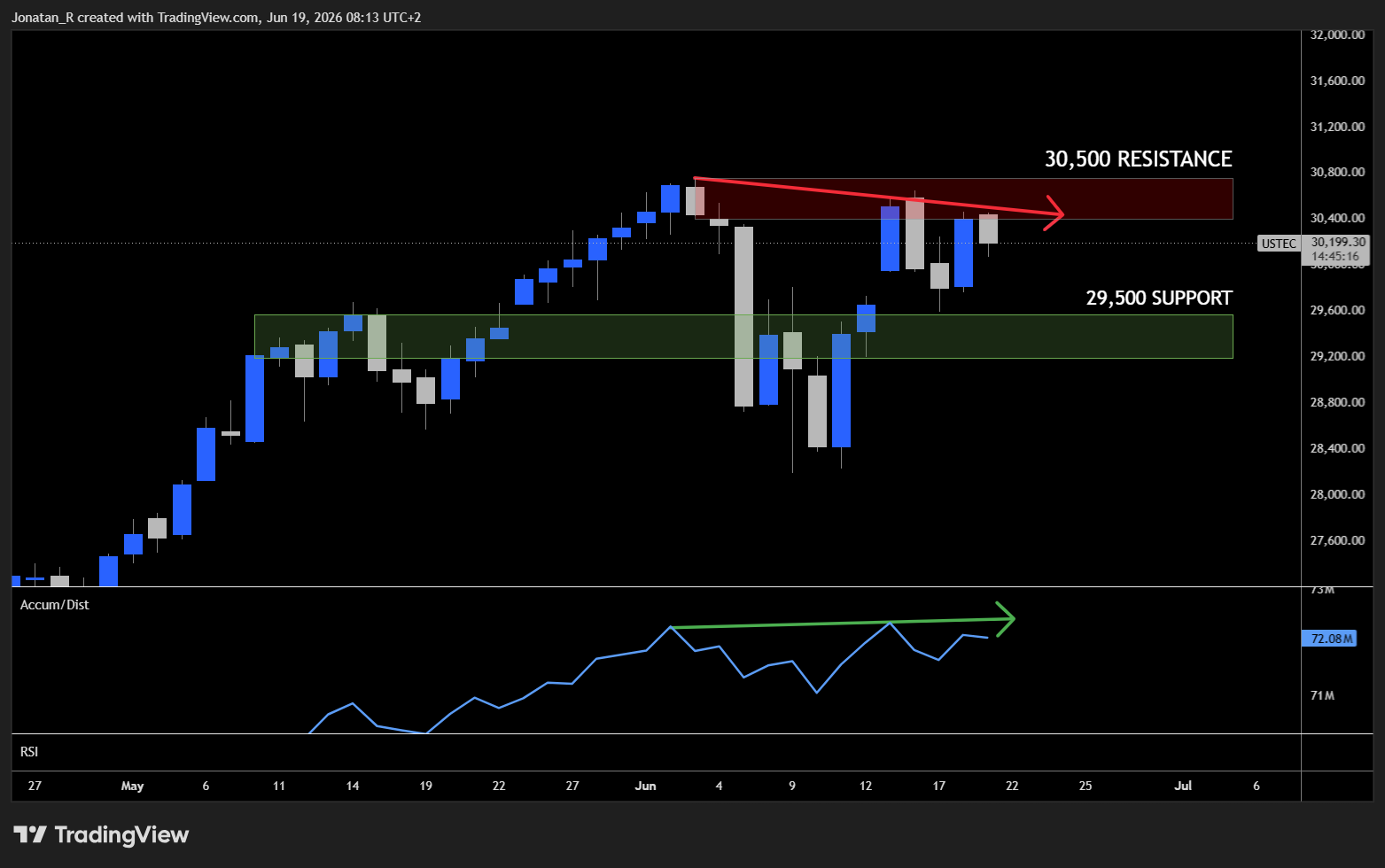
On the daily timeframe, the Nasdaq produced its first heavy rejection on 16 June at a major higher-timeframe resistance area, the previous all-time highs between 30,500 and 30,800. That rejection has since shaped a sequence of lower highs, a sign price is struggling to push back above this zone in the current uncertain environment.
The picture underneath is more constructive. The accumulation/distribution indicator is potentially printing higher highs even as price makes lower highs. That divergence suggests that whenever the index bounces, buyers are outperforming sellers, with the moves to the upside carrying more conviction and momentum than the moves lower.
Putting the two together, the levels to watch are clear. 30,500 caps the upside as resistance, while 29,500 sits beneath as support. Unless a clear catalyst emerges to drive a directional move, the area between 29,500 and 30,500 could form a new trading range for the index to consolidate within.
Nasdaq 4H chart: range EQ is the pivot
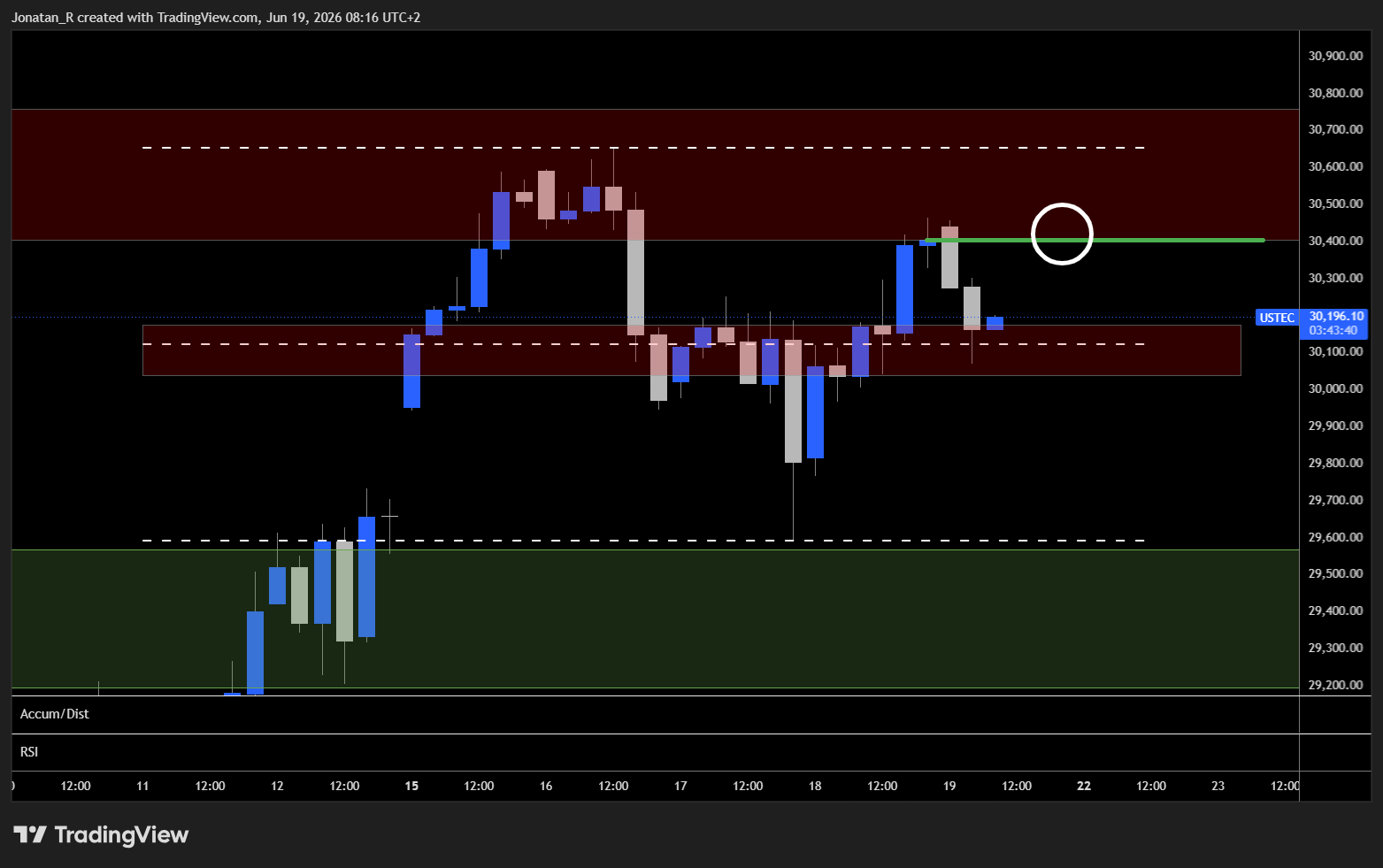
On the 4-hour timeframe, the index is trading within a clear range, with the range equilibrium sitting around 30,100. That midpoint is the level intraday traders are likely to use for managing risk.
A move below 30,100 could signal a test of the range low and bring price into a danger zone, where a break of structure would open the door to a deeper move lower. Holding the equilibrium keeps the constructive case alive, and a break back above the 30,400 region would strengthen it, potentially opening a path towards the range high and, beyond that, a possible breakout into new all-time highs.
That upside scenario would likely need a catalyst to drive it, whether from renewed momentum in the AI trade or clear signs that the US-Iran peace deal is moving forward constructively.
Trading involves risk.
Author



 Risk Disclaimer
The content provided here is for informational purposes only. It is not intended as personal investment advice and does not constitute a solicitation or invitation to engage in any financial transactions, investments, or related activities. Past performance is not a reliable indicator of future results.
The financial products offered by the Company are complex and come with a high risk of losing money rapidly due to leverage. These products may not be suitable for all investors. Before engaging, you should consider whether you understand how these leveraged products work and whether you can afford the high risk of losing your money.
The Company does not accept clients from the Restricted Jurisdictions as indicated in our website/ T&C. Some services or products may not be available in your jurisdiction.
The applicable legal entity and its respective products and services depend on the client’s country of residence and the entity with which the client has established a contractual relationship during registration.